A counter-example to Batyrev's conjecture on the non-negativity of stringy Hodge numbers
Abstract: Batyrev's conjecture on the non-negativity of stringy Hodge numbers has been a fundamental open problem, guiding and motivating many beautiful mathematical results in motivic integration, mirror symmetry, and the McKay correspondence. We give a counter-example to Batyrev's conjecture which was discovered with the assistance of OpenAI's ChatGPT.
Paper Prompts
Sign up for free to create and run prompts on this paper using GPT-5.
Top Community Prompts
Explain it Like I'm 14
Overview
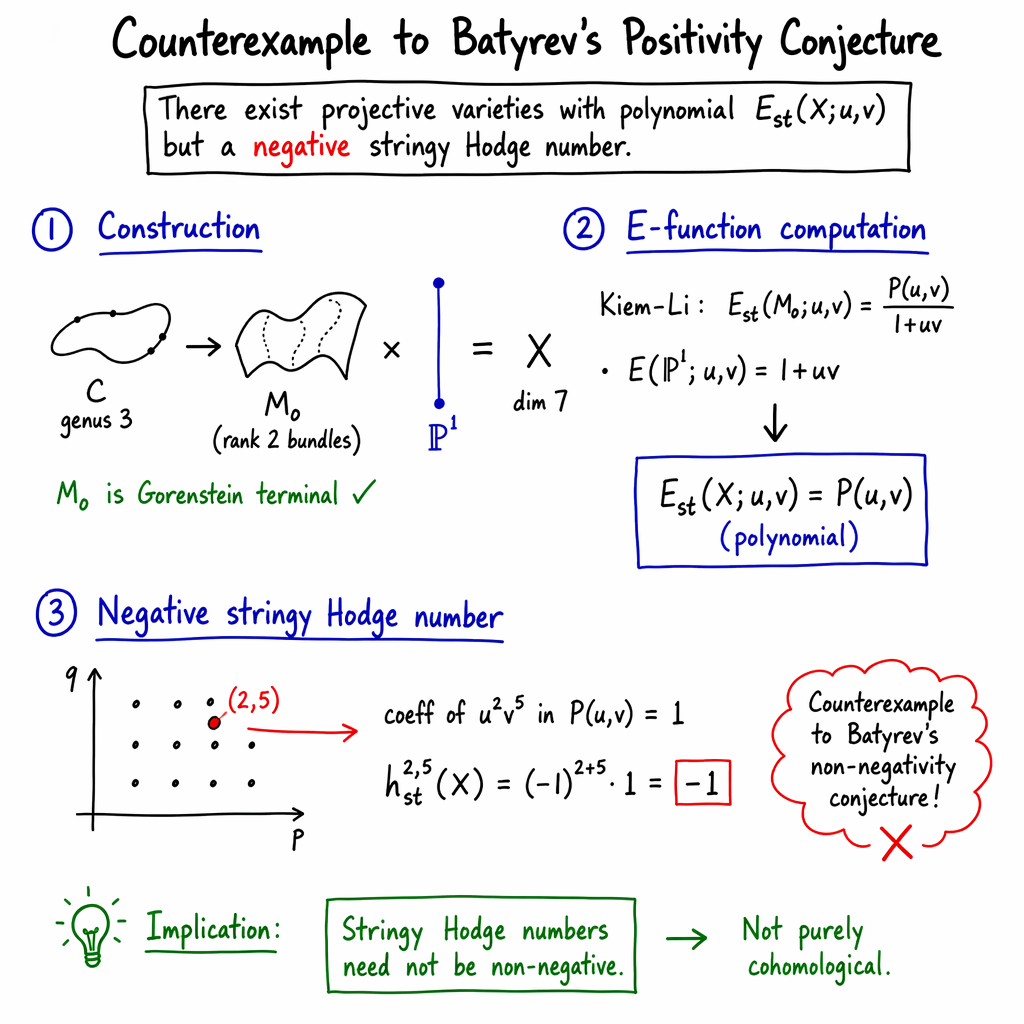
This short paper shows a surprising “no” to a long-standing “yes” guess in advanced geometry. The guess (a conjecture by Batyrev) said that certain numbers, called stringy Hodge numbers, should never be negative for a large class of geometric shapes with mild singularities (think of tiny “wrinkles” or “sharp corners”). The authors build a concrete 7‑dimensional example where one of these numbers is actually negative. This means the conjecture is false in general.
The key questions
- Can stringy Hodge numbers ever be negative when a special condition is met (namely, when the “stringy E‑function” is a polynomial and the shape has mild, well-behaved singularities)?
- More simply: Do the “counts” of certain hidden geometric features ever go below zero in the situations Batyrev described?
How they approached the problem
First, a bit of friendly background:
- Ordinary Hodge numbers: You can think of these as numbers that count different types of “holes” or patterns inside a smooth shape (like how a donut has a hole).
- Singularities: These are imperfections in a shape—sharp points or creases—where usual smooth rules break.
- Stringy Hodge numbers: When shapes have singularities, ordinary counting doesn’t work well, so mathematicians defined “stringy” versions using a careful recipe. These numbers are extracted from a two‑variable function , called the stringy E‑function. If this function is actually a polynomial, then its coefficients (with a sign convention) give the stringy Hodge numbers.
What the authors did:
- They looked at a well-studied geometric space built from vector bundles on a genus‑3 curve (you can think of this as a space that organizes many ways to put “arrows” along a curve in a stable way). This is known to have very nice but singular geometry (the singularities are “Gorenstein terminal,” which is a technical way of saying the singularities are mild and well-behaved for the tools they use).
- They formed , where is the projective line (topologically a sphere). This makes a 7‑dimensional space.
- Using a known formula (from earlier work by Kiem–Li) for the stringy E‑function of , and the fact that the E‑polynomial of equals $1+uv$, they computed
and found it is a genuine polynomial. That’s exactly the setting where Batyrev’s positivity conjecture was supposed to apply.
- To read off a stringy Hodge number , you look at the coefficient of in and then multiply by (this is the sign convention in the definition). They checked the coefficient and got a negative outcome.
Main findings
- The space is 7‑dimensional, projective, and has mild (Gorenstein terminal) singularities.
- Its stringy E‑function is a polynomial, so the usual definition of stringy Hodge numbers applies.
- The specific stringy Hodge number turns out to be .
- This is a direct counter-example to Batyrev’s non-negativity conjecture, which predicted all such numbers should be non-negative in this situation.
Why is that important?
- It shows that even with very nice singularities and the “good” polynomial condition, these “counts” can be negative. So the big-picture belief that a hidden cohomology theory always underlies these numbers with non-negative dimensions cannot hold in full generality.
Why this matters
- Many areas—like mirror symmetry, motivic integration, and the McKay correspondence—used this positivity expectation as a guiding principle. This result says the general statement is too optimistic.
- It nudges mathematicians to refine their expectations: maybe non-negativity holds only in special cases (like when there’s a “crepant resolution,” a way to smooth out singularities without changing the counts), or maybe we need a different, more nuanced cohomology theory that can naturally produce negative contributions.
- It also highlights the power of combining known formulas and clever example-building to test big conjectures, and interestingly, the authors note they were assisted by an AI tool in discovering the example.
In simple terms
- People thought a certain kind of “hole-counting” for mildly wrinkled shapes could never go negative in a wide class of cases.
- The authors built a specific 7‑dimensional shape and showed one of those counts is .
- This means the general “never negative” claim is false, and future research must be more careful about when and why these counts stay non-negative.
Knowledge Gaps
Knowledge gaps, limitations, and open questions
The following items identify what the paper leaves missing, uncertain, or unexplored, phrased so that they can guide concrete follow-up work:
- Justify product multiplicativity. Provide a proof or precise citation for the claim that $E_{\st}(X\times Y;u,v)=E_{\st}(X;u,v)\,E(Y;u,v)$ when has Gorenstein terminal (or canonical) singularities and is smooth (here ). State exact hypotheses under which stringy -functions are multiplicative.
- Verify symmetry constraints on $E_{\st}(X;u,v)$. Check and document that the computed polynomial satisfies the expected symmetries (Hodge symmetry $E_{\st}(u,v)=E_{\st}(v,u)$ and Poincaré duality-type symmetry for Gorenstein canonical projective varieties). If symmetry fails, reconcile with theory or correct the computation.
- Global picture of stringy Hodge numbers for the example. Compute the full set of $h_{\st}^{p,q}(X)$, not just $h_{\st}^{2,5}$, and explicitly identify all negative entries. Provide the Hodge “diamond” for and confirm compatibility with $h_{\st}^{p,q}=h_{\st}^{q,p}$ and with the degree constraints.
- Geometric origin of negativity. Decompose $E_{\st}(M_0;u,v)$ into contributions from strata of the singular locus (e.g., strictly semistable locus/Kummer-type strata) and identify which strata contribute to the negative $h_{\st}^{2,5}$ after stabilization by . Give a geometric mechanism explaining the sign.
- Minimal dimension of counterexamples. Determine the smallest possible dimension in which a counterexample exists. Known results cover 3-folds; partial results cover some 4-folds. Are counterexamples possible in dimensions 5 or 6, or is 7 minimal? Construct or rule out examples in lower dimensions.
- Beyond products: indecomposable counterexamples. Find a projective variety (not decomposable as a nontrivial product with a smooth factor) with Gorenstein canonical or terminal singularities such that $E_{\st}(Y;u,v)$ is a polynomial and some $h_{\st}^{p,q}(Y)<0$. Alternatively, characterize when “denominator clearing” via products is essential.
- Calabi–Yau and Fano cases. Investigate whether there are counterexamples within key classes:
- Calabi–Yau varieties (projective, ) with Gorenstein canonical singularities and polynomial $E_{\st}$ but $h_{\st}^{p,q}<0$.
- Fano varieties with Gorenstein canonical singularities. Either construct such examples or prove obstruction results.
- General construction scheme. Formalize a method to produce counterexamples by “stabilizing” with smooth varieties to cancel denominators of $E_{\st}(Y;u,v)$. Classify which denominator factors (e.g., ) can be cleared by products with simple smooth varieties (e.g., projective spaces, tori) and which lead to negative coefficients in odd total degree.
- Crepant stack resolutions and mixed stringy cohomology. Using the authors’ prior results on crepant resolutions by smooth Artin stacks, compute the associated mixed stringy cohomology for this and identify how weight filtrations/spectral sequences produce the observed negative $h_{\st}^{p,q}$. Provide a cohomological explanation for the sign pattern.
- Birational invariance and stability of negativity. Since $E_{\st}$ is crepant-birationally invariant, clarify whether the negativity of $h_{\st}^{p,q}$ persists across all crepant models of . Explore how taking products with smooth varieties or performing other operations affects the sign pattern of stringy Hodge numbers.
- Scope within moduli of bundles. Extend the analysis from , rank $2$, trivial determinant to:
- Higher genus, different ranks, and nontrivial determinant.
- Moduli of Higgs bundles or parabolic bundles.
- Determine for which parameters $E_{\st}$ becomes polynomial after stabilization and when negative $h_{\st}^{p,q}$ occur.
- Quantitative bounds and patterns. Investigate whether negative stringy Hodge numbers can be made arbitrarily large in magnitude (e.g., via repeated stabilization) and characterize which bidegrees can exhibit negativity. Is there a systematic pattern or bound on negative entries?
- Compatibility with known positivity results. Cross-check the example against results such as Olano’s nonnegativity for $h_{\st}^{p,1}$ and other partial positivity theorems. Determine precisely which ranges of remain provably nonnegative in this example and in potential generalizations.
- Reproducibility and computational verification. Provide a transparent derivation from the Kiem–Li formula for $E_{\st}(M_0;u,v)$ to the explicit , including symbolic computation scripts, to enable independent verification of coefficients and sign conventions.
- Mirror symmetry implications. Examine whether a mirror partner (in any proposed sense) exists for and how the negative stringy Hodge numbers reflect on mirror symmetry predictions. Does negativity obstruct a naive mirror correspondence or suggest modifications to stringy invariants used in mirror symmetry?
Practical Applications
Overview
This paper provides a concrete counterexample to Batyrev’s long-standing conjecture asserting the non-negativity of stringy Hodge numbers for projective varieties with Gorenstein canonical singularities when the stringy E-function is polynomial. The authors construct a 7-dimensional example X = M₀ × P¹, where M₀ is the moduli space of rank-2 semistable bundles with trivial determinant over a genus-3 curve, and show h_st{2,5}(X) = −1. The result reshapes expectations across motivic integration, mirror symmetry, and stringy/stack-theoretic cohomology, and it notably documents the use of an LLM (ChatGPT) as part of the discovery process.
Below are practical, real-world applications and workflows derived from the paper’s findings, methods, and context. Applications are grouped by time horizon and, where relevant, linked to sectors, potential tools/products, and feasibility dependencies.
Immediate Applications
- Revising computational and theoretical workflows that assume non-negativity of stringy Hodge numbers
- Sectors: Academia (algebraic geometry, mathematical physics), Software (CAS/CAP developers)
- Tools/products/workflows:
- Update CAS libraries (e.g., SageMath, Macaulay2, Magma) and geometry packages to allow negative stringy Hodge numbers; add “sanity-checks” that do not hardcode positivity.
- Provide a command-line or notebook routine that verifies polynomiality of the stringy E-function before interpreting coefficients and flags negative entries when present.
- Assumptions/dependencies: Requires robust implementations of stringy E-function computations, log-resolution data or literature-based formulas; careful numerical and symbolic checks (Gorenstein/terminal hypotheses, polynomiality).
- Benchmark dataset and test harness for stringy invariants
- Sectors: Academia (motivic integration, birational geometry), Software (data and tooling for verification)
- Tools/products/workflows:
- Curate a public dataset of varieties (toric, quotient, moduli-type, and constructed examples like M₀ × P¹) annotated with stringy E-functions and Hodge outputs (including negative cases).
- Continuous-integration (CI) test suites for research code: automatically recompute invariants, cross-check with known results, and flag sign anomalies.
- Assumptions/dependencies: Availability of explicit formulas or computational pipelines; reproducible code and metadata; community curation and version control.
- Reframing heuristics and constraints in mirror symmetry computations
- Sectors: Academia (string/M-theory-adjacent mathematical physics)
- Tools/products/workflows:
- Modify mirror-construction pipelines to include an explicit “polynomiality + sign-check” stage for stringy Hodge numbers rather than assuming non-negativity.
- Introduce “positivity filters” only in regimes with proven positivity (e.g., finite quotient singularities, Gorenstein toric cases), with fallback checks elsewhere.
- Assumptions/dependencies: Accurate identification of positivity regimes (toric, quotient, threefold cases); access to stacky/Artin-stack-based methods when appropriate.
- Pedagogical use cases and curriculum updates
- Sectors: Education (undergraduate/graduate courses), Academic training
- Tools/products/workflows:
- Incorporate the counterexample as a case study in courses on algebraic geometry, motivic integration, and mirror symmetry, emphasizing the role of counterexamples in guiding theory.
- Develop guided computational assignments (e.g., computing E_st for specific families and verifying sign behavior).
- Assumptions/dependencies: Course materials and software environments that support symbolic computations and structured problem sets.
- Responsible and effective LLM-assisted mathematical research workflows
- Sectors: Academia, Software/AI
- Tools/products/workflows:
- Protocols for LLM-in-the-loop discovery: brainstorming candidate constructions, generating search heuristics, and drafting computational experiments; always coupled with rigorous human verification and reproducible code artifacts.
- Lab notebooks that track prompts, model versions, and verification steps; institutional guidance on attribution and disclosure when LLMs contribute to discovery.
- Assumptions/dependencies: Human oversight to mitigate hallucinations; integration with CAS, proof assistants, and citation managers; institutional policies on AI use.
Long-Term Applications
- Developing refined “stringy” (mixed) cohomology theories and positivity criteria
- Sectors: Academia (algebraic geometry, Hodge theory)
- Tools/products/workflows:
- Systematic programs to characterize when positivity holds (e.g., for specific singularity classes), and to define invariants that are functorial and computable but do not presuppose purity.
- Software modules implementing mixed stringy cohomology and new invariants derived from stacky/Artin-stack resolutions, with clear documentation on expected sign behavior.
- Assumptions/dependencies: Further theory connecting motivic integration with mixed Hodge structures; scalable computational models for resolutions or stack-theoretic replacements.
- AI-native mathematical discovery platforms
- Sectors: Software/AI, Academia
- Tools/products/workflows:
- Platforms integrating LLMs with CAS, SMT solvers, proof assistants, and literature graphs to automate search for counterexamples, generate candidate constructions, and verify conditions (e.g., Gorenstein terminal, polynomiality).
- “MathOps” pipelines for research groups: data registries of examples, automated regeneration of computations, provenance tracking, and peer-verification dashboards.
- Assumptions/dependencies: Continued advances in neuro-symbolic integration, formal proof tooling, and reliable mathematical retrieval models; robust evaluation standards and interpretability.
- Policy and governance frameworks for AI in mathematical research
- Sectors: Research policy, Funding agencies, Universities
- Tools/products/workflows:
- Guidelines on authorship, disclosure, and credit when AI systems materially contribute to conjecture testing or example generation.
- Funding initiatives for infrastructure that supports reproducibility (open datasets, open-source implementations, benchmark suites).
- Assumptions/dependencies: Community consensus on best practices; alignment with broader research-integrity norms.
- Implications for mathematical physics and string compactifications
- Sectors: Academia (theoretical physics)
- Tools/products/workflows:
- Reassessment of workflows where stringy Hodge numbers are used as proxies for physical spectra or state counts; integration of sign- and polynomiality-checks before interpretations.
- Exploration of alternative invariants or corrected counting procedures in singular settings.
- Assumptions/dependencies: Transferability of the counterexample’s lessons to physically relevant moduli; clarity on when stringy Hodge numbers map to physical quantities.
- Enhanced tooling for singularity classification and birational geometry
- Sectors: Academia, Software (research-grade CAD/CAS)
- Tools/products/workflows:
- Decision procedures that incorporate exceptions to positivity, guiding classification pipelines and avoiding false constraints in algorithmic searches over singular varieties.
- Libraries of crepant stacky resolutions (Deligne–Mumford or Artin) with APIs that expose discrepancy data and motivic integrals.
- Assumptions/dependencies: Computability at scale (log resolutions, stacky resolutions), stable APIs and data schemas, community-maintained example corpora.
Note on feasibility and dependencies:
- Many applications hinge on verifying technical hypotheses (e.g., Gorenstein terminal singularities, polynomiality of E_st) and on reliable computational backends.
- AI-assisted workflows must be coupled with strict verification, audit trails, and transparent attribution to be trustworthy and reproducible.
- Positivity remains valid in specific regimes (e.g., finite quotient and toric settings); deploying filters that condition on these regimes will minimize false assumptions in automated pipelines.
Glossary
- Arc space: The algebro-geometric space parameterizing formal arcs on a variety (maps from Spec k[[t]] to the variety), central to motivic integration. Example: "the volume of the arc space"
- Artin stack: A generalization of schemes/spaces allowing nontrivial automorphism groups, used to model moduli and to achieve crepant resolutions when Deligne–Mumford stacks do not suffice. Example: "a crepant resolution by a smooth Artin stack."
- Batyrev's conjecture: The assertion that if the stringy E-function of a projective variety with Gorenstein canonical singularities is a polynomial, then all stringy Hodge numbers are nonnegative. Example: "Batyrev's conjecture on the non-negativity of stringy Hodge numbers"
- Birational geometry: The study of varieties up to birational equivalence, focusing on transformations that are isomorphisms on dense open subsets. Example: "birational geometry"
- Calabi--Yau variety: A (possibly singular) variety with trivial canonical bundle (and, in the smooth case, vanishing first Chern class), central in mirror symmetry. Example: "singular Calabi--Yau varieties"
- Canonical singularities: A class of mild singularities in the minimal model program characterized by nonnegative discrepancies. Example: "Gorenstein canonical singularities"
- Coarse moduli space: The algebraic variety that parameterizes isomorphism classes of objects from a moduli stack, forgetting stacky stabilizers. Example: "the coarse moduli space of rank 2 semistable bundles over C with trivial determinant."
- Crepant resolution: A resolution f: Y → X preserving the canonical class (K_Y = f*K_X), important for stringy invariants. Example: "admits a crepant resolution "
- Deligne--Mumford stack: A stack with étale-local finite group quotient charts, commonly used to model orbifolds and stacky resolutions. Example: "a canonical smooth Deligne--Mumford stack"
- Discrepancy formula: The formula expressing the difference of canonical divisors on a resolution via discrepancies, governing singularity types. Example: "the discrepancy formula"
- Ehrhart theory: The study of lattice-point counts in dilations of polytopes and their generating functions, linking combinatorics to geometry. Example: "arising from Ehrhart theory"
- Finite quotient singularities: Singularities locally modeled as a quotient of a smooth variety by a finite group action. Example: "finite quotient singularities"
- Gorenstein: A property indicating the canonical divisor is Cartier (dualizing sheaf invertible), often assumed in stringy constructions. Example: "Gorenstein terminal singularities"
- Gorenstein measure: The motivic measure tailored to Gorenstein settings used to recover stringy invariants from arc spaces. Example: "the so-called Gorenstein measure"
- Log-resolution: A resolution of singularities making the exceptional divisor simple normal crossings, used to define stringy invariants. Example: "log-resolutions"
- Log-terminal singularities: Singularities with all discrepancies greater than −1 (klt), ubiquitous in the minimal model program. Example: "log-terminal singularities"
- McKay correspondence: A bridge between the geometry of resolutions of quotient singularities and the representation theory of the acting group. Example: "the McKay correspondence"
- Mirror symmetry: A duality predicting deep relationships (e.g., exchanged Hodge numbers) between pairs of Calabi–Yau varieties. Example: "mirror symmetry"
- Motivic change of variables formula: A transformation rule for motivic integrals under birational maps, accounting for Jacobians/discrepancies. Example: "a general motivic change of variables formula"
- Motivic integration: An integration theory over arc spaces valued in the Grothendieck ring, enabling definitions of stringy invariants. Example: "Motivic integration"
- Orbifold cohomology: A cohomology theory for stacks/orbifolds incorporating contributions from twisted sectors (inertia). Example: "orbifold cohomology"
- Orbifold Hodge numbers: Hodge numbers defined via orbifold cohomology, often matching stringy Hodge numbers for quotient singularities. Example: "the orbifold Hodge numbers of in the sense of Chen--Ruan"
- Q-Gorenstein variety: A variety whose canonical divisor is Q-Cartier (some positive multiple is Cartier). Example: "for a -Gorenstein variety"
- Semistable bundle: A vector bundle whose slope is at least that of every proper subbundle (slope semistability). Example: "semistable bundles"
- Small resolution: A resolution whose exceptional locus has codimension at least two (no divisors), often crepant in Gorenstein cases. Example: "a small resolution (hence crepant)"
- Stringy Betti numbers: Betti numbers derived from the stringy E-function, often computed combinatorially in toric cases. Example: "their stringy Betti numbers"
- Stringy E-function: A generating function built from discrepancies on a log resolution encoding stringy Hodge data. Example: "stringy -function $E_{\st}(X;u,v)$"
- Stringy Hodge numbers: The signed coefficients of the stringy E-function when it is a polynomial, generalizing Hodge numbers to singular settings. Example: "stringy Hodge numbers"
- Terminal singularities: Very mild singularities with strictly positive discrepancies, stronger than canonical. Example: "terminal singularities"
- Toric variety: A variety built from a fan with an algebraic torus action, often amenable to combinatorial methods. Example: "complete Gorenstein toric varieties"
- Trivial determinant: The property that a vector bundle’s determinant line bundle is isomorphic to the trivial line bundle. Example: "trivial determinant"
- Twisted arcs: Arcs on a Deligne–Mumford stack that record stacky automorphism data, used in motivic integration over stacks. Example: "twisted arcs"
Collections
Sign up for free to add this paper to one or more collections.

