Standard Model Symmetries and the Nested Embeddings of $\mathbb{R}\subset\mathbb{C}\subset\mathbb{H}\subset\mathbb{O}$
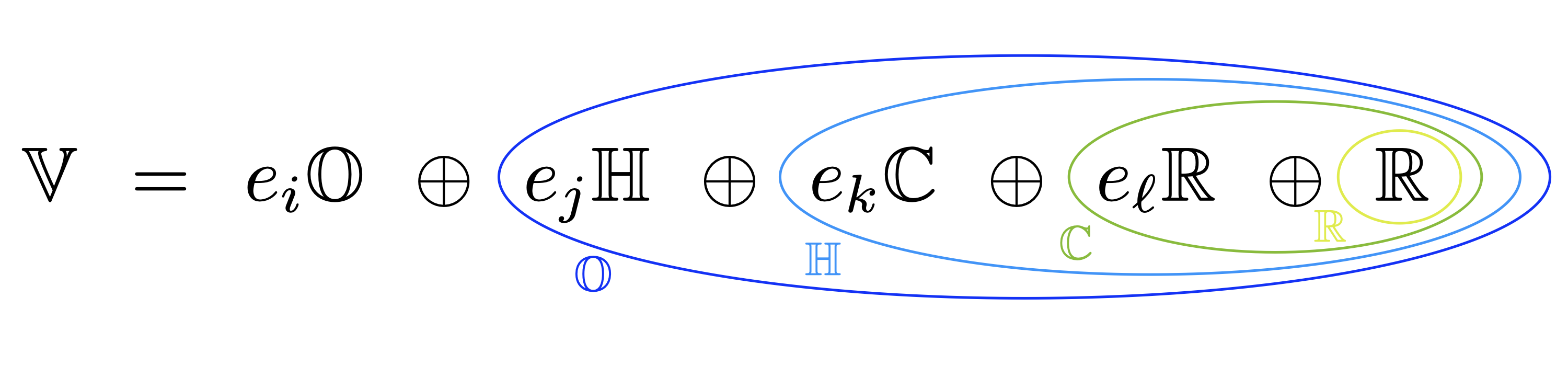
Abstract: Where do the Standard Model's internal symmetries come from? Treating $\mathbb{O}\oplus\mathbb{H}\oplus\mathbb{C}\oplus\mathbb{R}$ as a module for its own multiplication algebra enables a particular origin story for the Standard Model's pre-Higgs, $\mathfrak{g}{SM}:=\mathfrak{su}(3){C} \oplus \mathfrak{su}(2){L} \oplus \mathfrak{u}(1){Y},$ and post-Higgs, $\mathfrak{g}{LE}:=\mathfrak{su}(3){C} \oplus \mathfrak{u}(1){Q},$ symmetries. We recognize both these endomorphisms and their modules alike as $\mathbb{Z}_2n$-graded algebras. Then, annihilating certain highest grade (volume) elements, and imposing an equal-trace condition on anti-hermitian operators leads precisely to $\mathfrak{g}{SM}$ and $\mathfrak{g}{LE}$. Weak hypercharge and electric charge operators, $Y$ and $Q,$ take on a remarkably simple form: $\sum \frac{1}{n}\mathbb{I}{n\times n}$. With the help of auxiliary imaginary units, this 15 $\mathbb{R}$ dimensional $\mathbb{O}\oplus\mathbb{H}\oplus\mathbb{C}\oplus\mathbb{R}$ embeds naturally as a vector space into several well-studied 16 $\mathbb{R}$ dimensional algebras, which we generically refer to as $\mathbb{V}.$ With this embedding, the Standard Model's internal symmetries may then be seen to arise in part from the sequence of nested inclusions: $\mathbb{R}\subset\mathbb{C}\subset\mathbb{H}\subset \mathbb{O}\subset\mathbb{V}.$ In the sedenionic case of $\mathbb{V} = \mathbb{S},$ the full sequence becomes a Cayley-Dickson tower. We define the notion of endomorphic models of particle physics, and connect $End_\mathbb{R}(\mathbb{V})\simeq Cl(0,8)$ to the earlier ideas of Bott Periodic Particle Physics. We comment on a possible connection between the existence of multiple complex structures and the baryon asymmetry problem.
Paper Prompts
Sign up for free to create and run prompts on this paper using GPT-5.
Top Community Prompts
Explain it Like I'm 14
Overview
This paper asks a big question: where do the Standard Model’s internal symmetries come from? (These are the math rules behind the strong force SU(3), the weak force SU(2), and electric charge U(1).) The author shows a clean way to get exactly these symmetries by starting from familiar number systems nested inside each other: R ⊂ C ⊂ H ⊂ O
- R = real numbers
- C = complex numbers
- H = quaternions
- O = octonions
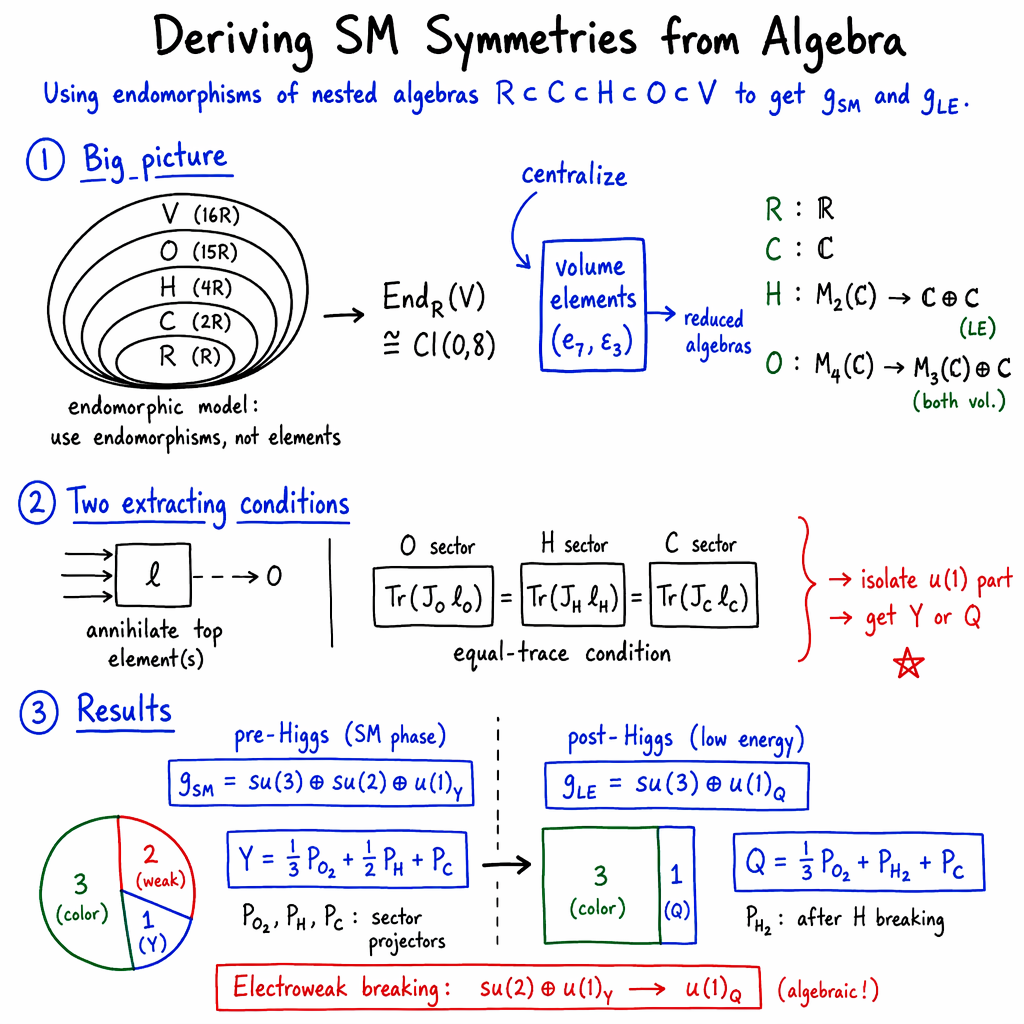
The key idea is to stop thinking of particles as “living inside” these number systems and instead think of particles as patterns in how these numbers act on each other (like buttons that transform the numbers). With two simple rules, the Standard Model’s symmetries pop out naturally, before and after the Higgs field acts.
Key Objectives
Here are the main questions the paper tackles:
- Can the Standard Model’s internal symmetries be derived from the nested number systems R ⊂ C ⊂ H ⊂ O?
- Can we model particles using the “actions” (operations) on these numbers, instead of the numbers themselves?
- Can this approach also explain the change in symmetries after electroweak symmetry breaking (when SU(2)×U(1) becomes U(1) for electric charge)?
- Can we write down especially simple formulas for weak hypercharge Y and electric charge Q?
Approach and Methods
The paper builds a careful bridge from number systems to physics. Here’s the path, explained in everyday terms.
The building blocks: R, C, H, O
- Think of R, C, H, O as four levels of “number LEGO.” Each level adds new “imaginary directions.”
- They sit inside each other like nested dolls: R ⊂ C ⊂ H ⊂ O.
From numbers to actions (endomorphic models)
- Instead of saying “particles are numbers,” the paper says “particles are ways numbers act on themselves.”
- Mathematically, these ways-of-acting are linear maps (like pressing buttons that transform the numbers). The collection of all such buttons is called an endomorphism algebra.
Clifford algebras and a “special direction”
- The endomorphism algebras for these number systems match well-known objects called Clifford algebras.
- Inside each Clifford algebra is a “volume element” ω that behaves like an imaginary unit (it squares to −1). Choosing ω is like picking a special direction in space.
Centralizers: keep only what respects the special direction
- The centralizer of ω is the set of actions that commute with (respect) this special direction.
- This step shrinks the big algebra down to a smaller, more structured one—exactly the kind we want for particle symmetries.
- Result:
- From octonions O you get a complex 4×4 matrix algebra that splits into 3×3 plus 1×1 blocks: this naturally suggests SU(3) for the strong force and a leftover U(1).
- From quaternions H you get a complex 2×2 matrix algebra M2(C) (for SU(2)) before symmetry breaking, and after a second step it becomes C ⊕ C (two separate U(1)’s), mirroring the electroweak transition.
Modeling electroweak symmetry breaking
- Before the Higgs acts (“pre-Higgs”), the quaternionic sector behaves like a single block M2(C) (matching SU(2)).
- After symmetry breaking (“post-Higgs”), that block splits into two separate pieces C ⊕ C (matching U(1) for electric charge plus decoupling the rest).
- This mathematically mirrors SU(2)×U(1) → U(1) of the Standard Model.
Lie–Jordan splitting: symmetries vs observables
- Any matrix algebra can be split into anti-hermitian parts (symmetries, like generators of rotations) and hermitian parts (observables, like charge operators).
- This helps cleanly read off the symmetry algebras (SU(3), SU(2), U(1)) and the charge operators (Y and Q).
Two simple rules that pick the right symmetries
To isolate exactly the Standard Model symmetries from the larger algebra, the author imposes:
- Annihilate the highest-grade (“top”) piece:
- In O: kill the top octonion direction (pre-Higgs).
- In H and O: kill both top directions (post-Higgs).
- Intuition: lock in a special imaginary direction so only compatible actions survive.
- Equal-trace (balance) condition across sectors:
- Impose a balancing rule that gives equal weighted traces in the octonion, quaternion, and complex parts.
- Intuition: make the overall phases “fair” across the nested pieces.
- These two rules carve out precisely SU(3)×SU(2)×U(1) before the Higgs and SU(3)×U(1) after.
Main Findings
Here are the key results the paper reports:
- It derives the Standard Model’s internal symmetry algebras from the nested number systems:
- Pre-Higgs: su(3) ⊕ su(2) ⊕ u(1)
- Post-Higgs: su(3) ⊕ u(1)
- It gives especially simple formulas for weak hypercharge Y and electric charge Q using “projectors” (filters that select parts of the space):
- These are surprisingly neat: each looks like a sum of “on/off” switches with simple fractions.
- It shows the electroweak breaking step (SU(2)×U(1) → U(1)) naturally follows from a special property of the quaternionic sector: its full “action algebra” really needs both left and right multiplication, and this lets it split at the right time.
- It connects the whole setup to a 16-dimensional space V (like O⊕O or the sedenions S), where End_R(V) ≅ Cl(0,8). This is the gateway to Bott periodicity (a deep repeating pattern every 8 dimensions) and to a “Bott periodic Fock space” picture for many-particle states.
- It proposes that having more than one valid “complex structure” (more than one choice of imaginary direction) might be related to why the universe prefers matter over antimatter (baryon asymmetry).
Why These Results Matter
- A unified origin story: The paper offers a crisp, number-theory-based path to the Standard Model’s internal symmetries using only:
- Nested numbers R ⊂ C ⊂ H ⊂ O
- Actions on these numbers
- Two simple selection rules (fix the top element; balance the traces)
- Elegant charge operators: The hypercharge Y and electric charge Q emerge in very simple, projector-based forms. In standard normalization, each looks like a sum of terms of the type (1/n)·Identity, which also matches “maximally mixed” density matrices in quantum mechanics—an intriguing hint about information-theoretic structure in charges.
- Natural electroweak step: The method cleanly reproduces the symmetry change after the Higgs acts, using only the built-in features of quaternions.
- Links to big mathematical ideas: Embedding into a 16-dimensional space with End_R(V) ≅ Cl(0,8) ties the model to Bott periodicity, a cornerstone in mathematics and physics, and suggests a structured way to represent multi-particle states.
- Future directions: Multiple complex structures might help explain matter–antimatter imbalance; the framework also meshes with studies of exceptional algebras (like E8) and higher algebras (like sedenions).
Conclusion
In simple terms, the paper shows that if you:
- build from the nested number systems R ⊂ C ⊂ H ⊂ O,
- describe particles as “ways numbers act,”
- pick a special imaginary direction and keep only the actions that respect it,
- and apply a fair “balance rule” across the parts,
then the Standard Model’s internal symmetries and charge operators fall out neatly—even the electroweak breaking step. This gives an elegant, compact mathematical picture of why the Standard Model looks the way it does, and it opens paths toward deeper unification and new insights about the structure of matter.
Knowledge Gaps
Knowledge gaps, limitations, and open questions
Below is a focused list of concrete gaps and unresolved questions that would enable targeted follow‑up work.
- Foundational justification of constraints
- Provide a physical principle (beyond algebraic convenience) that uniquely motivates the two key constraints used to extract gauge algebras: (i) “annihilate the highest-degree element(s)” and (ii) the equal-trace condition Tr(J_O ℓ_O) = Tr(J_H ℓ_H) = Tr(J_C ℓ_C). Assess uniqueness: do alternative choices lead to different gauge groups or charge operators?
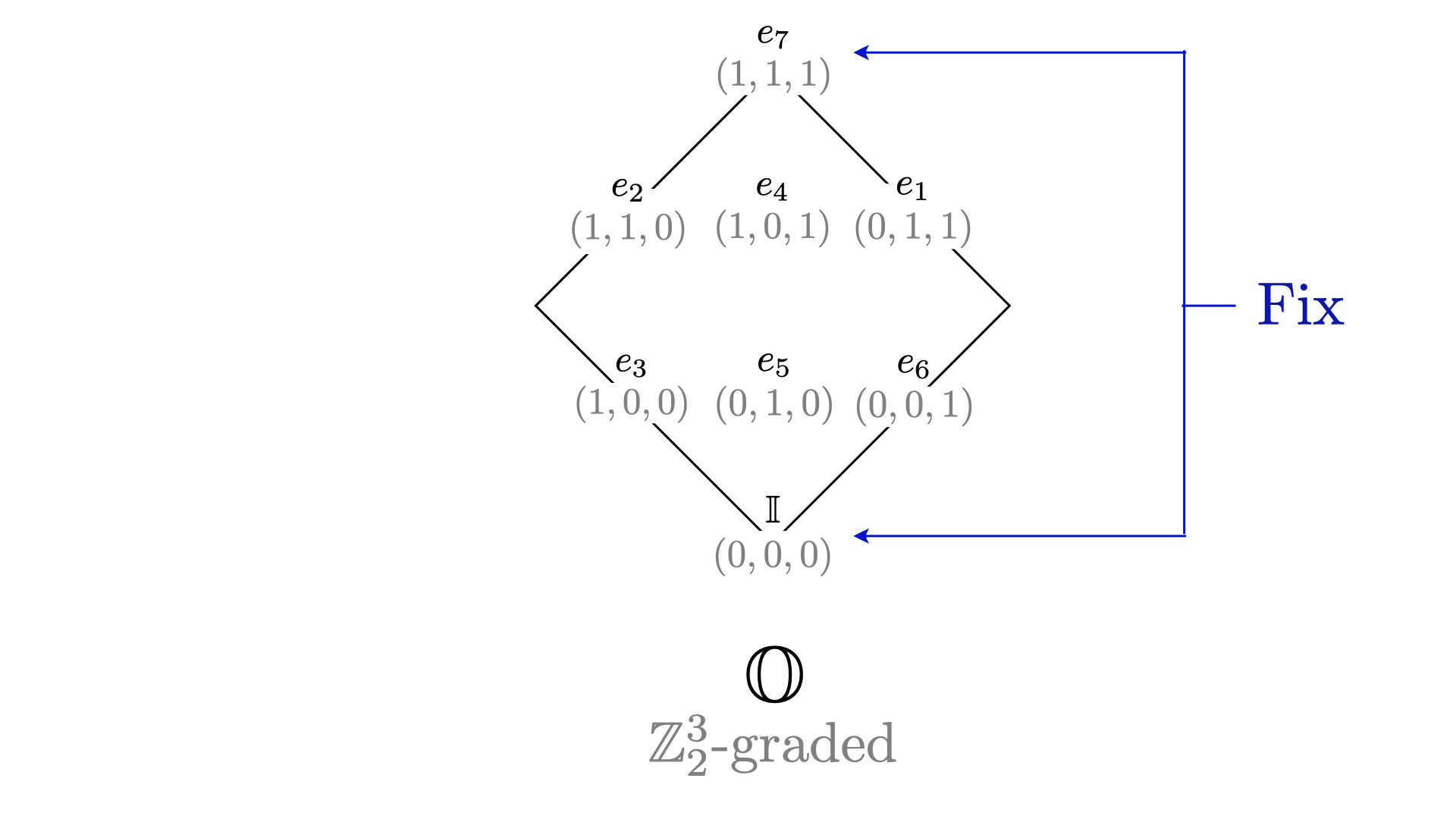
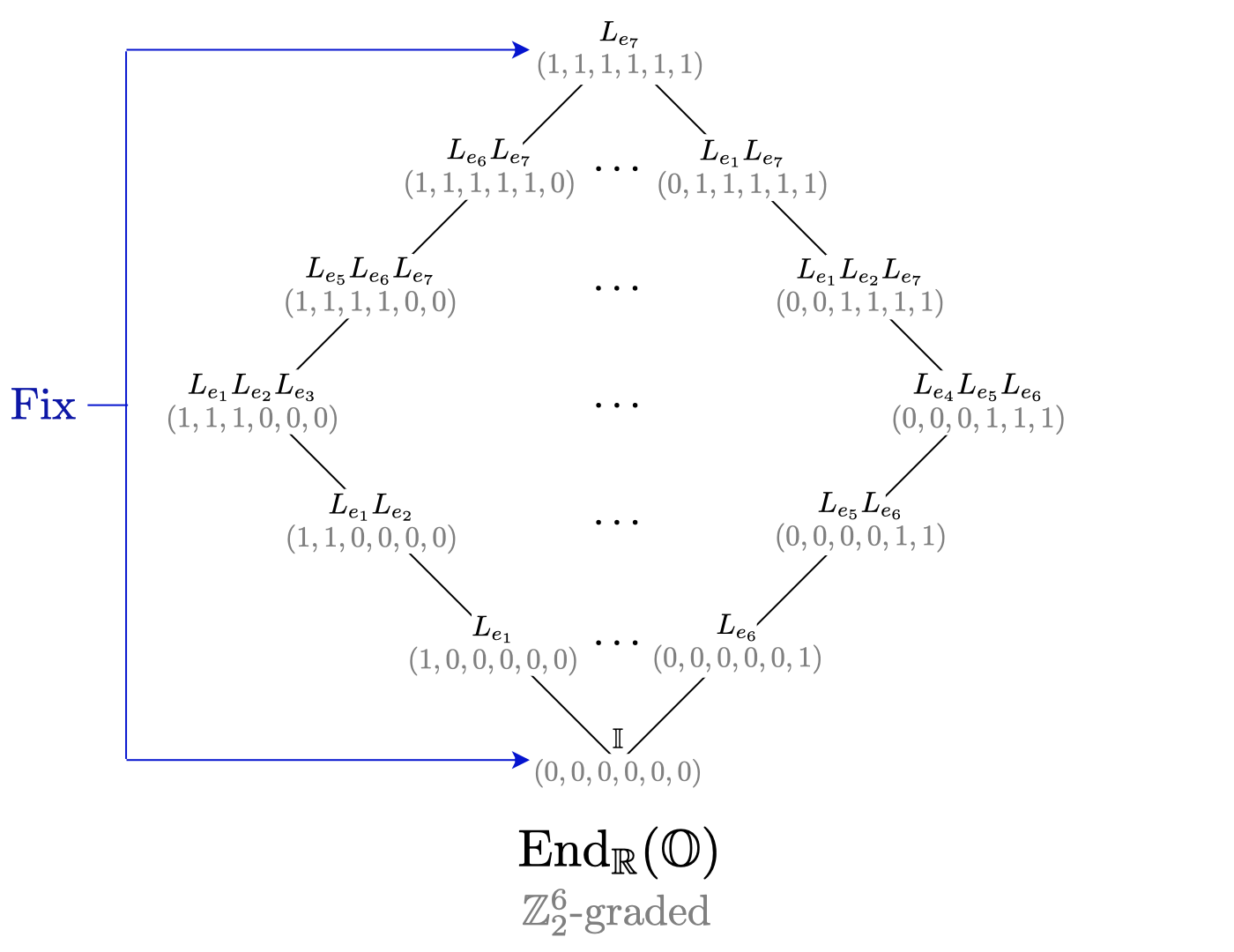
- Clarify the physical meaning of “fixing” the highest-grade element in the Z_2n grading (e.g., e7 and ε3). Is this a gauge choice, a vacuum choice, or a dynamical selection? Provide a mechanism or variational principle that selects these elements.
- Uniqueness and model selection
- The construction depends on selecting a 16ℝ-dimensional host algebra V (e.g., O ⊕ O, sedenions S, or complex octonions thought of as 16ℝ). Identify criteria that single out a unique V (associativity issues, zero divisors, representation-theoretic constraints, or phenomenology). Determine whether different choices of V yield inequivalent physics.
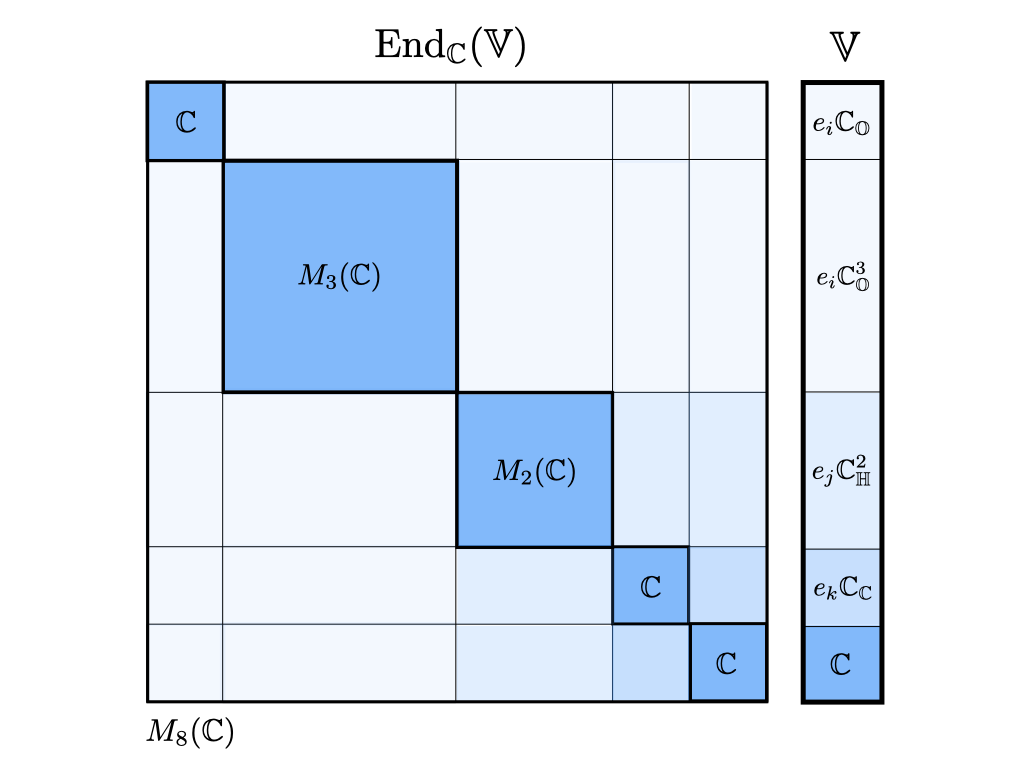
- Investigate robustness of the derived centralizers (e.g., M4(C) → M3(C) ⊕ C and M2(C) → C ⊕ C) under different choices of complex structures (L_{e7} vs R_{e7}, etc.) and under automorphisms (e.g., G2 rotations of the octonionic basis).
- From algebra to fields and dynamics
- Specify how local gauge fields (connections), kinetic terms, and Yang–Mills dynamics emerge from the endomorphic/Clifford framework. Derive an action or Lagrangian and show how standard QFT dynamics (including gauge covariant derivatives) are recovered.
- Elaborate the “Bott Periodic Fock space” prescription into a working QFT: define creation/annihilation operators, enforce (anti-)symmetrization/statistics, locality, and causality; demonstrate how scattering amplitudes or correlation functions are computed.
- Electroweak symmetry breaking and the Higgs
- Replace the algebraic “phase change” B_H: Cl(0,2) ⊗ Cl(0,2) → C ⊕ C with an explicit dynamical mechanism (e.g., a Higgs field in a specified representation) that reproduces SU(2)_L ⊕ U(1)_Y → U(1)_Q and the observed Higgs mass and couplings.
- Demonstrate explicitly how chiral electroweak couplings (left doublets vs right singlets) arise in this framework, including the mapping of left/right chirality to algebraic structures (e.g., via complex structures or projectors).
- Charge assignments, anomalies, and consistency checks
- Using the proposed Y and Q operators, compute the charges of all SM fermions, gauge bosons, and Higgs within the present O→V construction (not by reference to prior work), and verify exact agreement with the SM.
- Prove anomaly cancellation (gauge and mixed gravitational) for one generation and for three generations in this framework. Check the SU(2) Witten global anomaly.
- Clarify normalization of U(1)_Y (and Q) and show how the canonical SM normalizations emerge (including coupling unification criteria, if any). Address the statement that Tr(Y)/dim(V) = Tr(Q)/dim(V) = 3/8: relate this to standard GUT normalizations or derive an independent physical meaning.
- Fermion content and generations
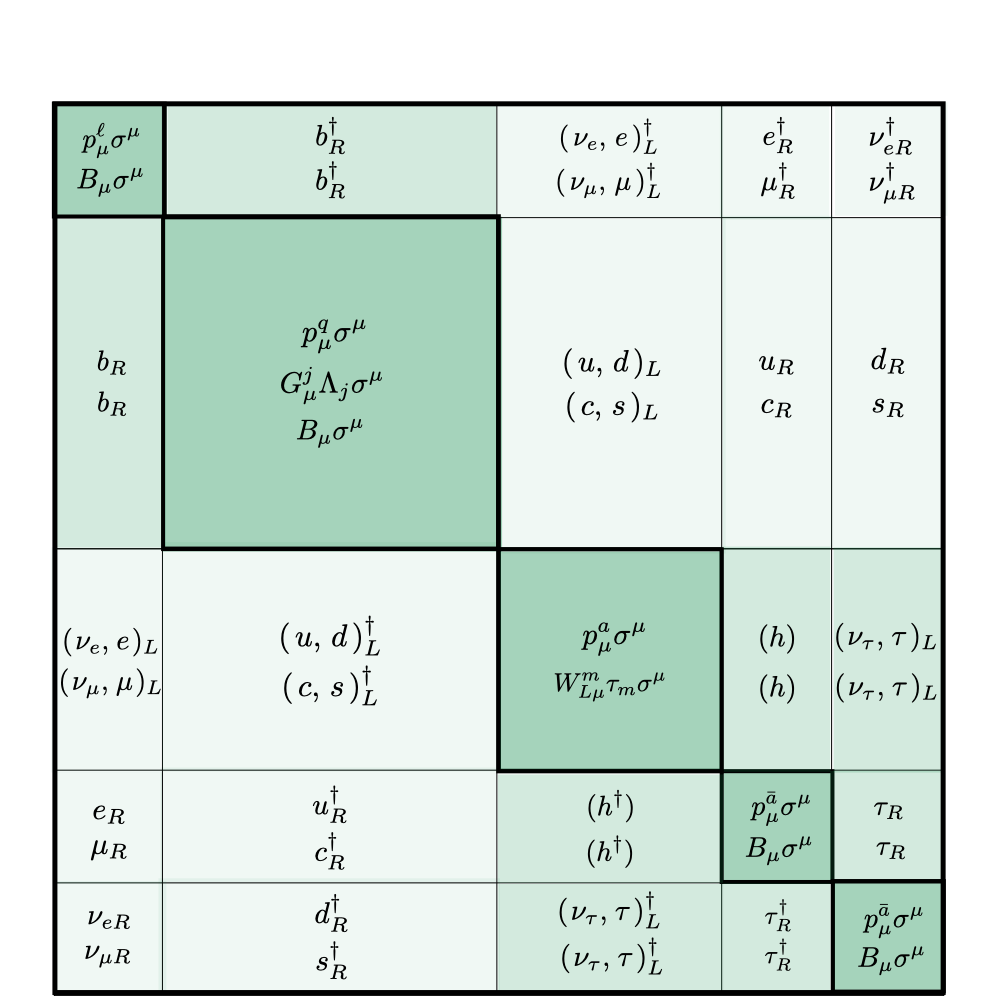
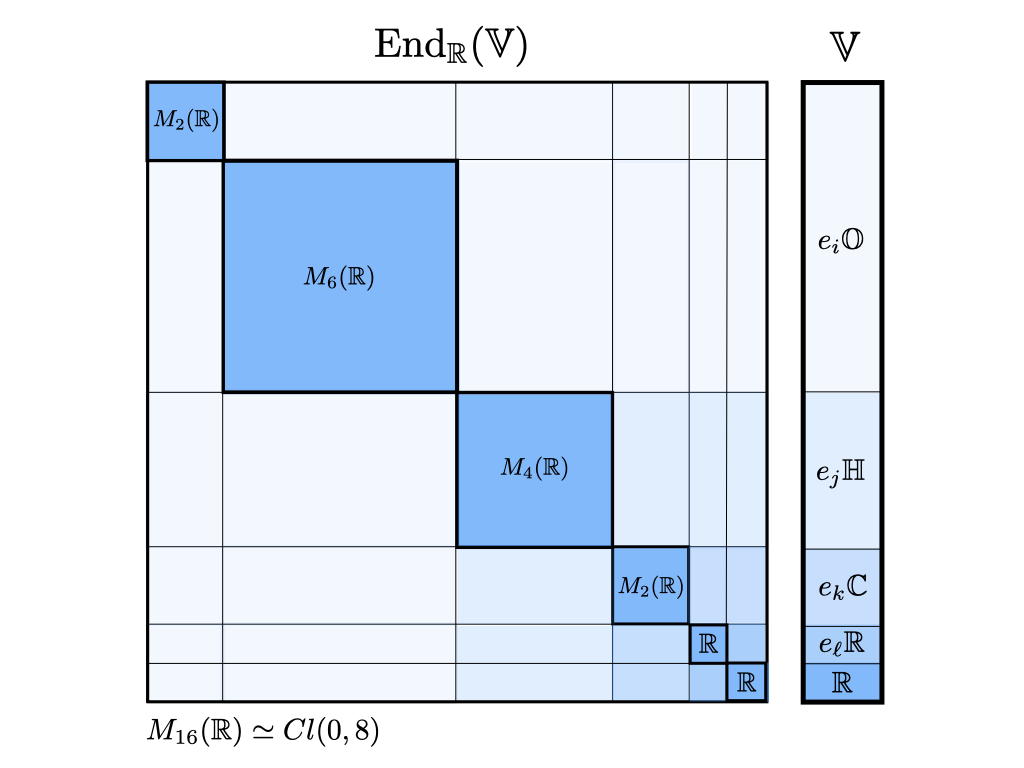
- Provide a complete, self-contained derivation of the full SM matter content (including three generations and right-handed neutrinos) within the present O-based construction. Make the decomposition corresponding to Fig. 1 explicit here, including the top-quark sector.
- If the top quark is conjectured to be composite (via combining extra internal irreps), construct the bound-state mechanism, spectrum, and mass generation; confront precision electroweak and flavor constraints.
- Masses, mixing, and CP violation
- Derive Yukawa structures, fermion mass hierarchies, and CKM/PMNS mixing from the algebraic setup. Identify where flavor structure lives in End_R(V) or in the nested embeddings R ⊂ C ⊂ H ⊂ O ⊂ V.
- The paper suggests multiple complex structures might relate to the matter–antimatter asymmetry. Formulate a concrete mechanism that links complex-structure choice to CP violation and baryogenesis; compute observables (e.g., CKM phase, BAU).
- Role and selection of complex structures
- Quantify how the choice between L_{e7} and R_{e7} (and analogous choices) changes matter vs antimatter assignments and helicity structure. Determine if a dynamical or topological mechanism selects one complex structure in our universe.
- Classify all admissible complex structures in the construction and analyze their phenomenological consequences (charges, chiralities, anomaly structure).
- Mathematical derivations needing completion
- Provide full proofs for the centralizer computations, especially the reduction B_O ≃ M8(R) → M4(C) → M3(C) ⊕ C when commuting with both L_{e7} and R_{e7}, and the two‑volume-element reduction B_H ≃ Cl(0,2) ⊗ Cl(0,2) → C ⊕ C.
- Rigorously establish all isomorphisms in Eq. (endcliffs) and their volume elements within the present conventions, including the real vs complex trace independence claimed for the trace conditions.
- Clarify the algebra O = O ⊕ H ⊕ C ⊕ R with componentwise multiplication: analyze its idempotents, ideals, and whether additional structure (e.g., nontrivial cross terms) is required or desirable for physics.
- Gravity and spacetime
- The framework highlights Cl(3,1) via quaternionic multiplication algebras but does not couple internal and spacetime symmetries. Develop a unified treatment that incorporates Lorentz symmetry, spinors, and (optionally) gravity; determine whether internal and spacetime sectors interact within End_R(V) without violating no‑go theorems.
- Explore whether the approach can produce curved-spacetime couplings (e.g., via Clifford bundles) and what it implies for quantum gravity or emergent spacetime scenarios.
- Predictivity and phenomenology
- Identify sharp, testable predictions that distinguish this construction from the SM or from other algebraic models (e.g., relations among couplings, rare processes, spectrum of exotics, compositeness signals).
- Analyze whether the framework implies unification of gauge couplings or constrains the Weinberg angle at a scale; compute renormalization-group trajectories if a unification scheme is implied.
- Extensions and comparisons
- Work out the suggested E8 connection explicitly: map the O-based decomposition into an E8 model (choice of real vs split forms), identify the embedding of SM gauge and matter content, and address known pitfalls (proton decay, doublet–triplet splitting).
- Compare systematically with alternative octonionic/sedenionic and Clifford-based SM reconstructions; identify where the present approach improves on uniqueness, simplicity, or phenomenological viability, and where it inherits similar open problems.
- Formal interpretation of Y and Q as “maximally mixed” sums
- The observation that Y and Q look like sums of density matrices for maximally mixed states is intriguing. Develop an information-theoretic derivation of charge quantization from a maximal-entropy principle and test whether it generalizes beyond the SM.
- Choice of signatures and split forms
- Assess how results change if one uses split forms (e.g., split octonions) or different Clifford signatures, and whether phenomenology prefers a particular signature choice.
- Computational artifacts and completeness
- Provide a complete, self-contained reconstruction of the particle–irrep table (Fig. 1) within this paper’s O→V route, including explicit projectors P_{O1}, P_{O2}, P_{H1}, P_{H2}, P_C acting on the modules, so that all charges and representations are directly verifiable without external references.
Practical Applications
Immediate Applications
Below are actionable uses that can be piloted now by research groups, software teams, and educators, based on the paper’s methods (endomorphic modeling, multiplication algebras, centralizers, Lie–Jordan splitting, and nested Cayley–Dickson embeddings), and on its concrete results (derivations of SU(3)×SU(2)×U(1), simplified and , Bott-Periodic Fock-space framing).
- Endomorphic model-building toolkit
- What: A software library that takes a chosen algebraic workspace (e.g., or ) and:
- 1) constructs left/right/full multiplication algebras,
- 2) computes centralizers of volume elements,
- 3) performs Lie–Jordan splitting,
- 4) enforces the paper’s symmetry constraints (annihilation of highest-grade elements and equal-trace conditions),
- 5) outputs the gauge algebra and charge operators.
- Output: Reproducible derivations of and post-EWSB ; automatic generation of and .
- Sectors: Software (scientific computing), Academia (high-energy theory).
- Potential products: Python/Julia/Mathematica packages; plugins for SARAH/FeynRules.
- Assumptions/dependencies: Choice of with ; stable nonassociative and Clifford backends.
- Charge-operator generator and validator
- What: A tool that emits the simplified hypercharge and electric charge operators
- and ,
- verifies normalizations, and checks consistency across sectors.
- Use: Rapid cross-checks in BSM model proposals; debugging of hypercharge assignments; automated consistency checks tied to trace constraints.
- Sectors: Academia (model building), Software (symbolic/numeric algebra).
- Dependencies: Projector implementations and trace routines; conventions for complex structures.
- Electroweak symmetry breaking as centralizer reduction, made computable and visual
- What: Interactive demonstration of as “EWSB,” and of how maps to /.
- Use: Classroom/colloquium apps and notebooks that tie algebraic reductions to physical symmetry breaking.
- Sectors: Education, Academia.
- Dependencies: Selection of volume elements and idempotents; fixed conventions for .
- Bott-Periodic Fock-space scaffolding for multiparticle state bookkeeping
- What: Implement the paper’s “Bott Periodic Fock space” idea by encoding single-particle states in and -particle sectors in , with utilities for (anti-)symmetrization and interfacing to QFT software.
- Use: Consistent, low-boilerplate multiparticle algebraic pipelines; possible sanity checks for state counting and chiral structure.
- Sectors: Academia (theory/symbolic QFT), Software (tensor algebra).
- Dependencies: Conventions for embedding, and bridges to standard QFT packages.
- Reusable nonassociative/Clifford computation kernels
- What: Efficient routines for left/right multiplication algebra composition, centralizers, and -gradings; unit-tested primitives for and their endomorphisms.
- Use: Shared infrastructure for division-algebra-based models; faster prototyping for exceptional and Clifford-based physics.
- Sectors: Software (HPC/scientific libraries).
- Dependencies: Numeric stability for nonassociative products; GPU/parallel backends.
- Curriculum and training modules on graded algebras and SM symmetries
- What: Compact modules that teach how -gradings, centralizers, and Lie–Jordan splitting recover SM internal symmetries.
- Use: Graduate-level courses; summer school material; research onboarding.
- Sectors: Education.
- Dependencies: Clear notation standards; visualization assets.
Long-Term Applications
These applications rely on further research, validation, and/or scaling, including connecting the endomorphic program to standard QFT, phenomenology, and computation.
- Unified model exploration via endomorphic methods
- What: Systematic searches over embeddings to generate families of viable gauge sectors, charge operators, and representation content; automated scans across complex-structure choices (e.g., vs ).
- Potential outcomes: Constraints or predictions on right-handed neutrinos, hypercharge normalization patterns, or hints toward compositeness (e.g., top quark).
- Sectors: Academia (HEP, mathematical physics).
- Dependencies: Mapping to phenomenology; anomaly cancellation, RG flows, and collider constraints.
- Baryogenesis mechanisms from multiple complex structures
- What: Formal development and phenomenological modeling of CP-violation sources tied to complex-structure choices highlighted in the paper’s Observation (a).
- Use: New scenarios for baryon asymmetry; novel CP-violating operators.
- Sectors: Academia (cosmology/HEP).
- Dependencies: Precise dynamical realization; consistency with EDM and flavor bounds.
- Algebra-first QFT engines
- What: New simulation frameworks that encode fields, symmetries, and states directly as endomorphisms of compact algebras (e.g., ), with Bott periodicity guiding scalable multiparticle sectors.
- Benefits: Potentially leaner state representations; symmetry actions via a single universal product (from the Lie–Jordan split), improved modularity for gauge/Higgs sectors.
- Sectors: Academia (computational/theoretical physics), Software (symbolic/HPC).
- Dependencies: Renormalization, regulators, and lattice/discretization strategies compatible with endomorphic encoding.
- Accelerated representation-theory pipelines for exceptional algebras
- What: Applying the -decomposition inside exceptional algebra frameworks (e.g., ), enabling automated branching, centralizer computations, and candidate particle embeddings.
- Use: Cross-comparison of E8-based and division-algebra-based models; library of embeddings for phenomenological testing.
- Sectors: Academia (mathematical physics).
- Dependencies: Robust nonassociative algebra backends; consensus on embedding conventions.
- Domain-specific compilers and parallel runtimes for graded/Clifford algebra
- What: Compilers that exploit -grading and projector structure for code generation and parallelization of algebra-heavy workloads (symbolic QFT, group theory).
- Use: Speedups for large scans and high-rank algebra calculations; better utilization of GPUs/TPUs.
- Sectors: Software (compilers/HPC), Academia.
- Dependencies: Stable intermediate representations for nonassociative operations; automatic differentiation support.
- AI/ML architectures with graded-symmetry priors
- What: Incorporate graded algebra and projector constraints as inductive biases or regularizers in models processing symmetry-rich data (e.g., jets, events, or lattice configurations).
- Potential: Improved sample efficiency and generalization when symmetry structure is known a priori.
- Sectors: AI for Science, HEP analysis.
- Dependencies: Careful translation from algebraic constraints to ML layers/losses; datasets where such priors matter.
- Standards and verification for algebraic physics models
- What: Community standards (schemas, tests) for specifying algebras, volume elements, centralizers, and trace constraints so that independent teams can reproduce derivations of , , and gauge algebras.
- Use: Reproducibility and formal verification (e.g., in Lean/Isabelle) of algebraic steps in model building.
- Sectors: Academia, Research Software Engineering, Policy (open science/reproducibility).
- Dependencies: Broad community buy-in; investment in formal proof tooling for nonassociative settings.
- Education-at-scale and interdisciplinary training
- What: Long-term curriculum integration across math, physics, and computation, including capstone tools (Cayley–Dickson visualizers, “EndoSM” model builder, “BottFock” multiparticle lab).
- Impact: Pipeline of researchers fluent in division algebras, Clifford algebras, and their physical applications.
- Sectors: Education, Workforce development.
- Dependencies: Sustained support; alignment with evolving physics curricula.
Notes on feasibility and assumptions across applications
- Physical validity: The endomorphic program must continue to connect to standard QFT and empirical constraints (anomalies, precision electroweak, LHC/HL-LHC, cosmology).
- Algebraic choices: Results depend on selected complex structures, volume elements, and embeddings in (16-dimensional real spaces with ).
- Computation: Nonassociative algebra libraries and Clifford backends need to be efficient and numerically stable to scale.
- Interpretation: The simplified forms of and and the centralizer-based EWSB are powerful for model building; experimental predictions require additional dynamical input.
Glossary
Below is an alphabetical list of advanced domain-specific terms from the paper, each with a short definition and a verbatim usage example from the text.
- Anti-hermitian: Operators u with u† = −u; they generate Lie algebras in this framework. "the anti-hermitian elements, taken alone, close as a Lie algebra."
- Anti-involution: An operation † satisfying (ab)† = b†a† and (a†)† = a; here it is the adjoint on matrix algebras. "with natural anti-involution and so may be subject to Lie-Jordan splitting"
- Associative algebra: An algebra whose multiplication is associative; many operator algebras here are associative even if the base algebra is not. "is isomorphic to as an associative algebra."
- Baryon asymmetry problem: The observed imbalance between matter and antimatter in the universe. "We comment on a possible connection between the existence of multiple complex structures and the baryon asymmetry problem."
- Bott Periodic Fock space: A proposed Fock-space-like construction built from Bott-periodic decompositions of Clifford algebras. "A Bott Periodic Fock space may be understood in the following way."
- Bott Periodicity: The periodic classification of real Clifford algebras (period 8) and related structures. "The model, then gains access to concepts of Bott Periodicity, and the stated proposal of a Bott Periodic Fock Space."
- Cayley-Dickson embeddings: Successive inclusions of algebras in the Cayley–Dickson construction (R ⊂ C ⊂ H ⊂ O ⊂ ...). "the Standard Model's internal symmetries may then be seen to arise in part from the sequence of nested inclusions: $R\subsetC\subset\mathbb{H}\subset \mathbb{O}\subset\mathbb{V}.$"
- Cayley-Dickson imaginary units: The successive imaginary generators introduced at each stage of the Cayley–Dickson construction. "upon the inclusion of Cayley-Dickson imaginary units, may be embedded as a vector space into several commonly studied 16 dimensional algebras."
- Cayley-Dickson tower: The hierarchy produced by repeatedly applying the Cayley–Dickson construction. "In the sedenionic case of the full sequence becomes a Cayley-Dickson tower."
- Centralizer: The set of elements commuting with a specified element (here, the volume element ω) inside an algebra. "we will find the centralizer of the volume element with respect to the full multiplication algebra, $C_{B_{A}(\omega)$."
- Chiral: Referring to handedness; here, a model sensitive to chirality. "(For this article, it should be noted that we use a complex structure within thereby reducing it to a starting point that allows for a chiral model with on-shell counting.)"
- Clifford algebra: An algebra generated by a quadratic form with specified signature; central to the paper’s operator realizations. "For each case of and it is possible to identify certain Clifford algebras to which they are isomorphic (as associative algebras)."
- Clifford volume element: The top-grade product of Clifford generators; here chosen to square to −1 and used to define complex structures and centralizers. "multiplication by certain octonionic imaginary units, acting as Clifford volume elements."
- Commutator: The Lie bracket [a,b] = ab − ba; used to define Lie-algebra closure of operators. "(They close, of course, under the commutator.)"
- Complex structure: An operator J with J2 = −1 used to complexify real algebras or modules. "we use a complex structure within thereby reducing it to "
- Density matrix: A positive semidefinite, unit-trace operator describing a mixed state. "represents the density matrix corresponding to a maximally mixed state."
- Derivation algebra: The Lie algebra of derivations of an algebra; for octonions it is denoted . "the generators used to describe gluons in octonionic theories"
- Electroweak symmetry breaking: The transition SU(2)L × U(1)Y → U(1)Q in the Standard Model. "enable an $\mathfrak{su}(2)_{\textup{L}\oplus\mathfrak{u}(1)_{\textup{Y}\mapsto \mathfrak{u}(1)_{\textup{Q}$ transition familiar from electroweak symmetry breaking."
- Endomorphism algebra: The algebra of linear endomorphisms (operators) on a vector space. "The endomorphism algebra is of special interest for more than one reason."
- Endomorphic model of particle physics: A model where particle content arises from operator sequences (endomorphisms) rather than base algebra elements. "An endomorphic model of particle physics is an algebraic model whereby the particle content is not described directly by the algebra itself, but instead, by sequences of algebraic elements multiplying themselves"
- Even subalgebra: The subalgebra of even-grade elements inside a Clifford algebra. "replace the real Clifford algebra with its even (complex) subalgebra."
- Exceptional Jordan algebra: The 27-dimensional exceptional Jordan algebra (often of 3×3 Hermitian octonionic matrices). "the exceptional Jordan algebra, e.g. Silagadze \citep{Silagadze}, Manogue and Dray \citep{Man2022}, Dubois-Violette and Todorov \citep{DVtod}, Chester, Marrani, Corradetti, Aschheim, Irwin, \citep{Che2023}, Baez and Schwahn \citep{BS},"
- Exceptional Lie algebras: The five exceptional simple Lie algebras (G2, F4, E6, E7, E8). "exceptional Lie algebras, e.g. Manogue, Dray, Wilson \citep{Man2022}, Boyle \citep{boyle1},"
- Fock space: A construction for multi-particle state spaces via tensor powers. "The direct sum of all Clifford algebras of the same type then may collectively form a Bott Periodic Fock space, "
- Hermitian: Operators h with h† = h; they form a Jordan algebra under the Jordan product. "the hermitian elements, taken alone, close as a Jordan algebra"
- Idempotent: An element P with P2 = P; used here as projectors onto subspaces. "The idempotents and act on the octonions only, while annihilating all else."
- Irreps: Short for irreducible representations; minimal building blocks of group representations. "why it should splinter into the many particle irreps we see in the Standard Model."
- Jordan algebra: A commutative, nonassociative algebra defined by the Jordan product. "the hermitian elements, taken alone, close as a Jordan algebra"
- Jordan product: The symmetrized product {a,b} = ab + ba (up to normalization). "Here, defines the Jordan product (up to a factor of 1/2)"
- Left multiplication algebra: The algebra generated by left-multiplication maps Lx: y ↦ xy. "We then define 's left multiplication algebra, to be the subalgebra of $\textup{End}_{\mathbb{F}(A)$ generated by ."
- Lie algebra: A vector space with an antisymmetric bilinear bracket obeying the Jacobi identity. "the anti-hermitian elements, taken alone, close as a Lie algebra."
- Lie-Jordan splitting: The decomposition of a ∗-algebra into anti-hermitian (Lie) and hermitian (Jordan) parts with compatible products. "may be subject to Lie-Jordan splitting,~\citep{321},\citep{Z5}."
- Lie product: The commutator [a,b] = ab − ba defining the Lie bracket. "while defines the Lie product."
- Module: A generalization of vector space where scalars come from a ring or algebra; here, O is a module over its multiplication algebra. "Treating as a module for its own multiplication algebra enables a particular origin story for the Standard Model's pre-Higgs, $\mathfrak{g}_{\textup{SM}:=su,$ and post-Higgs, $\mathfrak{g}_{\textup{LE}:=su,$ symmetries."
- Multiplication algebra: The associative algebra generated by left and/or right multiplication maps of an algebra A. "Finally, we define 's full multiplication algebra, to be the subalgebra of $\textup{End}_{\mathbb{F}(A)$ generated by both and "
- Non-degenerate real Clifford algebra: A Clifford algebra built from a non-degenerate quadratic form over the reals. "any non-degenerate real Clifford algebra may be rewritten as "
- Octonions: A nonassociative, alternative division algebra of dimension 8 over R. "In the case of the octonions, one finds that its left- and right-multiplication algebras each coincide with "
- Quaternions: A 4-dimensional associative, noncommutative division algebra over R. "We write a generic quaternion as "
- Right multiplication algebra: The algebra generated by right-multiplication maps Rx: y ↦ yx. "We define 's right multiplication algebra, as the subalgebra of $\textup{End}_{\mathbb{F}(A)$ generated by ."
- Sedenions: A 16-dimensional nondivision algebra obtained by the Cayley–Dickson process applied to octonions. "In the sedenionic case of the full sequence becomes a Cayley-Dickson tower."
- Standard Model gauge algebra: The direct sum of Lie algebras governing internal SM symmetries pre- and post-Higgs. "contain the Standard Model's pre-Higgs $\mathfrak{g}_{\textup{SM} := \mathfrak{su}(3) \oplus \mathfrak{su}(2)\oplus \mathfrak{u}(1),$ and post-Higgs $\mathfrak{g}_{\textup{LE}:=\mathfrak{su}(3) \oplus \mathfrak{u}(1)$ symmetries"
- Trace (operator trace): The sum of diagonal elements; used here to impose equal-trace constraints across sectors. "and imposing an equal-trace condition on anti-hermitian operators leads precisely to $\mathfrak{g}_{\textup{SM}$ and $\mathfrak{g}_{\textup{LE}$."
- Triality algebra: The Lie algebra of triality automorphisms (here denoted ) acting on octonions. ""
- -graded algebra: An algebra decomposed into components labeled by n-bit vectors, with multiplication adding grades mod 2. "We recognize both these endomorphisms and their modules alike as -graded algebras."
Collections
Sign up for free to add this paper to one or more collections.

