- The paper demonstrates that exciting normal modes in Abelian Higgs vortices significantly alters inter-vortex forces, leading to spectral wall phenomena and quasi-bound states.
- The study employs high-resolution field-theoretic numerics and analytical computations to detail the interplay between static and mode-induced forces in type I and type II regimes.
- The results have broad implications for soliton dynamics across condensed matter, cosmology, and non-integrable field theories, suggesting extensions to more complex systems.
Type I/II Vortex Dynamics With Excited Normal Modes
Introduction
This work provides a comprehensive analysis of Abelian Higgs vortex dynamics with excited normal modes in both type I and type II regimes. The study systematically examines how inter-vortex forces, spectral phenomena associated with normal mode excitation (notably spectral walls), and centrifugal effects in orbital motion conspire to generate intricate dynamical behaviors—including quasi-bound and long-lived states, scattering deviations from moduli space predictions, and complex interaction energy landscapes. The approach synergizes high-resolution field-theoretic numerics, spectral analysis, and analytical computation of interaction laws.
Spectral Structure of Vortex Normal Modes
The spectral properties of vortex excitations are analyzed as a function of the Higgs self-coupling λ and topological charge N. For N=1, the k=0 discrete shape mode persists for 0.1≲λ≲1.5, while for N=2 additional discrete modes appear. Mode frequencies, their evolution with λ, and their merging with the continuum spectrum (the "spectral wall" transition) are computed via finite-difference solutions of the linearized eigenproblem around static vortex backgrounds.
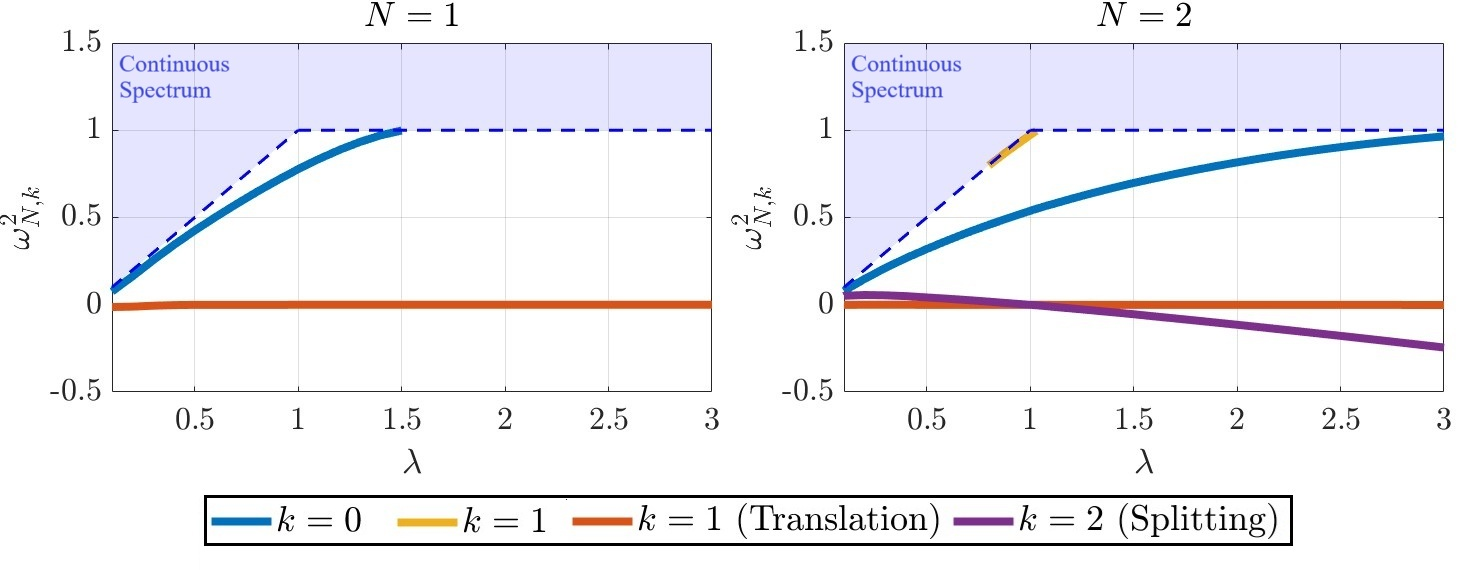
Figure 1: The frequency of the vortex normal modes as a function of λ∈[0.1,3] for N=1,2 and k≤N. The shaded region indicates the continuous spectrum.
Key observations include the existence of a single shape mode for N0 (N1), a richer mode structure at N2, and precise delineation of the spectral wall threshold. The impact of various N3-modes and their spatial structure is resolved, facilitating detailed assignment of dynamical effects to specific spectral channels.
Inter-vortex Interactions and Mode-induced Forces
The total interaction energy consists of two principal contributions: the static intervortex force and the dynamical modification from excited normal modes. The static interaction interpolates between the asymptotic analytical regime and numerically computed short-range formulas, accurately capturing the dependence on the scalar and magnetic field profiles. The mode-induced correction arises from the dependence of the mode frequency N4 on the vortex separation N5, and is computed by tracking instantaneous mode oscillations in dynamical simulations.
Static attraction dominates in type I (N6) and repulsion in type II (N7). Normal mode excitation can invert the sign of the net force, induce local extrema (stationary points) in the interaction energy, and generate new potential barriers correlated with the disappearance of bound modes at the spectral wall.
Spectral Walls, Scattering, and Quasi-Stationary States
An essential phenomenon uncovered is the presence of spectral walls—spacetime loci at which a discrete mode merges into the continuous spectrum. As vortices approach or recede, the mode frequency sweeps through the spectrum and, upon hitting the continuum, nonadiabatic energy transfer and strong dynamical signatures emerge.
For type I vortices, out-of-phase shape mode excitation generates repulsive forces able to halt or reflect attractive dynamics, leading to pronounced bounce dynamics at the spectral wall and to the formation of quasi-bound states at finite separation.
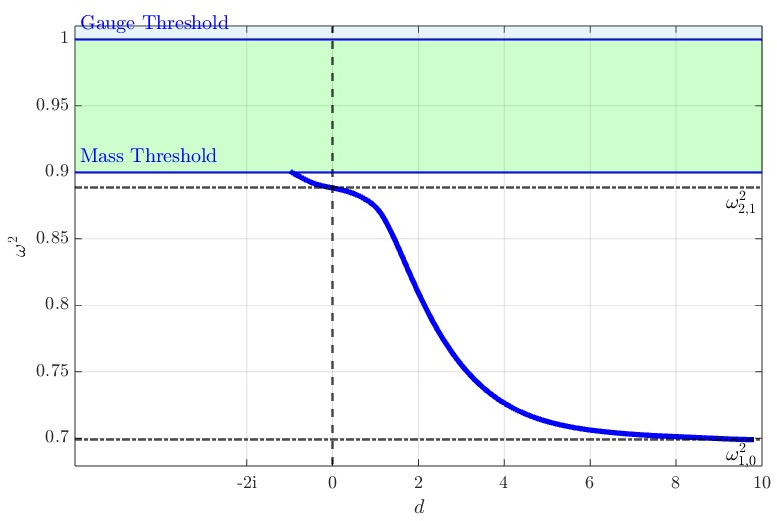
Figure 2: Angular frequency flow for a two-vortex system (N8) as a function of vortex separation N9. The green region marks the gauge threshold; the blue region, the mass threshold. The dashed red curve is a N=10 approximation.
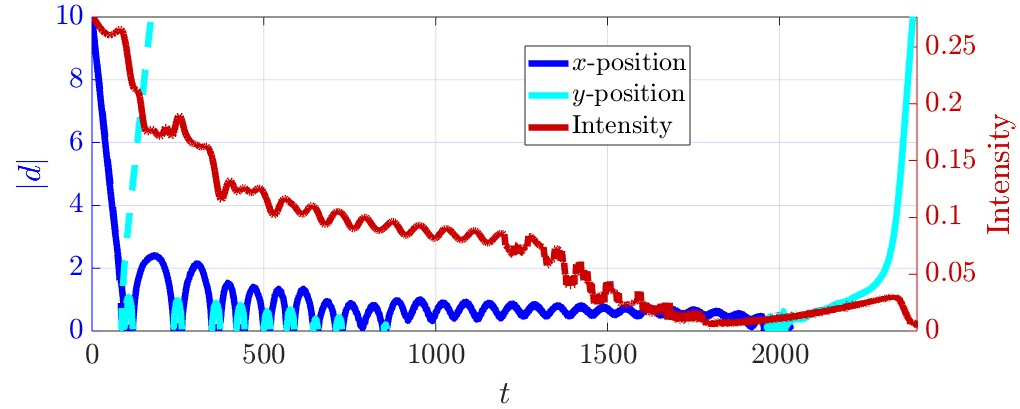
Figure 3: Trajectories of a two-vortex system (N=11, N=12, N=13) showing N=14 and N=15 positions over time and excitation intensity decay; dashed lines show unexcited comparisons.
For type II vortices, in-phase excitation renders the interaction attractive, generating long-lived orbits and multi-bounce dynamics. Interaction energies display local minima where the mode-induced attraction balances static repulsion, enabling dynamically stable quasi-bound states.
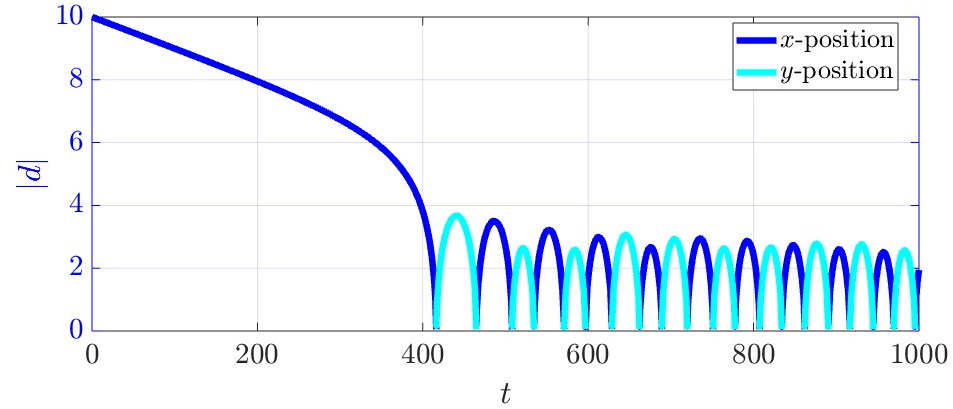
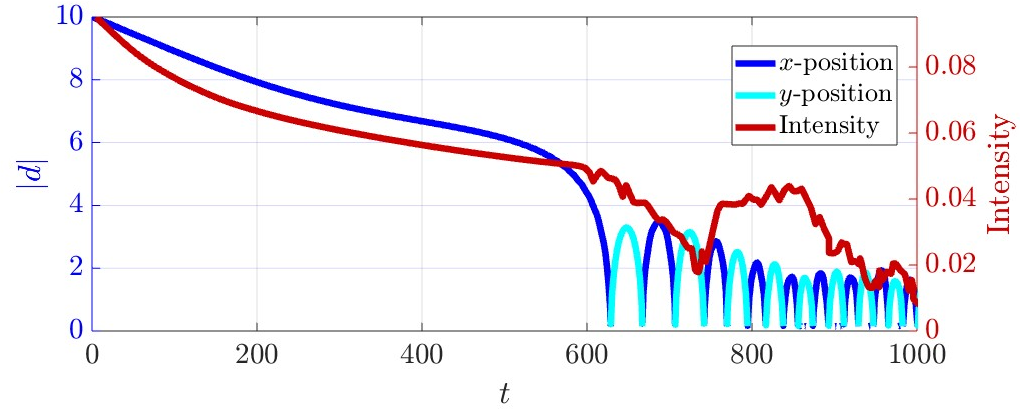
Figure 4: Trajectories of a two-vortex system (N=16, N=17, N=18) showing trapping and oscillations around a metastable point.
The formation of spectral walls is robust, controlling whether energy can be reversibly exchanged between shape oscillations and kinetic motion or is radiated away. Fine-tuning initial excitation phase and intensity critically influences whether vortices coalesce, backscatter, or form multi-bounce windows. The study also connects these phenomena with the resonance- and shape-mode-driven structures analyzed in other BPS soliton systems (Alonso-Izquierdo et al., 30 Jun 2026).
Orbital Dynamics and Competition of Forces
For circular orbits, the balance of attractive/repulsive forces (static, mode-induced, centrifugal) determines orbit stability and longevity. In type I, orbits are stabilized by static attraction and repulsive centrifugal barriers. In type II, mode-induced attraction can stabilize orbits near local interaction energy minima, but only as long as oscillation intensity persists before radiative decay disrupts balance.
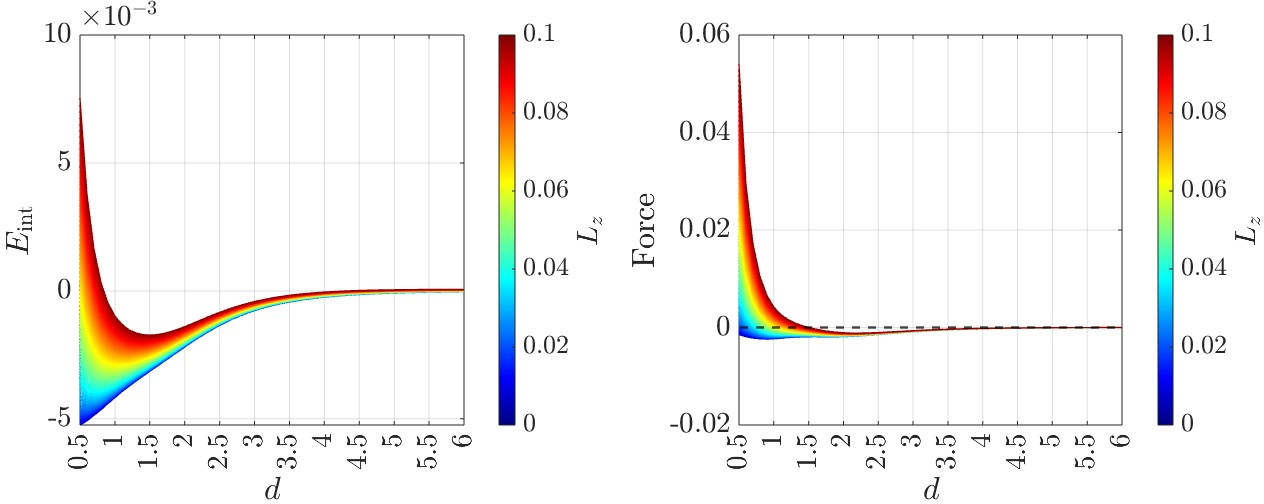
Figure 5: Interaction energy (left) and total force (right) for a two-vortex system (N=19) with initial excitation intensity k=00 and angular momentum k=01 as a function of orbit radius k=02.
Vortex–antivortex pairs are investigated under initial angular momentum; unless finely tuned, static attraction leads to annihilation, but with sufficient tangential velocity long-lived orbits can be constructed. This establishes connection with recent work on resonance phenomena and annihilation patterns in the deep type II regime.
Implications and Prospective Directions
This work establishes several key results:
- Spectral wall phenomena occur generically in type I/II vortex systems, not only at critical coupling, and fundamentally alter the scattering and interaction landscapes.
- Excitation of internal normal modes enables qualitative changes in inter-vortex forces, realizing repulsion for type I and attraction for type II vortices, as well as generating meta-stable orbits and long-lived quasi-bound states.
- Orbital stability is dictated by a nontrivial competition between static, mode-induced, and centrifugal contributions, with excitation decay ultimately governing orbital lifetimes.
- The resonance window and fractal structure familiar from 1D kink–antikink systems extends to 2D topological solitons, enriching the taxonomy of non-integrable field theory phenomena.
These insights have broad implications for topological soliton dynamics in condensed matter (superconductors, nematic phases), cosmology (cosmic string networks, gravitational wave backgrounds, see also [bachmaier2025simulations], [Hind1]), and for the theoretical understanding of mode-soliton interactions and adiabatic approximations in non-integrable settings.
Future developments suggested include: examining the impact of impurities (as trapping centers or resonance disruptors), extension to Chern–Simons and nonrelativistic models (where the structure of mode excitation and spectral walls may be further enriched), investigation of vortex lattices and collective modes, and the inclusion of nontrivial backgrounds (as in oscillating axion fields [kitajima2025abelian]). Generalization to higher-dimensional BPS objects (e.g., monopole networks) and coupling to gravitational or electromagnetic radiation fields presents another promising avenue.
Conclusion
The rigorous joint numerical–analytical methodology reveals that Abelian Higgs vortices with excited normal modes exhibit a rich dynamical phase structure governed by competition between static and mode-induced forces, transitions at spectral walls, and centrifugal effects in orbital motion. These findings systematically chart the modifications to vortex dynamics away from critical coupling and identify generic mechanisms—spectral wall trapping, quasi-bound states, and orbit stabilization—by which internal degrees of freedom and spectral evolution govern the non-equilibrium behavior of topological solitons. The framework developed provides a launchpad for further theoretical and phenomenological investigations of soliton dynamics across condensed matter, cosmology, and field-theoretical applications.
Reference:
"Type I/II Vortex Dynamics With Excited Normal Modes" (2607.15187)