- The paper introduces SINDy, a sparse regression methodology that recovers interpretable governing equations from modest, real-world engineering datasets.
- It details variants like weak forms, constrained regression, and SINDyc to mitigate noise, leverage prior knowledge, and incorporate control inputs.
- Case studies on UAV systems and chaotic thermosyphon flows validate SINDy's efficiency in achieving accurate, physically consistent dynamic models.
An Expert Summary of "An Introduction to Sparse Identification of Nonlinear Dynamics for Engineering Applications" (2607.15077)
Overview and Motivation
This work presents a comprehensive treatment of the Sparse Identification of Nonlinear Dynamics (SINDy) approach for discovering interpretable dynamical system models from data, targeting real-world engineering scenarios. The authors emphasize limitations of black-box surrogates like neural networks—most notably, their opacity and high data requirements—whereas SINDy aims to recover physically interpretable governing equations from modest, realistic datasets through sparse regression. The paper encompasses both a stepwise SINDy tutorial and advanced extensions that address measurement noise, partial prior knowledge, control inputs, high dimensionality, and uncertainty quantification. The methodology is contextualized via detailed case studies: a quadrotor unmanned aerial vehicle (UAV) (ODE identification), and a chaotic thermosyphon heat exchanger (PDE identification).
SINDy Methodology and Extensions
SINDy formulates the governing equations reconstruction as a sparse regression problem over a library of candidate nonlinearities. Let x(t) represent the state vector, with dynamics x˙=f(x). A matrix Θ(X) encodes the candidate basis functions evaluated over measurement data, and Ξ the corresponding sparse coefficient matrix. The essential step is to solve for Ξ such that X˙≈Θ(X)Ξ, enforcing sparsity to ensure parsimony and physical plausibility.
Several SINDy variants are discussed:
- Weak/Integral SINDy: Integration and Galerkin-based approaches to boost robustness to heavy noise and irregular sampling, bypassing unreliable direct differentiation [messenger_WSINDy-ODE_2021, messenger_WSINDy-PDE_2021].
- Constrained and Parametrizable SINDy: Enforces known coefficients or structure using constraint operators in the sparse regression, crucial for systems with partial physical prior knowledge [Loiseau2017jfm, champion_SR3_2020].
- SINDy with Controls (SINDyc): Augments candidate libraries with exogenous inputs, enabling identification in forced or actuated systems [brunton_SINDyc_2016].
- Dimensionality Reduction & Latent Dynamics: For high-dimensional systems, SINDy leverages POD/DMD or autoencoder mappings to learn equations in low-dimensional latent spaces [champion_Autoencoder-SINDy_2019, bakarji_Time-Delay-Autoencoder-SINDy_2023].
- Ensemble and Active Learning SINDy (E-SINDy): Ensemble averaging of sparse models provides uncertainty quantification and supports active data selection (lowering experimental cost) [fasel_eSINDy_2022, larranaga2026].
- Noise Management: SINDy workflows are coupled with smoothing, regularized derivatives (e.g., TV differentiation [chartrand_numerical_2011]), and library normalization to address ill-conditioning and data corruption.
Case Study I: UAV System Identification
The UAV testbed exemplifies SINDy's ability to integrate partial analytical models with data-driven discovery. Standard approaches either fit parameters to known models or rely on black-box neural surrogates. Instead, SINDy with custom candidate function libraries and constrained regression identifies missing forces/moments while embedding known kinematic and dynamic structure. The process proceeds by simulating a quadcopter under diverse control trajectories, extracting time-series from onboard sensors, and pre-conditioning the data (smoothing, normalization).
The candidate library spans both physical functions (from rigid body kinematics) and unknown dynamics (e.g., drag, rotor damping), while constraints are programmatically enforced to fix coefficients for terms with known physics and sparsify them for other states.
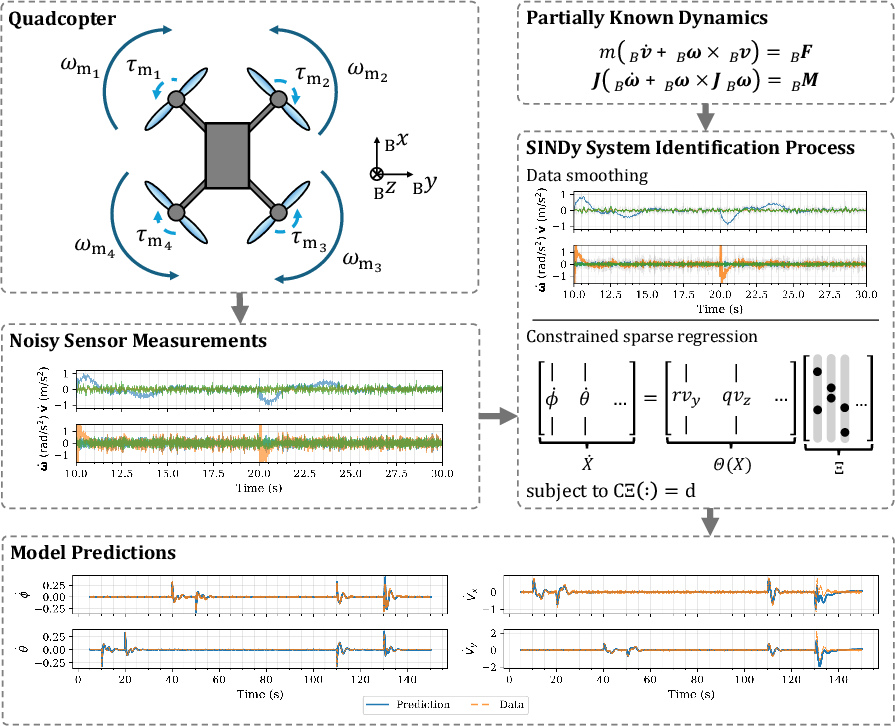
Figure 1: End-to-end UAV identification procedure, from flight data extraction through smoothing and constrained sparse regression, yielding interpretable governing equations and accurate trajectory predictions.
The constrained SINDy model achieves interpretability (matching the form of underlying physics), accurate prediction, and clear attribution of measured effects, outperforming generic surrogates on both explanatory power and reliability. Extensions of this approach facilitate on-the-fly adaptation (Osman et al. [osman_adaptive_2025]) and regression to higher-fidelity models for real-time control and fault detection.
Case Study II: Chaotic Thermosyphon Flow
SINDy is further validated in the context of PDE-governed systems representing a canonical engineering paradigm: the convective thermosyphon. The challenge lies in discovering interpretable PDEs from spatiotemporal fields, addressing requirements for low-dimensional reduction and complex operator libraries due to the equations' spatial dependence and polar coordinate structure.
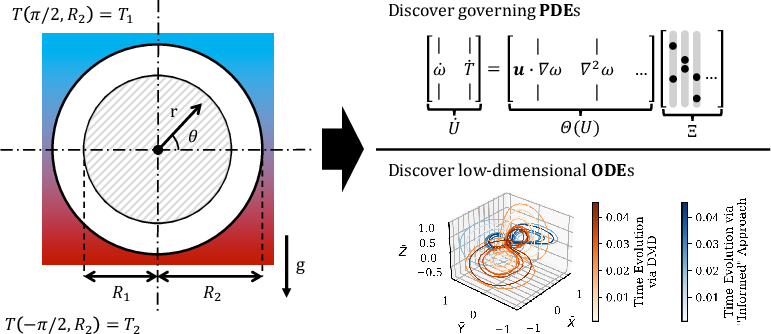
Figure 2: Thermosyphon geometry and multiple strategies for extracting low-dimensional latent dynamics, visualized both in state-space and attractor cross-sections.
Two identification routes are evaluated:
- Informed reduction: Extracting physically meaningful, low-dimensional observables (circulation, thermal centers of mass) via integrals, then identifying the reduced ODE system (analogous to the Lorenz attractor, as derived analytically by Huang et al. [huang_convective_2023]).
- Data-driven reduction via DMD/SINDy: Employing Dynamic Mode Decomposition for optimal latent-space projection before sparse identification, verifying that both "informed" and fully data-driven reductions capture the key bifurcations and chaotic transitions.
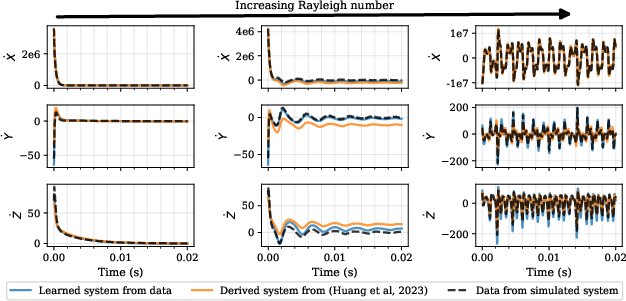
Figure 3: Comparison of state derivative predictions between SINDy-discovered and analytically-derived models across a range of Rayleigh numbers, highlighting strong agreement and correct parameterization of bifurcation behavior.
A direct PDE identification is also performed, constructing candidate libraries with higher-order operators (e.g., Laplacians) tailored to the governing vorticity-temperature formulation. This approach avoids collinearity pitfalls typical of monomial-based PDE libraries and successfully recovers functional forms even with limited/noisy measurements.
Implications and Future Directions
This paper demonstrates that SINDy, augmented by domain-aware extensions, delivers interpretable, compact, and extrapolatable models for complex engineering systems. The approach is markedly sample-efficient compared to deep surrogates and, crucially, facilitates mathematical and physical insight into discovered dynamics. The integration of weak forms, active learning, and uncertainty estimation directly addresses core reliability bottlenecks of data-driven modeling.
For real applications, such as flight control, design iteration, or thermal process regulation, these features are essential to enable safe, explainable, and certifiable deployment. On the theoretical side, ongoing research targets deeper integration with Bayesian priors [fung_Bayesian-SINDy_2025, hirsh_UQ-SINDy_2022], generalized latent coordinate discovery, physical constraint enforcement, and tackling stochasticity (see Boninsegna et al. [boninsegna2018sparse]). Efforts are also focusing on enabling discovery under more severe data and noise restrictions, with ultra-low-data learning and active experimental design likely to become standard practice in scientific ML.
Conclusion
This work provides an advanced, practical synthesis of SINDy theory and its variants, equipping researchers with modular, extensible methods that address key barriers to robust, interpretable model discovery in real engineering contexts. The well-documented case studies clarify trade-offs, best practices, and limitations encountered in UAV and PDE-based application domains. The open-source implementation further accelerates adoption and experimentation. SINDy thus stands out as a leading paradigm for the principled scientific inference of nonlinear dynamical systems from data.

