Qubes OS Security in the Public Record
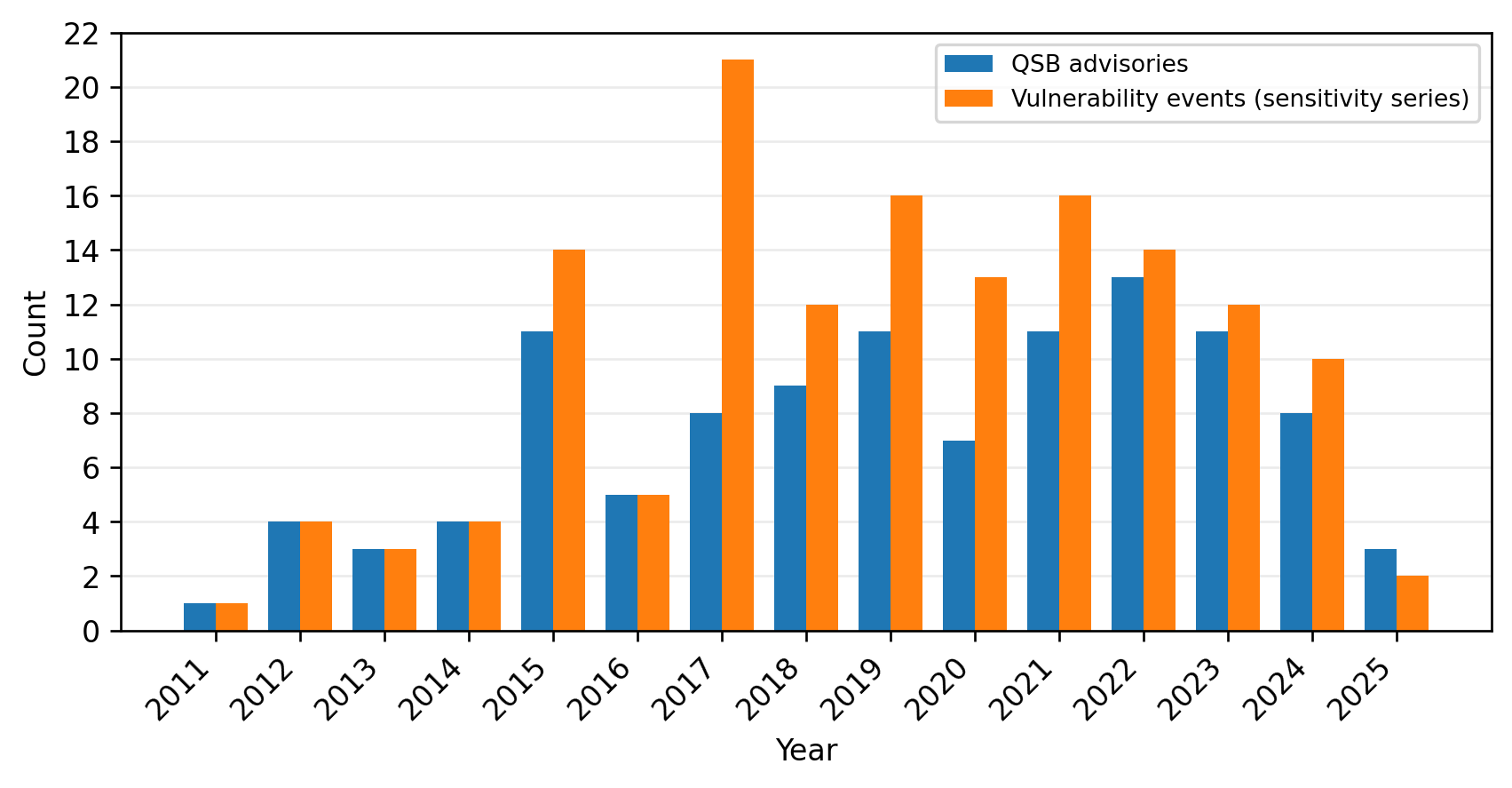
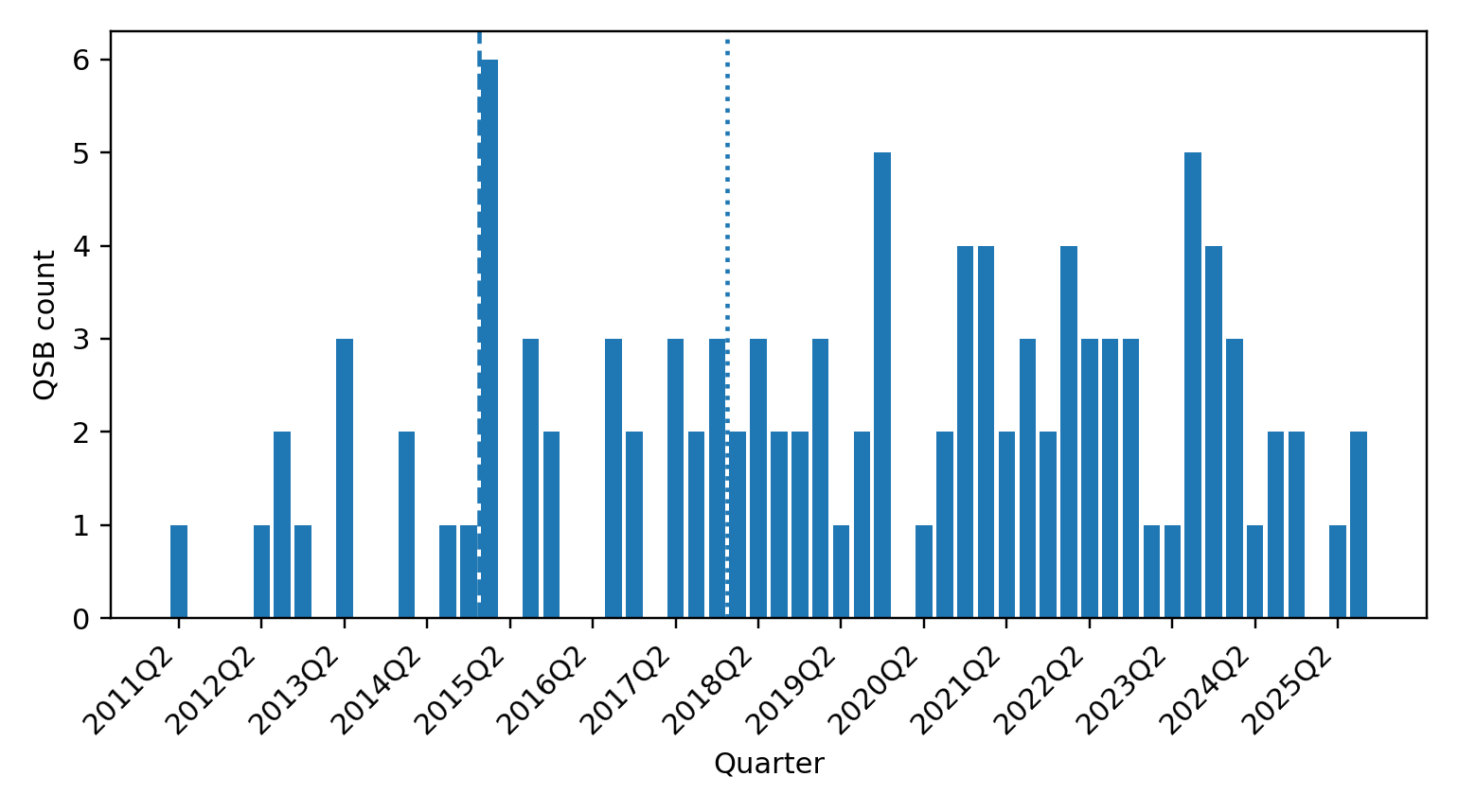
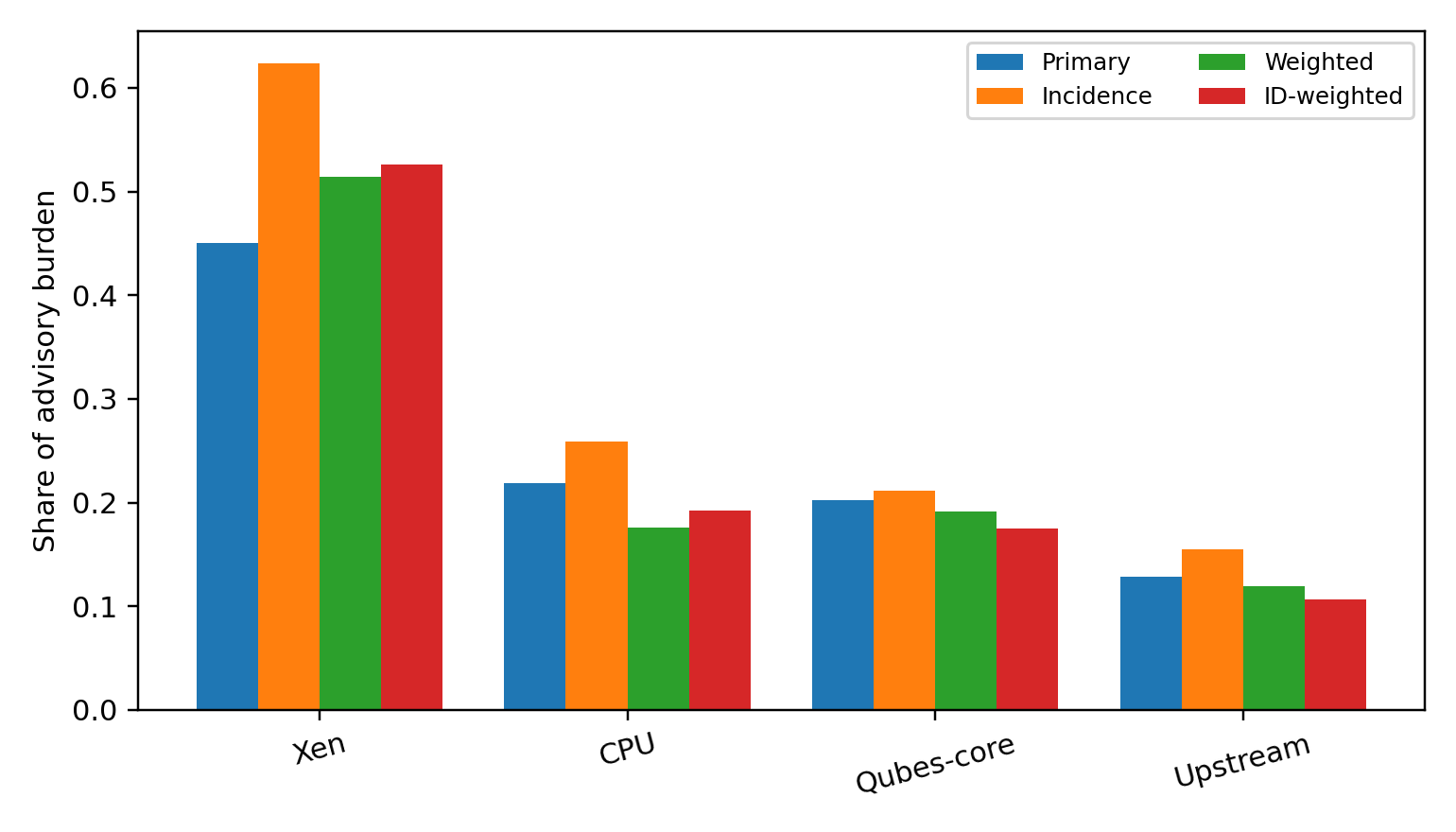
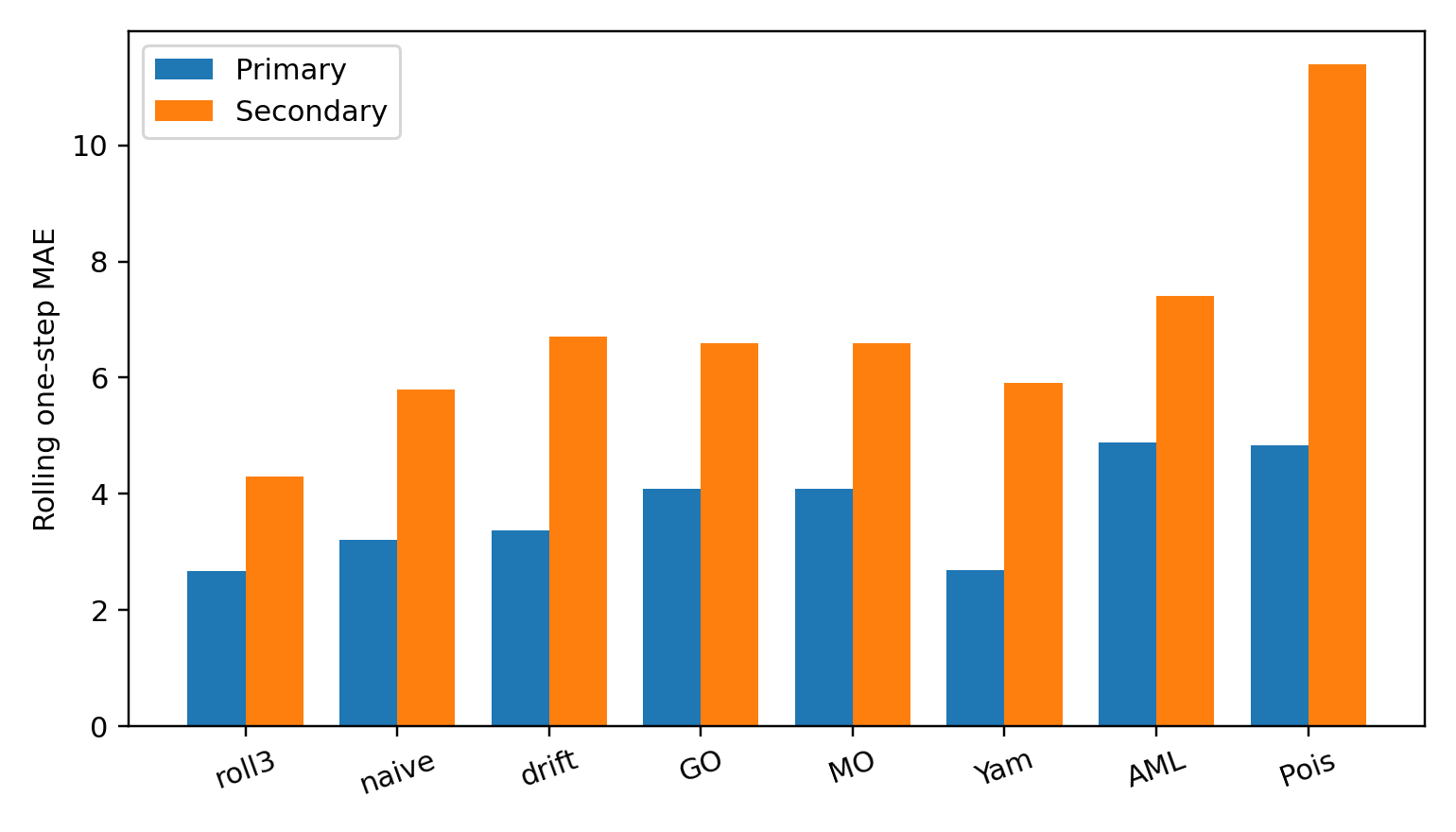
Abstract: Qubes OS is a revealing case for security measurement because its architecture makes component boundaries security-relevant. We present a protocol-driven longitudinal analysis of 109 public Qubes Security Bulletins (QSBs, 2011--2025), the official Qubes-maintained Xen Security Advisory (XSA) tracker, and a secondary vulnerability-event sensitivity series. The study measures the public advisory record rather than latent vulnerability incidence or realized compromise. The methodology combines audited deterministic component attribution, change-point analysis, overdispersion checks, severity-proxy weighting, censoring sensitivity, documentary latency lower bounds, and baseline-aware evaluation of vulnerability discovery models (VDMs). The results show persistent upstream dependence in that public record. On the official tracker, 113 of 464 XSAs affect Qubes; under primary labeling, 87 of 109 QSBs (79.8\%) are attributable to Xen, CPU/microarchitectural, or other upstream components rather than Qubes-core logic, with similar results under weighted views. Change-point analyses identify 2015Q1 as the dominant break in the quarterly advisory series, while post-2018 annual disclosure rates are statistically flat. Poisson inferences are stable under dispersion diagnostics and negative-binomial sensitivity checks. The attribution codebook performs well in a stratified 30-QSB audit, and S-shaped VDMs fit descriptively but do not significantly outperform a rolling-mean baseline in short-horizon forecasts. Overall, the Qubes public advisory record appears stable, but not quiet: disclosure activity plateaus at a higher level than in the earliest years, while the observed burden remains concentrated in upstream trust anchors.
Paper Prompts
Sign up for free to create and run prompts on this paper using GPT-5.
Top Community Prompts
Explain it Like I'm 14
What this paper is about
This paper looks at the “public trail” of security warnings for Qubes OS, a security-focused operating system that splits your computer into many separate “boxes” (called qubes) so problems in one box don’t easily spread to others. Instead of trying to guess how many hidden bugs exist or how many attacks really happened, the author studies what is publicly recorded: official Qubes Security Bulletins (QSBs) and related Xen Security Advisories (XSAs). The big idea is to see where most problems come from and how the pattern of warnings has changed over time.
The main questions in simple terms
The study asks:
- Where do most Qubes OS security warnings come from: Qubes’ own code or the big building blocks it relies on (like the Xen hypervisor and CPU hardware)?
- Did the amount of public security warnings change at certain points in time?
- Are there good ways to predict future warning counts, or do simple averages work just as well?
How the study was done (in everyday language)
Think of Qubes OS like a building made of many rooms (the qubes). Qubes’ own code decides who can enter which room, but the building stands on a foundation and frame (Xen and the CPU). If a crack appears, is it in the frame (upstream) or in the room’s furniture (Qubes’ own logic)?
To answer this, the author:
- Collected the public record: 109 Qubes Security Bulletins (QSBs) from 2011–2025, plus Xen advisories and a Qubes-maintained list that says which Xen issues actually affect Qubes.
- Labeled each bulletin by what part it mainly involves:
- Xen/hypervisor
- CPU/microarchitecture (hardware/processor issues)
- Qubes-core (Qubes’ own control tools like qrexec and the GUI paths)
- Upstream integration (other outside components Qubes uses)
- Double-checked the labeling rules on a sample by reading the full bulletin texts to make sure the title-based labels were accurate.
- Looked for “step changes” over time: like noticing a clear jump in the rate of warnings in a certain quarter or year.
- Checked if the warning counts behaved like ordinary “random counts” (similar to how you might expect a certain number of events per time period) and whether fancy count models were necessary.
- Tried two quick “importance” tricks:
- Gave a bit more weight to bulletins that listed many specific issues (more IDs mentioned in the title).
- Tagged bulletins about modern CPU “speculative execution” problems (like Spectre-like issues) to see how much these shaped recent years.
- Measured how fast updates appear: reading recent bulletins and Qubes’ policy to see if security fixes are available at the time of the bulletin and how long before they move from “testing” to “stable” for everyone.
- Tested forecasting: compared classic “S-shaped” prediction curves (that often fit software bug discovery) against simple baselines like “the average of the last few years” to see which predicts next year’s count better.
What the study found and why it matters
Here are the key results:
- Most issues come from “upstream,” not Qubes’ own core code:
- About 4 out of 5 QSBs were mainly about Xen, CPU/hardware behavior, or other outside components. Qubes’ own core logic was a minority of the warnings.
- This matches Qubes’ design goal: keep its own trusted core small and rely heavily on a few powerful components (like Xen and the CPU). The flip side is that if those upstream parts have issues, Qubes will feel it.
- There was a clear shift around early 2015, and things have been steady (not silent) after 2018:
- The number of bulletins rose from the very early years and jumped around the first quarter of 2015.
- Since 2018, the yearly level has been pretty stable: not racing upward, not dropping to near-zero.
- Recent years include many CPU “speculative execution” issues:
- From 2018 onward, a noticeable chunk of bulletins focuses on modern CPU weaknesses (like Spectre-like families). This means the steady level of activity is partly driven by hardware research waves, not just Qubes changes.
- The counting methods look sound:
- The data behaved well under standard “count” assumptions; extra-complicated models weren’t needed to explain the basic trends.
- The labeling rules were accurate in the audit, especially for clearly labeled cases.
- Fancy prediction curves didn’t beat a simple average:
- “S-shaped” models described the overall shape of the history well, but when asked to predict next year, they didn’t outperform a straightforward rolling three-year average.
Why this matters:
- Qubes’ strategy—keep the trusted core small—seems to show up in the public record. Most visible problems arise from the hypervisor, CPU, or other upstream parts, not Qubes’ own control code.
- Security teams using Qubes should pay close attention to Xen advisories and CPU microcode updates, because that’s where much of the action is.
- When planning for the future, simple “what happened recently” baselines are about as good as fancier models for one-year-ahead expectations.
What this could mean going forward
- For users and admins:
- Keep an eye on QSBs and especially on Qubes’ Xen advisory tracker. Many important fixes will come from Xen or CPU vendors.
- Understand the update flow: bulletins say fixes appear immediately in the security-testing channel, and usually move to stable about two weeks later. That window is a practical exposure period.
- For researchers and tool builders:
- When measuring security over time, be clear about what’s being measured. This paper measures public bulletins (what we can see), not hidden bugs or real-world attacks (which we can’t fully see).
- Don’t rely only on curve-fitting to claim progress or predict the future. Always compare to simple baselines and test if the fancy model really helps.
In short: Qubes OS’ public security warnings mostly come from the powerful pieces it depends on (Xen and CPU hardware). After a jump around 2015, the number of warnings has been steady since 2018, with many recent ones tied to modern CPU issues. The project’s update process is timely (testing right away, stable in about two weeks), and simple forecasting beats or ties fancy prediction models for short-term planning.
Knowledge Gaps
Unresolved knowledge gaps, limitations, and open questions
The following list consolidates concrete gaps and open questions left unresolved by the paper, prioritized to guide future research and data collection:
- Latent risk vs. public record: The study measures only published QSBs and the XSA tracker, not latent vulnerability incidence, exploitation in the wild, or operational compromise. Future work should link advisories to exploitation datasets (e.g., CISA KEV, Exploit DB, MISP), incident reports, and telemetry to severity-weight counts by real-world threat.
- Event-level severity enrichment: CVSS/EPSS weights are absent due to inconsistent bulletin enrichment. Build a per-issue panel by extracting all CVEs/XSAs mentioned in each QSB, joining to NVD CVSS, EPSS, and Xen severity classifications to compute severity-weighted shares and trends.
- Advisory bundling and de-aggregation: Identifier count is a coarse proxy for multiplicity. Decompose each QSB into its constituent CVE/XSA events to avoid multiplicity bias, ensure de-duplication across bulletins, and enable event-level modeling.
- Full-corpus attribution validation: Attribution is title-driven with a small post hoc audit. Conduct independent dual-coder annotation of the entire corpus using full bulletin text and linked advisories, quantify inter-rater reliability, and publish adjudicated labels.
- Precedence rule sensitivity: The deterministic primary-label precedence (CPU > Xen > Qubes-core > upstream) may skew results in mixed cases. Re-estimate component shares under alternative precedence orders and probabilistic multi-label attribution to bound estimation error.
- Tracker-policy drift: The XSA tracker encodes a relevance policy (e.g., excluding host DoS). Audit historical changes to this policy and reclassify past XSAs under a consistent rule set to measure sensitivity of upstream shares to policy drift.
- Change-point causality: The 2015Q1 break is repeatedly recovered but its causes are not tested. Compile a timeline of QSB process changes, Xen release cadence changes, and disclosure policy shifts around 2014–2015 to distinguish process artifacts from security-state shifts.
- Post-2018 “stability” power: Short annual series limit power to detect subtle trends. Apply hierarchical Bayesian count models (e.g., Bayesian structural time series with spike-and-slab components and covariates) to test for weak trends and composition shifts.
- Forecasting alternatives and calibration: Only classical VDMs and simple baselines are evaluated at h=1. Assess state-space models, BSTS, ETS, integer-valued autoregressive (INGARCH) and Hawkes processes; evaluate multi-step horizons, coverage calibration, and probabilistic scoring (CRPS, log score).
- Upstream-to-QSB coordination lags: The paper does not quantify time from upstream disclosure (XSA, microcode) to QSB publication. Reconstruct end-to-end timelines (upstream release → QSB → security-testing → stable) to identify bottlenecks and predictors of long vs. short lags.
- Update/mitigation latency distribution: Only a documentary lower bound (≈0 days to security-testing; ≈2 weeks to stable) is provided. Build a historical latency panel using package build timestamps, repository metadata, mirror logs, and signed tag times to estimate full distributions and variance across categories.
- User update adoption lag: Repository availability does not equal user protection. Measure time-to-install for security-testing and stable channels (e.g., opt-in anonymous telemetry, user surveys, or mirrored download analytics) to quantify real exposure windows.
- Hardware heterogeneity and impact: Microarchitectural advisories are not stratified by CPU vendor/model. Tag events by affected microarchitectures and estimate the fraction of the user base impacted (e.g., via community hardware surveys) to weight hardware advisories by exposure.
- Comparative baseline: Results are not contextualized against other security-focused or mainstream OSes. Construct matched public-record datasets (e.g., for Fedora/Ubuntu advisories, other compartmentalized systems) to benchmark Qubes’ advisory rates and compositions.
- Exposure normalization: Counts are not normalized by owned attack surface. Compute advisories per KLOC for Qubes-core and per interface/API count for Xen-boundary interactions to assess whether Qubes-core’s low share persists after normalizing by exposure.
- Subsystem-level Qubes-core analysis: Qubes-core is treated as a single bucket. Break down advisories by qrexec, GUI/clipboard, policy/parser, and management paths to identify persistent hotspots and direct hardening effort.
- Failure-mode taxonomy: The study does not classify QSBs by defect type (memory corruption, logic, policy, configuration). Build a taxonomy to target mitigations (e.g., memory safety, input validation, policy hardening) and track shifts over time.
- Attack-surface evolution effects: Architectural shifts (PV→PVH/HVM, VM class simplification) are not linked quantitatively to advisory composition. Correlate code deltas, interface changes, and deprecations with component-specific advisory rates before/after Qubes 4.x.
- Coverage and false negatives: No estimate of issues that did not produce a QSB. Triangulate with CVE lists, commit messages, and mailing-list disclosures to assess whether some security fixes bypassed QSBs and whether coverage changed over time.
- Embargo handling and publication delay: Embargoed vulnerabilities and their timelines are not analyzed. Where permissible, quantify embargo durations and their relationship to the eventual QSB timeline to improve risk communication.
- Transient-execution risk in-context: Microarchitectural advisories’ residual risk is not quantified under Qubes’ default mitigations. Evaluate the effectiveness and performance costs of enabled mitigations in Qubes-specific workflows, and identify scenarios where users may opt out.
- Device backend and dom0 focus: Backend drivers (netback, usbback, storage backends) are not analyzed as separate contributors to risk. Produce per-backend time series and map mitigation coverage (e.g., driver isolation, device assignment policies).
- Upstream-integration granularity: “Upstream integration” is coarse. Split into Linux kernel (domU/dom0), packaging (RPM/dnf), Salt, templates, firmware, and supply chain to identify which upstreams dominate integration risk.
- Research-attention confounding: Composition shifts (e.g., transient execution) are attributed qualitatively to research waves. Model this explicitly by integrating bibliometric proxies (paper counts, CVE variant counts) as exogenous covariates for advisory composition.
- Regression/rollback analysis: Patch quality and regressions are not measured. Build a dataset of updates that led to rollbacks, follow-up QSBs, or hotfixes to quantify patch risk and improve testing strategy.
- Process-change documentation: QSB template/process changes over time may affect counts and granularity. Maintain and analyze a changelog of security process updates to control for measurement artifacts.
- Nowcasting and right-censoring: Partial-year endpoints are handled by exclusion only. Use nowcasting methods (e.g., delay-adjusted Poisson, reporting-delay modeling) to estimate in-year totals and uncertainty.
- Identifier-weight proxy validation: The paper’s identifier-weighting assumes more identifiers ≈ more burden. Validate this proxy against true per-QSB CVE counts and severity to quantify bias and, if needed, design a corrected weighting.
- Tracker exclusion of host DoS: Some excluded XSAs (host DoS) may still affect availability in Qubes threat models. Re-evaluate exclusion criteria in the Qubes context and produce sensitivity analyses that include selected DoS classes.
- Configuration heterogeneity: Risk varies by templates/kernels/customizations, but analysis assumes defaults. Stratify exposure and impact by common configurations (e.g., Debian vs. Fedora templates, HVM vs. PVH) to refine risk estimates.
- Secondary series transparency: The secondary vulnerability-event series is released only as annual aggregates. Publish the micro-level event mapping (with provenance) to enable independent replication and alternative enrichments.
- Multivariate attribution modeling: Mixed advisories are frequent but analyzed via deterministic assignment and simple weights. Use multivariate count models to estimate each component’s contribution jointly while accounting for co-occurrence.
- Concentration metrics for trust anchors: Risk concentration is described qualitatively. Compute concentration measures (Lorenz/Gini curves, Herfindahl-Hirschman Index) over time to quantify “trust-anchor compression” and assess diversification over strategy changes.
- Counterfactual architecture: The implications of relying on Xen are not compared to alternatives (e.g., KVM, microkernels). Develop counterfactual models and collect comparative advisory data to inform architectural choices.
Practical Applications
Immediate Applications
Below are concrete applications that can be deployed now by security teams, vendors, researchers, and power users, based directly on the study’s findings and protocol.
- Upstream-centric vulnerability monitoring and triage (software, finance, healthcare, energy)
- What to do: Prioritize Xen Security Advisories (XSAs) and CPU/microcode disclosures as first-class inputs to enterprise patch pipelines, given that ~80% of Qubes advisories map upstream.
- Tools/workflows: Subscribe to the Qubes XSA tracker; auto-ingest XSAs and CPU microcode announcements into ticketing/SIEM; create runbooks that escalate upstream issues above app-layer bugs.
- Assumptions/dependencies: Continued availability and accuracy of the XSA tracker and vendor microcode feeds; clarity on which XSAs are relevant to your deployment.
- Patch-capacity planning using rolling baselines, not VDMs (software, finance, public sector)
- What to do: Use simple rolling three-year means to forecast next-year advisory load and staff patch teams, since S-shaped VDMs did not outperform rolling baselines in short-horizon forecasts.
- Tools/workflows: Add a “rolling-mean” widget to vulnerability management dashboards; set quarterly service-level objectives based on plateaued but nonzero advisory rates post-2018.
- Assumptions/dependencies: Sufficient local historical advisory/patch volume to compute rolling baselines; stable disclosure practices.
- Fast-ring security-testing channel adoption (software, enterprise IT)
- What to do: Mirror Qubes’ documented practice of immediate publication to security-testing with ~2-week migration to stable; add a canary cohort to compress exposure windows.
- Tools/workflows: Two-ring update channels (security-testing and stable), staged rollouts, automated rollback; clear communication to stakeholders on the two-week window.
- Assumptions/dependencies: Ability to segment endpoints into rings; organizational tolerance for slightly higher risk in testing ring.
- Microarchitectural wave readiness (software, cloud, healthcare/medical IT, finance)
- What to do: Treat transient-execution/microcode waves as periodic events; pre-approve firmware/BIOS change windows; rehearse cross-team workflows (security, platform, procurement).
- Tools/workflows: Firmware governance calendars; automated inventory of CPU SKUs and microcode versions; “hardware risk” tags in CMDB.
- Assumptions/dependencies: Vendor microcode availability; reliable hardware inventory; cross-team coordination.
- Red-team and assurance focus on hypervisor and device backends (software, cloud, ICS/energy)
- What to do: Bias security testing toward Xen/hypervisor, scheduler/resource isolation, device backends (netback/USB), where QSB burden concentrates.
- Tools/workflows: Threat-model refresh; targeted fuzzing of hypervisor interfaces; scheduler/resource isolation abuse scenarios in purple-team exercises.
- Assumptions/dependencies: Access to realistic lab environments; relevant skills for low-level testing.
- Deterministic advisory attribution for portfolio projects (academia, software, security vendors)
- What to do: Reuse the paper’s auditable token-based codebook to auto-classify advisories by component for other OSes or products; track upstream vs. product-core burden over time.
- Tools/workflows: Lightweight NLP/token-matching pipeline; publish per-advisory labels; visualize category shares and trend shifts.
- Assumptions/dependencies: Advisory titles/texts that consistently reference components; periodic manual audits to catch mixed cases.
- Change-point monitoring for security operations (software, MSSPs)
- What to do: Add quarterly change-point detection on advisory counts to flag regime shifts (e.g., a new upstream class of issues or process changes).
- Tools/workflows: Bayesian one-break or BIC-based Poisson segmentation job running on advisory feeds; alerts to leadership when a new segment is detected.
- Assumptions/dependencies: Sufficient data points; relative stability of counting rules (avoid process-induced false breaks).
- Procurement and SBOM alignment to “trust-anchor compression” (policy, software supply chain)
- What to do: In contracts and SBOM practices, require vendors to identify hypervisor, CPU, and other trust anchors; demand response plans tied to those anchors’ advisories.
- Tools/workflows: RFP/RFQ templates that list upstream anchors; vendor security questionnaires referencing XSAs/microcode cadence; SBOM fields for “anchor class.”
- Assumptions/dependencies: Supplier transparency; internal capability to evaluate upstream advisory responsiveness.
- Sector-specific isolation desktops with upstream watch (healthcare, finance, public sector)
- What to do: For regulated desktops using compartmentalization (e.g., Qubes-style or VDI), institutionalize upstream-tracker watch and microcode patch SLAs as compliance controls.
- Tools/workflows: GRC control mapping: “hypervisor advisory SLA,” “microcode SLA”; dashboards showing conformance.
- Assumptions/dependencies: Regulator acceptance of upstream-focused controls; auditable evidence of timely updates.
- Vendor/bug-bounty budget allocation to upstreams (software, cloud)
- What to do: Earmark a percentage of security spend for upstream hypervisor/hardware research and coordinated disclosure support, reflecting observed burden concentration.
- Tools/workflows: Joint bug bounties with Xen/hypervisor projects; funding for upstream CI/CD hardening and fuzzing infrastructure.
- Assumptions/dependencies: Legal frameworks for funding upstream work; governance for shared incentives.
- Curriculum and lab modules on advisory-based measurement (academia, education)
- What to do: Use the replication bundle to teach advisory measurement, change-point analysis, overdispersion checks, and baseline-aware forecasting.
- Tools/workflows: Course notebooks; student projects replicating the protocol on another OSS project.
- Assumptions/dependencies: Access to the public artifact bundle; faculty comfort with statistical tooling.
- Cyber risk quantification tuned to Poisson adequacy (finance/insurance, cyber actuarial)
- What to do: Treat advisory counts as approximately Poisson for this class of series when dispersion diagnostics support it; avoid unnecessary NB complexity.
- Tools/workflows: Portfolio models with dispersion checks; sensitivity runs that bound α when near-zero.
- Assumptions/dependencies: Comparable process stability; careful mapping from “advisories” to insured loss proxies.
- End-user guidance for Qubes power users (daily life, privacy advocates)
- What to do: Subscribe to QSBs and the XSA tracker; be ready to apply security-testing updates promptly for CPU/Xen issues; schedule firmware updates after critical microcode releases.
- Tools/workflows: Update scripts; canary VMs for early testing; backup discipline before firmware changes.
- Assumptions/dependencies: User comfort with staged updates and firmware tooling.
Long-Term Applications
These opportunities require further research, standardization, scaling, or ecosystem coordination.
- Cross-ecosystem advisory ontology and classifiers (academia, software, standards)
- What: Generalize the deterministic codebook into a community advisory ontology with interoperable labels (hypervisor, CPU, kernel, app, integration).
- Potential tools/products: Open standard plus reference classifier libraries; integrations for CNA/CVE publication pipelines.
- Dependencies: Broad vendor buy-in; governance for evolving labels; multi-language advisory support.
- Real-time advisory regime observatory (software, public sector, critical infrastructure)
- What: A public “security observatory” that tracks change-points, upstream burden, and composition shifts across major platforms to inform capacity planning.
- Potential tools/products: Web dashboards; API feeds with regime alerts; sector-tailored briefs (healthcare, energy).
- Dependencies: Stable data feeds; funding for curation; safeguards against misinterpretation of disclosure noise.
- Upstream-anchored compliance frameworks (policy, regulators)
- What: Codify controls that explicitly reference upstream trackers (XSAs, microcode) and defined patch cadences in regulations/guidelines for critical sectors.
- Potential tools/products: Control catalogs and audit procedures; mappings to NIST, ISO, CIS.
- Dependencies: Regulator consultation; evidence that upstream-cadence controls reduce risk without undue operational burden.
- Advisory-aware change management copilots (software, ITSM vendors)
- What: AI assistants that parse advisories, auto-attribute components, flag likely blast radius, and recommend ring deployment plans with rollback contingencies.
- Potential tools/products: ITSM plugins leveraging the paper’s protocol; integration with CMDB and patch tools.
- Dependencies: High-quality advisory parsing; accurate asset inventories; human-in-the-loop oversight.
- Microarchitectural risk dashboards with SKU targeting (hardware vendors, enterprises)
- What: Map transient-execution families to vulnerable CPU SKUs and deployment footprints; auto-generate patch/mitigation plans and performance impact forecasts.
- Potential tools/products: Vendor-supported dashboards; enterprise CPU-fleet mappers; mitigation simulators.
- Dependencies: Fine-grained SKU metadata; transparent microcode change logs; performance telemetry.
- Forecast-governance standards for security programs (policy, software)
- What: Require comparative forecast evaluation (e.g., Diebold–Mariano tests) before accepting VDM-based capacity or budget claims in governance processes.
- Potential tools/products: Playbooks and audit templates; benchmark datasets for yearly re-validation.
- Dependencies: Organizational analytics maturity; availability of historical data across teams.
- Isolation-architecture procurement blueprints (policy, industry consortia)
- What: Templates for acquiring compartmentalized desktops/VDI that explicitly price the operational cost of upstream maintenance and microcode wave response.
- Potential tools/products: TCO calculators including “trust-anchor maintenance load”; contractual SLAs tied to upstream advisories.
- Dependencies: Supplier transparency; economic models validated in multiple sectors.
- Sector-tailored secure workstation platforms (healthcare, finance, defense)
- What: Hardened workstation offerings that operationalize the study’s guidance: upstream tracking baked-in, firmware governance, and ringed updates out-of-the-box.
- Potential tools/products: Managed Qubes-like distributions or VDI bundles; compliance reporting modules.
- Dependencies: Vendor support; certification pathways; customers’ willingness to adopt novel workflows.
- Scheduler/resource isolation test suites (academia, cloud, robotics)
- What: Standardized tests for scheduler and shared-resource leakage in hypervisors used by isolation-heavy systems (inspired by the paper’s emphasis on upstream anchors).
- Potential tools/products: Open benchmark suites; CI gates for hypervisor projects; ROS/robotics extensions.
- Dependencies: Community maintenance; representative workloads; reproducible testbeds.
- Granular repository-latency telemetry and SLOs (software, package ecosystems)
- What: Instrument end-to-end latency metrics (advisory → testing → stable) to publish empirical distributions and set SLOs per severity class.
- Potential tools/products: Repo timestamping standards; public latency dashboards; deviation alerts.
- Dependencies: Repository instrumentation across eras; agreement on severity bucketing.
- Funding mechanisms for upstream security anchors (policy, philanthropy, hyperscalers)
- What: Sustainable financing (e.g., security maintenance funds) for hypervisors and CPU microcode security, reflecting their disproportionate risk leverage.
- Potential tools/products: Matching funds, long-term grants, cross-industry consortiums.
- Dependencies: Governance to avoid capture; measurable outcomes; transparent reporting.
- Comparative studies across isolation systems (academia)
- What: Apply the protocol to Edera, ChromeOS, mobile hypervisors, and cloud microVM stacks to map upstream dependence patterns and regime changes.
- Potential tools/products: Public datasets; meta-analyses; best-practice guides for isolation system design.
- Dependencies: Access to clean advisory corpora; normalized relevance filters; reproducible pipelines.
Glossary
- AIC: Akaike Information Criterion, a model selection metric penalizing complexity; lower is better. "AIC 72.06"
- Alhazmi–Malaiya Logistic (AML): An S-shaped vulnerability discovery model capturing initial growth, acceleration, and saturation phases. "Alhazmi--Malaiya Logistic (AML)"
- Bayesian Information Criterion (BIC): A model selection criterion that balances fit and parsimony; used to choose change-point locations. "BIC-optimal one-break Poisson segmentation"
- Bayesian single change-point: A Bayesian method to detect a single structural break in a time series. "Bayesian single change-point inference"
- binary segmentation: A recursive change-point detection algorithm that splits the series into segments iteratively. "binary segmentation with a minimum segment length of four quarters"
- bootstrap (percentile): A resampling technique to estimate uncertainty (e.g., confidence intervals) without strong distributional assumptions. "bootstrap 95\% CI 73.5--87.8"
- branch prediction: A CPU microarchitectural feature that predicts control-flow to speed execution; may enable speculative attack vectors. "branch prediction"
- change-point analysis: Statistical techniques for identifying times at which the probabilistic behavior of a process changes. "change-point analysis"
- CVE: Common Vulnerabilities and Exposures, a standardized identifier for publicly known security issues. "number of explicit XSA/CVE mentions"
- CVSS: Common Vulnerability Scoring System, a standardized framework for rating vulnerability severity. "Bulletin-level CVSS enrichment is inconsistent"
- deviance/df: The ratio of model deviance to degrees of freedom, used to assess model fit and dispersion in count models. "deviance/df is 1.15"
- Diebold–Mariano test: A statistical test for comparing predictive accuracy between two forecasting methods. "Diebold--Mariano test for equal predictive accuracy"
- dom0: The privileged control domain in Xen responsible for managing other domains and hardware access. "pushed out of dom0."
- domU: An unprivileged guest domain in Xen running user VMs. "domU integration issue"
- exact enumeration: Computing posterior probabilities by exhaustively summing over all candidate configurations (e.g., break locations). "posterior mass is obtained by exact enumeration"
- Gamma prior: A prior distribution often used for Poisson rates in Bayesian models due to conjugacy. "Gamma(1,1) priors"
- Goel–Okumoto (GO): A classical software reliability growth model assuming an exponential error detection process. "Goel-Okumoto (GO)"
- grant table: A Xen mechanism allowing controlled sharing of memory pages between domains. "grant table"
- GUI virtualization subsystem: The component that virtualizes the graphical user interface to enforce isolation between VMs. "GUI virtualization subsystem"
- Harvey–Leybourne–Newbold correction: A small-sample adjustment to the Diebold–Mariano test statistic. "Harvey--Leybourne--Newbold small-sample correction"
- HVM: Hardware-assisted Virtual Machine mode in Xen that leverages CPU virtualization extensions. "PVH/HVM-oriented defaults"
- identifier-weighted: An attribution weighting scheme that scales an advisory by the count of explicit identifiers (e.g., XSA/CVE) it mentions. "Identifier-weighted: one advisory is weighted by the number of explicit XSA/CVE mentions"
- incidence attribution: A multi-label counting scheme where an advisory contributes to every category it touches. "Incidence: one advisory contributes one count to each category it touches."
- IOMMU: Input–Output Memory Management Unit, a hardware feature that remaps device DMA to enforce isolation. "IOMMU"
- Jaccard index: A similarity metric for sets, here used to evaluate multi-label attribution agreement. "samplewise Jaccard index"
- macro-F1: The unweighted mean F1-score across classes, emphasizing performance on minority classes. "macro-F1 0.969"
- Mann–Kendall test: A nonparametric test for detecting monotonic trends in a time series. "Mann--Kendall rank-based trend test"
- micro-F1: The F1-score computed globally over all instances, weighting classes by frequency. "micro-F1 is 0.988"
- microarchitectural: Pertaining to low-level CPU structures and behaviors (e.g., caches, predictors) that can leak information. "microarchitectural mechanisms"
- microcode: Low-level CPU firmware that can be updated to patch hardware-level issues. "Intel microcode updates."
- Musa–Okumoto (MO): A logarithmic Poisson execution-time software reliability model. "Musa-Okumoto (MO)"
- NB2 (negative binomial): A count model with mean–variance relationship Var(Y)=μ+αμ², accommodating overdispersion relative to Poisson. "NB2 mean-variance form"
- NHPP (non-homogeneous Poisson process): A Poisson process with a rate that varies over time; used in reliability/VDM modeling. "non-homogeneous Poisson process (NHPP)"
- non-linear least squares (NLS): A parameter estimation method minimizing squared errors for nonlinear models. "non-linear least-squares (NLS)"
- overdispersion: When observed variance in count data exceeds the mean, violating Poisson assumptions. "overdispersion checks"
- Pearson dispersion: A dispersion diagnostic comparing observed variance to the mean; near 1 suggests Poisson adequacy. "Pearson dispersion is 1.16"
- piecewise Poisson regression: A Poisson count model whose parameters can change at specified breakpoints. "piecewise annual Poisson regression"
- Poisson deviance: A likelihood-based measure of model fit for Poisson models. "Poisson deviance split search"
- Poisson trend: A forecasting baseline/model assuming Poisson-distributed counts with a trend component. "Poisson trend"
- posterior mass: The total probability assigned by a Bayesian model to parameter regions (e.g., break positions). "posterior mass is obtained by exact enumeration"
- profile-likelihood: A technique for constructing confidence intervals by maximizing the likelihood over nuisance parameters. "one-sided profile-likelihood upper bounds"
- PV (paravirtualization): A virtualization mode relying on guest cooperation for efficiency, common in older Xen setups. "legacy PV assumptions"
- PVH: A Xen mode combining aspects of PV and HVM to reduce attack surface and improve performance. "PVH/HVM-oriented defaults"
- qrexec: Qubes’ inter-VM RPC mechanism for securely invoking services across domains. "Qrexec: memory corruption in service request handling."
- qrexec-daemon: The privileged service that mediates qrexec communications and policies. "qrexec-daemon"
- Qubes Security Bulletin (QSB): A signed public advisory issued by the Qubes OS project. "Qubes Security Bulletins (QSBs)"
- rate ratio: The multiplicative change between two Poisson rates, used to quantify regime shifts. "The quarterly post-2015 rate ratio is 2.82"
- right-censoring: When observations at the end of a period are incomplete or truncated relative to earlier periods. "right-censored"
- rolling one-step-ahead forecast: A forecasting setup that predicts the next period using a model refit on a rolling window. "Rolling one-step-ahead annual forecasts"
- rolling three-year mean: A simple forecasting baseline using the average of the prior three years. "rolling three-year mean"
- scheduler attacks: Exploits that abuse shared scheduling mechanisms in a hypervisor to create security-relevant interference. "Scheduler attacks in Xen-style environments"
- Sen's median-slope estimator: A robust estimator of trend magnitude used with the Mann–Kendall test. "Sen's median-slope estimator"
- shadow paging: A virtualization technique where the hypervisor maintains shadow page tables for guest memory translation. "shadow paging"
- S-shaped VDMs: Vulnerability discovery models whose cumulative curves accelerate then decelerate, producing an S-shape. "S-shaped VDMs fit descriptively"
- transient execution: Speculative CPU behaviors that can be exploited to leak data (e.g., Spectre-class issues). "transient-execution"
- Trusted Computing Base (TCB): The set of hardware/software components whose correct operation is critical for security. "TCB"
- upstream dependence: Reliance on external components (e.g., hypervisor, CPU) for overall system security posture. "upstream dependence"
- upstream integration: Qubes’ category for advisories rooted in external components and their integration rather than core logic. "Upstream integration"
- vulnerability discovery models (VDMs): Statistical models describing how vulnerabilities are found over time. "vulnerability discovery models (VDMs)"
- Wilson confidence interval: A binomial proportion interval with better small-sample properties than the Wald interval. "Wilson confidence intervals"
- Xen hypervisor: The virtualization layer used by Qubes to isolate VMs into security domains. "Xen hypervisor"
- Xen Security Advisory (XSA): Official security advisories issued by the Xen Project. "Xen Security Advisories (XSAs)"
- XSA tracker: The Qubes-maintained mapping of which XSAs affect Qubes. "XSA tracker"
- Yamada model: An S-shaped reliability growth model often fitting error/vulnerability discovery patterns. "Yamada is the best descriptive model for the primary QSB series (AIC 72.06)"
Collections
Sign up for free to add this paper to one or more collections.

