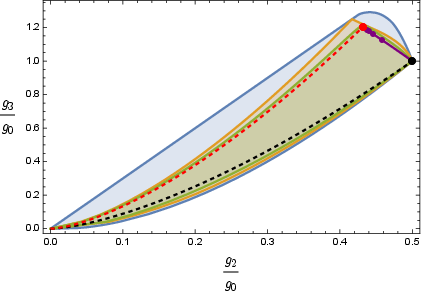
- The paper demonstrates that applying maximal supersymmetry and imposing peculiar parity on scalar amplitudes restricts gravitational EFTs and uniquely selects the Virasoro–Shapiro amplitude.
- It employs an on-shell superspace framework and nonlinear relations among Wilson coefficients to sharply narrow the allowed parameter space within the S-matrix bootstrap.
- The analysis shows that relaxing SU(8) to SU(4)×SU(4) introduces richer scalar dynamics, revealing critical insights into UV completions and finite spin spectra.
Gravitational Effective Theories with Maximal Supersymmetry and Peculiar Parity: A Technical Essay
Overview and Motivation
This paper investigates the space of four-dimensional ultraviolet (UV) completions for N=8 supergravity (SUGRA), focusing on weakly-coupled effective field theories (EFTs) with maximal supersymmetry and preserved SU(4)×SU(4) R-symmetry. The central question is to what extent physical principles—augmented by specific symmetry assumptions—constrain the allowed scattering amplitudes in gravitational EFTs and whether such principles uniquely select the closed string UV completion, represented by the Virasoro–Shapiro amplitude.
A particularly sharp constraint arises from imposing a "peculiar parity" condition on specific scalar amplitudes in the (6,6) sector of SU(4)×SU(4). This restricts parity-odd structures such as contractions with the Levi-Civita tensor, a property that is broken at loop level but can be imposed robustly at tree-level.
Theoretical Structure and Symmetry Analysis
The starting point is tree-level N=8 SUGRA in four dimensions, with higher-derivative deformations parameterized by Wilson coefficients. The theory admits a weak-coupling limit with no loop contributions from massless states, and amplitudes are built using on-shell superspace formalism.
The symmetry analysis distinguishes two cases:
- Unbroken SU(8) R-symmetry: Constraints from maximal SUSY and factorization, plus positivity, force all higher-derivative corrections to vanish, isolating the pure SUGRA theory.
- Relaxed to SU(4)×SU(4): Allows a dilaton and richer scalar structure. Peculiar parity, when imposed on 6-point scalar amplitudes, yields nonlinear constraints among the 4-point Wilson coefficients and dramatically reduces the space of allowed EFTs.
Nonlinear Constraints from Peculiar Parity
The construction centers on the low-energy expansion of the scalar amplitude: F(s,t,u)=stuκ2+g0+g2(s2+t2+u2)+g3stu+⋯
with gn coefficients corresponding to higher-derivative operators.
Imposing peculiar parity on scalar amplitudes in the (6,6) sector leads to nonlinear relations among Wilson coefficients, such as: κ2g3=21g02,κ2g5=g2g0,κ4g6′=38κ4g6+61g03,κ2g7=g4g0+21g22,…
These constraints are derived through factorization of higher-point amplitudes and must be satisfied by any UV completion compliant with the stated symmetry and parity assumptions.
Bootstrap, Positivity, and the Allowed Space
The above nonlinear constraints are incorporated into modern S-matrix bootstrap frameworks, which use dispersion relations and positivity bounds. Together with the crossing conditions, the problem is cast as a semi-definite optimization in the space of Wilson coefficients:
Higher-order constraints further tighten the region, and imposing the condition that only finitely many spin states are present near the mass gap isolates the Virasoro–Shapiro amplitude as the unique solution.
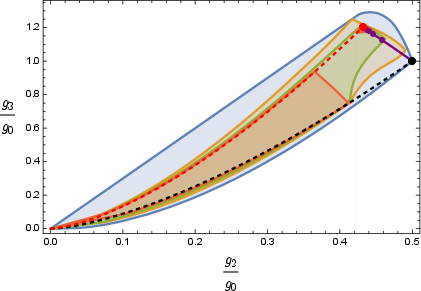
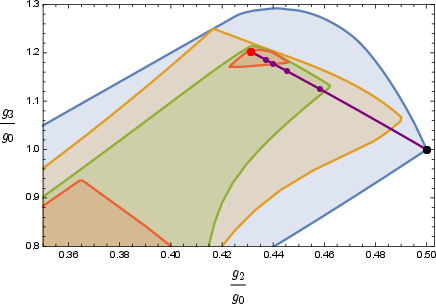
Figure 2: Full allowed region in the SU(4)×SU(4)1 plane, with a zoom near the diagonal connecting string and IST amplitudes. Colored regions illustrate the effect of additional nonlinear constraints and mass gap assumptions.
Exponentiation and Analytic Structure
The nonlinear constraints enable exponentiation of the low-energy amplitude: SU(4)×SU(4)2
The general solution consists of meromorphic amplitudes, represented as infinite products over masses, whose structure mirrors string amplitudes: SU(4)×SU(4)3
Positivity of the partial wave decomposition rigorously isolates the linear mass spectrum, characteristic of closed superstrings.
Numerical and Analytic Isolation of String Theory
The combination of maximal SUSY, tree-level factorization, SU(4)×SU(4)4 R-symmetry, and peculiar parity, together with positivity, isolates the Virasoro–Shapiro amplitude with a discrete Regge trajectory—uniqueness is established both numerically and analytically. Relaxing the assumption of the mass gap allows an infinite tower (IST) or generalized spin tower amplitudes, but these are excluded if only a finite spin content is allowed at the lowest mass threshold.
Practical and Theoretical Implications
The results strongly constrain gravitational EFTs under these symmetry and factorization conditions. The peculiar parity assumption, though broken at loop level, provides a symmetry-based explanation for the product form and meromorphy of string amplitudes. The emergence of constraints only at higher-point amplitudes and their invisibility in fixed-multiplicity operator bases highlights the importance of hidden structures in constraining UV completions.
Potential extensions include:
- Application to less symmetric theories or those with alternative R-symmetry groups.
- Study of peculiar parity analogs in the Standard Model and its effect on BSM scenarios.
- Exploration of analogous constraints in AdS/CFT correlators and multi-point bootstrap analyses.
Conclusion
The analysis demonstrates that imposing maximal supersymmetry, SU(4)×SU(4)5 R-symmetry, tree-level factorization, and a subtle parity constraint on scalar amplitudes tightly restrict gravitational EFTs. These principles, once positivity is invoked, select closed superstring theory (Virasoro–Shapiro amplitude) as the unique UV completion in this class, excluding infinite spin towers unless a mass gap is relaxed. This approach underscores the power of higher-point constraints and hidden symmetries in gravitational S-matrix bootstrap, and accentuates the role of parity and spectrum assumptions in determining UV consistent theories.