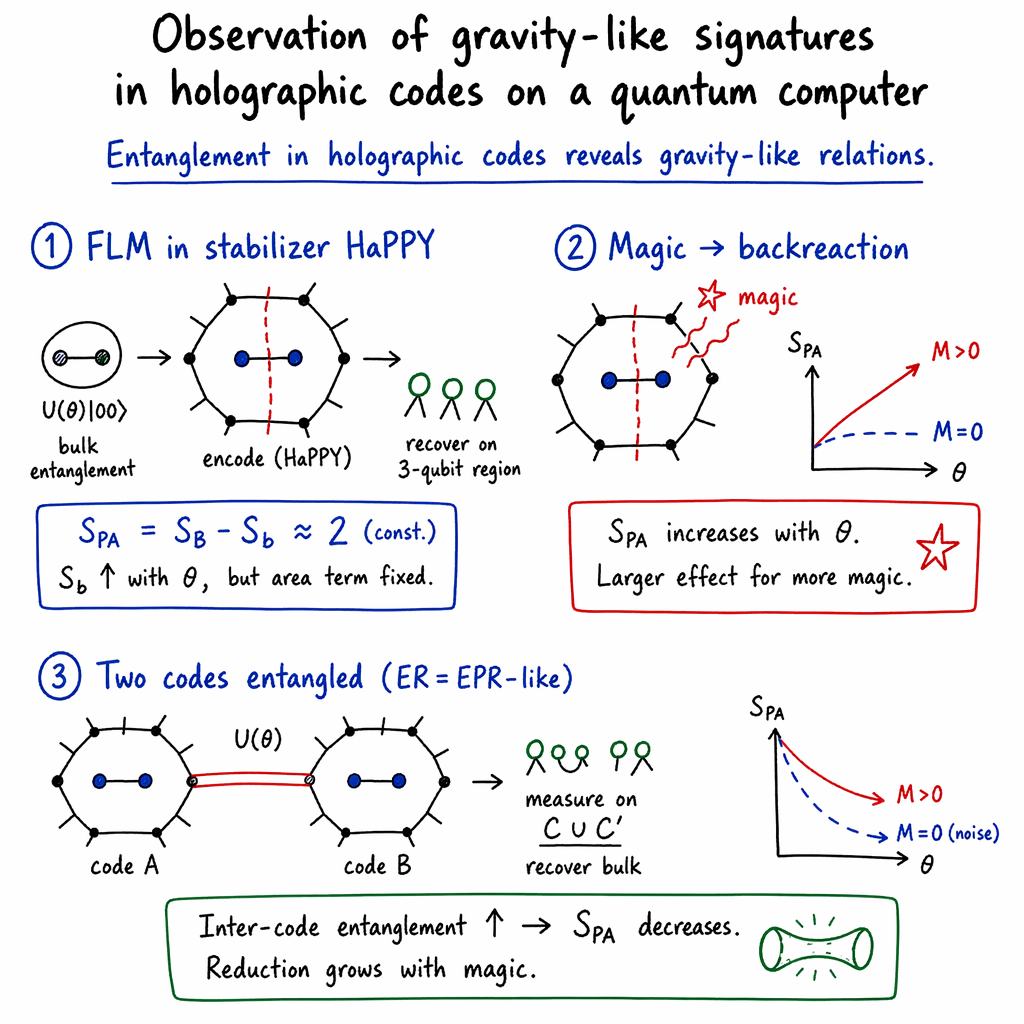
- The paper demonstrates experimental validation of the quantum-corrected RT/FLM formula using a trapped-ion quantum processor.
- The study implements magic-enriched HaPPY codes to observe state-dependent gravitational backreaction via modulated proto-area entropy.
- The work evidences entanglement-induced wormhole analogues by coupling dual codes, showcasing emergent spacetime connectivity consistent with holographic predictions.
Experimental Probing of Gravity-like Signatures in Holographic Codes
Introduction
The paper "Observation of gravity-like signatures in holographic codes on a quantum computer" (2607.12047) presents the first experimental investigation of quantum gravity analogues in tensor-network quantum error-correcting codes (QECCs) embedded on a quantum processor. The study targets key aspects of the AdS/CFT correspondence, focusing on the entanglement-geometry connection underlying holographic duality. The authors implement the HaPPY code—a paradigmatic holographic tensor-network QECC—on a trapped-ion quantum computer, experimentally validate the quantum-corrected Ryu–Takayanagi (RT)/Faulkner–Lewkowycz–Maldacena (FLM) formula, and demonstrate state-dependent geometric responses reminiscent of gravitational backreaction. They further report direct measurements of entropy signatures resembling proto-wormholes, consistent with holographic conjectures like ER=EPR.
The HaPPY code instantiated here encodes logical (bulk) data into a boundary via hyperbolic tessellation with perfect tensors, compiled as a quantum circuit leveraging the native all-to-all connectivity of trapped-ion hardware. A two-layer, 25-qubit HaPPY network is constructed to implement bulk-to-boundary mapping via concatenated seed codes: [[5,1,3]], [[4,2,2]], and [[3,3,1]] blocks (Figure 1).
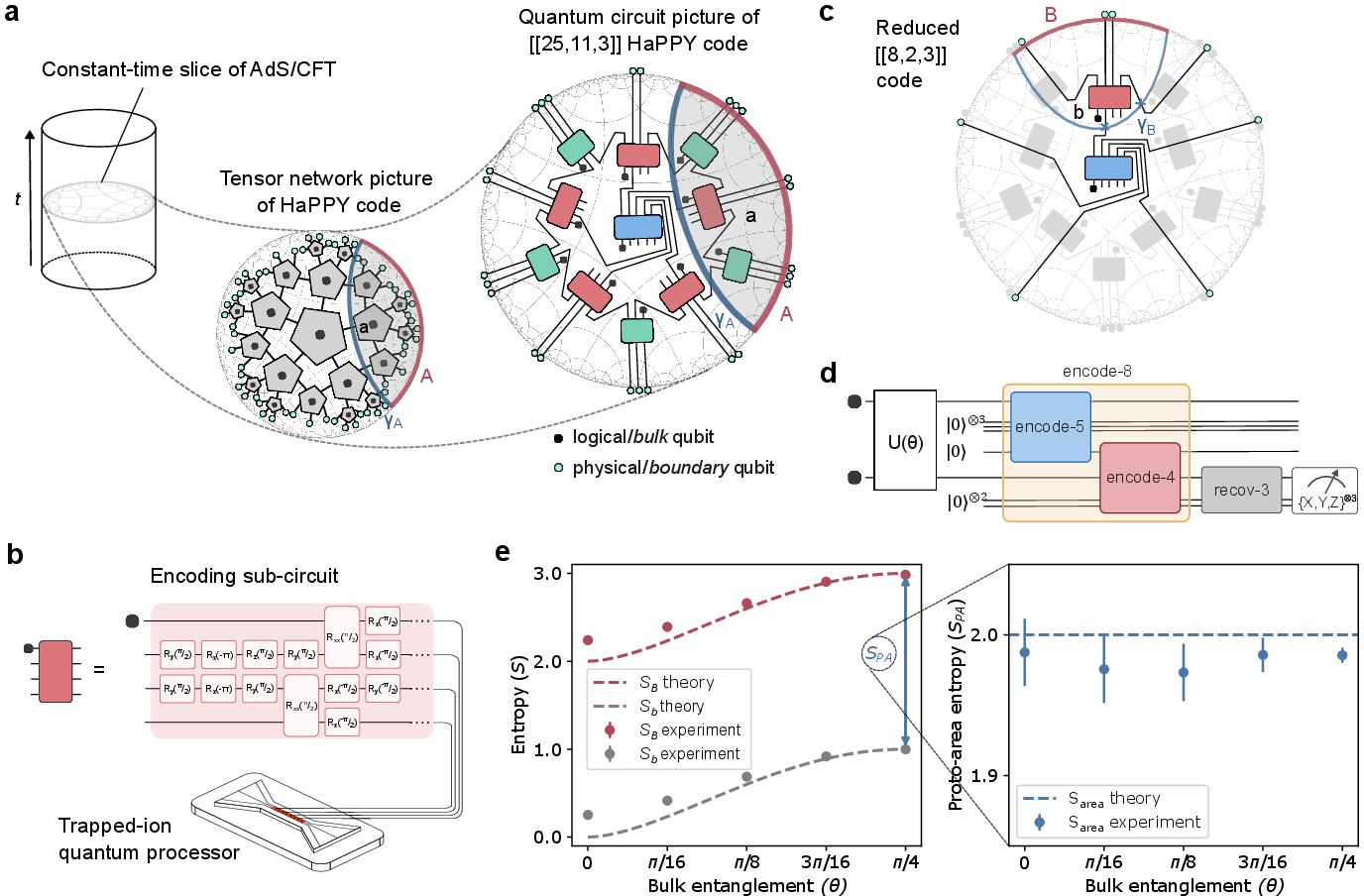
Figure 1: Experimental realization of a holographic quantum error correcting code, deployment of FLM testing, and circuit decomposition for quantum hardware.
To test the FLM quantum correction to the RT formula, the authors reconstruct the boundary reduced density matrix ρA and optimally recover the bulk state ρa for a connected boundary region using quantum state tomography. The proto-area entropy, SPA(A)=S(ρA)−S(ρa), measures the area-like contribution to boundary entropy as predicted by FLM. Experimental results align with the theoretical FLM prediction, confirming that SPA remains constant across varying bulk entanglement in the stabilizer code regime, thereby demonstrating exact realization of the quantum extremal surface prescription at finite system size.
Magic-Enriched Codes and State-Dependent Geometric Response
The HaPPY code, originally built from Clifford gates, produces rigid geometry insensitive to bulk state—a stark limitation for modeling gravity. To induce gravitational backreaction, coherent over-rotations ("magic") are injected into encoding gates, breaking the stabilizer structure (Figure 2). Magic is quantified via stabilizer Rényi entropy of the code’s Choi state.
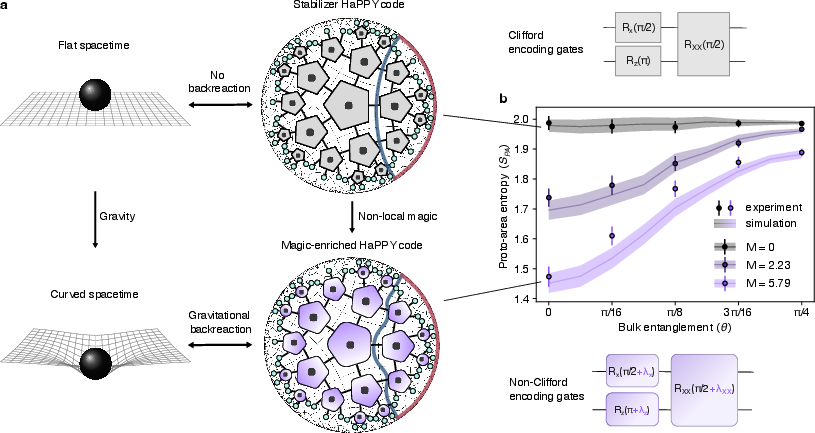
Figure 2: Gate-level schematic for Clifford and magic-enriched HaPPY codes and proto-area entropy response with magic injection.
In magic-enriched codes, bulk entanglement influences the proto-area entropy, which now increases with inter-bulk entanglement angle θ. The slope dSPA/dθ strengthens with higher injected magic, consistent with theoretical predictions that state-dependent area contributions are essential for gravity in holography. This experimentally demonstrates emergent behaviour analogous to the quantum extremal surface prescription, with non-stabilizer resources serving as a necessary ingredient for geometry backreaction.
Entanglement-Induced Connectivity and Wormhole Analogues
To directly probe the ER=EPR paradigm, the authors couple two HaPPY codes via entanglement between their logical (bulk) qubits, constructing a proto-wormhole circuit. Increasing inter-code entanglement decreases the effective wormhole length, reflected by a reduced proto-area entropy for the combined boundary region—a behaviour predicted by holographic wormhole geometry (Figure 3).
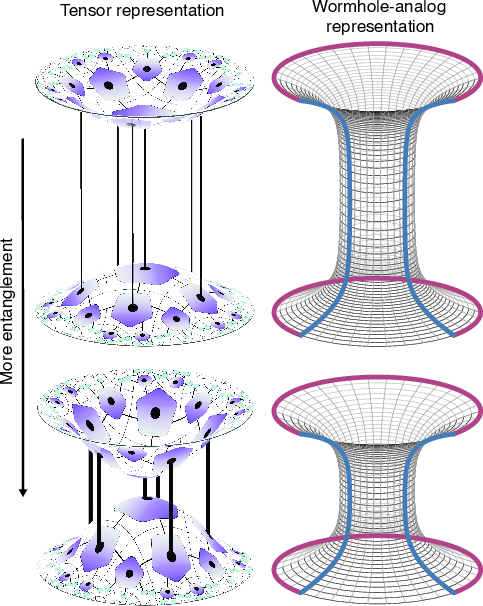
Figure 3: Schematic of entanglement-induced connectivity, proto-wormhole construction, and geometric shortening with inter-code entanglement.
Double-sided experiments encompassing 2×[[5,1,3]] and 2×[[8,2,3]] codes are implemented. Quantum state tomography and recovery procedures on the boundary and logical subspaces reveal that [[4,2,2]]0 decreases as the bulk entanglement angle [[4,2,2]]1 increases in magic-enriched setups (Figure 4).
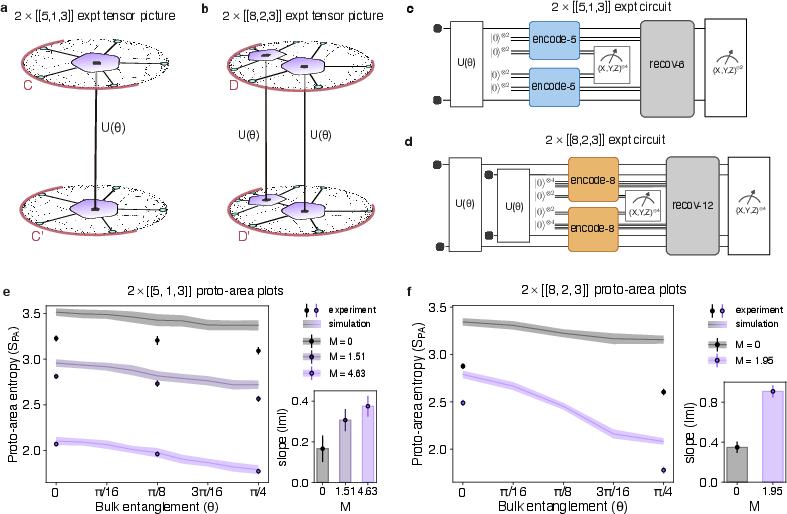
Figure 4: Experimental circuit diagrams and measured proto-area entropy for double-sided (wormhole) holographic codes.
The magnitude of proto-area entropy reduction correlates positively with the injected magic, suggesting a direct link between non-stabilizer resources and emergent spacetime connectivity. Numerical simulations with optimal and hardware-constrained recovery circuits confirm the robustness of this signal against noise, underscoring the gravitational precursor behaviour observed.
Hardware Realization, Tomographic Protocols, and Scalability
The circuit implementations leverage the trapped-ion quantum computer's all-to-all connectivity and high-fidelity gate set. Encoding circuits are compiled to native gates using custom transpilation, maximizing resource efficiency. Entropic observables are extracted via maximum-likelihood quantum state tomography, with reduced circuit descriptions exploiting tensor-network isometric structure to minimize qubit requirements without loss of entropic fidelity.
Scalability constraints are identified, notably in quantum state tomography and optimal recovery circuit depth. Proposed near-stabilizer or tensor-network-informed tomography schemes (e.g., bounded-extent tomography (Arunachalam et al., 5 Jun 2026)) and theoretical arguments regarding recovery suboptimality suppression in large-[[4,2,2]]2 systems suggest that future expansions to regimes of semiclassical geometry are feasible.
Theoretical and Practical Implications
This experimental work demonstrates that programmable quantum hardware can faithfully realize key signatures of emergent gravity in holographic error-correcting codes. The state-dependence of area-like contributions, the effect of non-stabilizer (magic) resources on geometry, and direct evidence of entanglement-induced connectivity echo core predictions of quantum gravity. The results motivate further research on scalable quantum architectures for modeling spacetime emergence, investigation of the role of magic in gravitational backreaction, and exploration of more complex holographic codes and dynamical probes.
Numerical and Experimental Robustness
Strong numerical and experimental agreement for FLM testing and magic-induced state dependence is reported across all setups, with error bars dominated by stochastic gate-angle noise. Coherent gate-angle offsets are identified as a subdominant noise source, with stochastic error modeling yielding conservative underestimates of the proto-area entropy signal.
Conclusion
This study provides the first direct experimental confirmation of quantum-corrected holographic entanglement-geometry relations in a tensor-network code, and establishes a technical protocol for observing gravitational precursors in quantum hardware. The interplay between quantum entanglement, non-stabilizer resources, and emergent geometry is quantitatively resolved. The demonstrated methodology serves as a blueprint for future quantum gravity simulations, with implications for scalable entropic and dynamical probing of emergent spacetime.