- The paper develops a Fokker-Planck framework that analytically derives stationary wealth distributions under taxation and redistribution.
- It demonstrates that redistribution protocols, including uniform and nonuniform schemes, effectively stabilize multiplicative wealth dynamics.
- Analytical and simulation results quantify the impact of tax rates on wealth inequality through changes in the Gini coefficient.
Fokker-Planck Analysis of Multiplicative Wealth Dynamics with Taxation and Redistribution
The paper "A Fokker-Planck approach to a stochastic multiplicative wealth model with taxation and redistribution" (2607.11755) rigorously investigates the interplay between multiplicative wealth dynamics, taxation, and redistribution using both analytical tools and agent-based simulations. Motivated by the minimal agent-based model of P.M.C. de Oliveira, the authors develop a Fokker-Planck formalism to analyze the stationary states induced by various redistribution protocols. By generalizing the redistribution rule to encompass nonuniform state-dependent mechanisms—including stylized representations of conditional cash transfer (CCT) programs—the framework systematically characterizes the resulting stationary wealth distributions and quantifies inequality via the Gini coefficient.
The wealth evolution of each agent i in a population of N agents is governed by discrete time steps, where individual wealth undergoes multiplicative stochastic growth, followed by taxation and redistribution: Wi,t+1=[1−τi,t]fi,tWi,t+ri,tj=1∑Nτj,tfj,tWj,t
Here, fi,t is an idiosyncratic stochastic factor, τi,t the tax rate, and ri,t the agent-specific allocation of redistributed wealth. The tax rate in the critical case of uniform taxation (p=0) is set as τi,t=A, allowing the study to focus on the redistributive rule ri,t.
Multiplicative Growth: Dynamics Without Redistribution
In the absence of redistribution (ri,t≡0), the stochastic process reduces to: N0
where N1 is the mean return, N2 the noise amplitude, and N3 is Gaussian. The resulting wealth distribution is log-normal, with variance diverging in time, evidencing unbounded inequality and wealth condensation.
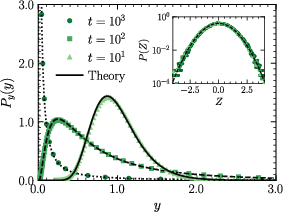
Figure 1: Probability density of the rescaled wealth N4 at various times, showing log-normal dynamics and temporal spread; simulation results and theoretical predictions coincide.
This section establishes that, under pure multiplicative growth with uniform taxation but no redistribution, the system does not reach a stationary wealth distribution; instead, condensation into the lowest wealth layer ensues. The analytical solution aligns precisely with agent-based simulations.
Redistribution Schemes: Analytical Fokker-Planck Solutions
The framework incorporates redistribution by parameterizing N5 via a wealth-dependent kernel N6, normalizing as N7 with N8. The resulting SDE for normalized wealth is
N9
with associated Fokker-Planck equation: Wi,t+1=[1−τi,t]fi,tWi,t+ri,tj=1∑Nτj,tfj,tWj,t0
The stationary solution for general Wi,t+1=[1−τi,t]fi,tWi,t+ri,tj=1∑Nτj,tfj,tWj,t1 is obtained, demonstrating that redistribution induces a mean-reverting mechanism, stabilizing the wealth dynamics and preventing divergence in variance.
In the uniform redistribution case (Wi,t+1=[1−τi,t]fi,tWi,t+ri,tj=1∑Nτj,tfj,tWj,t2), the SDE simplifies to a mean-reverting multiplicative process. The stationary distribution is an inverse-gamma law: Wi,t+1=[1−τi,t]fi,tWi,t+ri,tj=1∑Nτj,tfj,tWj,t3
with Wi,t+1=[1−τi,t]fi,tWi,t+ri,tj=1∑Nτj,tfj,tWj,t4. Increasing Wi,t+1=[1−τi,t]fi,tWi,t+ri,tj=1∑Nτj,tfj,tWj,t5 (tax rate) concentrates the wealth distribution around Wi,t+1=[1−τi,t]fi,tWi,t+ri,tj=1∑Nτj,tfj,tWj,t6; the tail exponent increases, further suppressing wealth condensation.
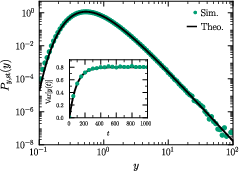
Figure 2: Stationary PDF Wi,t+1=[1−τi,t]fi,tWi,t+ri,tj=1∑Nτj,tfj,tWj,t7 under uniform redistribution and time evolution of variance, highlighting convergence to the inverse-gamma distribution.
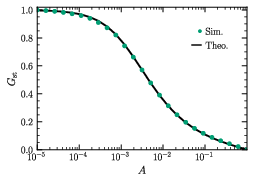
Figure 3: Stationary Gini coefficient as a function of taxation parameter Wi,t+1=[1−τi,t]fi,tWi,t+ri,tj=1∑Nτj,tfj,tWj,t8; theoretical and simulated results exhibit perfect correspondence.
The closed-form analytical expression for the stationary Gini coefficient corroborates simulation results, validating the Fokker-Planck approach. Notably, higher tax rates lead to monotonic decreases in inequality.
A redistribution kernel Wi,t+1=[1−τi,t]fi,tWi,t+ri,tj=1∑Nτj,tfj,tWj,t9 decreasing smoothly with fi,t0 (e.g., fi,t1) enhances transfers to poorer agents. The stationary distribution exhibits reinforced concentration for small fi,t2, and the tail remains governed by power-law decay with exponent fi,t3, independent of fi,t4 or fi,t5.
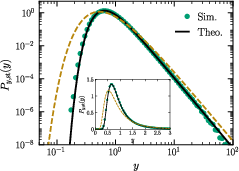
Figure 4: Stationary wealth PDF for nonuniform redistribution, demonstrating sharper concentration and reduced upper tail compared to uniform redistribution.
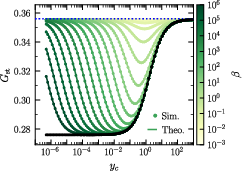
Figure 5: Stationary Gini coefficient versus redistribution scale fi,t6 for multiple fi,t7 values, showing non-monotonic dependence and significant inequality reduction for optimized parameters.
The Gini index attains its minimum for intermediate fi,t8, especially in the fi,t9 case.
Two-Level Redistribution
The two-level redistribution model, τi,t0 for τi,t1 and τi,t2 otherwise, emulates sharply targeted CCT schemes. Analytical and simulated results assert that maximal inequality mitigation (τi,t3) occurs for specific threshold values τi,t4, with improvement up to τi,t5 below the uniform benchmark.
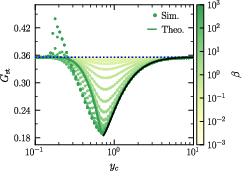
Figure 6: Stationary Gini coefficient under two-level (CCT-like) redistribution, highlighting substantial reduction for optimal τi,t6 and τi,t7.
Robustness of Stationary Distributions and Stylized Facts
The analysis reveals universality in the qualitative features of stationary wealth distributions across redistribution mechanisms. For any non-regressive, positive redistribution kernel, the stationary distribution exhibits an asymptotic power-law tail with exponent τi,t8. The only effect of redistribution details is in the magnitude of prefactors and low-wealth suppression, not the tail exponent.
Policy implications suggest that highly selective redistribution focused on intermediate wealth thresholds maximizes inequality reduction. However, excessive selectivity can lead to inefficiency; too narrow thresholds revert the system toward the uniform redistribution benchmark.
Implications and Outlook
The implications for economic modeling and policy analysis are significant. The formalism provides quantitative predictions for the impact of taxation and redistribution protocols on wealth concentration and inequality. It establishes that uniform or nonuniform redistribution mechanisms are effective in stabilizing wealth distributions and suppressing wealth condensation, subject to parameter regimes.
The mathematical and simulation-based results support that redistributive policies—particularly those targeting the lower and middle wealth strata—are crucial in preventing absolute oligarchy and promoting egalitarian stationary states. Future research directions include extending the formalism to nonlinear taxation protocols and more realistic market models (e.g., yard-sale or exchange-based), as well as exploring universality classes in empirical wealth distributions.
Conclusion
The paper delivers a systematic Fokker-Planck analysis for multiplicative wealth dynamics with taxation and redistribution, deriving exact stationary solutions for broad classes of redistribution protocols. Key numerical and analytical results demonstrate that redistribution is essential to enforce stationarity and prevent unchecked wealth condensation. The tail exponent of stationary wealth distributions is robust to details of the redistribution rule, but policy parameters decisively affect concentration and the Gini coefficient. These findings offer a rigorous quantitative basis for evaluating and designing redistributive economic policies in agent-based and macroscopic settings.

