Lecture Notes: Convex Optimization
Abstract: Lecture notes for a course on convex optimization taught by Andreas Habring at Graz University of Technology in 2026. The notes cover mathematical preliminaries, fundamental results about existence and of solutions for minimization problems, projected subgradient descent, proximal-gradient methods, heavy ball gradient descent, Nesterov accelerated gradient descent and FISTA, primal-dual methods, and a short intro to optimal transport.
Paper Prompts
Sign up for free to create and run prompts on this paper using GPT-5.
Top Community Prompts
Explain it Like I'm 14
What is this paper about?
This is a set of lecture notes that teach the basics of convex optimization. In simple terms, it explains the math behind finding the best solution to a problem when the “shape” of the problem is friendly (convex). Convex shapes and functions are like smooth bowls: they make it easier and safer to find the true best point (the bottom of the bowl), not a fake best point.
What questions does it try to answer?
The notes build up answers to questions like:
- How do we describe and measure objects like vectors and functions in math?
- What does it mean for a set or a function to be convex, and why is that helpful?
- How can we tell, using simple tests, that a function is convex?
- When does a function actually have a minimum, and how do we know that minimum is the best possible (global) one?
- What operations keep convexity intact (so we don’t break the “bowl” shape by accident)?
How do the notes approach these questions?
The notes start from the ground up, introducing basic tools and ideas, then layering them to reach powerful conclusions. Here’s the rough journey, with everyday analogies:
- Vector spaces and norms: Think of vectors as arrows or lists of numbers. A norm is just a way to measure size (like using different rulers). In finite dimensions, different rulers are comparable, so you won’t wildly disagree on what’s “big” or “small.”
- Inner products: This is a way to measure alignment between two vectors (like asking, “Do two arrows point in a similar direction?”). It leads to famous inequalities (Cauchy–Schwarz, Hölder) that help control sizes of sums and products.
- Sequences, limits, and compactness: A sequence converges if its points settle down somewhere. A set is “compact” (in these notes: closed and bounded) if every sequence inside it has a converging subsequence that stays in the set. Intuition: you put everything in a sealed box; nothing escapes and things behave nicely.
- Functions and continuity: A continuous function has no sudden jumps. A Lipschitz function changes at a controlled speed (never too fast).
- Linear maps, dual space, adjoint: Linear maps are functions that preserve straightness and scaling. The “dual” is the world of measuring tools (linear functionals) that take a vector and give a number. In spaces with an inner product, every measuring tool acts like taking a dot product with some vector (Riesz theorem). The “adjoint” is a formal way to “move” a linear map from one side of a dot product to the other (like a transpose of a matrix).
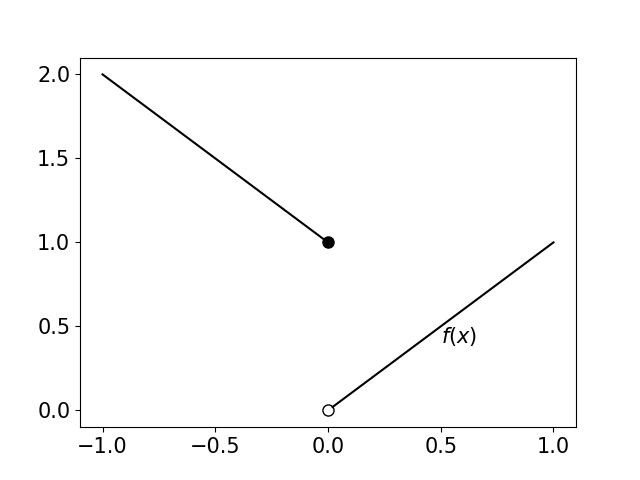
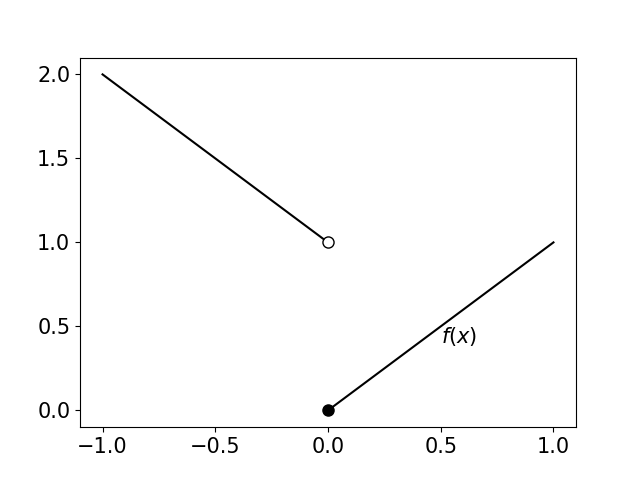
- Extended real-valued functions, epigraphs, and lower semicontinuity: Allowing a function to be “infinite” helps model constraints (you add “∞” outside allowed regions). The epigraph is the set of points lying on or above the graph of the function. Lower semicontinuity means the function doesn’t suddenly drop off a cliff; this helps ensure minima exist.
- Coercive functions and the direct method: Coercive means the function’s value goes to infinity if you walk far away. The “direct method” is a classic 4-step proof pattern to show a minimum exists: take a minimizing sequence, show it’s bounded (thanks to coercive), extract a convergent subsequence (compactness), and pass to the limit (lower semicontinuity).
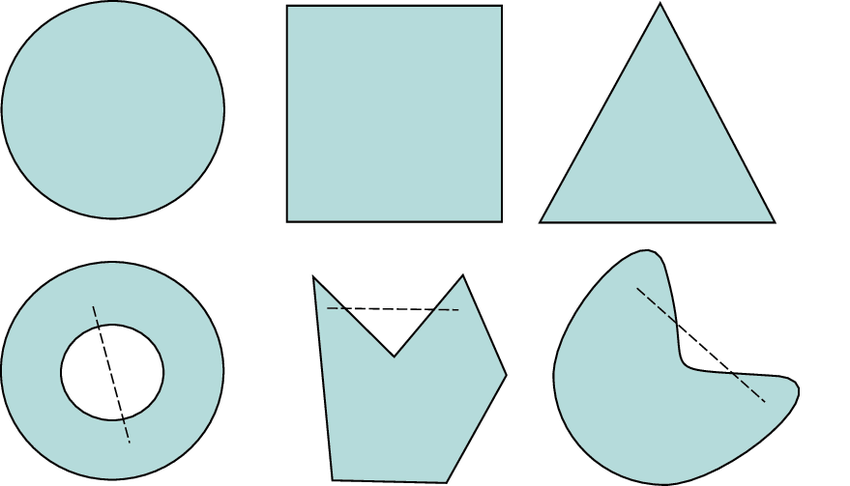
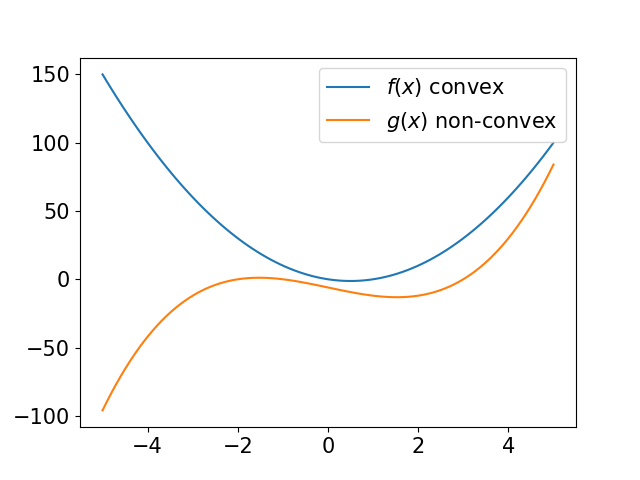
- Convex sets and functions: A set is convex if any straight line between two points in the set stays inside; a function is convex if it lies below its straight-line chords (the bowl picture). You’ll meet:
- Convex hull: stretch a rubber band around a set of points; the shape you get is convex.
- Hyperplanes and halfspaces: flat sheets that can split space; used to separate convex sets (Hahn–Banach separation).
- Tests for convexity:
- Zero-order: chords lie above the graph.
- First-order (gradient): the tangent line at any point lies below the function.
- Second-order (Hessian): the curvature matrix is always nonnegative (no local “humps”).
- Preserving convexity: adding convex functions, taking maximums, composing with certain functions, applying linear changes of variables, and minimizing over some variables all keep convexity intact.
What are the main results and why do they matter?
Key takeaways you can use:
- All norms in finite-dimensional spaces are equivalent: using different reasonable rulers won’t break your arguments.
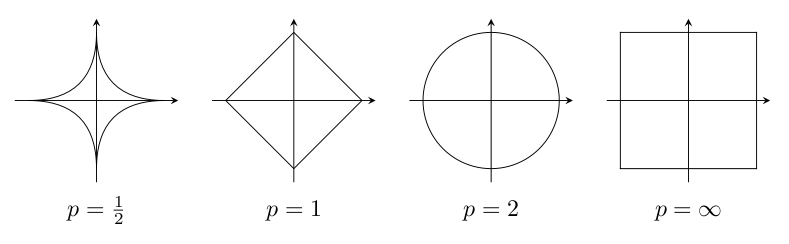
- Powerful inequalities (Cauchy–Schwarz, Hölder) and the triangle inequality for ℓp norms: these control sizes and make proofs go through.
- Bolzano–Weierstrass: every bounded sequence in finite-dimensional space has a convergent subsequence. This is the engine behind many existence proofs.
- Existence of minimizers (direct method): if your function is proper, coercive, and lower semicontinuous (and you’re in finite dimensions), then it actually achieves a minimum. No more “the best value is only approached but never reached.”
- Convexity tests:
- If the gradient exists, convexity is equivalent to “tangent planes lie below the function.”
- If the Hessian exists, convexity is equivalent to “Hessian is positive semidefinite.”
- If the function is convex and differentiable, any point with zero gradient is a global minimizer. In bowls, a flat spot at the bottom is the bottom.
- Separation theorem (Hahn–Banach): two non-overlapping convex sets can be cleanly separated by a flat sheet (line/plane). This explains why convex problems are easier: there are neat “cuts” and certificates of optimality.
- Convexity is stable under many operations:
- Sums and nonnegative scalings stay convex.
- Taking the maximum of convex functions is convex.
- Linear transformations and certain compositions preserve convexity.
- Minimizing over some variables (inf over y) keeps convexity in the remaining variables. Example: distance to a set is a convex function.
- Useful examples:
- Norms are convex.
- The log-sum-exp function is convex (important in machine learning).
- Quadratic-over-linear is convex on positive denominators.
- e{||x||2} is convex.
Why this matters: In optimization, convexity guarantees that local bests are global bests, and it often makes algorithms reliable and efficient. These results let you design models that are both expressive and solvable.
What is the potential impact?
Convex optimization is a backbone of modern technology:
- In machine learning, it powers many training objectives and guarantees stable learning when the loss is convex.
- In engineering, it helps design safe and efficient systems (like circuits, control, and networks).
- In data science, it leads to methods that are robust and have predictable behavior.
These notes give you the “toolkit” to:
- Recognize when a problem is convex.
- Prove a solution exists and is unique.
- Transform problems to keep convexity.
- Use gradients and Hessians to test convexity and certify optimality.
In short, they teach you how to build “bowl-shaped” problems on purpose, so finding the bottom is both possible and dependable.
Knowledge Gaps
Knowledge gaps, limitations, and open questions
Below is a concise, actionable list of what is missing, uncertain, or left unexplored in the manuscript, organized to guide future extensions and corrections.
- Document-level correctness and reproducibility: the LaTeX source contains numerous syntax and macro errors (e.g., unmatched braces in renew/DeclareMathOperator, broken math delimiters, encoding issues such as “Hölder,” malformed equations), preventing compilation and hindering verification; a corrected, compilable version is needed.
- Mathematical setting clarity: many results alternately assume a general vector space, a normed space, an inner-product space, or finite-dimensional Euclidean space without consistently stating the required assumptions; each theorem/definition should explicitly state the exact structure (finite vs infinite dimensional, normed vs inner-product, topology used).
- Separation theorem precision: the “Hahn–Banach separation theorem” is stated without a precise setting (finite-dimensional vs topological vector spaces) and mixes inner-product and dual-space formulations; supply a correct finite-dimensional hyperplane separation statement, distinguish weak vs strong/strict separation, specify assumptions (closedness, convexity, openness, compactness, or relative interior), provide proofs, and include counterexamples when assumptions fail.
- Hyperplane definition generality: hyperplanes are defined via an inner product (a ∈ V), but separation is later phrased with a ∈ V*; reconcile these viewpoints by defining hyperplanes via linear functionals in general normed spaces and clarify when the inner-product representation applies (via Riesz).
- Carathéodory’s theorem: the convex hull characterization is given via arbitrary convex combinations but lacks the finite-dimensional refinement that any point in conv(C) can be represented by at most d+1 points; add statement, proof, and implications for algorithms and geometry.
- Relative interior and support functions: results involving separation and supporting hyperplanes omit the notion of relative interior and support functions; add definitions and theorems (e.g., supporting hyperplane theorem), which are foundational for optimality and duality.
- Cones and dual cones: the notes do not cover convex cones, dual cones, and polar sets; include these to enable general duality, optimality conditions, and geometric interpretations.
- Closedness and domains: exercises ask whether dom(f) of a closed (lsc) function is closed, but the manuscript does not resolve this; provide a definitive statement with proof and counterexamples (dom(f) need not be closed in general).
- Lower semicontinuity and attainment: the direct method is presented only in finite dimensions and with coercivity; extend to infinite-dimensional reflexive Banach spaces (weak lsc, coercivity on weakly compact sets), and articulate the exact conditions ensuring attainment.
- Distance-to-set properties: the distance function is shown convex via partial minimization but conditions for attainment of the infimum (i.e., existence and uniqueness of projections onto closed convex sets) are not addressed; add results on projections (existence, uniqueness, nonexpansiveness, Pythagorean identity).
- Line-restriction characterization: the theorem “f is convex iff its restriction to every line is convex” is stated but the proof is incomplete; finish both directions, specify domain convexity requirements, and discuss extensions to quasiconvexity.
- First-order conditions beyond smoothness: the first-order characterization uses gradients and ignores nonsmooth convex functions; introduce subgradients and subdifferentials, state the subgradient inequality, Fermat’s rule, and calculus rules for subdifferentials.
- Second-order characterization nuance: the manuscript claims “f strictly convex iff ∇²f(x) ≻ 0,” which is false as stated (strict convexity does not require Hessian to be positive definite everywhere; e.g., f(x)=x⁴ is strictly convex on R with ∇²f(0)=0); correct the statement, give the precise conditions (e.g., PSD Hessian with additional conditions ensures convexity; PD Hessian is sufficient but not necessary for strict convexity), and add counterexamples and refined criteria.
- Smoothness and descent lemmas: Lipschitz continuity of the gradient, the descent lemma, and equivalences between smoothness and Hessian bounds are not covered; add these to support algorithmic convergence rates.
- Strong convexity ecosystem: strong convexity is defined, but its equivalent characterizations (e.g., quadratic lower bound, strong monotonicity of ∇f, Hessian lower bound ∇²f ⪰ μI in smooth case) and implications (error bounds, uniqueness, linear rates) are missing; include these links.
- Partial minimization regularity: the convexity preservation under infimum lacks regularity assumptions for stability and interchange of limit/infimum; state conditions ensuring lsc/closedness of g(x)=inf_y f(x,y) and when the infimum is attained (e.g., compactness/coercivity in y, joint lsc).
- Composition rules: only the “convex + nondecreasing” composition rule is treated; add full composition calculus (e.g., perspective, affine invariance, infimal convolution, log-sum-exp and softmax as perspectives/suprema), with precise monotonicity domains.
- Dual norms and operators: dual of ℓp is stated but not proved; add proofs, general dual norm formula, and operator duality A*:W*→V* in Banach spaces (distinct from Hilbert adjoints), clarifying the dependence on inner products.
- Adjoint/operator confusion: the “adjoint” is introduced as A*:W→V relying on inner products; in Banach spaces the adjoint maps between duals; clarify terminology and provide both frameworks, with examples and consequences for optimization.
- Proximal calculus and Moreau theory: no treatment of proximal operators, Moreau envelope, and Moreau decomposition; add definitions, properties (firm nonexpansiveness), and calculus to enable modern first-order methods.
- Duality and KKT conditions: convex conjugates, Fenchel–Young inequality, Fenchel–Moreau theorem, Lagrangian duality, Slater’s condition, and KKT optimality conditions are absent; include these core results with proofs and illustrative examples.
- Algorithms and complexity: there is no algorithmic content (gradient descent, projected/subgradient methods, accelerated methods, coordinate descent, proximal splitting, ADMM, interior-point methods), nor iteration complexity (oracle complexity, condition number effects); add convergence analyses and step-size rules.
- Statistical and inverse problems motivation: examples focus on elementary functions; incorporate canonical models (least squares, logistic loss, hinge loss, ℓ₁, TV, nuclear norm) with convexity proofs and proximal mappings to ground algorithms in applications.
- Stability and sensitivity: properties like epi-convergence, stability of minimizers under perturbations, and sensitivity analysis (Danskin’s theorem, envelope theorem) are missing; add statements and proofs for robustness.
- Constraint qualifications: the notes lack constraint qualifications (e.g., Slater) and their role in strong duality and KKT; include statements, counterexamples when CQ fails, and geometric interpretations.
- Relative smoothness and Bregman geometry: no treatment of Bregman divergences, mirror descent, or relative smoothness/convexity; add definitions and results enabling algorithms beyond Euclidean geometry.
- Reference coverage: the manuscript does not cite standard references (e.g., Rockafellar, Boyd–Vandenberghe, Bauschke–Combettes, Nesterov); include a curated bibliography to substantiate results and guide further study.
- Figures and labels: several figures and labels are referenced but some equations/labels are malformed or incomplete; ensure all figures are present, accurately labeled, and tied to precise statements.
- Exercises without resolution: multiple “exercise” placeholders cover essential facts (e.g., operations preserving convexity, adjoint properties) with no solutions or references; add solutions or pointers to standard proofs so readers can verify key steps.
Practical Applications
Immediate Applications
The lecture notes consolidate key convex analysis and optimization primitives that are directly deployable across modeling, algorithm design, verification, and engineering workflows. Below are actionable, sector-linked use cases that leverage specific results and constructions in the notes.
- Convex modeling and verification pipeline for optimization problems (software, operations research, finance, energy, healthcare)
- What you can do now: Translate domain problems into convex programs using the provided constructions: indicator functions to encode constraints; epigraphs to model nonlinear objectives; convexity-preserving operations (sums, affine precomposition, composition with monotone convex functions, maxima) to build valid models; quadratic-over-linear terms for SOCP models; log-sum-exp for softmax/log-likelihoods.
- Tools/workflows: CVXPY/CVX/Convex.jl with a “model linter” that checks convexity via these rules; epigraph and indicator-function transforms; norm selection for regularization (L1/L2/L∞).
- Dependencies/assumptions: Finite-dimensional setting; verify domain is convex and functions are closed or lsc; ensure coercivity via explicit regularization to guarantee existence (direct method).
- Step-size and conditioning aids for first-order methods (software, ML, signal processing)
- What you can do now: Use induced operator norms to bound Lipschitz constants and pick gradient descent step sizes; leverage strong convexity (if present) for linear-rate convergence guarantees; use equivalence of norms in Rd to reason about convergence under different norms.
- Tools/workflows: Auto-compute or overbound L, μ from matrix/operator norms; preconditioning based on induced norms.
- Dependencies/assumptions: Accurate norm bounds; differentiability where required; finite-dimensional problem data.
- Safe feasibility checks and certificates via separation (software, ML, policy, compliance)
- What you can do now: Use hyperplane separation (Hahn–Banach separation) to:
- Construct cutting planes in feasibility and robust optimization.
- Derive certificates of infeasibility or separation for compliance/policy constraints.
- Implement linear classifiers and support functions (precursor to SVM-like workflows).
- Tools/workflows: Separation oracle API for cutting-plane and column-generation methods; fairness auditing tools that certify separability of acceptable vs unacceptable outcomes under convex constraints.
- Dependencies/assumptions: Sets must be convex; for strict gaps, closedness and one set compactness conditions.
- Projection and distance-based safety/regularization (robotics, control, graphics, ML)
- What you can do now: Use convexity of distance-to-set to build penalty terms for collision avoidance and constraint softening; implement projection onto convex sets (POCS) for feasibility restoration and denoising.
- Tools/workflows: Real-time QP/SOCP in MPC; safety layers that penalize d(x, C); sensor fusion with convex projection steps.
- Dependencies/assumptions: Convex obstacle/constraint sets; fast solvers for real-time use.
- Convex learning models with guaranteed optimization (education tech, healthcare, finance)
- What you can do now: Train convex models that rely on log-sum-exp (e.g., multinomial logistic regression), L1/L2 regularization via norm balls; exploit first/second-order convexity tests to guarantee global optima and choose solvers (gradient vs Newton).
- Tools/workflows: Standard ML stacks (scikit-learn, liblinear, GLM frameworks) with convexity-aware hyperparameter tuning (coercivity via regularization).
- Dependencies/assumptions: Differentiability where using gradient/Hessian tests; data standardization for stable norm-induced constants.
- SOCP-ready formulations via quadratic-over-linear terms (communications, energy, finance)
- What you can do now: Model beamforming power constraints, resource allocation ratios, and certain risk/efficiency ratios using the convex quadratic-over-linear function; map them into SOCP.
- Tools/workflows: SOCP solvers (ECOS, MOSEK); disciplined convex programming patterns for these atoms.
- Dependencies/assumptions: Positive denominator constraints enforced (domain R × (0, ∞)).
- Existence checks and safeguards in inverse problems and estimation (medical imaging, geophysics, computer vision)
- What you can do now: Use lsc + coercivity + finite dimensionality to ensure minimizers exist; add regularization (e.g., norm penalties) if coercivity is missing; rely on closedness of epigraphs and indicator functions to guarantee well-posedness.
- Tools/workflows: Variational reconstruction pipelines (with L2/L1 penalties), feasibility via indicator functions.
- Dependencies/assumptions: Model fidelity; convex regularizers; data consistency constraints modeled as closed sets.
- Robust and worst-case design via max-of-convex and Jensen (operations, supply chain, finance)
- What you can do now: Encode worst-case objectives/constraints with pointwise maxima of convex functions; apply Jensen to justify convex risk surrogates for mixtures/averages.
- Tools/workflows: Robust optimization templates (norm-bounded uncertainty); CVaR-like convex surrogates through max/epigraph constructs.
- Dependencies/assumptions: Uncertainty sets convex; data bounds credible.
- Portfolio and risk optimization with norm and entropic penalties (finance)
- What you can do now: Markowitz-type convex QPs; tracking error via L2; sparsity via L1; entropic risk or softmax-style aggregation with log-sum-exp; dual norms to express robust constraints (e.g., ∥A⊤x∥∞ bounds).
- Tools/workflows: QP/SOCP solvers; convex modeling frameworks with explicit risk atoms.
- Dependencies/assumptions: Estimation error and stationarity; transaction constraints convexified.
- Convex constraint encoding in policy design (public policy, healthcare resource allocation)
- What you can do now: Express fairness, budget, capacity, and equity constraints as convex sets; use separation to diagnose incompatibilities; rely on existence theorems to ensure implementable policies.
- Tools/workflows: Policy simulators with convex optimization backends; sensitivity checks via separation or projection distances.
- Dependencies/assumptions: Proper convex formalization of fairness/feasibility; closedness of constraint sets.
- Curriculum, pedagogy, and assessment assets (academia)
- What you can do now: Use these notes to structure modules on convexity, existence, separation, and first/second-order conditions; build auto-graders that verify convexity and feasibility using composition and epigraph rules.
- Tools/workflows: Jupyter/Colab with CVXPY exercises; visualization of norm balls, epigraphs, and separation.
- Dependencies/assumptions: Students operate in finite-dimensional settings; solver availability.
Long-Term Applications
The same building blocks suggest more ambitious products and research directions that need further development, scaling, or integration with domain specifics.
- Automated convexity and well-posedness checker integrated into programming languages and IDEs (software engineering, ML platforms)
- Vision: A static analyzer that proves convexity, closedness, and coercivity of user-defined objectives/constraints; proposes valid epigraph/indicator transformations; estimates Lipschitz and strong-convexity constants automatically.
- Dependencies/assumptions: Symbolic differentiation, certified bounding of operator norms, domain reasoning for function compositions; integration with solver backends.
- Differentiable convex solver layers with formal guarantees (ML systems, scientific computing)
- Vision: Embed convex problems as differentiable layers (end-to-end training) with certainty about global optimality and stability; exploit monotonicity and strong convexity for smooth, well-conditioned implicit differentiation.
- Dependencies/assumptions: Efficient KKT differentiable solvers; condition number control via regularization (coercivity/strong convexity).
- National-scale resource allocation with robust fairness guarantees (policy, healthcare, energy)
- Vision: Use separation and convex feasibility to define, audit, and certify fairness and capacity constraints in large deployments (e.g., vaccine distribution, load shedding); worst-case convex surrogates for uncertainty in demand/supply.
- Dependencies/assumptions: High-fidelity convex models of logistics; data governance; credible convex uncertainty sets.
- Real-time autonomy stacks built on convex safety envelopes (robotics, transportation)
- Vision: Universal safety layers that maintain distance to convexified hazard sets; hierarchical MPC using SOCP/QP with certified margins; projection-based recovery when near infeasible regions.
- Dependencies/assumptions: Fast embedded solvers; accurate convex approximations of nonconvex environments; robust perception-to-constraint mapping.
- Convex relaxations and certificates in power systems at scale (energy)
- Vision: Systematic deployment of SOCP/SDP relaxations for AC optimal power flow with a-priori separation/certification when infeasible; distance-to-feasibility metrics for operators.
- Dependencies/assumptions: Network models where convex relaxations are tight; contingency modeling via convex uncertainty sets; solver scalability.
- Verified optimization-driven compliance tooling (finance, privacy, safety)
- Vision: Use hyperplane separation to produce human-auditable certificates for compliance constraints; formalize epigraph-based bounds on risk exposure and privacy loss as convex constraints.
- Dependencies/assumptions: Regulatory acceptance of mathematical certificates; clear convex formulations of compliance rules.
- Adaptive convexification pipelines for nonconvex problems (chemistry, materials, telecom)
- Vision: Automated detection of nonconvex elements and replacement by tight convex surrogates using max/epigraph and composition rules; iterative refinement guided by separation oracles.
- Dependencies/assumptions: Gap estimation between original and convexified problems; convergence monitoring; domain-specific surrogate design.
- Education-at-scale with interactive theorem-backed modeling assistants (academia, edtech)
- Vision: Tutors that guide students through verifying convexity (first/second-order, monotonicity), modeling via epigraphs/indicator functions, and diagnosing existence via lsc/coercivity—providing counterexamples when conditions fail.
- Dependencies/assumptions: Formal reasoning engines; curated counterexample libraries; solver integration.
- Cross-domain norm and metric selection services (software, data science)
- Vision: Advisors that select norms (L1/L2/L∞, mixed norms) to encode sparsity, robustness, or fairness; compute dual norms to form robust constraints; quantify trade-offs via equivalence-of-norms bounds.
- Dependencies/assumptions: Domain-specific desiderata mapping to norm geometry; calibration data; sensitivity analyses.
- Safety and stability verifiers using monotonicity and curvature tests (control, cyber-physical systems)
- Vision: Use gradient monotonicity and positive-semidefinite curvature checks to certify convex Lyapunov candidates and safe regions; compute distances to certified sets for online monitoring.
- Dependencies/assumptions: Reliable modeling of dynamics; numerical robustness of Hessian PSD testing at scale.
Notes on shared assumptions and dependencies:
- Many guarantees rely on finite-dimensional settings, convex domains, closedness/lower semicontinuity of functions, and coercivity (or added regularization) to ensure minimizers exist and algorithms converge.
- Separation with strict margins requires additional set properties (closedness, one set compact).
- Real-time deployments hinge on solver performance and accurate convex abstractions of inherently nonconvex phenomena.
- Data quality and uncertainty set design critically affect robustness and fairness claims.
Glossary
- Abelian group: A group whose operation is commutative. Example: "is an abelian group, that is, the following hold for all :"
- Adjoint: For a linear map between inner-product spaces, the operator A* satisfying ⟨Ax, y⟩ = ⟨x, A*y⟩. Example: "We define the adjoint operations via"
- Affine subspace: A translate of a linear subspace (a flat of the form z + span{vectors}). Example: "Every affine subspace, that is, for any set of vectors the set"
- Banach space: A complete normed vector space (all Cauchy sequences converge). Example: "A normed space is called Banach space if every Cauchy sequence is convergent."
- Bolzano-Weierstraß: The theorem that every bounded sequence in finite dimensions has a convergent subsequence. Example: "[Bolzano-WeierstraÃ]"
- Cauchy sequence: A sequence whose elements become arbitrarily close to each other. Example: "We call a sequence Cauchy iff"
- Cauchy-Schwartz: The inequality |⟨v,w⟩| ≤ ||v||·||w|| in inner-product spaces. Example: "[Cauchy-Schwartz]"
- Closed (function): A function whose epigraph is a closed set. Example: "A function is called closed if its epigraph is a closed set."
- Coercive: A function that tends to +∞ as the argument’s norm goes to ∞. Example: "We call coercive if"
- Convex combination: A weighted average with nonnegative weights summing to one. Example: "using more general convex combinations."
- Convex hull: The smallest convex set containing a given set. Example: "The convex hull of is defined as the set"
- Direct method: An existence proof technique using a minimizing sequence, compactness, and lower semicontinuity. Example: "The proof follows the so-called direct method."
- Dual norm: The norm on the dual space defined via a supremum over the unit ball. Example: "The canoncical norm on is the dual norm"
- Dual space: The space of all linear functionals on a vector space. Example: "The dual space is the vector space of all linear maps $V\rightarrowR$"
- Epigraph: The set of points on or above a function’s graph. Example: "The epigraph of a function is defined as"
- Equivalence of norms: In finite dimensions, any two norms are comparable up to constants. Example: "[Equivalence of norms]"
- Frobenius norm: The square root of the sum of squares of matrix entries. Example: "Frobenius: ."
- Hahn-Banach seperation theorem: Disjoint convex sets can be separated by a linear functional (hyperplane). Example: "[Hahn-Banach seperation theorem]"
- Halfspace: One side of a hyperplane defined by a linear inequality. Example: "a halfspace is a set of the form"
- Hilbert space: A complete inner-product space. Example: "If the norm is derived from an inner product, we call the space a Hilbert space."
- Hölder conjugate exponents: Exponents p, q with 1/p + 1/q = 1. Example: "We call Hölder conjugate exponents."
- Hölder: The inequality relating inner products and ℓp/ℓq norms. Example: "[Hölder]"
- Hyperplane: A codimension-1 affine subset defined by a single linear equation. Example: "a hpyerplane is a set of the form"
- Indicator function: The function that is 0 on a set and +∞ outside it. Example: "the indicator function os defined as"
- Induced norm: The operator norm of a matrix induced by vector norms on domain/codomain. Example: "Induced norms: For every pair of norms , on and , respectively, we can define the induced norm"
- Isomorphic: Having a structure-preserving bijection (here, linear maps ≅ matrices). Example: "is isomorphic\footnote{in layman's terms: the same} to the space of all matrices ."
- Jensen: The inequality characterizing convexity via convex combinations. Example: "[Jensen]"
- Lipschitz continuity: A function with globally bounded rate of change. Example: "we call Lipschitz continuous if there exists such that"
- Logsumexp function: The smooth convex function log(∑exp(x_i)), often approximating max. Example: "The logsumexp function is convex"
- Lower semi-continuity: Property f(x) ≤ lim inf f(x_n) for x_n → x. Example: "[Lower semi-continuity]"
- Monotonicity of the gradient: For convex f, ⟨∇f(x)−∇f(y), x−y⟩ ≥ 0. Example: "[Monotonicity of the gradient]"
- Norm ball: The set of points within a fixed norm radius around a center. Example: "Every norm ball, that is, for every norm and every and the sets"
- Proper (function): An extended-real function not −∞ anywhere and finite somewhere. Example: "we call proper if and there exists such that ."
- Quadratic-over-linear (function): A function of the form x12/x2 on its domain. Example: "The quadratic-over-linear function"
- Riesz: The theorem identifying a Hilbert space with its dual via the inner product. Example: "[Riesz]"
- Sequential compactness: Every sequence has a convergent subsequence with limit in the set. Example: "[Sequential copmpactness]"
- Simplex: The set of nonnegative weights summing to one (e.g., Δk). Example: "we define the unit simplex as"
- Strictly convex: Convex with strict inequality for distinct points. Example: "We call strictly convex iff"
- Strongly convex: Convex with a uniform quadratic lower bound (curvature μ>0). Example: "We call -strongly convex iff"
- Young's inequality: For conjugate p, q: ab ≤ ap/p + bq/q. Example: "Note that Young's inequality states that"
Collections
Sign up for free to add this paper to one or more collections.

