- The paper introduces Differential Molecular Rotational Broadening (DMRB) as a novel method to detect latitudinal gradients in cloud density, temperature, and molecular abundances.
- The analysis uses state-of-the-art 3D simulations and high-resolution VLT-CRIRES spectroscopy to reveal a ∼200K equator-to-pole temperature contrast and significant CH4 and NH3 depletion at the equator.
- The study’s findings provide a scalable approach for atmospheric mapping, enhancing our understanding of cloud radiative feedback and chemical quenching in brown dwarf atmospheres.
Latitudinal Chemical and Cloud Variations in Brown Dwarf Atmospheres
Background and Motivation
Brown dwarfs occupy a unique regime spanning the gap between giant planets and low-mass stars, providing a powerful laboratory for investigating substellar atmospheric physics, chemistry, and dynamics. Their rapid rotation, significant radiative flux, and absence of confounding stellar irradiation enable direct studies of cloud formation, chemical quenching, and atmospheric circulation. The L-T transition, demarcated by a shift from CO-dominated to CH4-dominated chemistry, is closely linked to cloud dissipation and color variability. Previous 3D GCMs and multiband observations have indicated the presence of equatorial cloud belts, thermal gradients, and meridional chemical stratification [teinturier_clouds_2026, tan_atmospheric_2021, suarez_ultracool_2023].
3D Model Predictions: Cloud, Temperature, and Chemistry
State-of-the-art 3D simulations incorporating cloud radiative feedback, rapid rotation, and kinetic chemistry predict pronounced latitudinal gradients in cloud mass, temperature, and molecular abundances. Preferential silicate cloud formation at low latitudes arises from the suppression of vertical mixing by Coriolis forces at high latitudes and nonlinear cloud/convection feedbacks. The cloud greenhouse effect produces a warm equatorial region, with a ∼200K temperature contrast between equator and poles at ∼10 bars (Figure 1). Chemistry is regulated by vertical quenching, with the abundances of CH4, NH3, and H2O enhanced at cooler, poleward latitudes, while CO and N2 persist equatorward, owing to their stability at higher temperature.
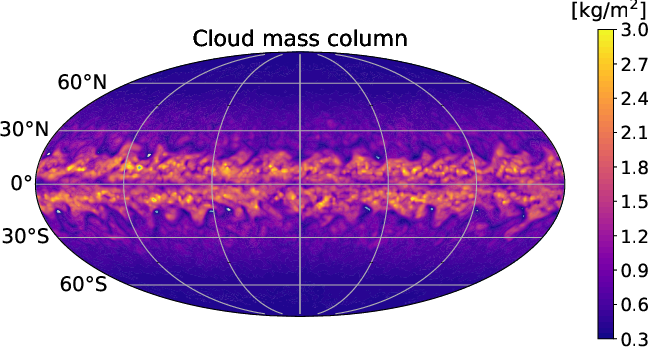
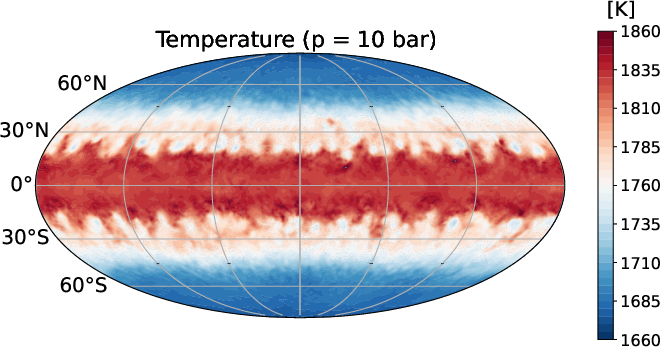
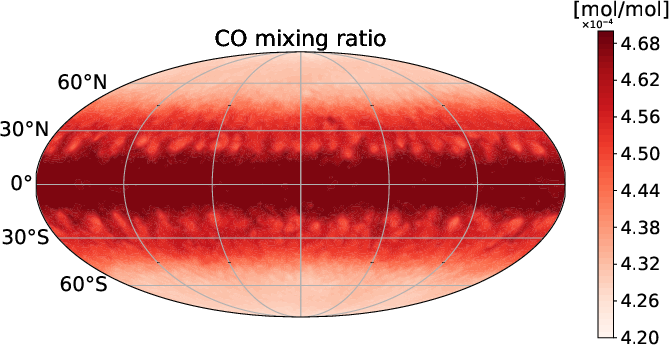
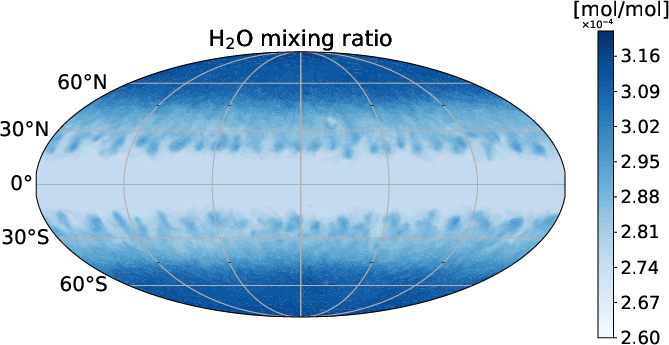
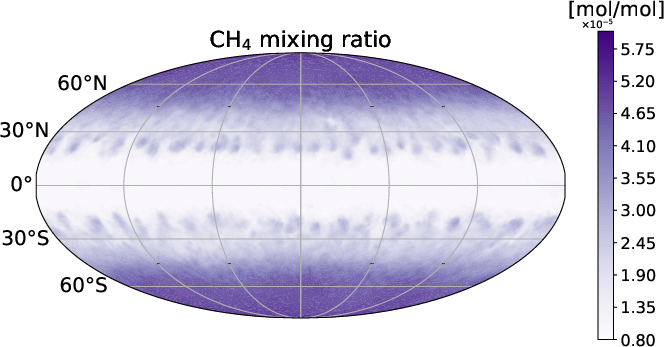
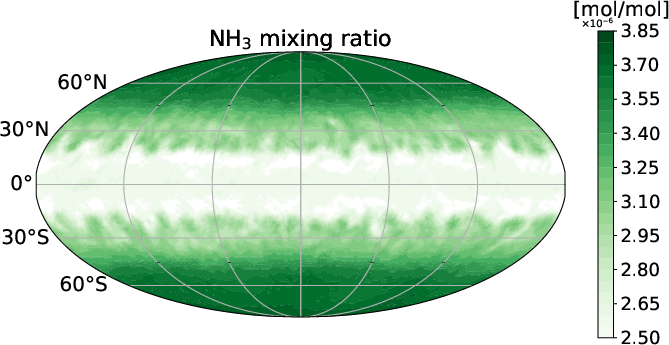
Figure 1: Panel maps from 3D model at L-T transition showing clouds, temperature, and mixing ratios of CO, H2O, CH4, NH3 across latitude.
These spatial trends are further quantified by longitudinal averages (Figure 2). The quenching-level chemistry is dominated by vertical mixing rates, significantly exceeding meridional transport timescales [lee_dynamically_2024], allowing local temperature fields to set molecular distributions above the quench point.
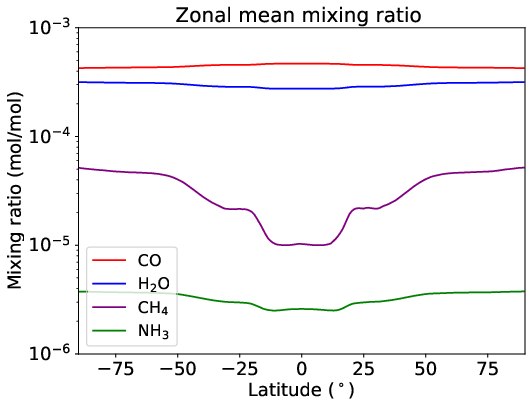
Figure 2: Longitudinally averaged latitudinal mixing ratios of H∼0O, CO, CH∼1, NH∼2, revealing depleted CH∼3 and NH∼4 at the equator, enhanced CO.
Methodology: Differential Molecular Rotational Broadening (DMRB)
The paper introduces Differential Molecular Rotational Broadening (DMRB), exploiting the spatial chemical heterogeneity to diagnose latitudinal gradients via rotational line broadening differences in high-resolution spectra. For a brown dwarf with an equatorial depletion in a given molecule, the measured ∼5 for that molecule is reduced, as spectral lines are formed preferentially at higher latitudes with lower projected velocity. The analytic formalism is validated against synthetic spectra and 3D simulation outputs, revealing significant sensitivity for minor species (CH∼6, NH∼7) that show strong latitudinal contrasts (Figure 3).
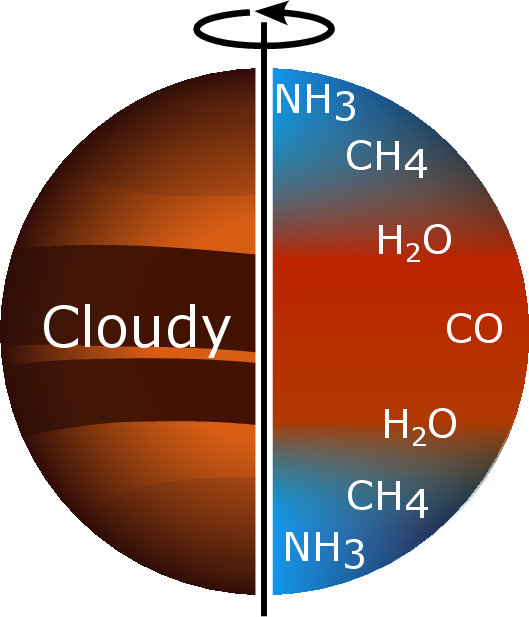
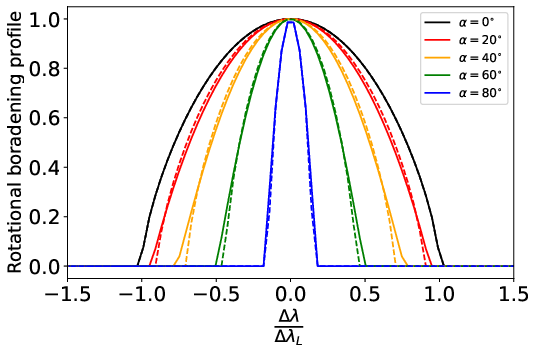
Figure 3: Schematics of latitudinal cloud/temperature/chemical variation and associated partial rotational broadening function due to equatorial depletion.
Application: DENIS J0255-4700 Case Study
The late L dwarf DENIS J0255-4700 is analyzed via VLT-CRIRES high-resolution K-band spectroscopy. With a rotation period of 2.21 h (from TESS), inclination ∼872∼9, and measured ∼041 km/s, it is close to the L-T transition and an optimal test case for DMRB. A full atmospheric retrieval yields robust molecular detections for CO, H∼1O, CH∼2, NH∼3, with SNR ∼4 20.
Using model and observational residuals, rotational broadening for each molecule is determined. The values obtained are:
- ∼5(all) = ∼6 km/s
- ∼7(CO) = ∼8 km/s
- ∼9(H40O) = 41 km/s
- 42(CH43) = 44 km/s
- 45(NH46) = 47 km/s
The reduction in 48 for CH49 is statistically significant (30 deviation relative to CO/H31O), directly supporting the model prediction of equatorial depletion. Residual analysis demonstrates excellent fit quality for molecular contributions (Figure 4, Figure 5), and the SNR and log-likelihood peak mapping confirm measurement robustness (Figure 6). Latitudinal distribution is inferred: an equatorial cloud belt extending to 32 latitude, consistent with 3D model geometries.
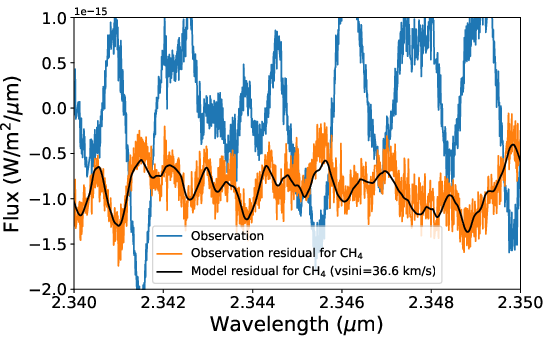
Figure 4: CH33 spectral residuals for DENIS J0255-4700; observed and model residuals with best-fit rotational broadening.
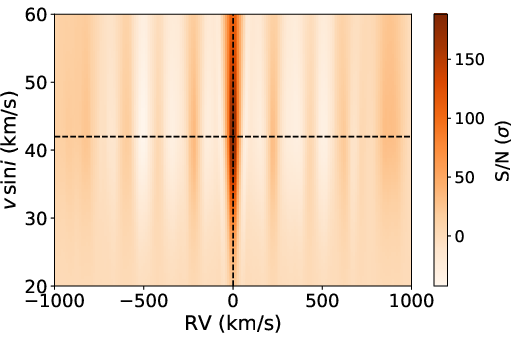
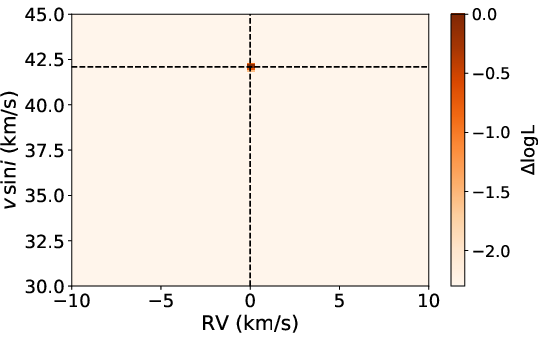
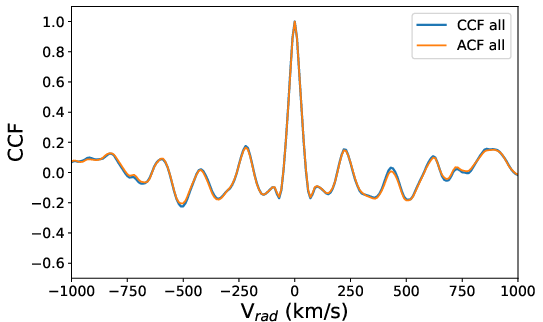
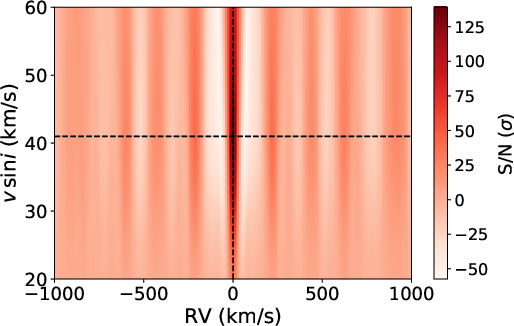
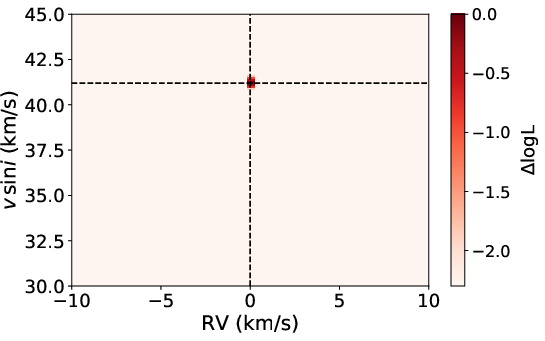
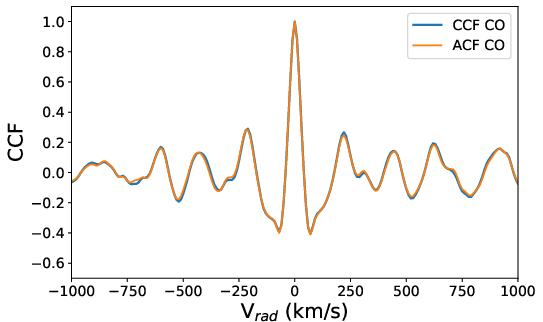
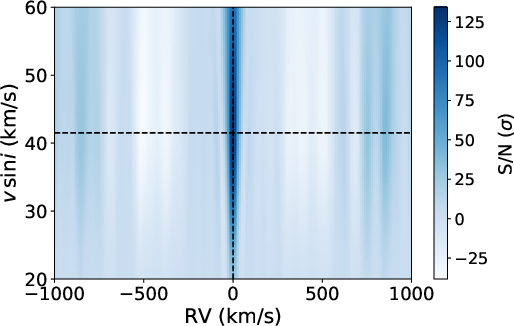
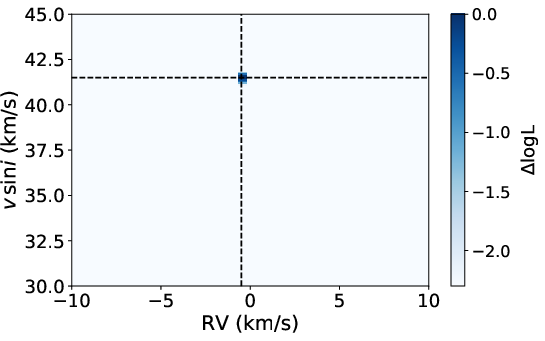
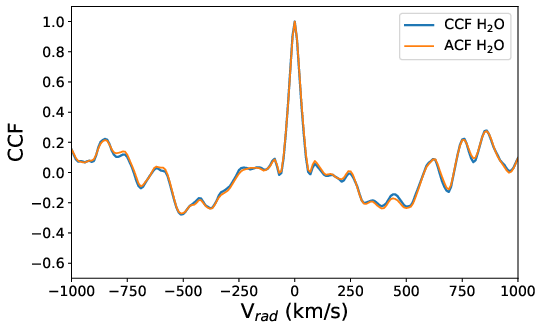
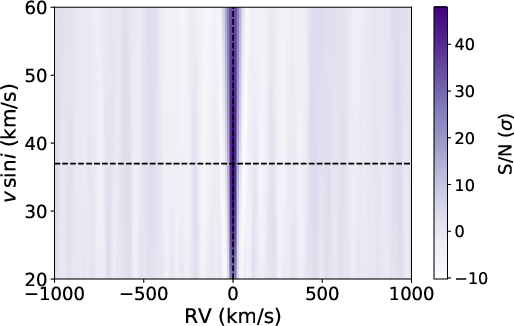
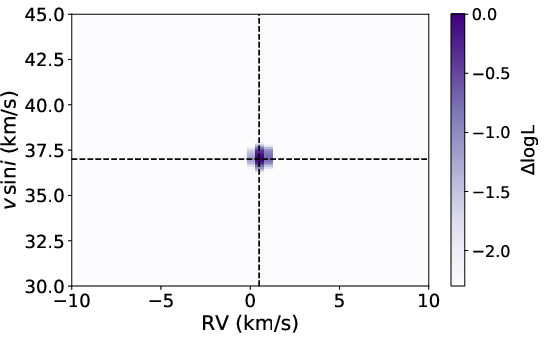
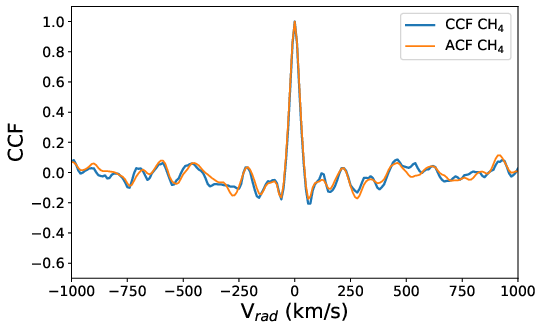
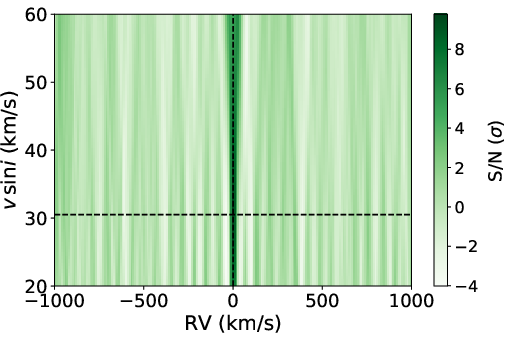
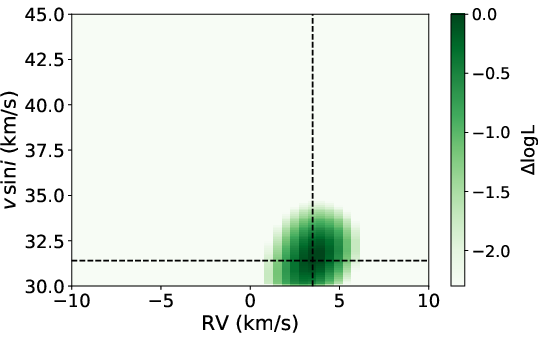
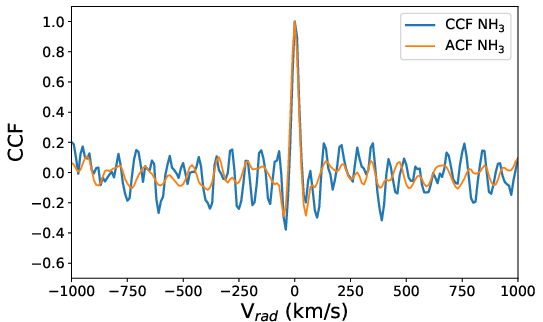
Figure 6: Maps of SNR, log-likelihood variation, and CCF/ACF functions for all molecules and individual species.
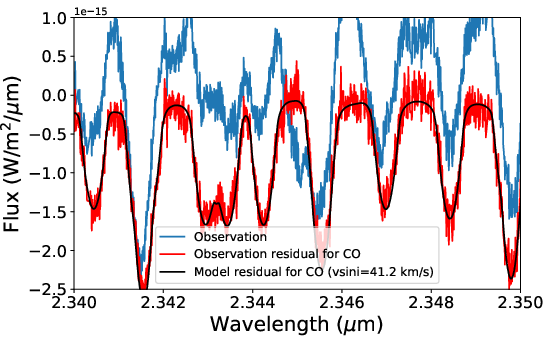
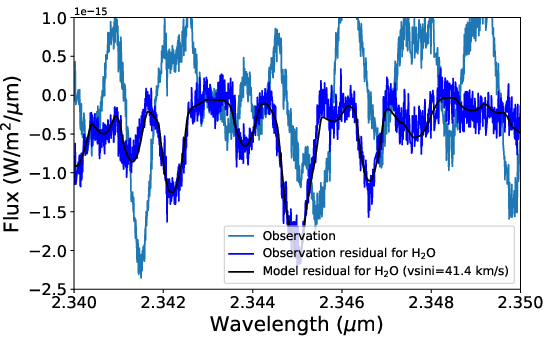
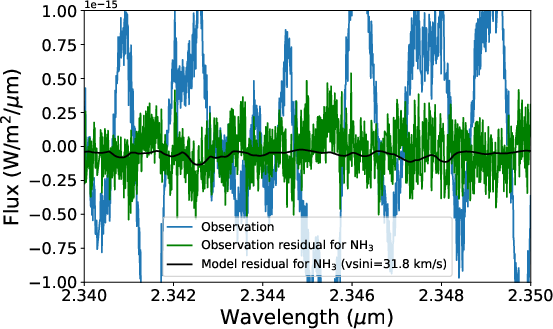
Figure 5: Residual spectra for each molecule (CO, H34O, CH35, NH36) with best-fit rotational broadening indicated.
Implications and Measurement Robustness
The DMRB method demonstrates sensitivity to latitudinal cloud-induced chemical gradients, particularly for minor species with strong spatial contrast. The observed differential rotational broadening cannot be explained by longitudinal or vertical inhomogeneities (exposure averaging over half a rotation), nor by systematic error, as shown by analysis order-by-order and correlated noise modeling. The magnitude of deviation for CH37 and NH38 supports the theoretical expectation, validating the coupling of cloud radiative feedback and chemical quenching.
(Figure 7)
Figure 7: Measured 39 values per molecule and all molecules; comparison with theoretical models for equatorial depletions at various latitudes.
Oblateness and equatorial jets may introduce modest corrections to 20 (215%), but the dominant signal is due to spatial chemical variation. Previous 22 measurements and inclination estimates may be biased for targets exhibiting equatorial chemical depletion; homogeneous species must be targeted for accurate bulk rotation characterization.
Prospects for DMRB and Atmospheric Mapping
DMRB is complementary to Doppler imaging, with higher sensitivity to latitudinal structure and less reliance on time-resolved data. With current instrumentation (8 m telescopes, VLT-CRIRES, CFHT-SPIRou), 20 brown dwarfs near the L-T transition are immediately accessible for latitudinal mapping; ELT-class telescopes will enable hundreds. The approach enables not only chemical mapping but cloud altitude constraint (via spectral windows probing different atmospheric depths), auroral/photochemistry studies, and application to directly imaged exoplanets [brandl_instrument_2010, kasper_pcs_2021].
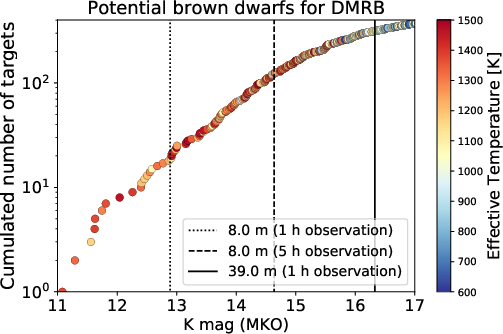
Figure 8: Accessible brown dwarfs for DMRB as a function of K-magnitude, observing time, and telescope diameter.
Efficacious atmospheric retrieval frameworks and comprehensive 3D GCMs coupling cloud and chemistry are advocated for fully quantitative latitudinal mapping and for understanding dynamical feedback in substellar atmospheres.
Conclusion
This work establishes that brown dwarf atmospheres, especially at the L-T transition, exhibit strong latitudinal gradients in cloud mass, temperature, and molecular abundances, driven by cloud radiative feedback and rapid rotation. The DMRB method robustly detects these gradients via species-specific rotational broadening in high-resolution spectra. Application to DENIS J0255-4700 confirms an equatorial cloud belt and CH23/NH24 depletion, consistent with 3D modeling. Theoretical and practical implications are substantial: DMRB provides a scalable approach for atmospheric mapping of brown dwarfs and exoplanets, offering insight into atmospheric dynamics, chemical transport, and cloud processes, as well as prospects for future instrument advancement and comprehensive retrieval analyses.