- The paper demonstrates that CSC quark phases significantly impact proto-neutron star evolution through an RG-NJL model coupled with a DD2 RMF equation of state.
- It maps isentropic trajectories under neutrino-trapped and neutrino-transparent conditions, revealing distinct phase boundaries for 2SC and CFL transitions.
- Numerical modeling uncovers thermal twin phenomena and constrains stable high-mass CSC cores, suggesting observable multimessenger signals from phase transitions.
Summary of Color-Superconducting Phases in Proto-Neutron Star Evolution
Introduction and Motivation
This work presents a systematic investigation into the presence and impact of color-superconducting (CSC) quark phases during proto-neutron star (PNS) evolution following core-collapse supernovae. By employing a renormalization-group-consistent Nambu–Jona-Lasinio (RG-NJL) model for deconfined quark matter, matched to a high-fidelity DD2 relativistic mean-field (RMF) equation of state for hadronic matter, the authors bridge the microscopic phase structure of dense QCD to macroscopic neutron star observables. The evolution is tracked along constant baryon number trajectories, reflecting the conservation law governing stellar remnants.
The analysis centers on two distinct equilibrium regimes determined by neutrino trapping: (1) neutrino-trapped conditions relevant for early PNS stages and (2) neutrino-transparent conditions associated with later cooling. These regimes determine beta-equilibrium, lepton fraction, and charge neutrality, critically affecting the phase boundaries and core composition.
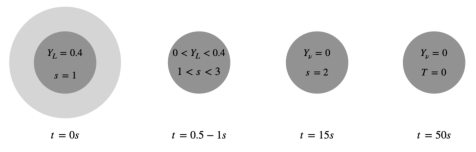
Figure 1: Schematic overview of proto-neutron star evolution, illustrating entropy and deleptonization transitions from birth to the cold neutron star stage.
Model Framework
Quark Sector: RG-Consistent NJL Model
The three-flavor RG-NJL model incorporates dynamical chiral symmetry breaking, diquark pairing (2SC and CFL condensates), and a repulsive vector interaction. The formalism supports calculation of gap parameters in all pairing channels and enforces electric/color neutrality using appropriate chemical potentials. Mean-field approximation yields temperature- and density-dependent EoSs without cutoff artifacts, crucial for consistent high-density extrapolation.
Hadronic Sector: DD2 RMF Model
The DD2 EoS provides density-dependent nucleon-meson couplings, accurately reproducing finite nuclei properties, symmetry energy constraints, and supporting high-mass neutron stars. Its thermodynamic consistency across wide parameter ranges is essential for core-collapse and merger simulations.
Phase Matching and Mixed Phase Construction
Phase transitions between hadronic and quark matter are realized via Maxwell construction for isentropic paths, while genuine mixed phases are interpolated using volume fractions matched to specific entropy per baryon values. For neutrino-trapped cases, local charge neutrality is imposed, adhering to high-surface-tension scenarios.
Phase Structure and Isentropic Trajectories
Phase diagrams in (T,μB) space reveal the emergence and suppression of CSC phases under varying entropy and lepton fraction conditions, with isentropic trajectories mapped onto these domains.
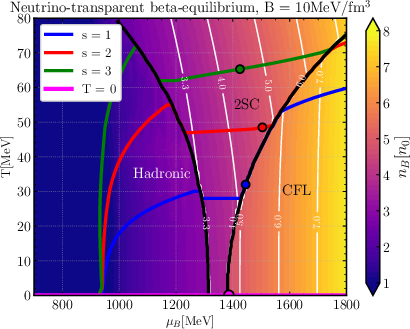
Figure 2: Phase diagram of color-superconducting matter—hadronic, 2SC, and CFL domains—showing isentropic tracks and density contours for s=1,2,3, highlighting the accessible phase structure.
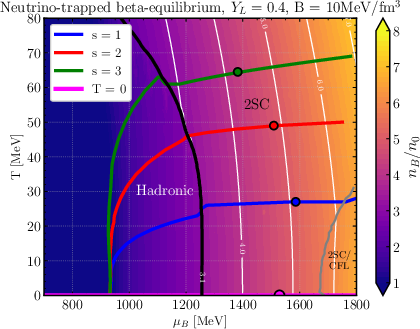
Figure 3: Matched DD2+NJL1 hybrid phase diagram with B=10MeV/fm3, showing phase boundaries and centers of maximal-mass configurations.
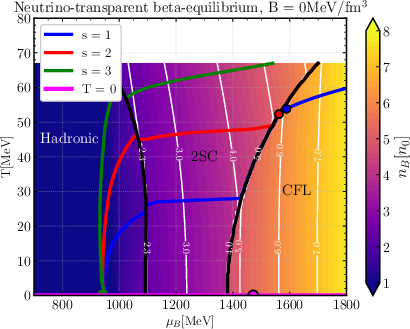
Figure 4: Phase diagram for the neutrino-trapped case at YL=0.4, demonstrating the absence of pure CFL domains and the emergence of mixed phases at high density.
Key qualitative findings:
- Increasing entropy per baryon shifts isentropic trajectories to higher temperatures and densities, facilitating entry into quark phases.
- The 2SC–CFL boundary bends toward higher density with increasing temperature.
- A large heat capacity in the 2SC phase produces distinct temperature plateaus along the isentrope.
- Neutrino trapping suppresses pure CFL phases at all relevant densities and modifies the beta-equilibrium, leading to higher proton fraction in hadronic matter and ensuring symmetry-energy-dominated behavior.
Mass–Radius Relations and Evolution
Detailed mass–radius curves are generated for both neutrino-transparent and neutrino-trapped equilibrium scenarios at various entropy states, highlighting the consequences of CSC phase transitions on stellar structure.
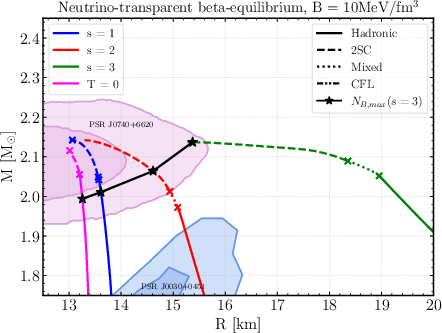
Figure 5: Mass–radius relations for hybrid EoS under neutrino-transparent conditions at fixed s=1,2,3 and T=0, showing distinct phase transitions at the stellar center.
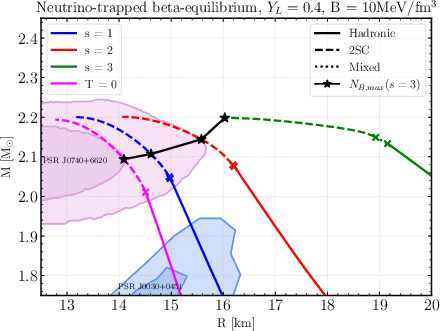
Figure 6: Mass–radius relations for YL=0.4 (neutrino-trapped), illustrating elevated radii and stable 2SC phases across cooling tracks.
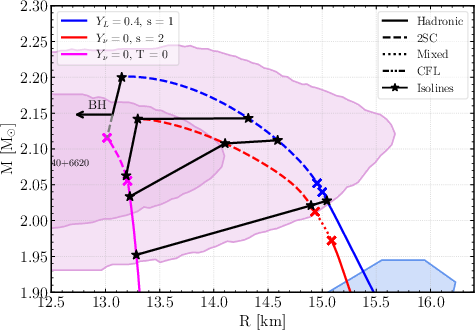
Figure 7: Zoomed MR diagram comparing evolutionary tracks for constant NB across birth, post-deleptonization, and cold isolate remnant, with phase transitions indicated.
Strong numerical results and claims:
- The cold T=0 sequence (neutrino-transparent) reveals maximum-mass configurations with small CFL cores, but instability rapidly follows CFL onset, restricting stable CFL domains to narrow, high-mass regions.
- High-entropy (e.g., s=3) tracks exhibit flat MR plateaus in the 2SC regime with nearly constant mass and decreasing radius—a signature of thermal twins enabled by non-congruent phase transitions.
- Neutrino trapping stiffens the EoS and delays deconfinement, sustaining a stable 2SC phase even after cooling, in contrast to transparent cases where the 2SC core may revert to hadronic matter.
The constant-baryon-number tracks dissect the full PNS trajectory and identify four possible core evolution scenarios:
- Delayed collapse—2SC to black hole: Initial baryon numbers exceeding hot maximum-mass lead to instability after deleptonization.
- Persistent 2SC phase: Stable 2SC core remains through all cooling stages.
- Vanishing CSC phase: A hot 2SC core reverts to hadronic matter upon cooling.
- Fleeting CSC phase: Hadronic birth transitions into 2SC at intermediate entropy, then back to hadronic at cold endpoint.
These scenarios are model- and parameter-dependent, but are robust features of hybrid EoS with quark pairing.
Practical and Theoretical Implications
- The results tightly constrain the parameter space for observable CSC phases in neutron stars, revealing that stable quark matter is limited to narrow, high-mass configurations after PNS cooling.
- The predicted existence of thermal twins has implications for gravitational-wave signals and supernova neutrino fluxes, as phase transitions alter cooling behavior and transport properties.
- Multiple phase transitions (Hadronic s=1,2,30 2SC s=1,2,31 Hadronic) are predicted to produce distinctive multimessenger signatures (e.g., MHz gravitational-wave bursts).
- Measurement of supernova neutrino signals may distinguish CSC matter, given its unique emissivity and cooling response compared to hadronic or CFL phases.
- The absence of stable CFL cores at high lepton fraction solidifies the role of electron-rich environments in suppressing three-flavor pairing, aligning with QCD model expectations.
- Future advances in gravitational-wave and neutrino astronomy promise to probe the transient and persistent presence of CSC phases within dense stellar matter.
Future Developments and Directions
- Enhanced dynamical simulations combining the hybrid EoS with detailed neutrino transport, convection, and diffusion are needed to fully validate temperature-gradient profiles and phase reversion mechanisms.
- Improved precision in determination of the quark–hadron surface tension and dynamical nucleation timescales will refine mixed-phase constructions.
- The integration of observed MHz gravitational-wave signals and supernova neutrino fluxes with mass-radius data holds potential for direct evidence of CSC matter in PNS evolution.
- Exploring alternative EoS parameterizations and bag constant values further constrains the stability and accessibility of CSC phases across the mass-radius landscape.
Conclusion
The RG-NJL hybrid framework delineates the set of possible color-superconducting core evolution paths in proto-neutron stars, revealing that persistence of quark pairing is confined to a narrow high-mass regime and is heavily dependent on early lepton-rich conditions. The interplay between thermal pressure, lepton fraction, and phase structure fundamentally controls the macroscopic fate of young neutron stars, with observable implications for multimessenger astrophysics. Long-term, the combination of gravitational-wave and neutrino signals offers a pathway to empirically validate the presence and impact of color-superconducting phases in ultra-dense matter.

