- The paper introduces HourGlass, a probabilistic framework that reconstructs hourly forecasts from coarse 6-hourly inputs using aggregate-augmented CRPS training.
- It employs a GNN encoder-processor-decoder with latent noise and backward skip connections to enforce temporal consistency and physical plausibility.
- Evaluations show that HourGlass preserves upstream skill for temperature, wind, and pressure while enhancing spatial realism and reducing excessive smoothing.
HourGlass: Probabilistic Temporal Downscaling for Data-Driven Weather Forecasts
Motivation and Problem Context
The paper "HourGlass: A probabilistic data-driven temporal downscaler for global and regional weather forecasting" (2607.11457) addresses the persistent gap between the temporal resolution of state-of-the-art MLWP models (typically 6-hourly) and the requirements of many forecast applications, which demand hourly outputs for operational utility, extreme event detection, and downstream tasks. Direct hourly forecasting with data-driven models is feasible but is shown to yield error accumulation and compromised temporal consistency, especially when trained on reanalysis datasets that contain artificial discontinuities due to assimilation cycling.
Temporal downscaling models reconstruct intermediate states from coarse input, typically interpolating between forecasts. Prior downscaling methods trained deterministically exhibit spatial smoothing and fail to maintain correct temporal consistency or small-scale variability. HourGlass innovates by introducing probabilistic training—using a CRPS-based loss function augmented with temporal consistency constraints—explicitly designed to produce spatially sharp, physically plausible trajectories at hourly resolution.
Architectural Overview
HourGlass adopts a GNN-based encoder-processor-decoder architecture, all implemented within the Anemoi framework. Temporal downscaling in HourGlass operates on forecast states at t0 and t6, and reconstructs the full trajectory at intermediate hours with a single forward pass, leveraging injected latent noise for probabilistic sampling of the temporal evolution. Prognostic variables utilize backward skip connections, enforcing physical consistency at anchor points. Importantly, the decoder outputs the full window jointly, enforcing correlation across time and minimizing computational cost relative to separate hourly inferences.
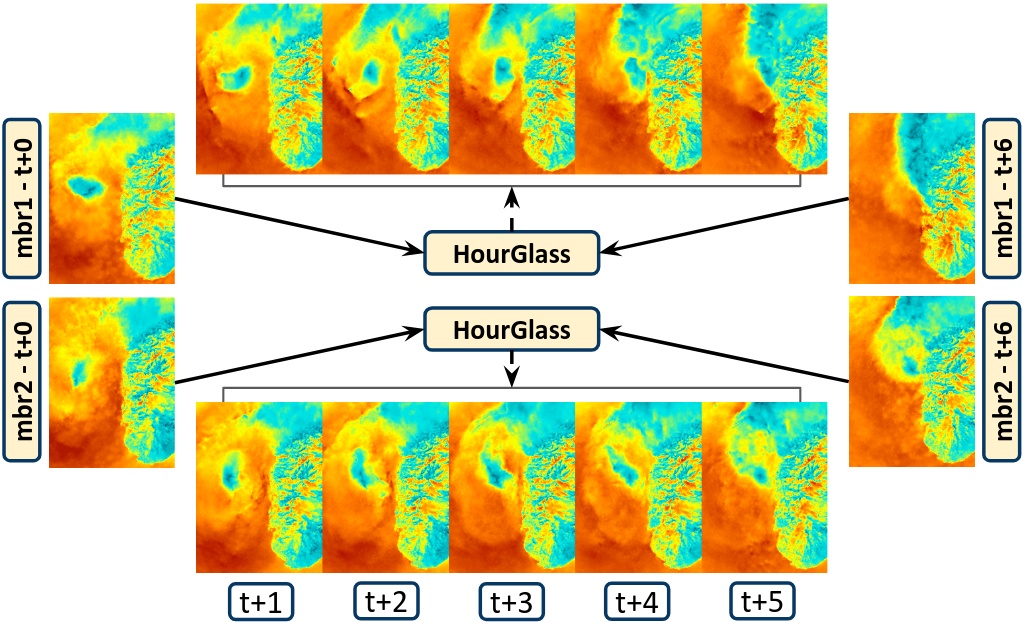
Figure 1: Example inference pipeline for Bris-HourGlass showing reconstructed hourly wind speed between 6-hour anchors for two ensemble members.
Regional applications (Bris-HourGlass) employ stretched-grid refinements to deliver high-resolution output, while global models (AIFS-HourGlass) maintain coarser but uniform resolution. The stochastic ensemble setup is distributed across GPUs (GH200 and A100), ensuring scalability for large domains and long rollout windows.
Dataset Construction and Temporal Consistency Challenges
To circumvent discontinuities inherent to ERA5 and MEPS reanalysis/analysis datasets—stemming from boundaries between assimilation cycles (Figure 2)—HourGlass is trained on temporally continuous NWP forecast trajectories, avoiding exposure to artificial jumps at initialization boundaries. Global training uses IFS forecasts, while regional fine-tuning for Bris-HourGlass relies on MEPS control forecasts. Data selection ensures coverage across times of day and forecast lead times, with forecast segments extracted to maximize the exposure to all relevant temporal regimes.
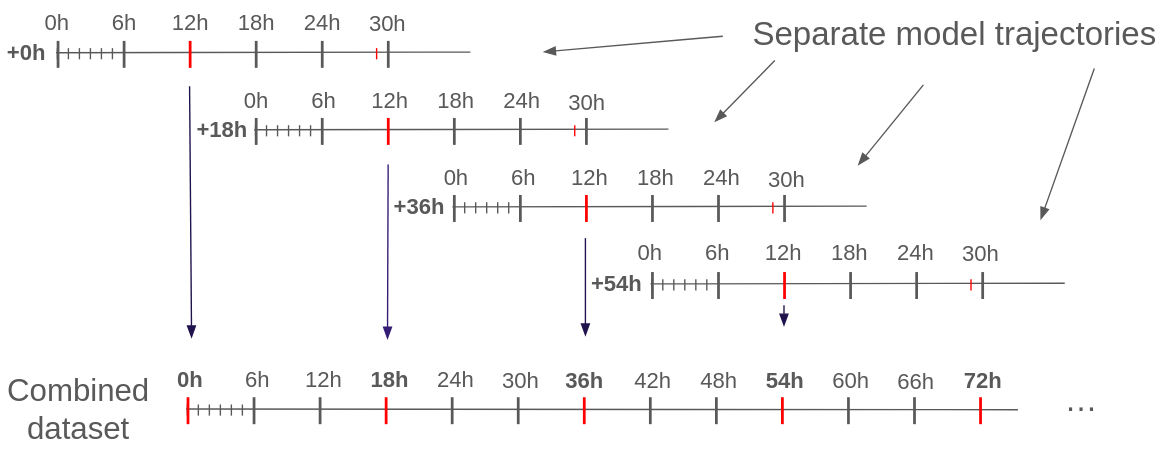
Figure 3: Construction of forecast segments for training, avoiding boundaries that introduce analysis-induced discontinuities.
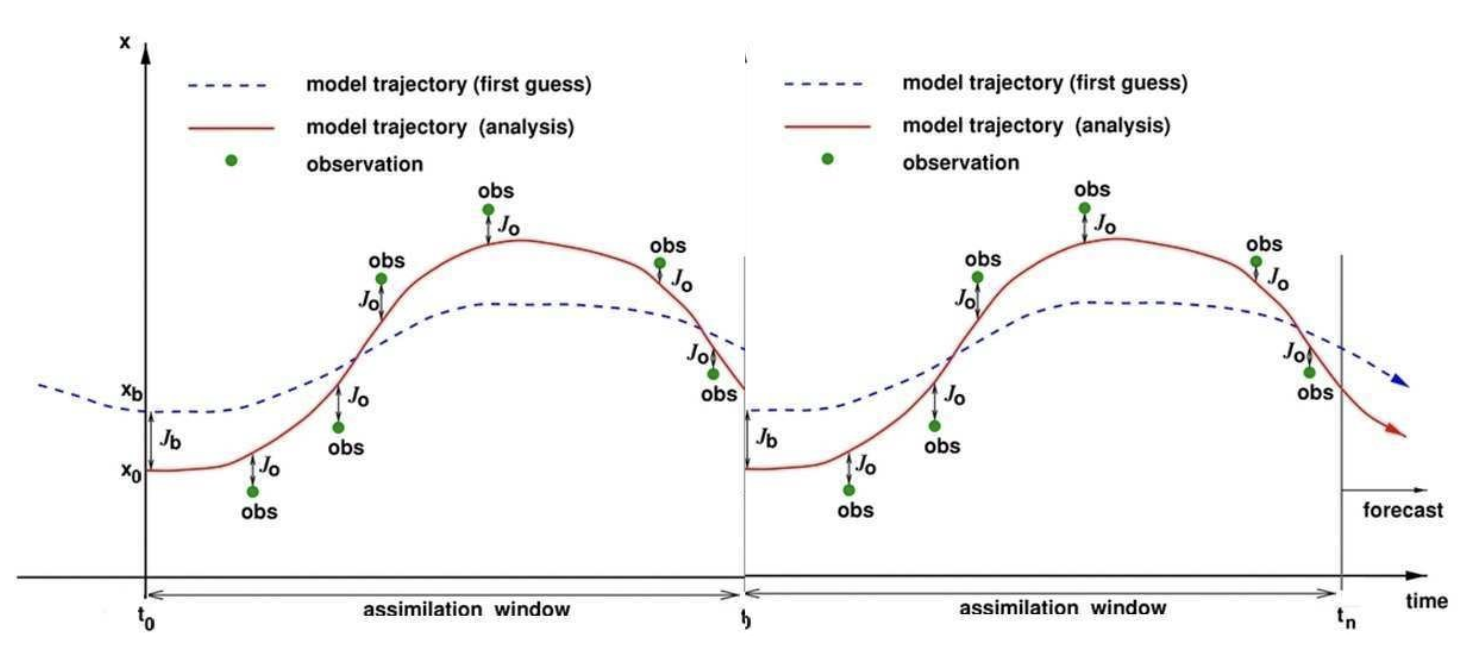
Figure 2: Illustration of temporal jumpiness across 4D-Var assimilation cycles in ERA5, motivating forecast-based training for temporal downscaling.
Probabilistic Training Objectives and Temporal Aggregates
HourGlass leverages an almost-fair CRPS loss well-suited for proper probabilistic verification (as detailed in [gneiting2007, lang2026aifscrps, price2025]). The base loss decomposes into mean absolute error and spread terms, penalizing deviation from truth and enforcing ensemble variability. To enforce temporal consistency, additional loss components penalize differences in minimum, maximum, mean, and stepwise differences of forecast values across the window. This ensures physically coherent evolution and reduces abrupt hour-to-hour fluctuations.
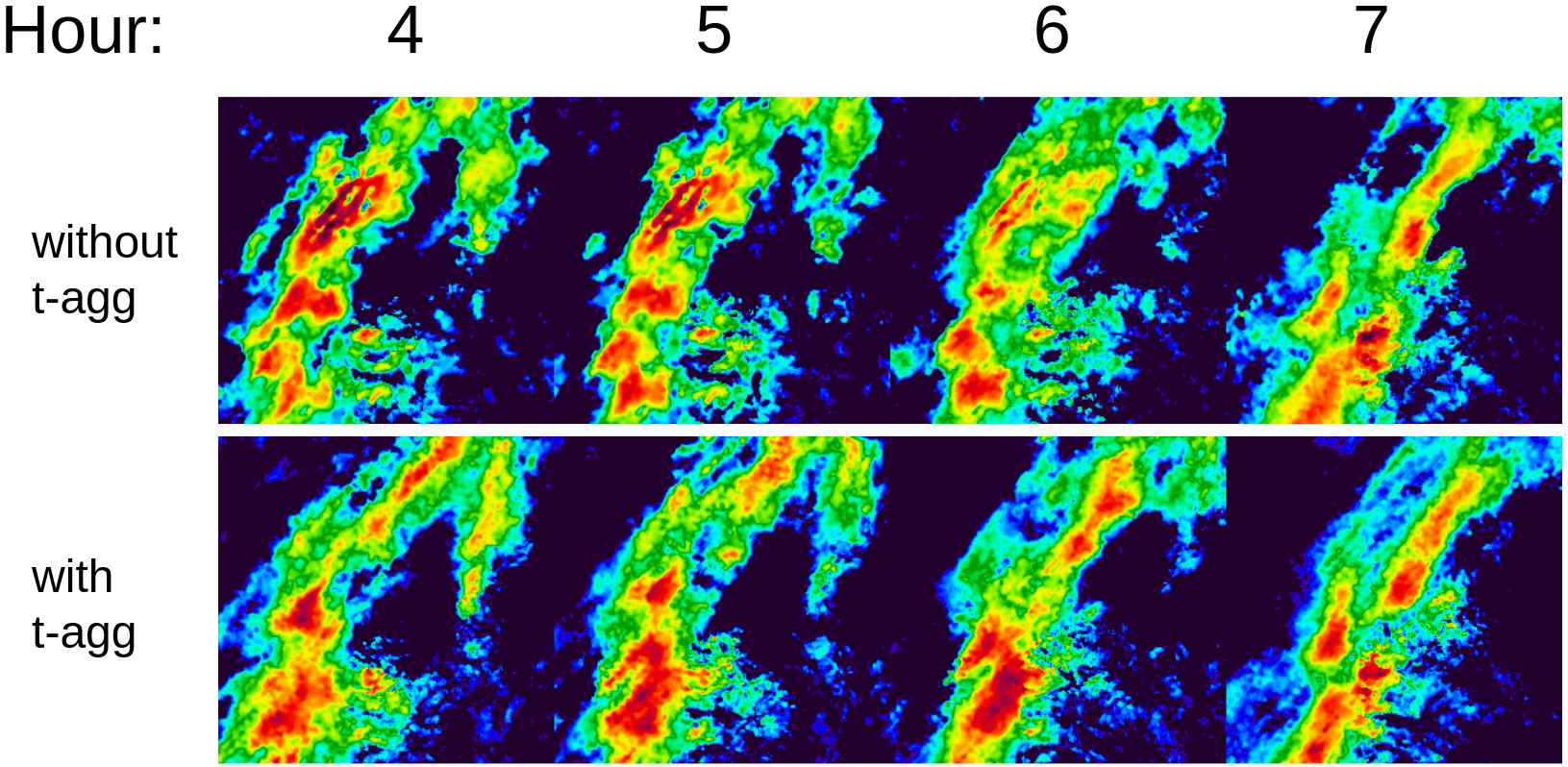
Figure 4: Impact of temporal aggregate loss terms—hourly precipitation forecasts trained with aggregate constraints exhibit smoother, more physically consistent evolution.
For regional subdomains, HourGlass incorporates a spatial consistency term via 2D FFT score, further enhancing realism of fine-scale spatial structures. The loss for each variable is normalized according to its empirical tendency variance, balancing contributions across multivariate fields.
Verification Results: Global and Regional Skill Preservation
Evaluations against SYNOP observations yield several key findings. Global AIFS-HourGlass applied to both deterministic and ensemble AIFS models shows hourly RMSE and CRPS evolutions closely tracking the skill trajectory of hourly IFS outputs within each 6-hour downscaling window (Figures 5–7). Inclusion of all temporal aggregate loss terms minimally impacts skill for temperature, wind, and pressure, but yields precipitation distributions closer to observations.
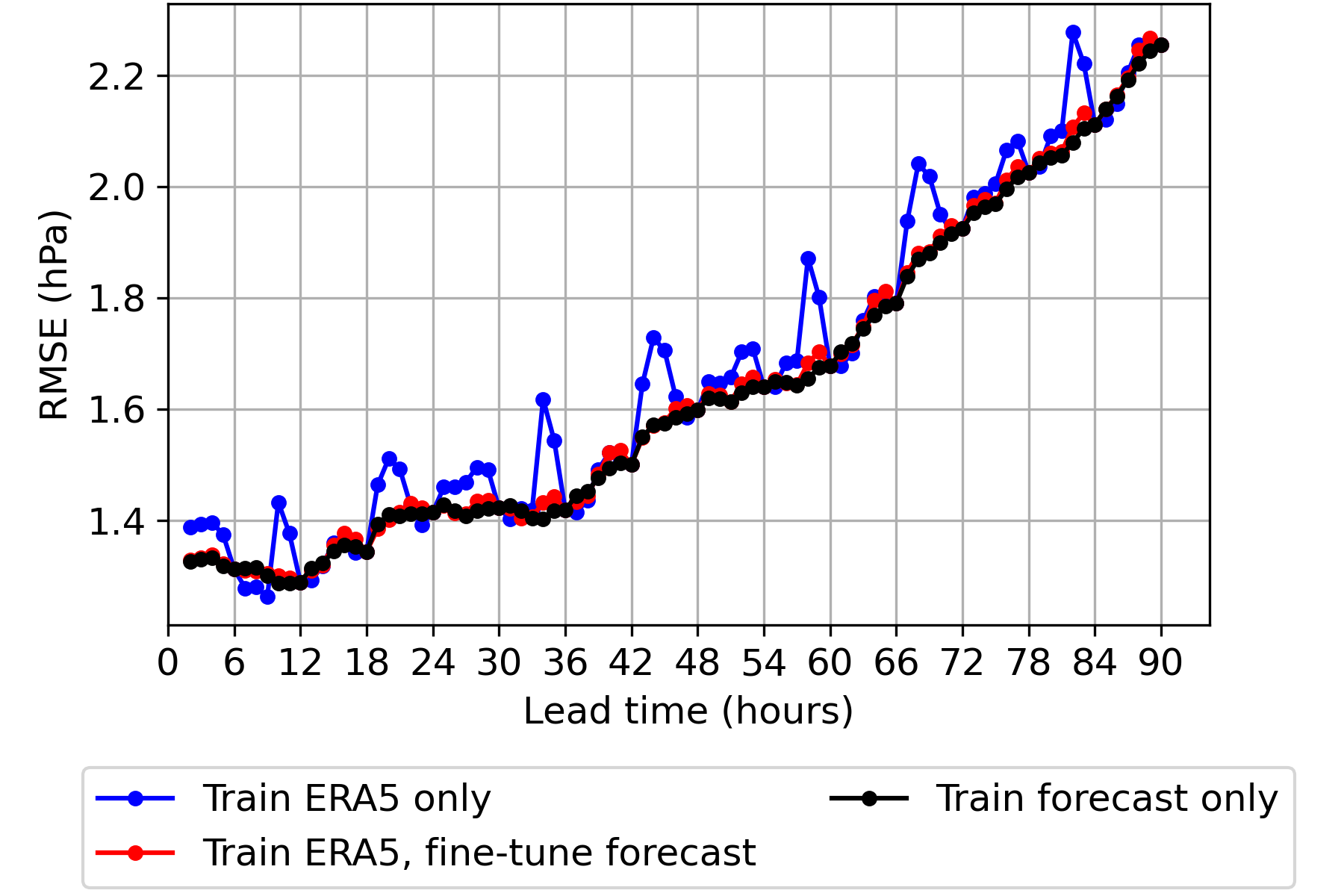
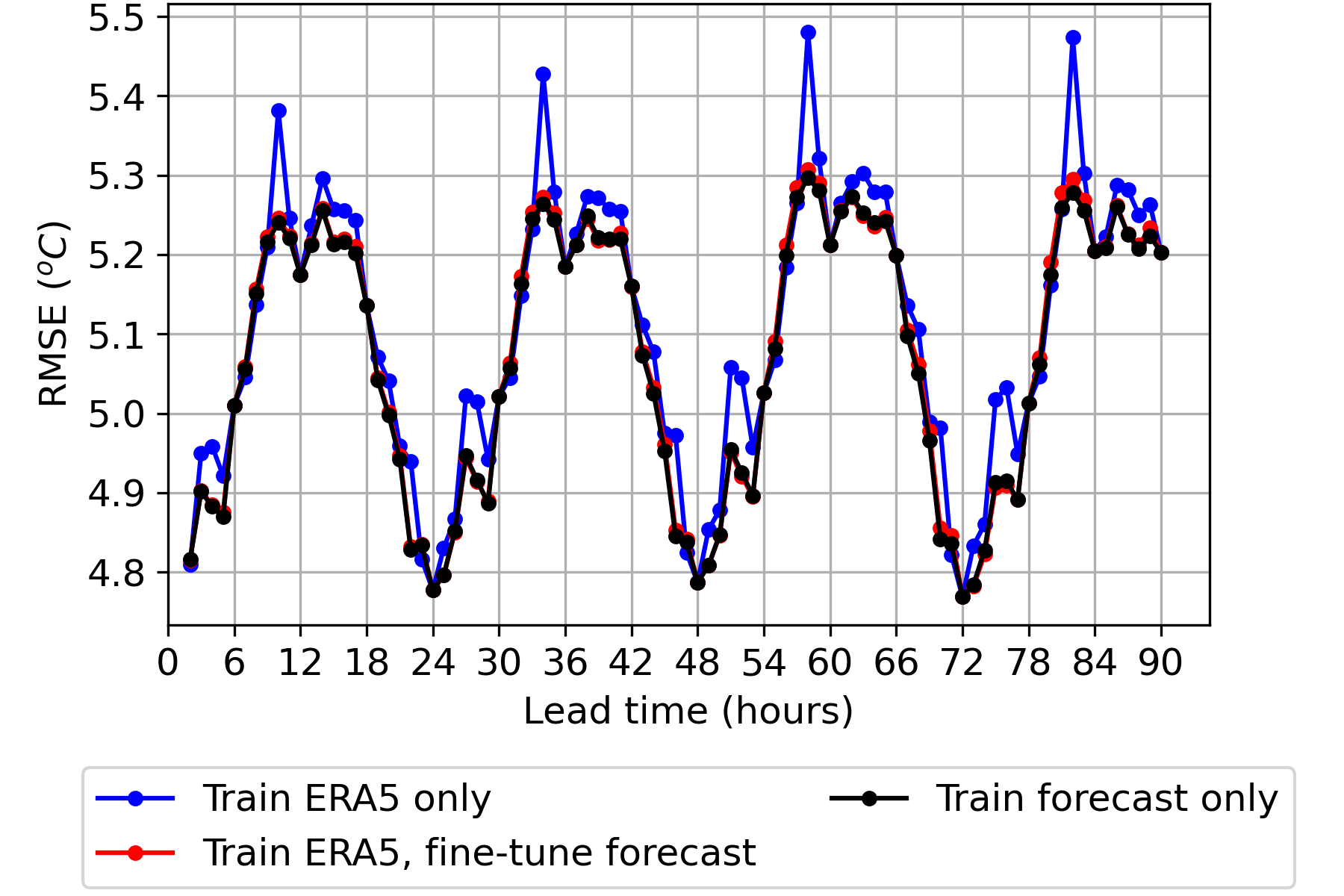
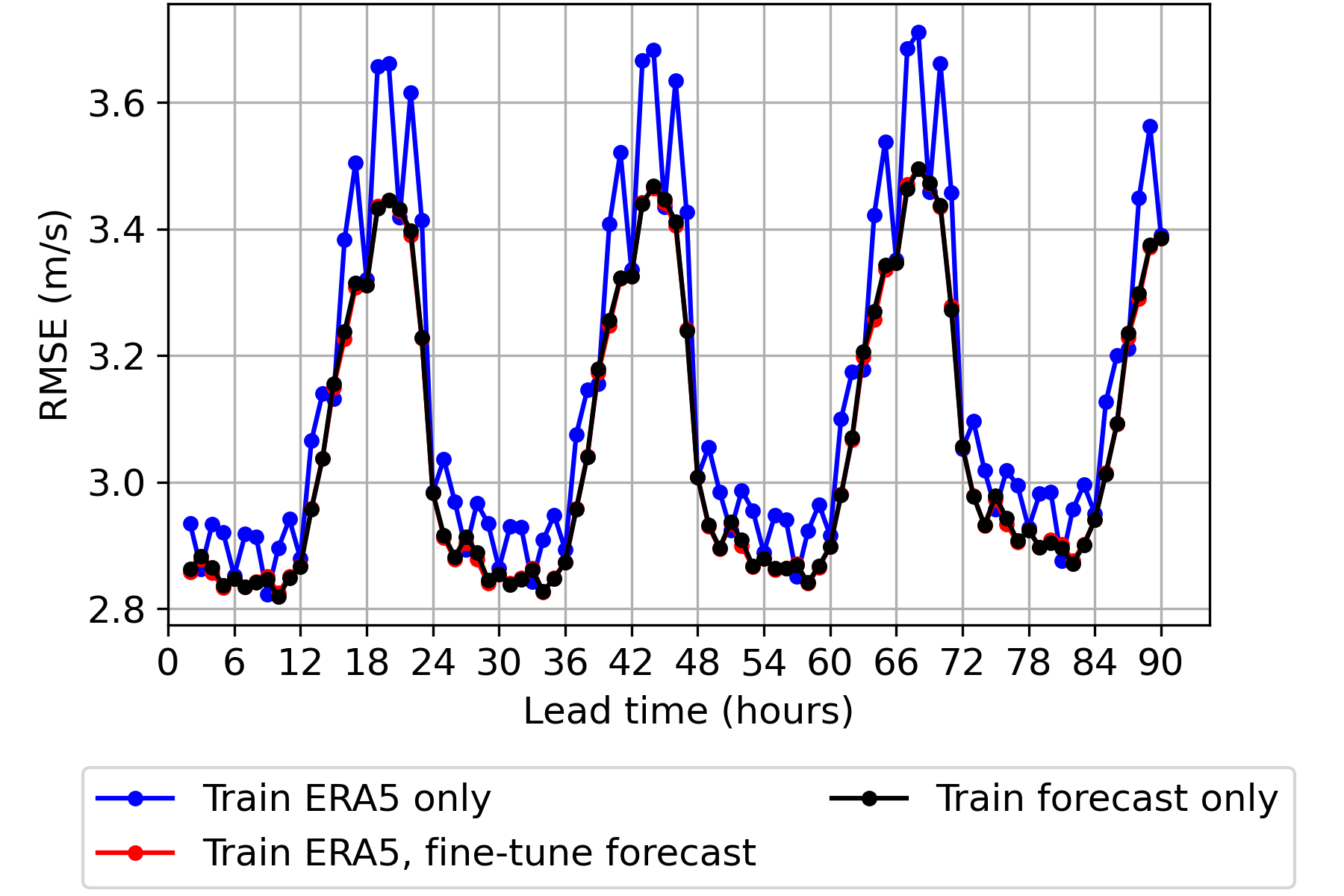
Figure 5: Hourly mean sea-level pressure RMSE for AIFS-HourGlass and IFS shows near-equivalent skill preservation across reconstructed windows.
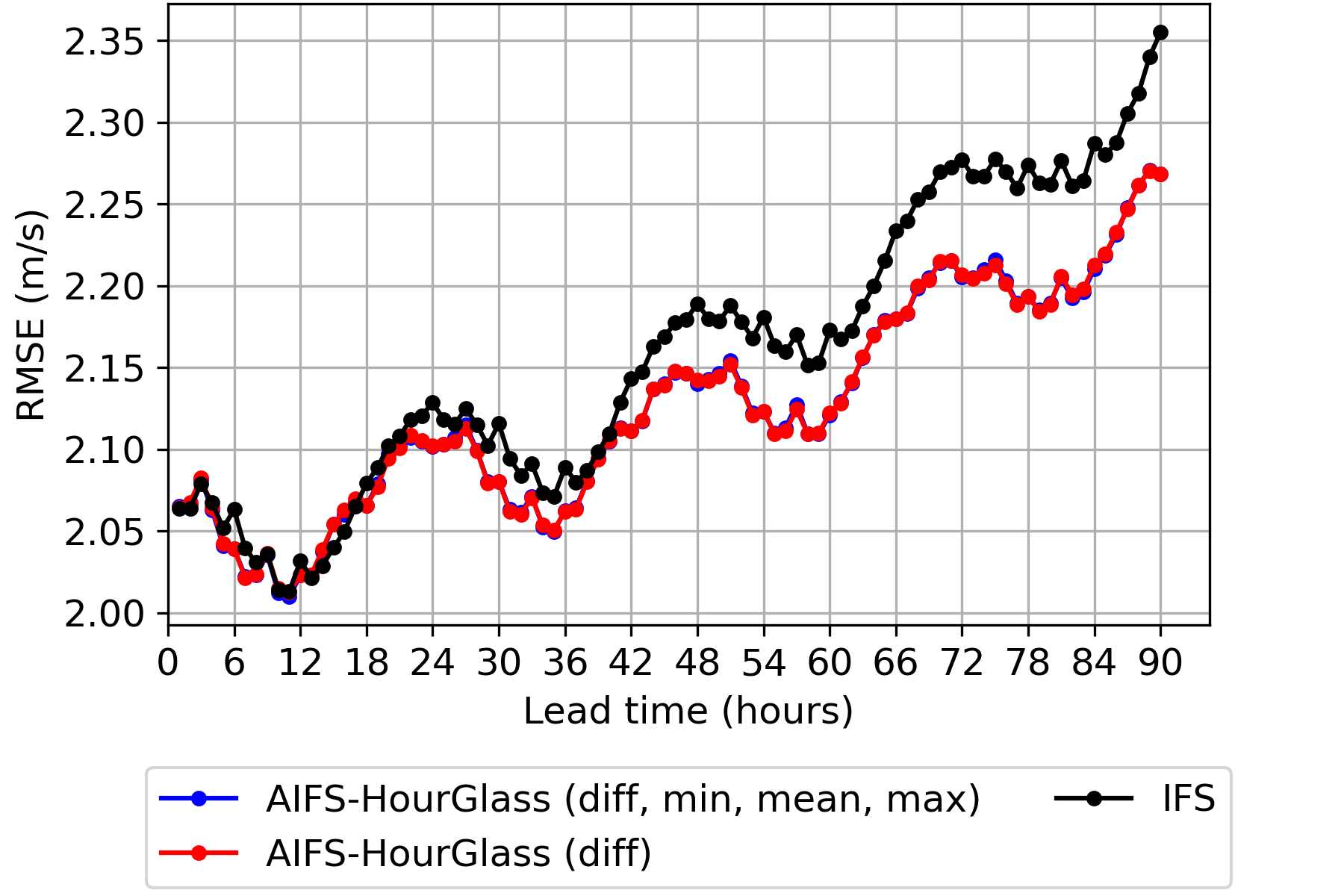
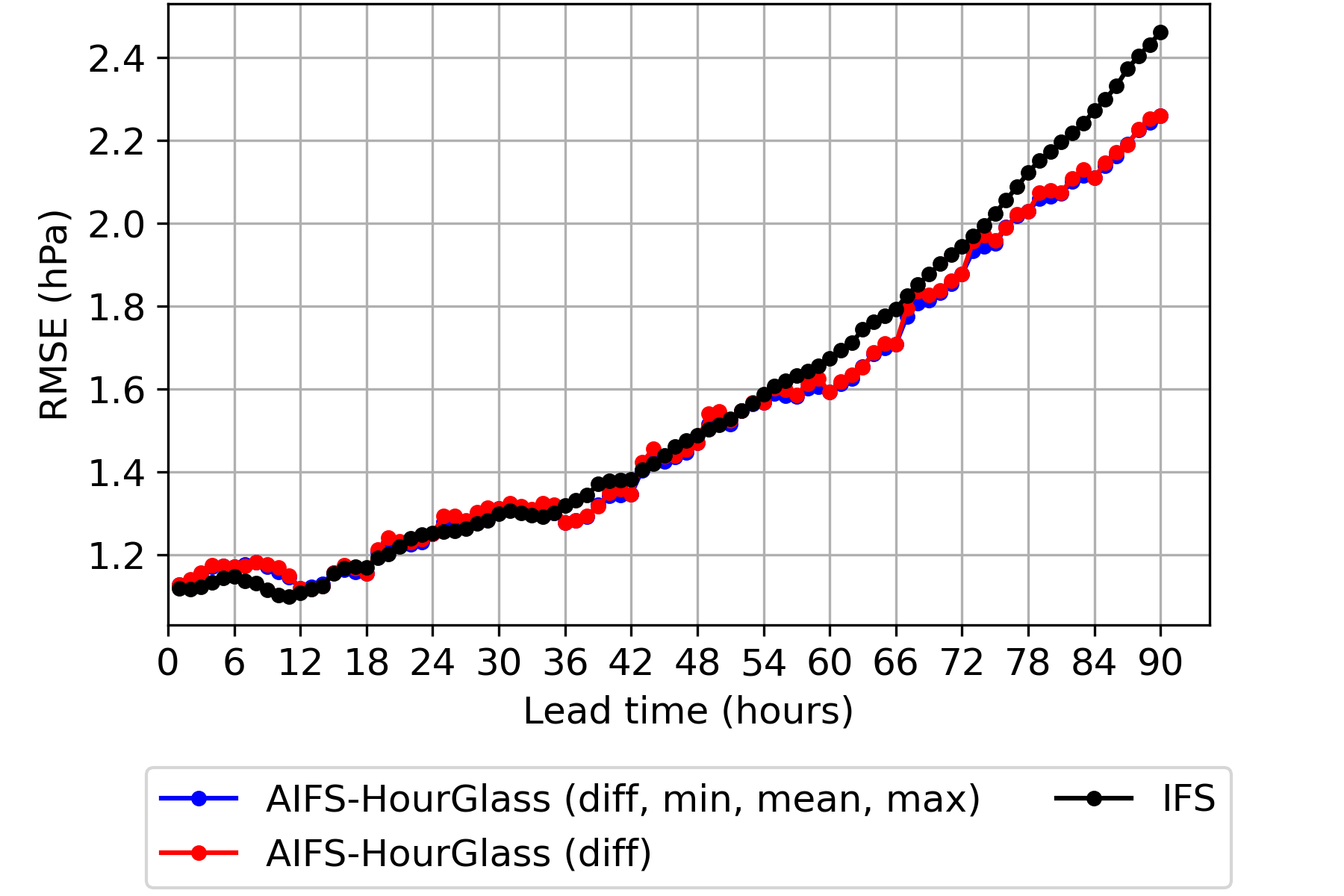
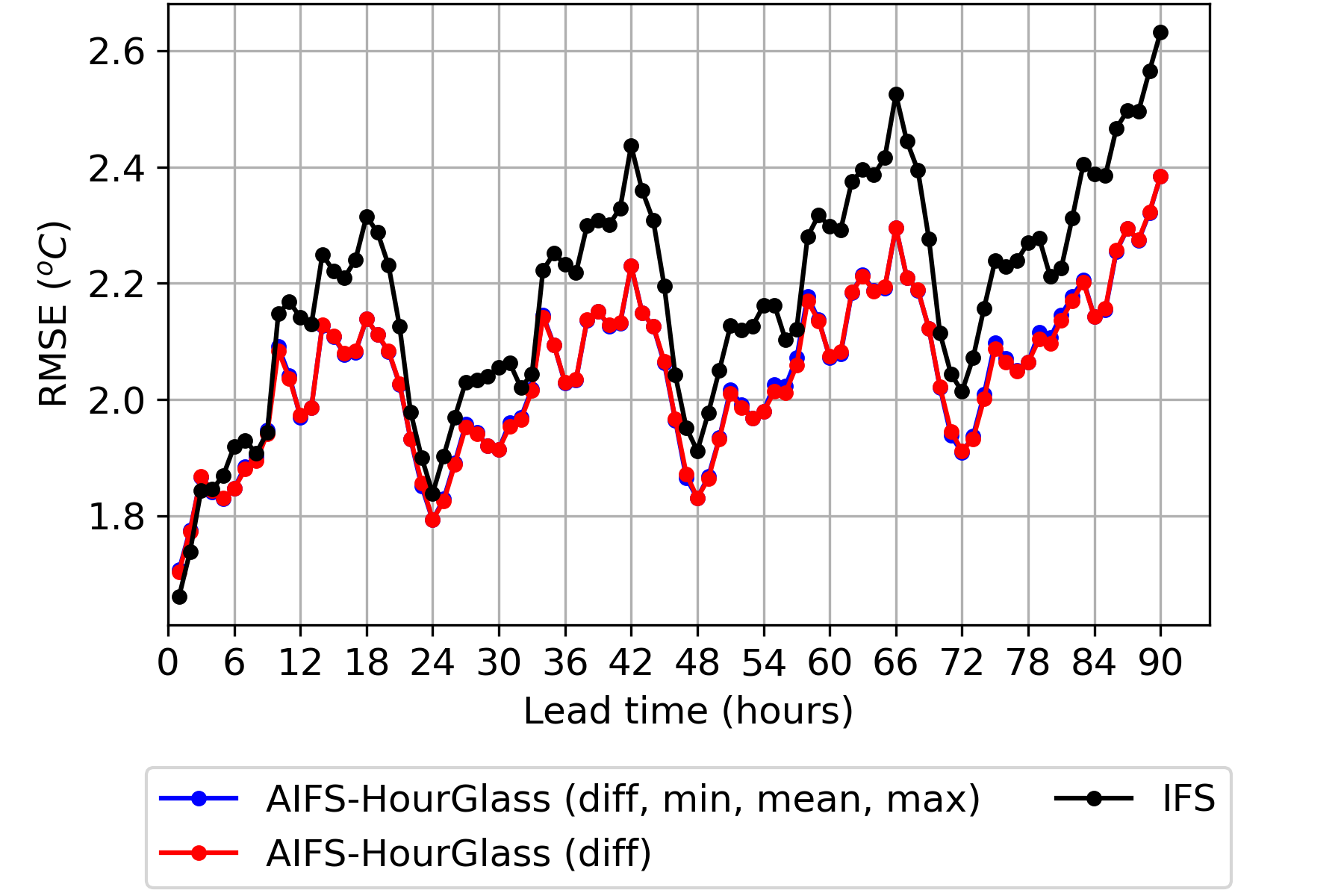
Figure 6: Hourly wind speed RMSE for AIFS-HourGlass and IFS demonstrates consistent temporal skill without artificial discontinuities.
Spectral analysis of precipitation reveals that HourGlass outputs exhibit enhanced small-scale variability relative to deterministic forecasts, reducing smoothing (Figure 7). Temporal increment spectra for surface wind indicate no excess smoothing at boundary transitions (Figure 8).
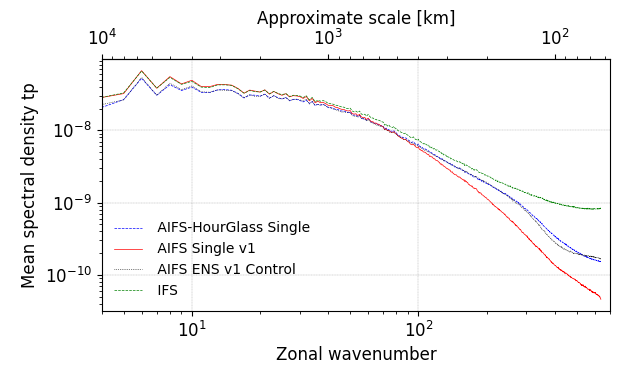
Figure 7: Precipitation spectrum comparison—AIFS-HourGlass delivers sharper small-scale precipitation structures akin to ensemble control, mitigating excessive smoothing of deterministic input.
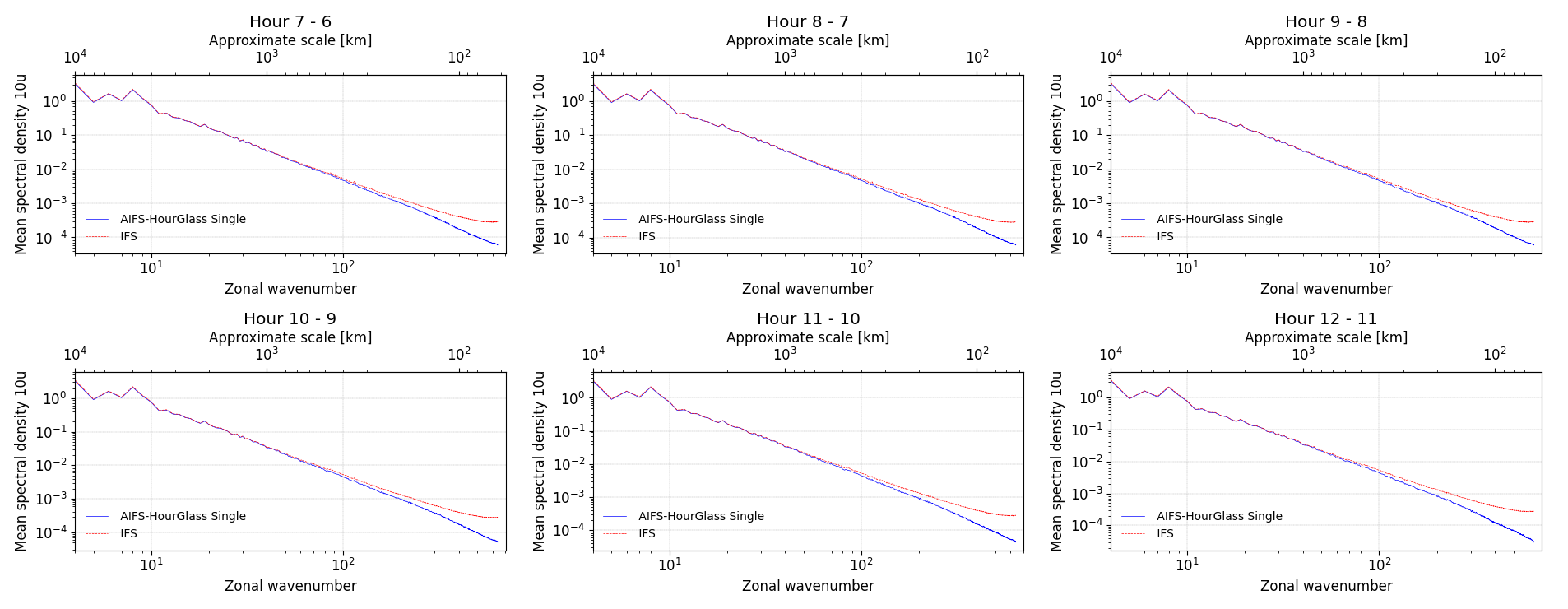
Figure 8: Temporal increment spectra for u-wind indicate HourGlass maintains sharp hour-to-hour variability across the reconstructed window, confirming temporal realism.
Bris-HourGlass, evaluated against MEPS ensemble forecasts, shows competitive scores for pressure, temperature, and wind (Figure 9). For precipitation, HourGlass improves spatial realism but underestimates extremes, particularly near anchor boundaries (Figure 10, Figure 11).
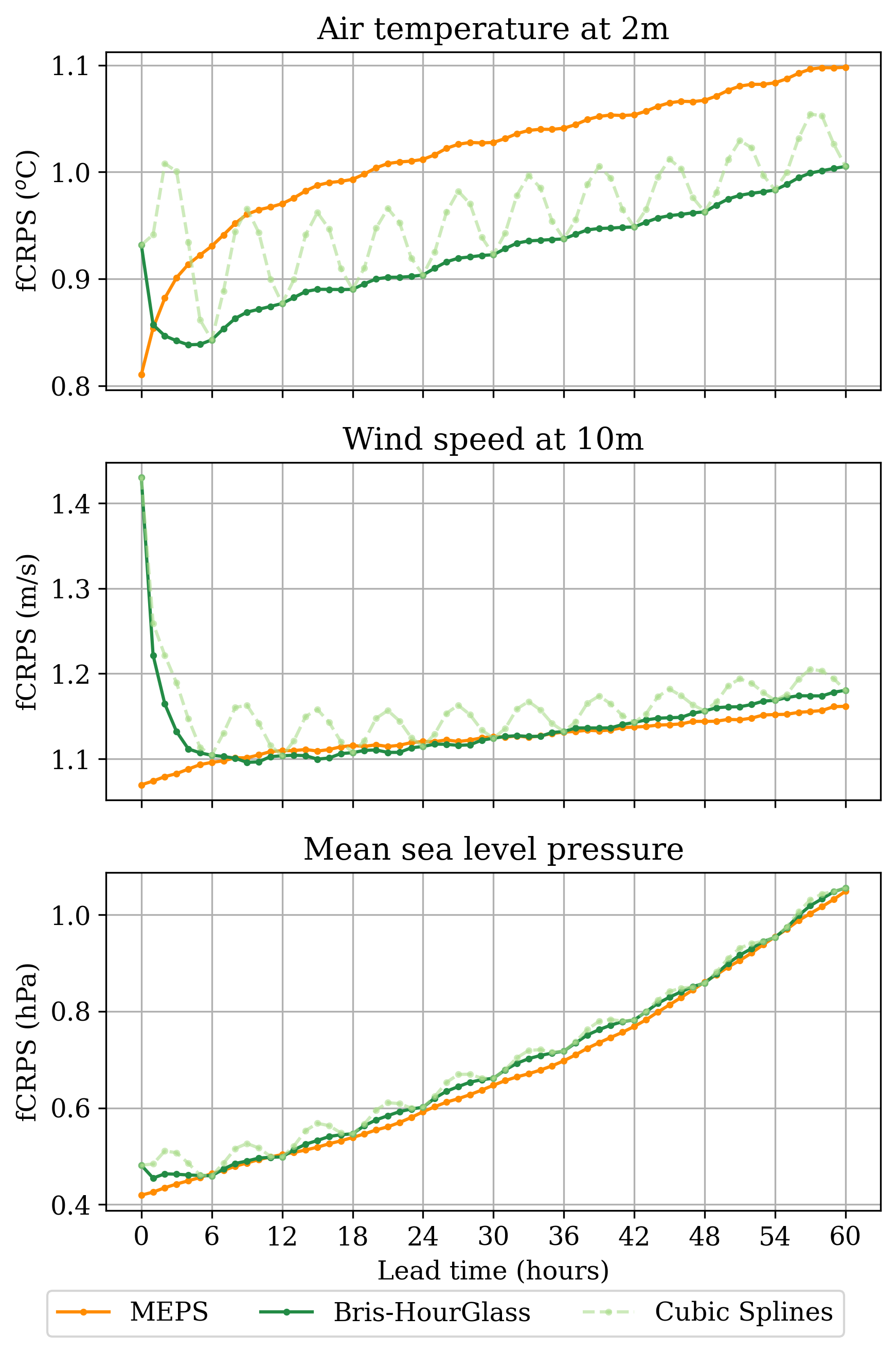
Figure 9: Fair CRPS comparison for surface variables—Bris-HourGlass achieves parity or improvement over MEPS and cubic interpolation baselines.
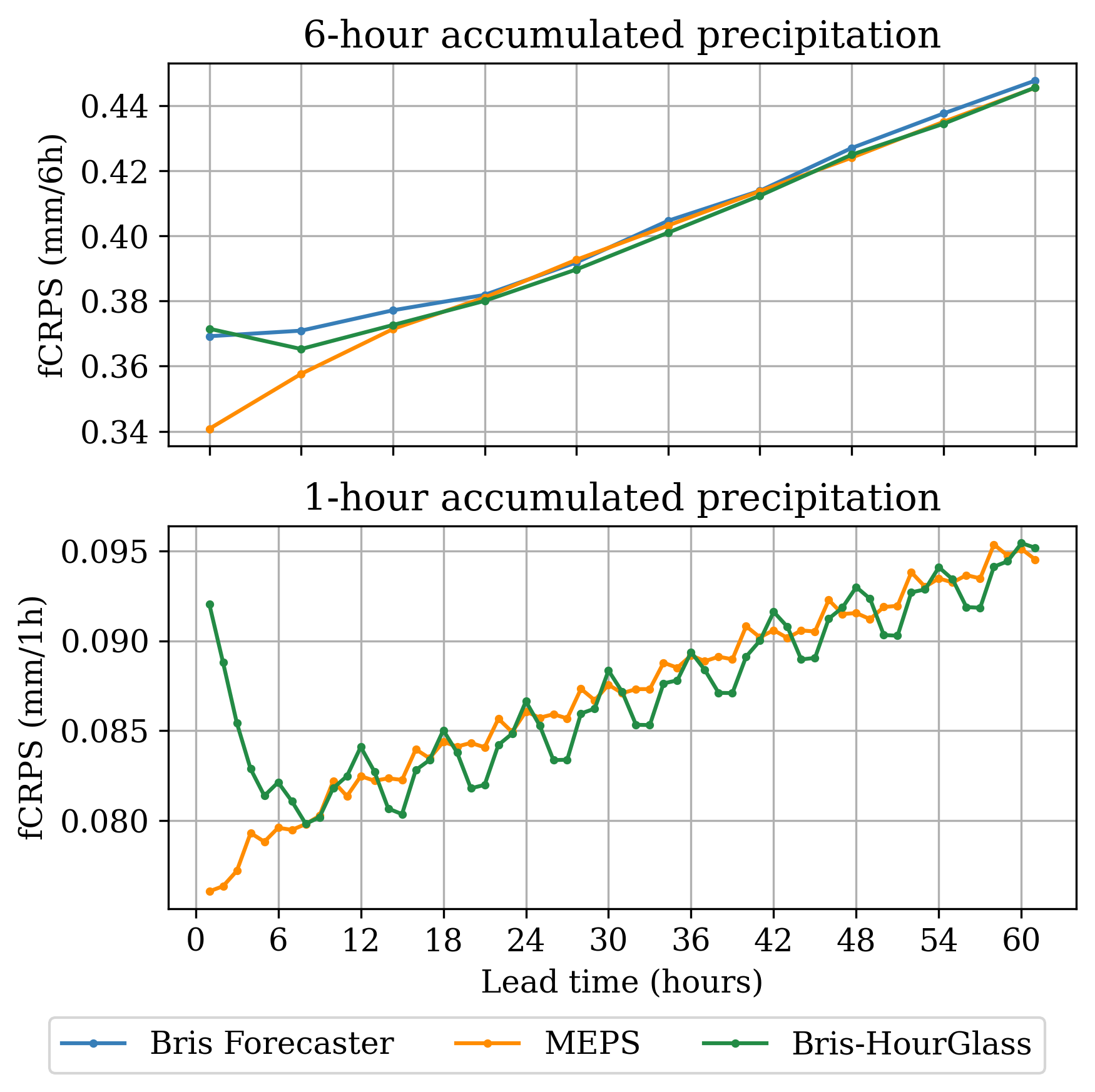
Figure 10: Bris-HourGlass hourly and 6-hourly precipitation CRPS, demonstrating improvement over upstream models, but boundary effects persist.
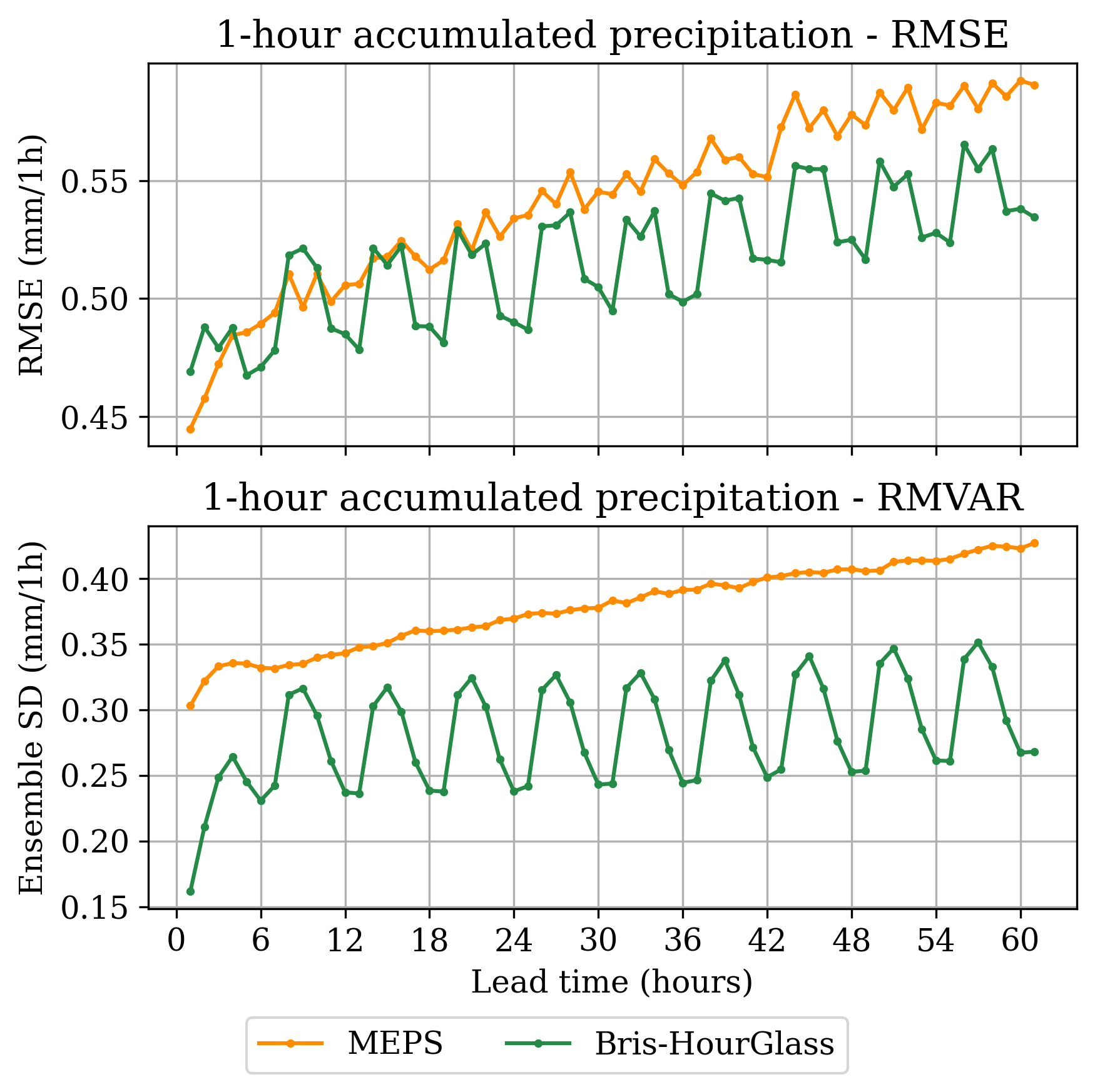
Figure 11: RMSE and spread statistics for hourly precipitation reveal increased spread toward window center and reduced RMSE near anchor times.
Bias analyses illustrate how reliance on temporal boundaries impacts the precipitation mean, with HourGlass relaxing toward its learned distribution away from anchor states (Figure 12). HourGlass adds significant value for extremal diagnostics such as 24-hour max temperature and wind, outperforming cubic splines interpolations (Figure 13).
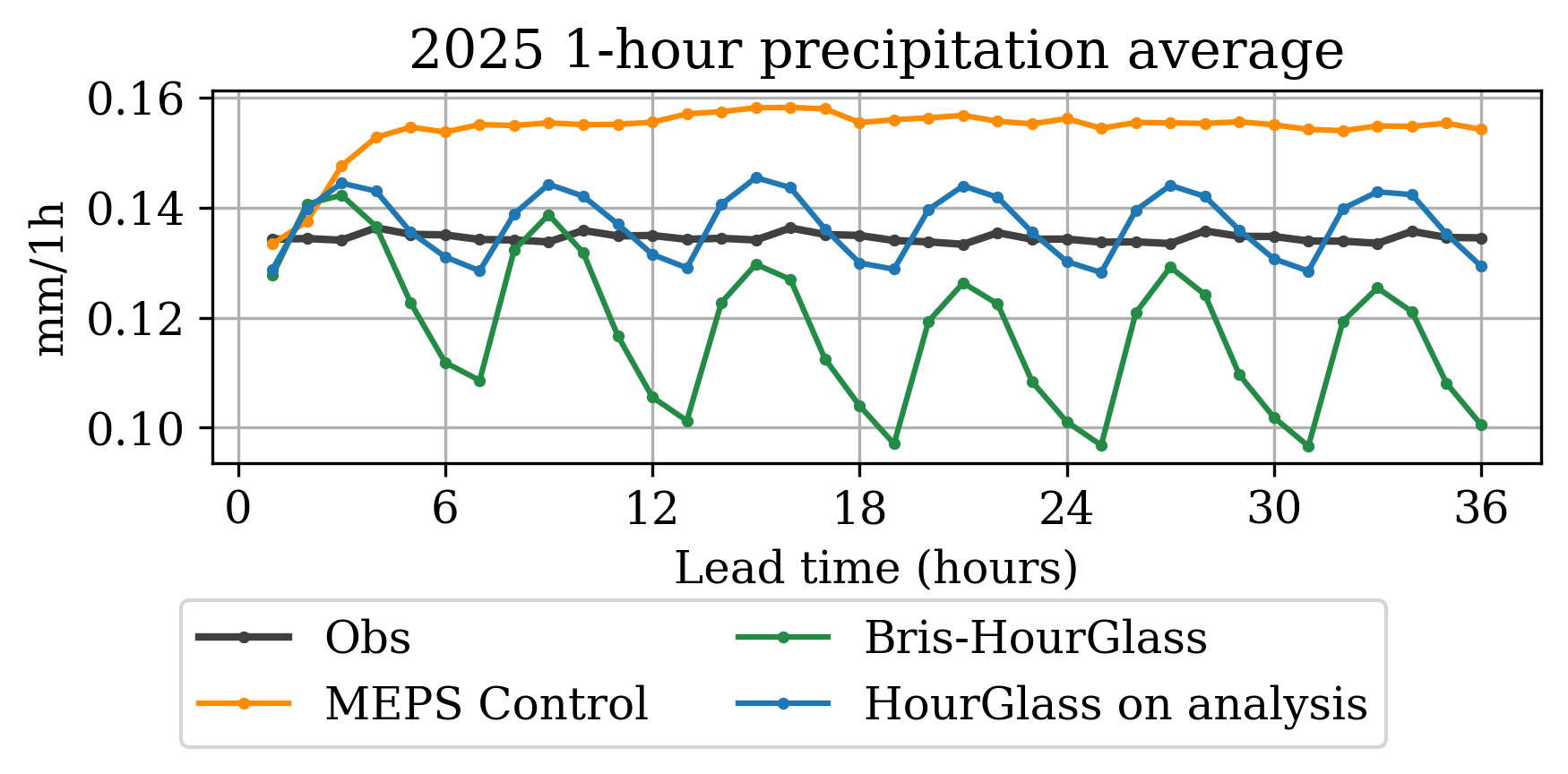
Figure 12: Validation-period mean precipitation bias comparisons for Bris-HourGlass, MEPS, and SYNOP observations across anchor initializations.
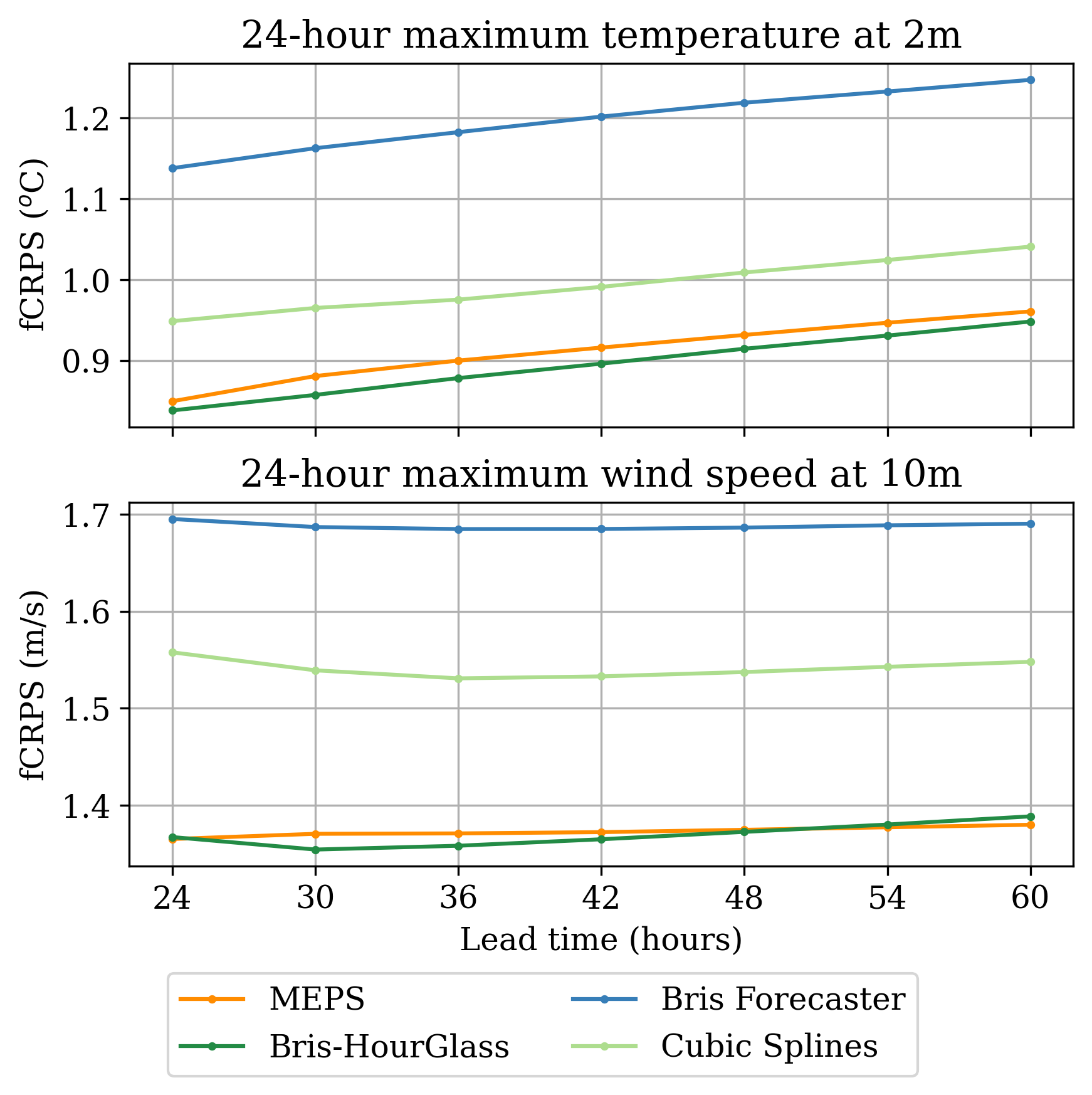
Figure 13: CRPS for 24-hour maxima highlights the utility of hourly downscaling for capturing peak values.
Case Studies: Dynamic, Convective, and Extreme Events
Case study analyses of extratropical cyclone Amy and a convective outbreak in the US Southern Plains demonstrate HourGlass's capability to reconstruct temporally consistent, physically plausible trajectories during rapidly evolving weather scenarios. Bris-HourGlass captures the timing and general intensity of precipitation and wind peaks during Amy, with spatially coherent movement and gradients. AIFS-HourGlass exhibits realistic evolution, though misses some sharp local maxima.
These results emphasize that while HourGlass improves spatial variability and smooths transitions, final accuracy remains limited by the upstream forecast and the inherent challenges in modeling extreme precipitation.
Implications, Limitations, and Future Directions
HourGlass establishes a framework for probabilistic temporal downscaling that preserves upstream forecast skill and enhances temporal and spatial realism at hourly resolution. Key implications include:
- Operational Utility: HourGlass outputs are suitable for downstream applications demanding hourly frequency, including hydrologic modeling, severe weather detection, and renewable energy forecasting.
- Temporal and Spatial Consistency: Probabilistic, aggregate-constrained training prevents temporal smoothing and maintains realistic small-scale variability, overcoming key limitations of MSE-based methods.
- Limitations in Extreme Precipitation: Like other MLWP models [xu2024, ben2024rise, price2025], HourGlass underestimates local precipitation extremes and remains bounded by the upstream forecast's skill and distribution. Improvements to upstream models or advanced loss formulations (multiscale CRPS [lang2025], amplitude/frequency-specific spectral regularization [subich2025], energy score-based generative frameworks [schillinger2025]) are promising avenues.
- Path Forward for AI Meteorology: HourGlass demonstrates scalable, operationalizable solutions for global and regional hourly downscaling; customizing training regimes near window boundaries and further constraining spatial variability via multiscale aggregate losses are logical extensions.
Conclusion
HourGlass provides a principled probabilistic temporal downscaling methodology for MLWP models, bridging the operational gap between 6-hourly forecasts and hourly applications. Through aggregate-augmented CRPS training and forecast-based datasets, it preserves upstream skill while enhancing temporal coherence and spatial structure, particularly for temperature, wind, and pressure. Remaining challenges in extreme precipitation forecasting reflect broader limitations of contemporary MLWP architectures and loss functions. The HourGlass framework is a robust template for operational hourly weather products and a foundation for future advancements in probabilistic, temporally consistent atmospheric AI models.