- The paper demonstrates that detailed Sérsic and bulge–disk decompositions unveil distinct mass–size relations for star‐forming and passive galaxies.
- It shows that star-forming galaxies follow a steeper MSR (slope ≈0.33) compared to a flatter relation (slope ≈0.10) for passive galaxies, indicating different evolutionary pathways.
- The analysis confirms a strong local density-driven quenching, with the passive fraction increasing from ~20% to ~60%, establishing an emerging passive–density relation in protocluster environments.
Mass–Size Evolution and Environment-Dependent Quenching in the Spiderweb Protocluster at z=2.16: Insights from JWST/NIRCam
Overview and Context
This work examines the mass–size relation (MSR) and the environmental dependence of galaxy structure in the Spiderweb protocluster (PKS1138-262) at z=2.16, leveraging JWST/NIRCam F115W, F182M, and F410M imaging. The analysis synthesizes single Sérsic and bulge–disk decompositions for a homogeneously selected member sample, with an emphasis on both structural scaling relations and the passive–density relation, addressing open questions on how environment drives quenching and structural transformation in forming clusters.
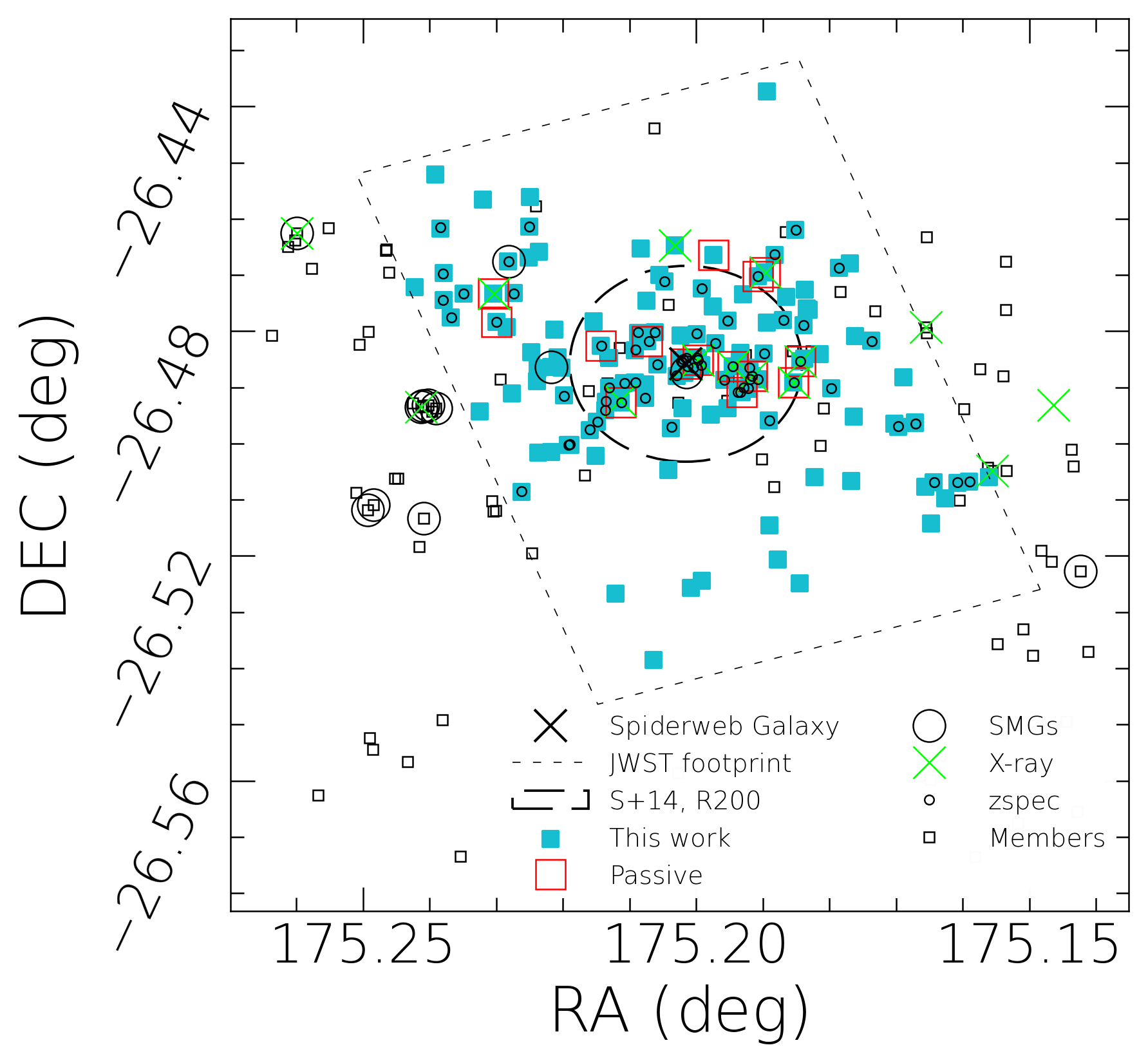
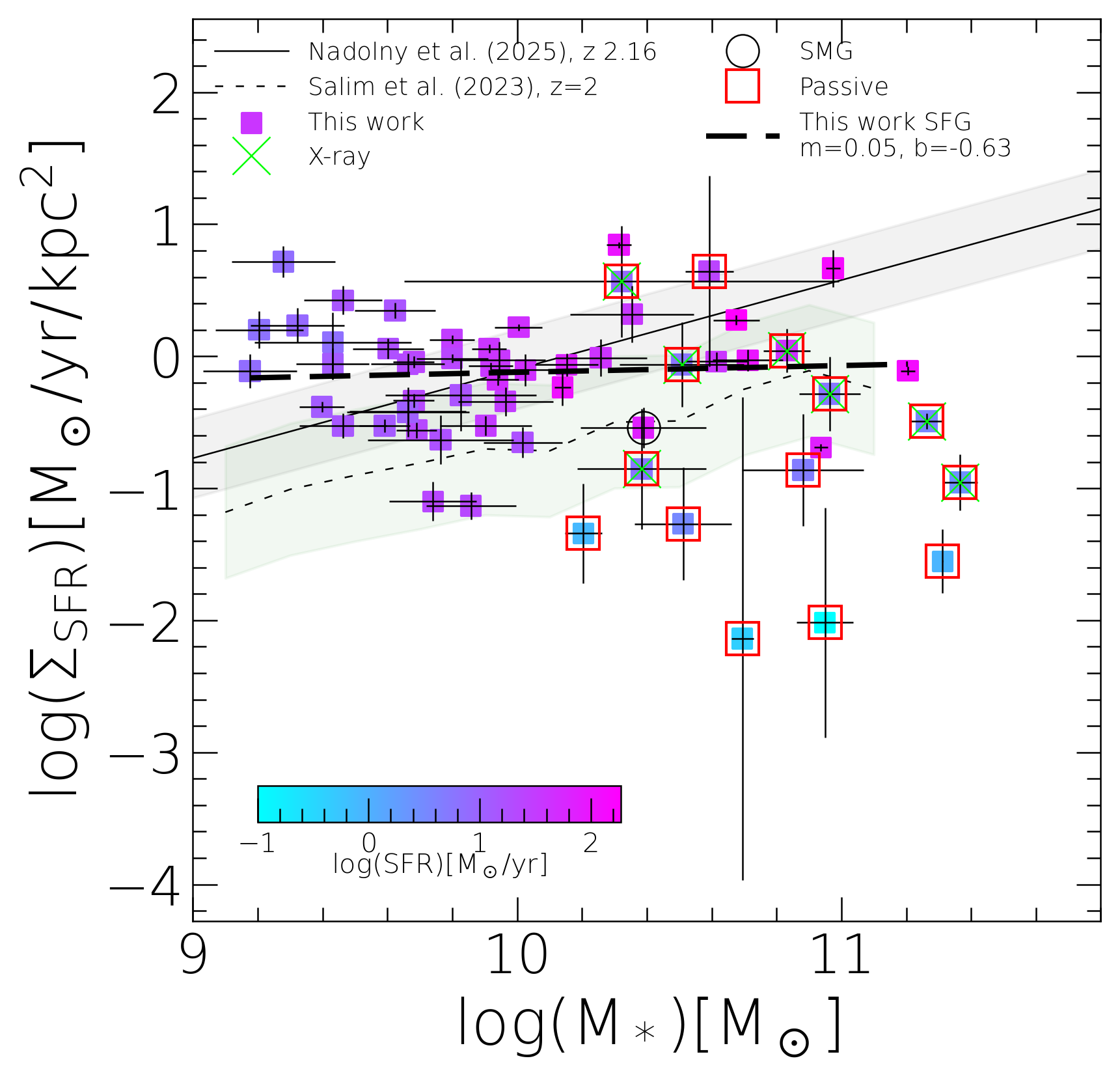
Figure 1: Spatial distribution of Spiderweb protocluster member and ancillary galaxies, delineated by categorization and spectroscopic status.
Data and Methodology
The study incorporates 103 protocluster galaxies within the NIRCam field of view, including Hα emitters (HAEs), photometrically selected members, and submillimeter/X-ray galaxies. Morphological parameters are extracted using GALAPAGOS-2/GALFIT-M, allowing for wavelength-dependent modeling and multi-component bulge–disk decompositions. Environmental density is quantified using the projected third-nearest neighbor metric (Σ3). Star formation activity is classified based on a galaxy's offset from the star-forming main sequence (SFMS), facilitating robust identification of passive versus active systems without relying exclusively on rest-frame color criteria.
Mass–Size Relation Across Environment and Population
The structural analysis reveals a mass–size relation for Spiderweb star-forming galaxies (SFGs) that is broadly consistent with field SFGs, albeit with a slight steepening at the high-mass end. Specifically, the MSR for SFGs yields a slope m=0.33±0.08 and an intercept b=0.62±0.07 (at M∗=5×10¹⁰M⊙), with a mean Reff,F182M=2.80±0.15 kpc.
The passive galaxy population, in contrast, displays a significantly flatter MSR (m=0.10±0.16) and larger typical sizes than passive field counterparts, with an intercept b=0.20±0.06 (z=2.160 kpc). The dispersion is comparable between both populations at z=2.161 dex.
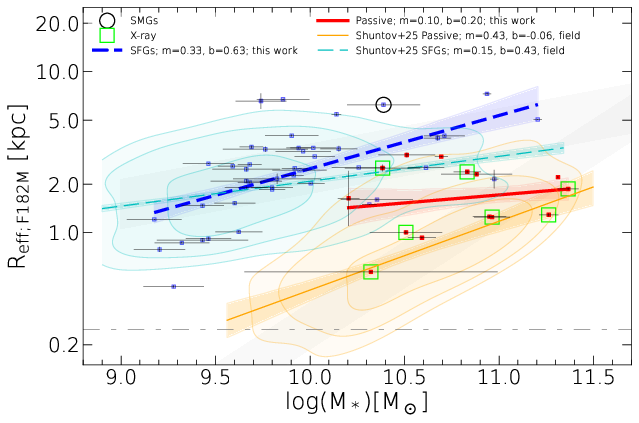
Figure 2: Mass–size relation using NIRCam/F182M single-Sérsic effective radii for SFGs and passive members in the Spiderweb protocluster. Comparison is made with both field and cluster samples.
A salient finding is that passive Spiderweb galaxies are systematically larger than field passive galaxies but remain smaller than cluster early-type galaxies at similar redshift, indicating an intermediate evolutionary phase wherein quenching precedes canonical size growth observed in more evolved clusters.
The study extends to bulge–disk decompositions in three NIRCam bands. Across all populations, bulges are consistently more compact than disk components by z=2.162–z=2.163 dex. SFG bulges are significantly larger than those of passive galaxies (up to 160% in F115W), contrasting with field galaxy trends at lower redshift and consistent with the rapid structural evolution at z=2.164.
Passive galaxies across the Spiderweb environment show stable MSR slopes/intercepts across bands, supporting a scenario of simple morphologies (high Sérsic indices), while SFGs demonstrate flatter MSRs and stronger wavelength dependence, especially for disk components. Notably, ALMA-selected dusty SFGs manifest steeply declining sizes with increasing wavelength, reflecting centrally concentrated dust-obscured star formation within extended stellar disks.
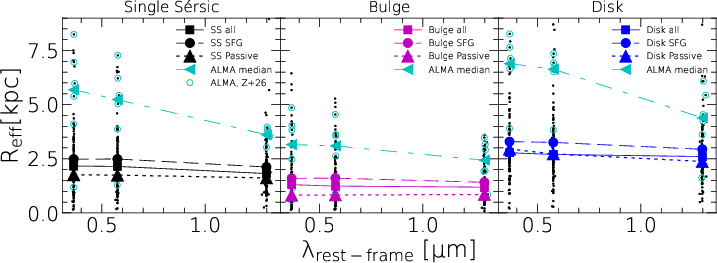
Figure 3: Effective radius as a function of rest-frame wavelength for the total, SFG, and passive populations, with ALMA-detected dusty massive galaxies highlighted.
Evolution of the Mass–Size Relation Intercept
A critical quantitative result is the environmental placement of MSR intercepts as a function of redshift. For Spiderweb SFGs, the intercept aligns closely with field SFGs, whereas for passives it is z=2.165 dex above the field but z=2.166 dex below cluster values.
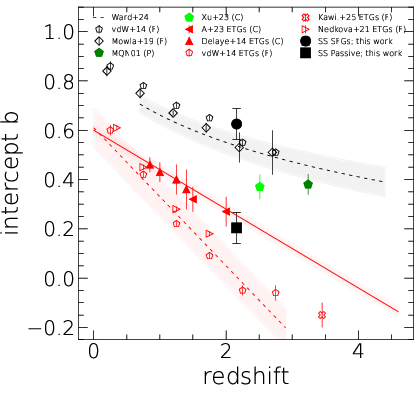
Figure 4: Best-fit MSR intercept as a function of redshift, evaluated at z=2.167, comparing Spiderweb to field and virialized clusters.
This intermediate value signals that in dynamically young, assembling protoclusters, environmental quenching precedes, and possibly accelerates, the arrival of newly quenched, larger, passive galaxies—invoking progenitor bias—before merger-driven size growth dominates as in mature clusters.
Passive–Density Relation and Environmental Quenching
The passive fraction increases monotonically with projected local density: from z=2.168 at z=2.169 gal/Mpcα0 (consistent with the field) to α1 above α2 gal/Mpcα3. There is no significant residual dependence on clustercentric (global) radius up to α4, underscoring the dominance of local (group-scale) overdensity in regulating quenching at α5.
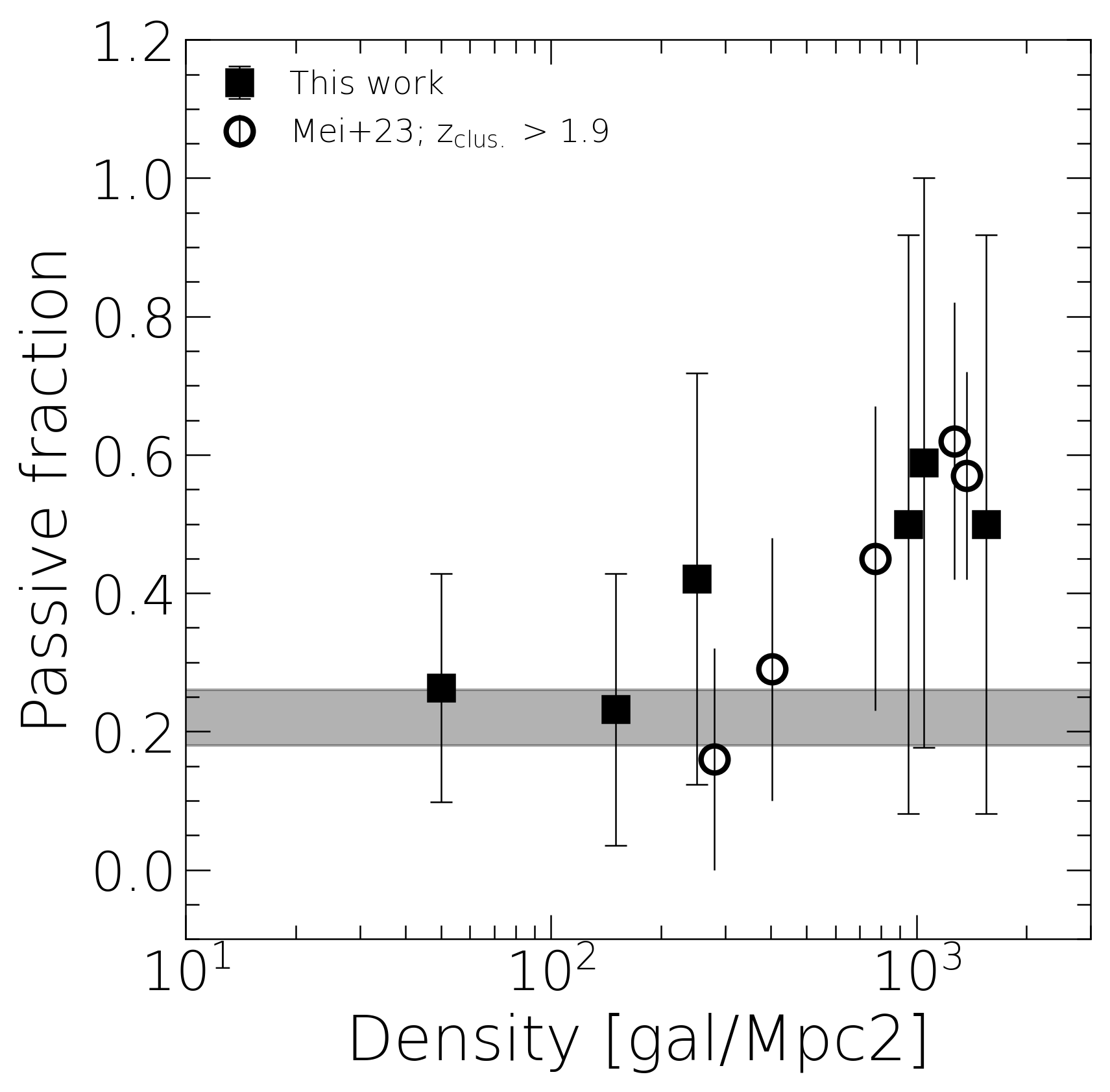
Figure 5: Fraction of passive galaxies as a function of projected local density.
A weak but significant positive correlation exists between local density and Sérsic index, predominantly in redder bands (most significant in F410M). This is consistent with a morphology–density relation in place early in cluster assembly, where denser environments preferentially host galaxies with more centrally concentrated stellar light profiles.
Implications and Prospects
These results imply that environmental quenching and the emergence of the passive–density (morphology–density) relation are established at the protocluster stage, prior to virialization. The offset in the MSR for passive galaxies suggests that structural transformation and the stellar mass assembly of the quiescent population are partially decoupled. This supports a progenitor bias scenario, wherein larger galaxies are quenched in overdensities, and only subsequent cluster evolution (e.g., dry minor mergers, galaxy–galaxy encounters) drives additional size evolution.
From a practical perspective, this work refines the benchmarks for theoretical and semi-analytic models of galaxy evolution in dense environments at cosmic noon. It also demonstrates the incisive power of JWST/NIRCam multi-filter, multi-component decomposition on complete protocluster samples. Further exploitation of these techniques, especially with larger uniform samples across multiple forming clusters, will facilitate stronger constraints on the timing and mechanisms of size and morphological transformation, the interplay between dusty star formation and structural growth, and the calibration of environment-dependent quenching scenarios.
Conclusion
This paper delivers a comprehensive, uniform analysis of the mass–size relation, star formation quenching, and environmental dependence of galaxy structure in the Spiderweb protocluster at α6 through advanced JWST/NIRCam imaging. The MSR for passive protocluster galaxies is flatter and offset to larger sizes compared to the field, and the passive fraction exhibits a pronounced dependence on local overdensity but not global position, confirming early emergence of the passive–density relation. The study advocates for the critical interleaving of progenitor bias, environmental and internal processes in dense group/cluster environments, and provides a framework for future, deeper investigations into cluster assembly and galaxy evolution at high redshift (2607.11448).