- The paper identifies SCGG-z5, a compact proto-group at z~5 with six closely associated galaxies, offering new insights into early group-driven baryonic assembly.
- It applies high-resolution JWST photometry and grism spectroscopy to perform multi-band SED modeling and Hα-based SFR analysis, revealing detailed spatial star formation and mass assembly gradients.
- The study demonstrates that the system is dark matter dominated with rapid dynamical evolution, which provides a critical test for models of early massive galaxy formation.
Compact Galaxy Group Assembly at z∼5: Insights from SCGG-z5
Introduction and Scientific Context
The formation pathways of massive galaxies in high-density environments remain a principal focus in observational cosmology, especially given the persistent underprediction by cosmological simulations of massive quiescent galaxy counts at z>4. Hierarchical assembly driven by mergers and efficient in situ star formation is predicted to dominate the early growth of these systems, particularly within peak-density structures such as proto-clusters and compact groups. Within this paradigm, short-lived, physically compact galaxy groups represent a crucial, yet rarely observed, evolutionary phase where group-driven baryonic and dynamical effects are expected to accelerate morpho-kinematic transformation and baryonic assembly.
The discovery of SCGG-z5, a spectroscopically confirmed compact proto-group at z=4.97 within the JWST SAPPHIRES Early Data Release, presents one of the clearest direct probes of this environment. Its six confirmed galaxies reside within a projected diameter of ∼16 kpc, with total stellar mass log(M∗/M⊙)=10.07±0.04 and a dark-matter-dominated group halo as inferred from group dynamics. This system provides high-resolution, multi-band JWST photometry and grism spectroscopy, enabling a combined resolved and integrated analysis of star formation, mass assembly, and dynamical state at a key cosmic epoch.
Identification and Group Characterization
SCGG-z5 was isolated via a statistically robust Poisson analysis of spectroscopic overdensities in Hα emission redshifts, yielding Nobs=58 emitters ($4.89 < z < 5.05$) with a 7.1σ deviation from field expectations. Within this spike, a contiguous core of six galaxies satisfies both spatial (<16.1 pkpc) and line-of-sight velocity (z>40 km sz>41) requirements for physical association, all with secure grism-based redshifts. This system is embedded within a broader overdensity, but only the compact six-member configuration probes the physically extreme, pre-coalescent group regime.
Each member's stellar population parameters were inferred through bagpipes SED modeling using 13-band NIRCam photometry. The galaxies span z>42, with the group total mass surpassing completeness limits at this redshift. Hz>43-based SFRs, calibrated for low metallicity and corrected for SED-derived dust attenuation, place three members above or coincident with the star-forming main sequence (SFMS) at z>44 (up to z>45 dex), while the most massive member falls significantly (z>46 dex; z>47) below the mean relation.
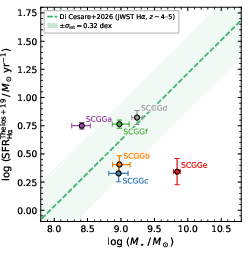
Figure 2: Hz>48-based dust-corrected star formation rates for SCGG-z5 member galaxies versus the z>49 SFMS; three members exceed or match the relation center, with strong offsets for the most massive galaxy.
Resolved and Integrated Morphology
Multi-component Sérsic fitting using high-resolution F200W imaging reveals that all six galaxies are resolved (z=4.970--z=4.971 kpc), with disk-like or irregular morphologies (z=4.972--z=4.973). Four members require multiple components; in particular, SCGGe contains an arc-like structure with a secondary nucleus, and SCGGf features distinct triple nuclei. Residual analysis shows low-amplitude, often bipolar patterns, interpreted as signatures of ongoing tidal interactions or perturbation from the group potential. The prevalence of complex and asymmetric morphologies persisting in all members is highly suggestive of a dynamically young, actively assembling system.
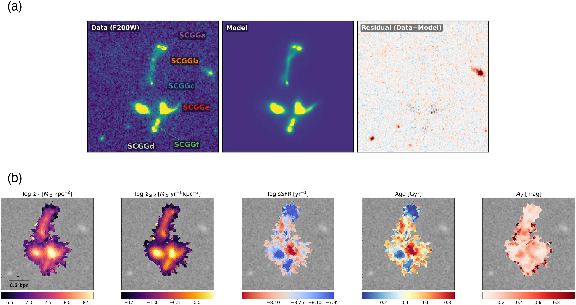
Figure 4: (a) Morphological decomposition for each member, highlighting multi-component structures; (b) pixel-by-pixel resolved maps of stellar mass surface density, SFR density, sSFR, mass-weighted age, and dust attenuation.
Pixel-by-pixel SED fitting with piXedfit enables spatially resolved assessment of assembly modes across group members. Three galaxies (SCGGf, SCGGd, SCGGa) display monotonic declines in sSFR with radius, with the innermost-to-outermost z=4.974--z=4.975 dex and significant outward increases in mass-weighted stellar ages. These signatures are consistent with vigorous inside-out stellar mass growth, in line with compaction-driven cold gas inflows and central star formation enhancement—mechanisms that have been invoked to explain core buildup in both theoretical models and local analogs.
In contrast, the most massive galaxy (SCGGe) has a tentative inverted sSFR gradient (central suppression of sSFR by 0.16 dex relative to the outskirts), the highest central stellar surface mass density (z=4.976), and outwardly increasing dust attenuation. This may signal the onset of central star-formation quenching, plausibly linked to either central gas exhaustion or disrupted inflows—consistent with theoretical expectations for early, rapid baryonic assembly.
SCGGb, the largest member by half-light radius, exhibits a flat sSFR profile and asymmetric, tidally disturbed starlight, indicating that environmental torques may be redistributing star formation across its extended disk.
Group Kinematics and Mass Budget
With a measured velocity dispersion of z=4.977 km sz=4.978 and projected group radius z=4.979 pkpc, the projected mass estimator yields ∼0. The corresponding stellar-to-dynamical mass fraction is ∼1, firmly indicating that the group is dark matter dominated at this early epoch.
The dynamical crossing time is short, ∼2 Myr (∼3\% of the cosmic age), implying the ongoing possibility for multiple internal passages and interactions before the system virializes or coalesces. While projection effects and non-equilibrium dynamics limit the interpretation precision, indirect application of self-similar virial scaling relations corroborates the high-velocity, early-assembly nature of the group.
Theoretical Implications and Comparison to Analogous Systems
Simulations (e.g., EAGLE analogues of compact group systems) predict rapid coalescence of comparable systems into a single ∼4 M∼5 galaxy by ∼6--∼7 and into a brightest group or cluster galaxy by ∼8. The resolved diversity in sSFR and age gradients is evidence that environmental topology influences mass assembly trajectories before coalescence is complete.
Beyond CGG-z5 at ∼9, which lacks spectroscopic confirmation, SCGG-z5 stands out for its complete, spectroscopically secured membership and high-resolution resolved maps. Lower- and higher-redshift compact groups (e.g., CGG-z4, CGG-z7) show a diversity of assembly, compaction, and potential quenching modes, highlighting the brief but critical window sampled by SCGG-z5.
Implications for Galaxy Evolution and Future Directions
The detection of strongly resolved inside-out assembly, interaction-driven diversity, and emergent central quenching at log(M∗/M⊙)=10.07±0.040 establishes compact group environments as a significant driver of early baryonic evolution. The consistent overmassiveness of the group halo relative to SHMR expectations for single field galaxies confirms the need to properly account for group-scale halos in early-universe models.
The results reinforce the necessity of spatially resolved studies—both spectroscopic and photometric—for understanding environmental assembly effects at high redshift. JWST-class IFU spectroscopy (e.g., NIRSpec) and ALMA [CII]/dust continuum mapping will be critical for direct assessment of kinematics, chemical abundances, and the cold gas reservoir across group members. These data are essential to disentangle interaction-driven variations from stochasticity in early galaxy SFHs, and to establish the generality of compaction, quenching, and tidal redistribution modes.
Conclusion
SCGG-z5 is a compelling demonstration of early group-driven assembly, with robust spectroscopic confirmation, strong evidence for multi-modal resolved star formation, and a dark-matter-dominated mass budget. The diversity of evolutionary stages within a log(M∗/M⊙)=10.07±0.04116 kpc region at log(M∗/M⊙)=10.07±0.042 provides a stringent test for models of massive galaxy and BCG formation. This system is a critical laboratory for examining how baryonic assembly, environmental effects, and dark matter halo growth couple at the onset of group-scale structure formation (2607.11182).