Search for dark matter in a signature with a four-prong large-radius jet in proton-proton collisions at s = 13 TeV
Published 13 Jul 2026 in hep-ex | (2607.11016v1)
Abstract: A search for a pair of nonprompt dark matter (DM) candidates produced in association with an initial-state radiation jet, in a signature containing a four-prong large-radius jet, is presented. The signal model contains a heavy vector or axial-vector mediator, which produces long-lived dark-sector particles that decay to a stable DM particle and a light boson, which decays to quarks. The analysis is based on data collected in the years 2016−2018 with the CMS detector at the LHC in proton-proton collisions at s = 13 TeV, corresponding to an integrated luminosity of 138 fb<sup>−1. Signal candidates feature large-radius jets, which are identified using a jet substructure tagger based on a graph neural network. The large-radius jet aims to reconstruct the decay of light DM mediators into four quarks, which are produced in association with two stable DM particles. The standard model background contributions are estimated from data using dedicated control regions. The missing transverse momentum spectrum is probed for a potential signal over the expected background. No significant excess over the standard model expectation is observed. Upper limits at 95% confidence level are set on the signal strength as functions of either the mediator mass or the relevant coupling. This is the first search for a pair of nonprompt DM candidates in the Lorentz-boosted topology, characterized by a large-radius jet and large missing transverse momentum.
The paper reports a novel search for nonprompt dark matter using a boosted four-prong jet signature and significant missing transverse momentum.
It employs a graph neural network to tag displaced jet substructure, achieving area-under-ROC values between 0.88 and 0.95 for effective signal discrimination.
Leveraging 138 fb⁻¹ of CMS data, the study sets strict 95% CL upper limits that constrain heavy mediator models in dark sector theories.
Search for Dark Matter with Four-Prong Large-Radius Jet Signatures at s=13 TeV
Signal Model and Motivation
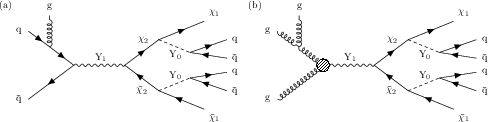
The analysis targets nonprompt dark matter (DM) signatures predicted by extensions of the standard model (SM) involving a dark sector with long-lived particles. The signal model employs heavy vector or axial-vector mediators, which couple the SM to the dark sector via quark-antiquark annihilation or gluon-gluon fusion, producing pairs of Dirac dark-sector fermions. Each such fermion decays to a stable DM particle and a light scalar boson, with the latter promptly decaying to quarks at a fixed mass of 1GeV. Due to the highly Lorentz-boosted topology, the four quarks from the two mediator decays are reconstructed as a single large-radius jet with distinct four-prong substructure, accompanied by substantial missing transverse momentum (pTmiss) from the two stable DM particles.
Figure 1: Representative Feynman diagrams illustrating mediator production via quark-antiquark annihilation or gluon-gluon fusion with an ISR jet and effective Y1gg coupling.
Jet Reconstruction and Graph Neural Network Tagging
To exploit the boosted topology and displaced signature, large-radius jets are reconstructed using the anti-kT algorithm with radius parameter R=0.8, employing particle-flow candidates and a pileup mitigation algorithm. Signal-like jets are selected through a tagger based on a graph neural network (GNN) utilizing both substructure and spatial information, including secondary vertices to enhance sensitivity to displaced decays. The GNN encodes jet constituents and correlations as nodes and edges in a fully connected graph, outputting a classification score reflecting signal likelihood.
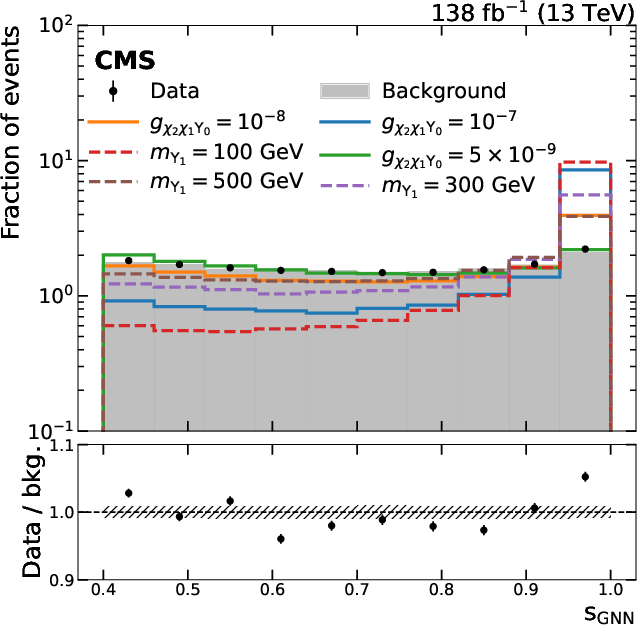
Figure 2: GNN score distribution in the signal region before selection, showing clear separation between signal hypotheses and total simulated background.
For optimal discrimination, the GNN tagger exploits both kinematic and topological features, achieving area-under-ROC values from ∼0.88 for most displaced/heaviest signals up to ∼0.95 for lighter configurations. The tagger's efficiency and scale factors are validated and corrected with the Lund jet plane (LJP) reweighting method, addressing modeling deficiencies in multiprong, displaced jet signatures.
Event Selection and Control Regions
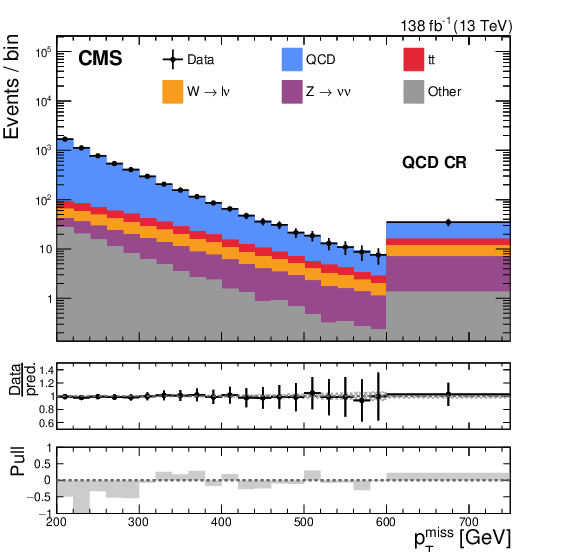
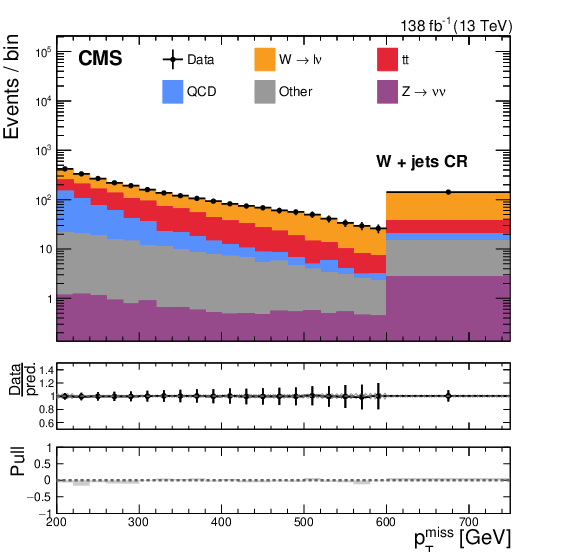
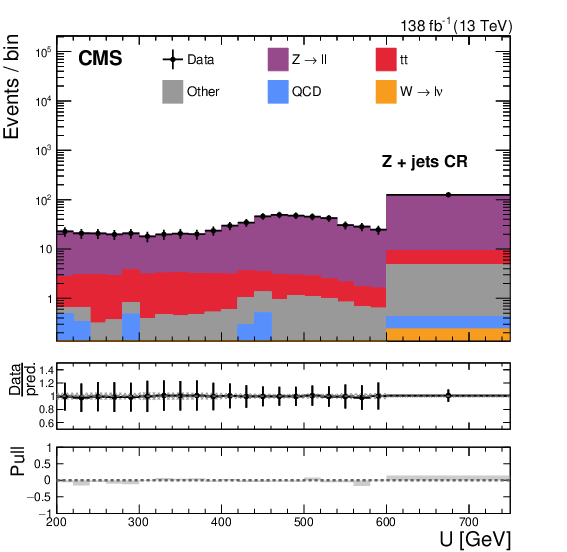
Event selection requires two AK8 jets with pT>200GeV and ∣η∣<2.5, with the leading jet exceeding 1GeV0. The candidate signal jet is mandated to have a GNN score 1GeV1 and an ungroomed mass above 1GeV2. A minimum 1GeV3 of 1GeV4 suppresses SM backgrounds, supported by stringent lepton vetoes. Three dedicated control regions (CRs) are defined for QCD multijet, 1GeV5+jets, and 1GeV6+jets backgrounds by relaxing the GNN score and/or lepton criteria. Background yields are estimated from CRs using transfer factors derived from simulation and validated in situ.
Statistical Analysis and Systematic Uncertainties
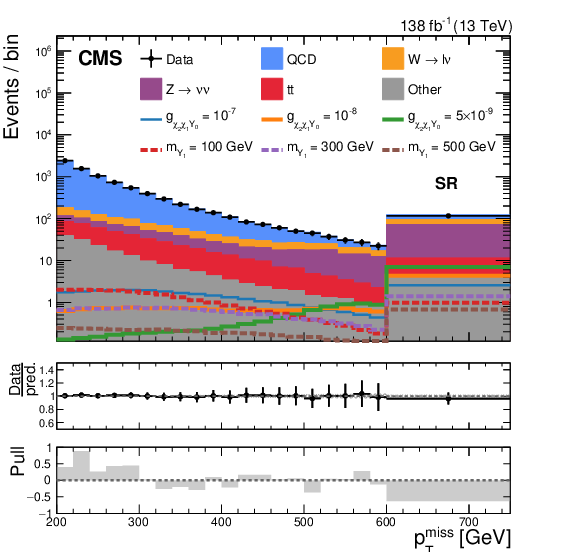
Signal extraction employs a binned maximum likelihood fit to the 1GeV7 distribution in the signal region (SR), with CRs incorporated for in situ normalization of dominant backgrounds. The fit models statistical and systematic uncertainties via nuisance parameters, including luminosity, lepton veto efficiency, jet energy scale/resolution, GNN tagger efficiency (with up to 1GeV8 uncertainty for highly boosted/displaced jets), and TF statistical precision. Shape uncertainties on 1GeV9 from unclustered energy and global JES/JER variations are fully correlated across bins.
Figure 3: Postfit pTmiss0 distributions in SR and CRs, with prefit signal shapes and data/background ratios. Good agreement is found across regions.
Results: Limits on Mediator Mass and Coupling
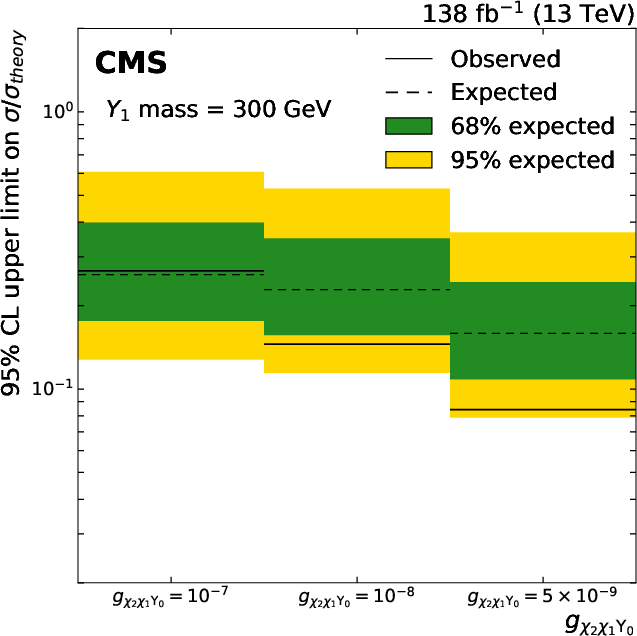
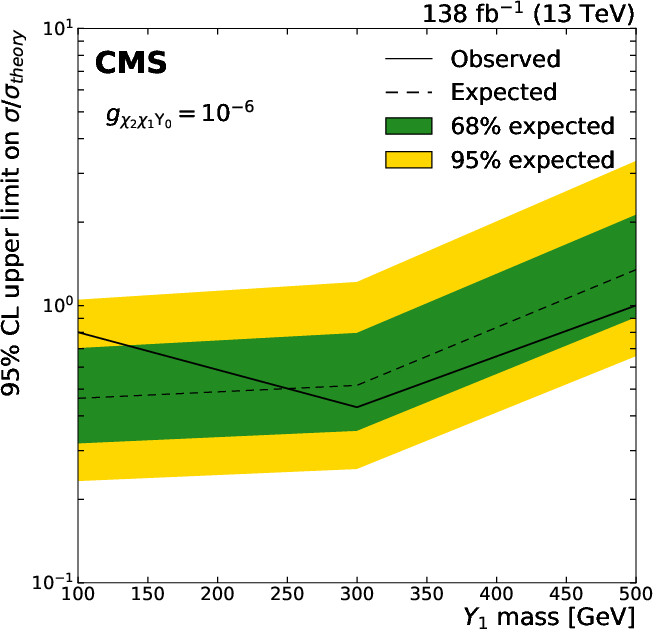
No significant excess above the SM prediction is observed across the data sample, corresponding to pTmiss1 integrated luminosity from 2016--2018 CMS data. Upper limits at pTmiss2 confidence level are placed on the signal strength as a function of mediator mass and coupling. For both mass and coupling scans, observed and expected limits are consistent within two standard deviations. The analysis excludes tested values in the parameter space associated with the signal hypotheses, thus constraining models of nonprompt DM mediation in highly Lorentz-boosted jet topologies.
Figure 4: 95\% CL upper limits on signal strength versus coupling (left) and mediator mass (right), with theoretical cross-sections and expected bands.
Implications and Future Directions
This study constitutes the first search for a pair of nonprompt DM candidates with a Lorentz-boosted, four-prong jet plus pTmiss3 signature. The deployment of a GNN tagger leveraging displaced substructure and secondary vertices represents a substantial methodological advancement, enabling discrimination of highly collimated, multiprong jets against challenging SM backgrounds. The large uncertainties attributed to displaced jet tagging highlight the limitations in modeling extreme boosted topologies, suggesting avenues for refinement in jet substructure algorithms and simulation techniques.
Practically, the results place strict bounds on dark sector models featuring long-lived mediators, favoring prompt or short-lived configurations for future searches. The analysis framework is extensible to additional displaced signatures, may be augmented with calorimeter timing or alternative geometric reconstruction, and could benefit from developments in ML-based jet substructure modeling. Theoretical implications include exclusion of regions in the coupling-mass parameter space for DM models with heavy vector mediators and long-lived dark-sector fermions, informing both phenomenological model building and DM-related collider strategies.
Conclusion
The analysis establishes a robust methodology for isolating nonprompt DM signals in the four-prong large-radius jet plus pTmiss4 topology, effectively leveraging GNN-based tagging and in situ background estimation. No evidence for signal is presented, resulting in upper limits that stringently constrain the relevant parameter space. The study sets a precedent for advanced ML-driven searches for displaced signatures and provides a valuable framework for future DM explorations at high-luminosity colliders.
“Emergent Mind helps me see which AI papers have caught fire online.”
Philip
Creator, AI Explained on YouTube
Sign up for free to explore the frontiers of research
Discover trending papers, chat with arXiv, and track the latest research shaping the future of science and technology.Discover trending papers, chat with arXiv, and more.