- The paper proves that a simple graph with Δ=4 and order exceeding one-third of its vertices is class 2 if and only if it contains an overfull subgraph with Δ=4.
- It applies advanced combinatorial methods, including multi-fans and Kierstead paths, to systematically eliminate non-overfull critical configurations.
- The research resolves previous proof gaps and establishes a framework that may extend to higher-degree graphs and related edge-coloring challenges.
Overfull Conjecture for Graphs with Maximum Degree 4
Introduction and Background
The overfull conjecture, posed by Chetwynd and Hilton in 1986, seeks a structural characterization for when a simple graph is class 2 (i.e., its chromatic index is Δ(G)+1) under a stringent degree lower bound. Specifically, for a simple graph G with maximum degree Δ(G)>∣V(G)∣/3, the conjecture states that G is class 2 if and only if it contains an overfull subgraph H with Δ(H)=Δ(G). This paper provides a rigorous and gap-free proof establishing the conjecture in the case Δ(G)=4, addressing issues in previous partial arguments and extending the theoretical foundation for chromatic index classification in this regime (2607.10947).
In the detailed treatment, the authors rely on fine-grained structural analysis, prior results concerning the configurations in small critical graphs, and advanced combinatorial techniques involving multi-fans, Kierstead paths, and forbidden subgraph configurations.
Key Definitions and Preliminaries
Fundamental to the proof are several classical, yet nuanced, concepts from edge coloring theory:
- Criticality and Class: A graph is class 2 if its chromatic index is Δ+1; it is Δ-critical if every proper subgraph has chromatic index ≤Δ and the graph itself is class 2.
- Overfull Subgraph: A subgraph G0 is overfull if G1, which forces G2.
- Multi-fans and Kierstead Paths: These structures are used to analyze colorability (especially regarding Kempe chains) and present vital recursion and contradiction arguments for small graphs.
Several structural lemmas are reused and sharpened, most notably specific restrictions on degree sequences, full-deficiency pairs, and adjacency patterns among low-degree vertices in the presence of class 2 criticality. Notably, well-known results by Holyer, Fiorini, Brinkmann-Steffen, Chetwynd-Yap, and recent progress by Shan and others provide essential machinery—ranging from computational classifications in small orders to polynomial solvability for overfull subgraph detection.
Main Theoretical Contribution
The central result is the following:
Theorem: Let G3 be a simple graph of order G4 with G5. Then G6 is a class 2 graph if and only if G7 contains an overfull subgraph G8 with G9.
The proof of sufficiency is trivial: the presence of an overfull subgraph directly guarantees that Δ(G)>∣V(G)∣/30 by Vizing's theorem and the definition of overfullness. The crux lies in demonstrating necessity, i.e., for every class 2 graph Δ(G)>∣V(G)∣/31 (with the given parameters), there necessarily exists such a subgraph Δ(G)>∣V(G)∣/32.
Structural Exclusion and Reduction
The argument proceeds by a detailed exclusion of non-overfull critical structures in the possible orders Δ(G)>∣V(G)∣/33. Leveraging lemmas prohibiting certain low-degree vertex adjacencies (e.g., [(2607.10947), Lemma 2.9, Corollary 2.1]), the authors systematically show that nearly all Δ(G)>∣V(G)∣/34-critical graphs in the order range must be Δ(G)>∣V(G)∣/35-regular and thus trivially overfull.
For graphs not Δ(G)>∣V(G)∣/36-regular, precise degree counts and forbidden subgraph configurations (illustrated in Figure 1) are invoked. Extensive casework rules out all possible exceptional critical graphs that could violate the conjecture. In every pertinent case, the requisite overfull subgraph is either present by degree count or the configuration contradicts criticality or class 2 status.
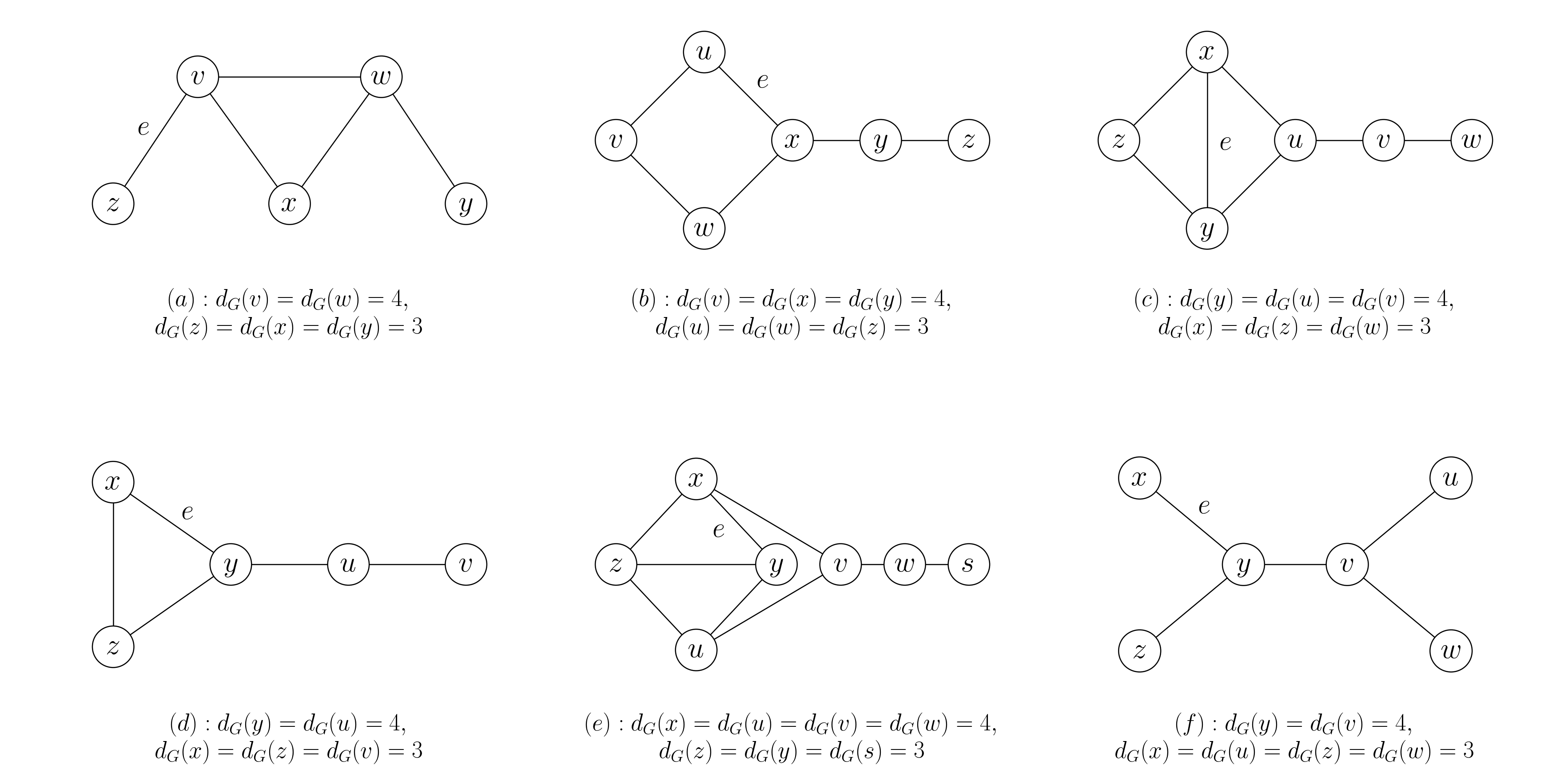
Figure 1: Local forbidden configurations in Δ(G)>∣V(G)∣/37-critical graphs; appearance of any implies Δ(G)>∣V(G)∣/38 under edge removal.
To control the combinatorial explosion, the proof utilizes several structure theorems on how Δ(G)>∣V(G)∣/39- and G0-vertices can be distributed and connected, invoking known extremal configurations and exploiting consequences of Vizing-type criticality. The authors handle all small possible orders explicitly, deploying configuration-based elimination and leveraging polynomial-time checking for overfull subgraphs in these cases.
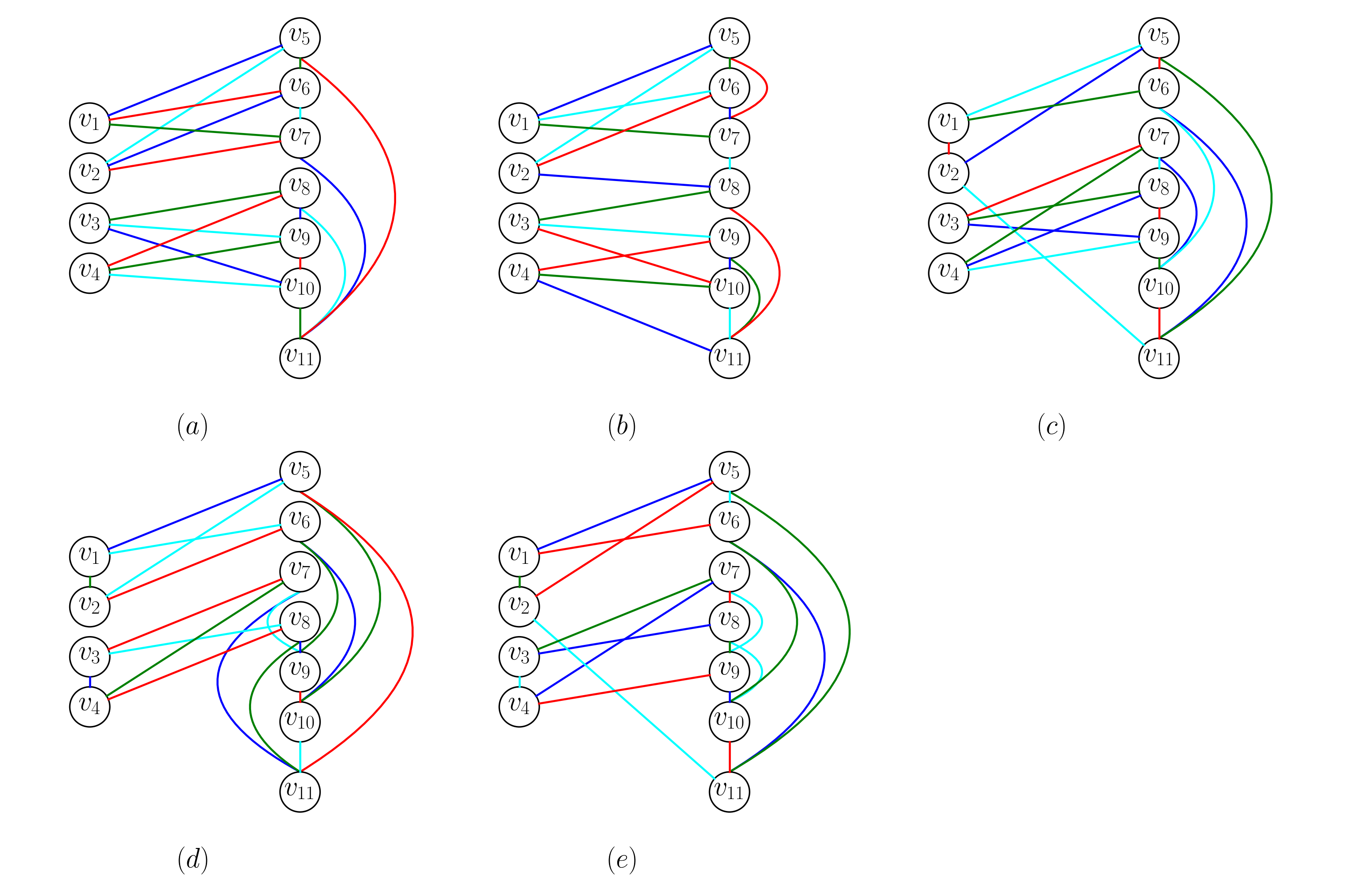
Figure 2: Specific example graphs of order up to 11 demonstrating the structural restrictions on G1-critical graphs.
Implications and Future Directions
This result completes the verification of the overfull conjecture for all simple graphs of maximum degree 4—a natural boundary where purely combinatorial arguments suffice and reductions to small order are tractable. The approach, combining structural graph theory, Kempe argumentation, and algorithmic considerations, may serve as a template for exploring the conjecture for larger fixed degrees or for extending computational classification to slightly larger graph classes.
Confirming the overfull conjecture for G2 not only resolves classification in this regime but also reinforces the connection between overfull subgraph criteria and the computational hardness of general edge coloring (noting NP-completeness above this threshold). Notably, the structural restrictions derived here can be instrumental in resolving related conjectures, such as the vertex-splitting or independence conjecture in edge coloring, particularly as these often reduce to questions about the existence and properties of critical subgraphs of bounded degree.
Future work will likely focus on extending this framework to higher degree graphs, improving or automating forbidden configuration enumeration, and elucidating connections to algorithmic edge coloring heuristics. Further, the methodology can augment the development of coloring algorithms for specific classes of sparse or nearly regular graphs in both applied and theoretical settings.
Conclusion
The authors have provided a complete and detailed proof that the overfull subgraph criterion characterizes class 2 graphs for all simple graphs with maximum degree 4 and size above G3, thereby confirming the Chetwynd-Hilton overfull conjecture in this regime (2607.10947). Through intricate structural analysis, forbidden subgraph arguments (as illustrated in Figures 1 and 2), and exhaustive casework, all potential exceptions are excluded. The result integrates advances in critical graph theory and bridges structural, algorithmic, and enumerative perspectives in graph edge coloring.
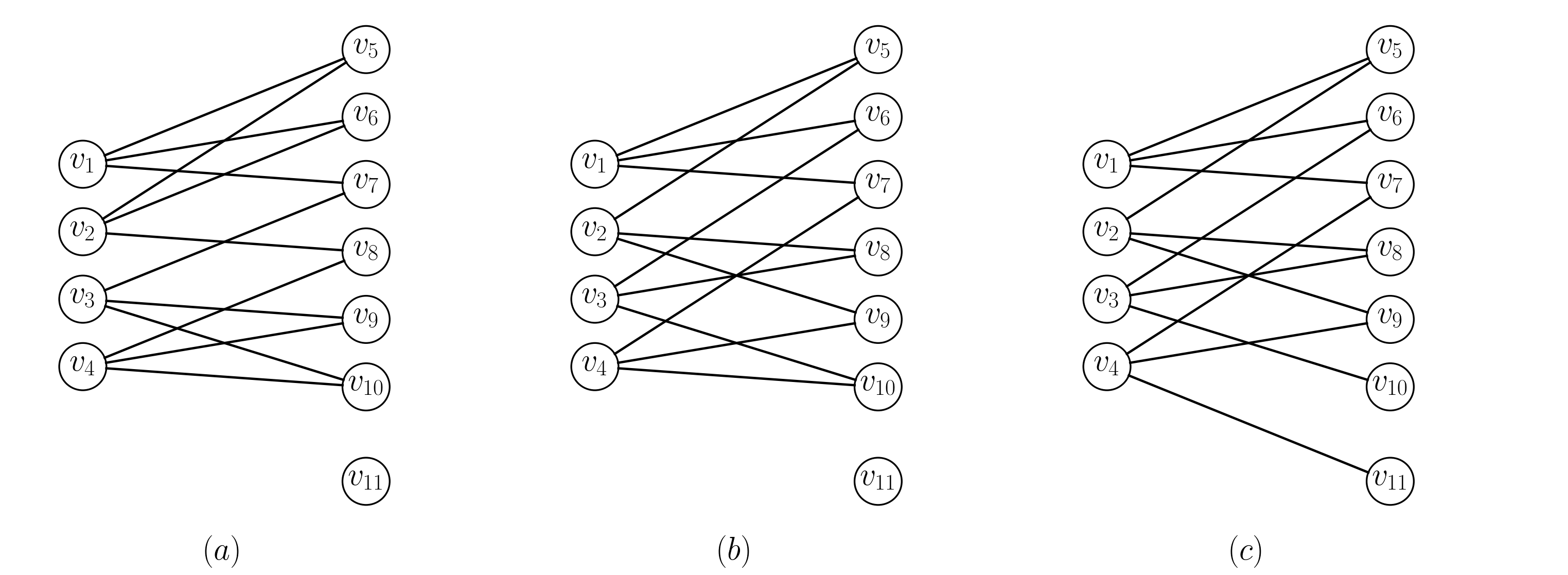
Figure 3: Composite configurations constructed to exhaustively exclude all non-overfull 4-critical graphs outside trivial cases.