- The paper introduces a randomized QOC framework that achieves quadratic error suppression by mixing control waveforms.
- It employs symmetry-based techniques like target-preserving twirling and time-reversal pairing to cancel coherent errors effectively.
- The approach is validated through CNOT gate synthesis experiments, demonstrating enhanced gate fidelity and reduced control time.
Randomized Quantum Optimal Control: A Framework for Enhanced Gate Fidelity and Noise Robustness
Introduction
The paper "Randomized Quantum Optimal Control" (2607.10946) introduces a rigorous framework for quantum optimal control (QOC) that leverages probabilistic mixtures of control waveforms to suppress coherent errors beyond the limits of deterministic protocols. By optimizing over ensembles of control functions and their associated probabilities, the authors demonstrate both analytically and numerically that randomized protocols can achieve target operations with stricter accuracy, faster, and with enhanced robustness to coherent noise—even under identical resource constraints.
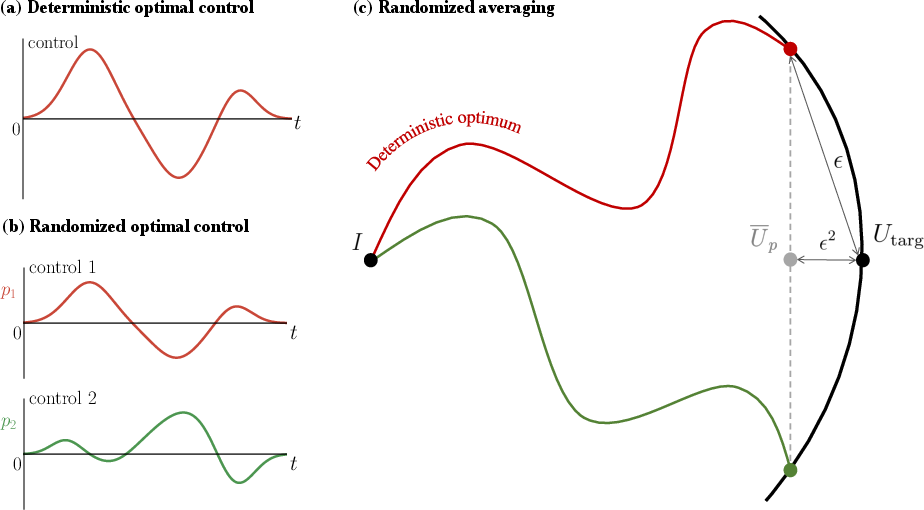
Figure 1: Schematic comparison between deterministic (single waveform) and randomized (ensemble of waveforms) QOC, highlighting the quadratic suppression of error in the randomized approach.
Randomized Control: Theoretical Framework
Conventional QOC seeks a single trajectory f(t) such that the resulting unitary Uf(T) closely approximates a desired target Utarg. The paper generalizes this paradigm: instead of a single waveform, randomized QOC constructs an ensemble {f(i)} with probability weights p, inducing a mixed-unitary channel. Optimization is performed on the diamond distance between the average channel and the target channel, taking advantage of convex combinations to engineer cancellations among leading error terms.
The critical mechanism is that averaging over appropriately chosen control branches can cancel first-order coherent errors in the generator of the relative unitary, yielding quadratic suppression of the overall error. This allows randomized QOC to reach a target accuracy in strictly less time than deterministic QOC under the same constraints.
Analytical Results: Quadratic Error Suppression
The authors provide an exactly solvable single-qubit example where the optimal randomized protocol achieves diamond-distance error equal to the square of the deterministic optimal error. The deterministic optimal control employs a symmetric two-bang pulse, while the randomized protocol mixes this with its sign-flipped counterpart, exploiting a phase symmetry to realize cancellation at the operator level. The result is a strict reduction in minimum time required for any prescribed accuracy:
ϵ⋄rand,⋆(T)=(ϵ⋄det,⋆(T))2<ϵ⋄det,⋆(T)
This establishes a strict randomized speedup, which is constructively proved and extends to broader models.
Symmetry-Based Construction of Randomized Ensembles
Beyond brute-force optimization over all branches, the paper develops two symmetry-based prescriptions to generate ensembles:
- Target-preserving twirl: Branches are constructed via conjugation with a finite set of unitaries G commuting with the target up to phase, twirling away error components inconsistent with the target symmetry.
- Time-reversal pairing: Pair each deterministic implementation with its conjugated inverse, cancelling residual twirl-invariant error components.
These constructions can be concatenated to eliminate all first-order coherent errors except those strictly compatible with the target symmetry.
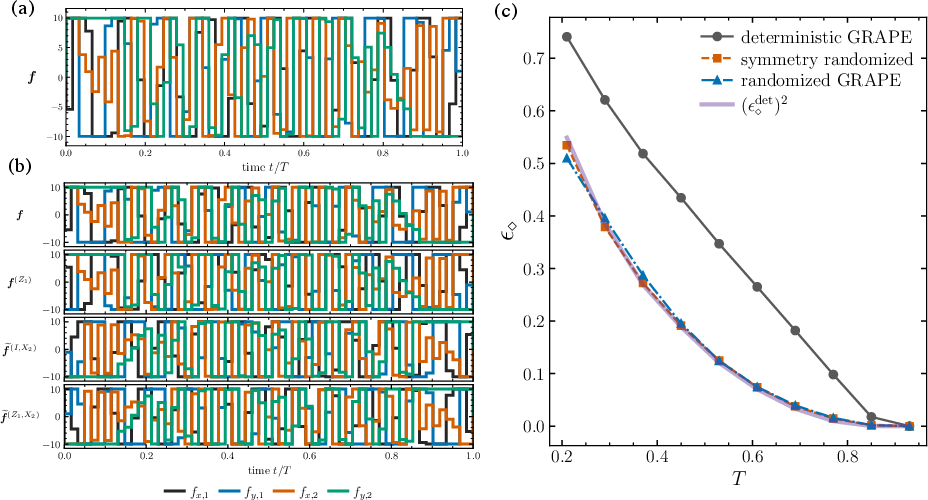
Figure 2: Application of symmetry-generated randomized control branches for CNOT implementation in a two-qubit model, illustrating the four branches derived from sign flips and time reversal.
CNOT Benchmark in Two-Qubit Models
For practical benchmarking, randomized QOC is applied to CNOT gate synthesis in a standard two-qubit Hamiltonian. The symmetry-generated protocol constructs four control branches from a deterministic GRAPE solution via sign flips and time reversal, each applied with equal probability. Direct numerical evaluation confirms that the diamond-distance error of this randomized protocol closely tracks the squared deterministic error, consistent with complete cancellation of dominant first-order error components.
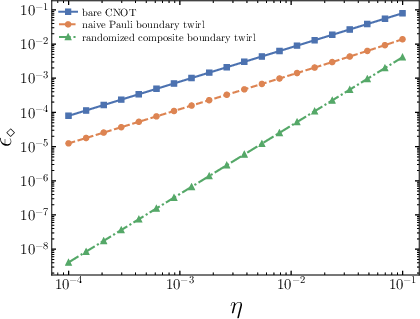
Figure 3: Diamond-distance error versus total control time for deterministic GRAPE and symmetry-generated randomized QOC—randomized protocol achieves quadratic error suppression, matching randomized GRAPE optimization.
Pauli Error Diagnostics and Observable Estimation
The paper provides a Pauli decomposition of the error generator for the optimized deterministic GRAPE pulse, demonstrating that symmetry constructions specifically target and cancel dominant error channels (e.g., Z1X2 in CNOT). Observable estimation experiments on output states further validate that randomized protocols systematically reduce bias in expectation values detectable only at first order for certain observables.
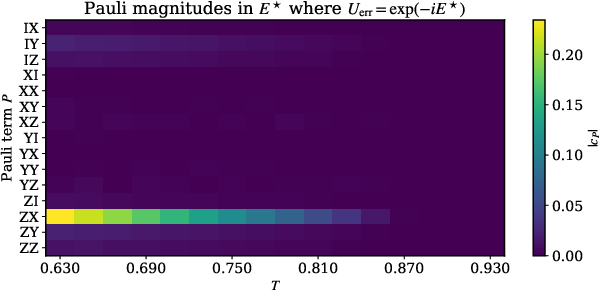
Figure 4: Pauli decomposition of the relative error generator E⋆ for the deterministic GRAPE pulse, showing cancellation of dominant Z1X2 errors by time-reversal pairing in the randomized protocol.
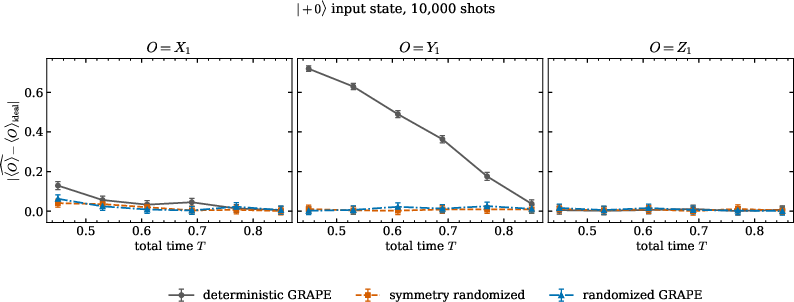
Figure 5: Comparison of observable estimation errors for different CNOT control protocols, highlighting the suppressed bias in randomized implementations for observables sensitive to coherent error.
Noise Robustness via Randomized Boundary Pulses
Beyond ideal gate synthesis, the randomized QOC framework is extended to noise robust implementations. By sandwiching the reference control with randomized Pauli-string boundary pulses, coherent 1-local noise contributions can be averaged out to zero, achieving Uf(T)0 scaling in diamond-distance error for Clifford targets. Finite-width boundary pulses are accounted for, with randomized pulse sequences ensuring quadratic error suppression even in realistic settings where boundary operations have nonzero duration.
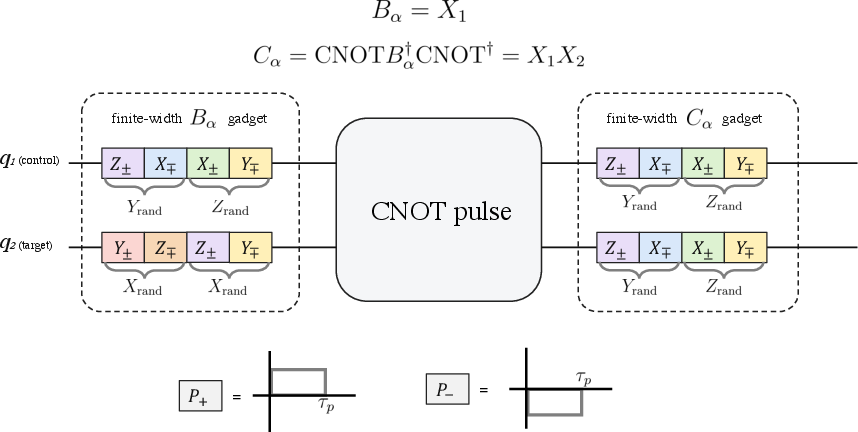
Figure 6: Schematic of a single branch of the finite-width randomized boundary pulse construction for CNOT, utilizing Pauli-string pre- and post-processing.
Figure 3: Noise robustness of CNOT implementation under coherent 1-local noise, showing Uf(T)1 scaling from randomized boundary twirl, versus Uf(T)2 scaling in bare/no twirl protocols.
Implications and Future Directions
This paper makes rigorous claims that randomized QOC universally outperforms deterministic QOC in gate fidelity and time-to-target, given identical resources, with quadratic separation confirmed both analytically and numerically. The framework integrates symmetry operations, time-reversal pairing, and boundary twirls to construct ensembles that systematically suppress coherent errors and noise, suggesting broad applicability to practical quantum gate synthesis, error mitigation, and noise tailoring.
The theoretical implications include the potential to extend randomized control techniques beyond mixed-unitary channels (e.g., targeting specific decoherence models), and establishing information-theoretic bounds on achievable accuracy. Hardware-specific tailoring of randomized QOC may facilitate high-fidelity quantum operations in systems dominated by coherent or correlated noise, offering a path to improved error thresholds for fault-tolerant quantum computation.
Conclusion
The randomized QOC framework provides a mathematically rigorous approach for accelerating quantum gate synthesis and suppressing coherent errors, outperforming deterministic control protocols using convex mixtures of optimized branches. The symmetry-based constructions and boundary randomization techniques offer practical strategies to engineer control ensembles with robust error cancellation, both for ideal gate operations and for noise robustness. Future avenues include generalizing to open-system dynamics, hardware-specific implementations, and deeper analysis of resource-error trade-offs in randomized control.