- The paper identifies a seven-stage SE agent development workflow that shifts emphasis from manual coding to evaluation-driven scaffolding and orchestration.
- The study employs a sequential mixed-methods approach—20 interviews and an 80-participant survey—to derive both inductive theory and deductive validation.
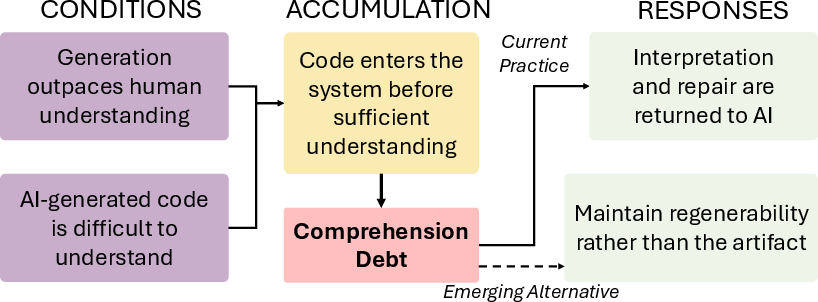
- Practitioners face challenges such as unreliable evaluation signals, provider-induced instability, and accumulating comprehension debt impacting maintainability.
Empirical Analysis of SE Agent Construction: A Mixed-Methods Perspective
Methodology and Study Design
The authors present an exploratory sequential mixed-methods analysis, operationalized through a rigorous sequence of semi-structured interviews (n=20, covering 12 organizations) and a broad-coverage validation survey (n=80) focused on the construction of software engineering (SE) agents—advanced LLM-driven systems automating SE tasks including code generation, debugging, review, and repository-level maintenance (2607.10856). The participant cohort skews toward R&D-intensive technology organizations at the frontier of agent adoption, encompassing both infrastructure engineers and practitioners building both general-purpose and domain/task-specialized SE agents.
The mixed-methods regime enables detailed inductive theory-building from interviews, iteratively refined via hybrid card-sorting analysis and member checking, with subsequent deductive validation against a larger practitioner base. This structure ensures both conceptual richness and broad generalizability.
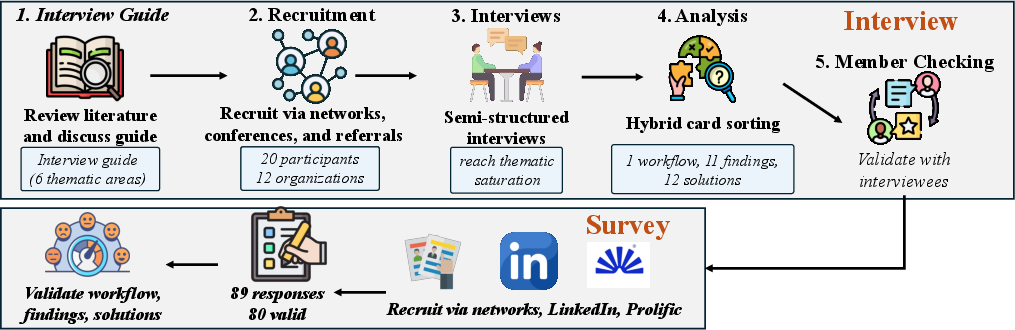
Figure 1: Process overview—sequential design combines qualitative interviewing, thematic analysis, and validation via broad-scale survey.
Emergent Seven-Stage Agent Development Workflow
Empirical findings reveal a distinct seven-stage development workflow for SE agents, distinguished from classical software life-cycle models:
- Requirements: Dual-audience specification targeting both human stakeholders and machine-readability for agents and automation.
- Evaluation: Early, pervasive evaluation infrastructure as steering and selection mechanism, distinct from classic post-hoc verification.
- Data: Contingent data curation for model adaptation—sometimes omitted for prompt-centric agents, but central for fine-tuning.
- Construction: "Cheapest-first" escalation from prompt engineering to parameter-efficient fine-tuning or full SFT, stitched together by an extensible scaffolding/harness controlling context, memory, and tool-use.
- Testing and Deployment: Combination of traditional correctness testing with system-level, task-oriented evaluation benchmarks.
- Human Feedback: Instrumented deployment and continuous collection of operational, behavioral, and user-in-the-loop feedback.
- Adaptive Maintenance: Ongoing evolution as upstream foundation models, APIs, or execution platforms are updated outside organizational control.
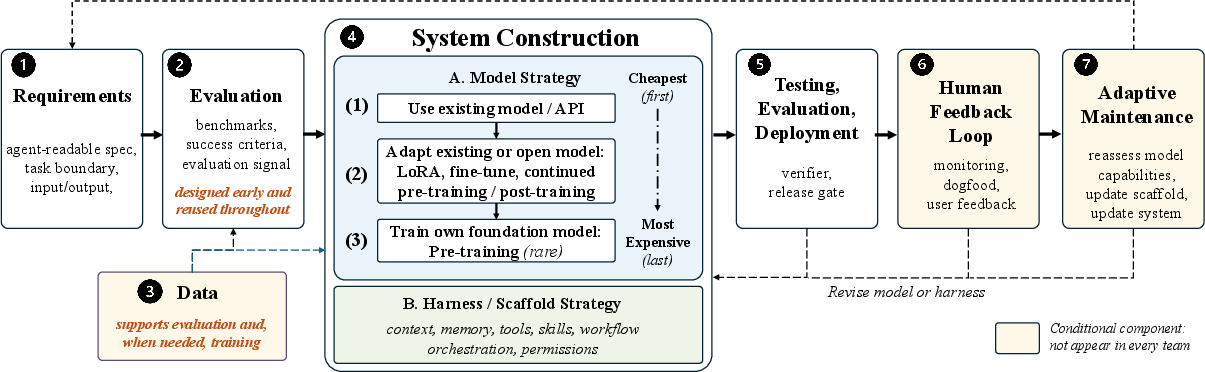
Figure 2: Agent development workflow—depicts iterative, feedback-driven loop centering evaluation and scaffolding.
Notably, this workflow reflects a marked shift: implementation cost is dramatically reduced, abstracted away via agentic coding, and bottlenecks are displaced toward requirements engineering, orchestrating harnesses, evaluation, and review.
Process Reconfiguration: Evaluation-Driven, Spec-Centric, and Role-Agnostic
The study surfaces several process shifts driving SE agent development away from classical SE:
- Implementation at Higher Abstraction: Agentic coding automates code production, shifting expertise from micro-level coding toward system/harness design, context curation, and orchestrating tool interfaces. Empirically, practitioners no longer “write code” but instead review, refactor, and manage thousands of lines generated per iteration.
- Effort Unmasking and Creation: Traditional non-coding activities—requirements scoping, artifact curation, coordination—emerge as new bottlenecks. Simultaneously, new burdens around agent output review, provenance validation, and regeneration accumulate, displacing manual coding as the core effort.
- Evaluation-Driven Development: Evaluation becomes the central control surface and iterative feedback signal, co-evolving with requirements and used as the primary decision lever for progression, regression, and architecture evolution. Specification and benchmarks become first-class, version-controlled assets.
- Blurring Role Boundaries: Explosion in abstraction and automation leads to role fusion—engineers, researchers, and product managers frequently traverse traditional specialization as agentic scaffolds collapse the stack and automate previously siloed responsibilities.
- Executable Specifications as Core Artifact: Agent proficiency is increasingly determined by maintained, versioned prompts, step-definitions, and harness logic—these durable assets are engineered/tested/reviewed in parallel with code.
Central Challenges of the Agentic Paradigm
Practitioner interviews and survey ratings (strong consensus across most items, avg. agreement >80%) converge on six primary development challenges:
Theoretical and Practical Implications
Theoretical
The paradigm outlined demonstrates that agentic SE development is not a process free-for-all, but an iterative, tightly evaluation-driven loop transforming the nature of process and artifact centricity. This shift away from deterministic, code-centered procedures toward dynamic, prompt- and evaluation-driven engineering raises foundational questions about the future roles of maintainability, explainability, and process governance.
The implication is that process models rooted in waterfall, spiral, or even agile/DevOps must adapt: agentic iteration generates new forms of debt (comprehension, regenerability) and new process anchors in harnesses and executable specifications. Research into process-aware orchestration, real-time evaluation signal evolution, and the impact of provider instability on socio-technical practices is now critical.
Practical
For practitioners, the findings suggest:
- Invest in Durable Scaffolding: Prefer modular, maintainable harnesses and clear distinction between temporary model-compensating logic and long-lived orchestration mechanisms.
- Prioritize Multi-layered Evaluation Protocols: Avoid overreliance on static benchmarks; blend production-aligned monitoring, multi-granular checks, and diversified success metrics.
- Expect Regenerability Over Artifact Preservation: Given rapid code drift and comprehension debt, invest in testing, spec, and infrastructure that enables quick re-generation, not just code-base curation.
- Accept Role Fluidity and Dynamic Specialization: Organizational structures and processes must support cross-specialization and rapid iteration, with individuals responsible for end-to-end pipeline slices.
Future Directions
This study highlights outstanding needs in automating review and comprehension support, dynamically robust evaluation protocol design, and in explicit handling of process risk induced by upstream vendor changes. Opportunities exist for agentic co-pilots specialized in review/maintenance, formalization of EDD/AgentOps protocols, and more robust validation/recoverability mechanisms.
A promising direction is meta-agentic design: using SE agents themselves for code review, maintenance, and even process adaptation—creating self-improving, evaluation-steering development ecosystems.
Conclusion
The paper establishes that construction of SE agents profoundly reconfigures software engineering practice: implementation is cheap, but the locus of engineering effort moves up the abstraction ladder to evaluation, coordination, specification, and maintainability. Classic process models yield to highly iterative, evaluation- and spec-centered loops, but new empirical and theoretical challenges, particularly in evaluation and maintainability, require urgent further research to ensure agentic engineering remains tractable and robust at scale.
Citation: "How Do Practitioners Build SE Agents? Insights from a Mixed-Methods Study" (2607.10856)