Causal Estimation of Share-Induced Engagement with Flywheel Effects
Published 12 Jul 2026 in stat.ME | (2607.10820v1)
Abstract: Sustainable user growth in online platforms depends not only on acquiring new users but also on reactivating and engaging existing ones through social sharing features. A well-designed sharing feature can trigger a self-reinforcing ``flywheel effect'': reactivated users become potential sharers whose engagement propagates through the network over multiple rounds, amplifying total engagement. Measuring the causal impact of such sharing features is challenging, as their effects unfold through complex social networks and temporal cascades, violating the no-interference assumption underlying classical A/B testing. We develop a framework for experiments on sharing features that accounts for interference caused by the flywheel effect and targets a global treatment effect on share-induced engagement. Our estimator is motivated by a flow-balance identity and interprets share-induced engagement as a geometric amplification process, yielding a closed-form propagation adjustment that accounts for multi-round diffusion using commonly available attribution logs. Under mild conditions, we establish consistency of the proposed estimator and develop a valid A/A testing procedure for pipeline validation. Simulation studies show that our method substantially reduces bias relative to the difference-in-means estimator and first-order adjustments, while the proposed A/A test maintains nominal Type I error. We also extend the framework to a user-level reactivation metric via a Poisson approximation. Finally, we demonstrate the approach on a real-world large-scale online platform and discuss empirical implications for evaluating sharing feature designs.
The paper introduces a propagation-adjusted estimator that rigorously quantifies the amplification of share-induced engagement using a multivariate Hawkes process.
It decomposes user actions into discovery and re-shares, enabling unbiased measurement of global platform gains amid complex network interference.
Empirical evaluations on simulations and real-world data demonstrate the estimator’s superior bias reduction and valid inference, confirming its practical relevance.
Causal Estimation of Share-Induced Engagement with Flywheel Effects
Motivation and Problem Setting
Contemporary online platforms leverage social sharing features to drive both user growth and engagement, not merely by accession of new users but by activating dormant accounts through network-mediated propagation mechanisms. The so-called flywheel effect—where content shared by active users triggers cascades of reactivation and further sharing among recipients—constitutes a dynamic, non-local treatment effect that propagates through the social graph over time. This mechanism introduces complex interference patterns, explicitly violating the SUTVA assumption central to classical A/B testing. As such, naive estimators are known to yield severely biased treatment effects on key share-induced engagement metrics when interference is ignored.
The central challenge addressed is rigorous, practical experimental evaluation of causal impact for sharing features (e.g., interface redesigns, share-promotion algorithms) in the presence of these multilayered flywheel effects. Traditional estimators neglect the diffusion-amplification process, systematically underestimating true platform-level gains, and precluding valid inference.
Dynamic Modeling of Content Sharing
The proposed framework constructs a multivariate Hawkes process to model share-and-reshare dynamics. The key formalism decomposes observed user-content actions into self-discovery events and share-induced cascades, with the latter governed by temporally decaying kernels representing information transmission along network edges. The model incorporates:
User and content indices for generality across large platforms.
Undirected user graph encoding the feasible set of sharing relationships.
Edge-content marked kernels parameterizing discovery- and share-driven propagation strengths and their time profiles.
Crucially, the model exposes a branching process interpretation: each exogenous discovery acts as an "immigrant," launching a share-induced tree where each event recursively spawns further offspring via social sharing, subject to the stability condition ρ(Q(k))<1.
This formalism enables clear definition of impact-of-sharing (IS), global treatment effect (GTE), and related functionals. The paper targets estimation of the platform-level difference in long-run share-induced engagement under global deployment of a new sharing feature versus control.
Propagation-Adjusted Estimation
The main methodological innovation is an estimator derived from an exact sender–receiver flow-balance identity, linking the recursive, multi-round nature of sharing to a geometric multiplier. The authors formalize that, for the aggregate platform, the total number of share-induced events can be decomposed into discovery-offspring propagated through successive downstream sharing with an amplification factor 1/(1−qeff), where qeff is an effective downstream sharing probability.
This motivates the propagation-adjusted estimator:
GTE=1−qTYTd−1−qCYCd
where Yad estimates the discovery-origin share-offspring per group and qa is the empirical downstream sharing rate, both directly computable from standard attribution logs.
The estimator is log-based and model-free—it avoids explicit likelihood or Hawkes parameter fitting, thus offering practical robustness to model misspecification, and can be operationalized with production event logs.
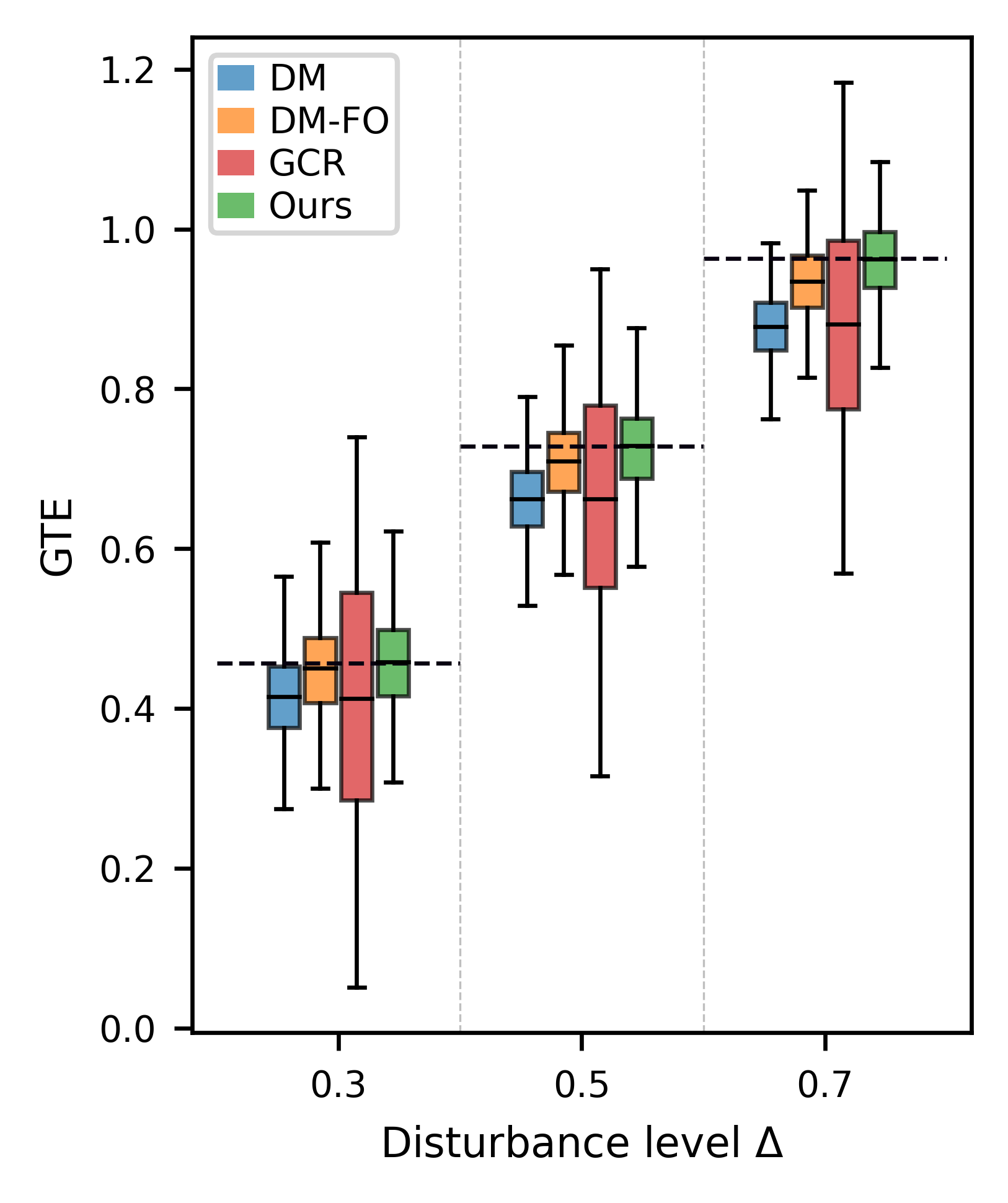
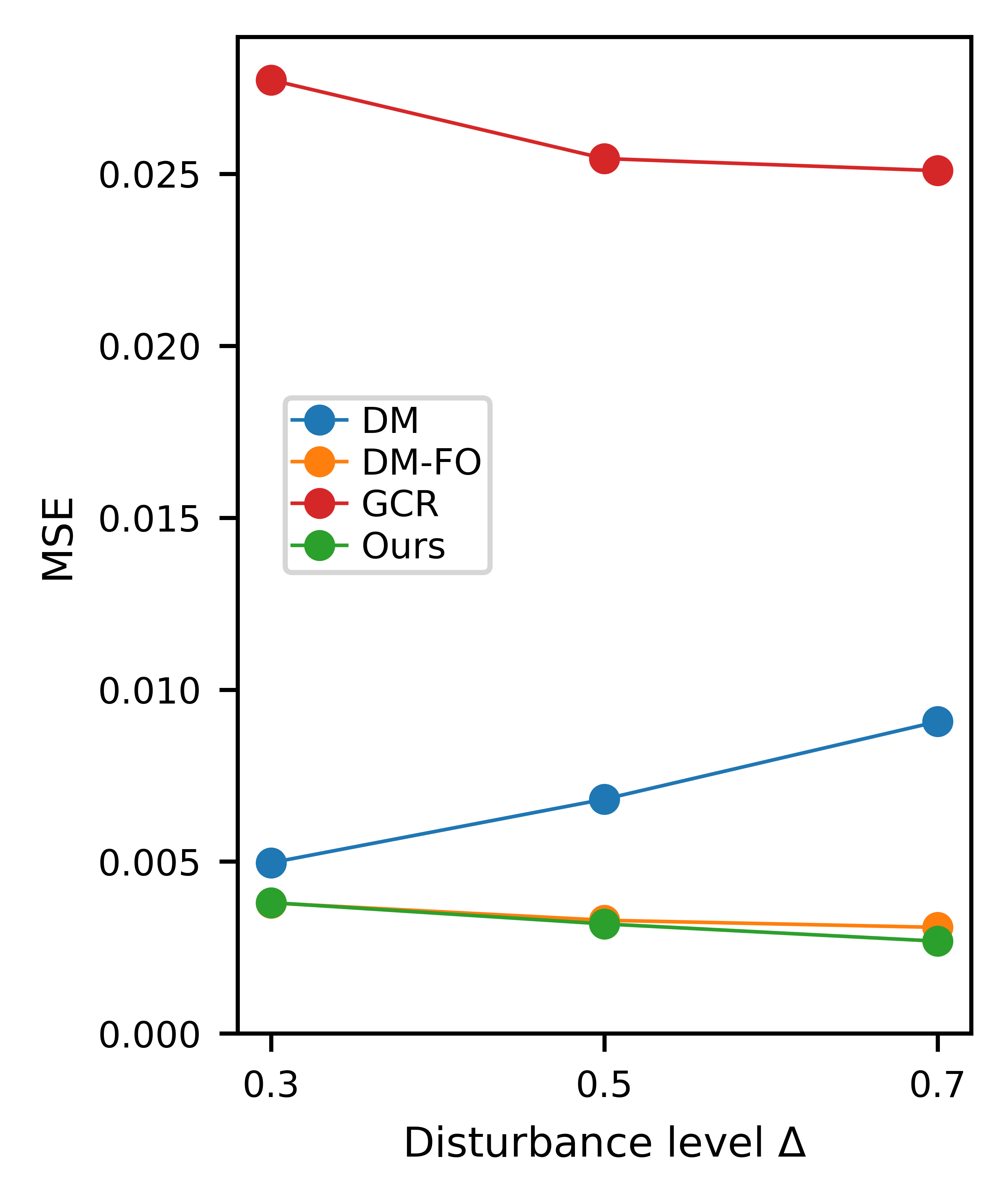
Figure 1: Comparative performance of impact-of-sharing estimators under different disturbance (heterogeneity) levels; propagation-adjusted estimator achieves the lowest bias and MSE.
Theoretical Guarantees and Inference
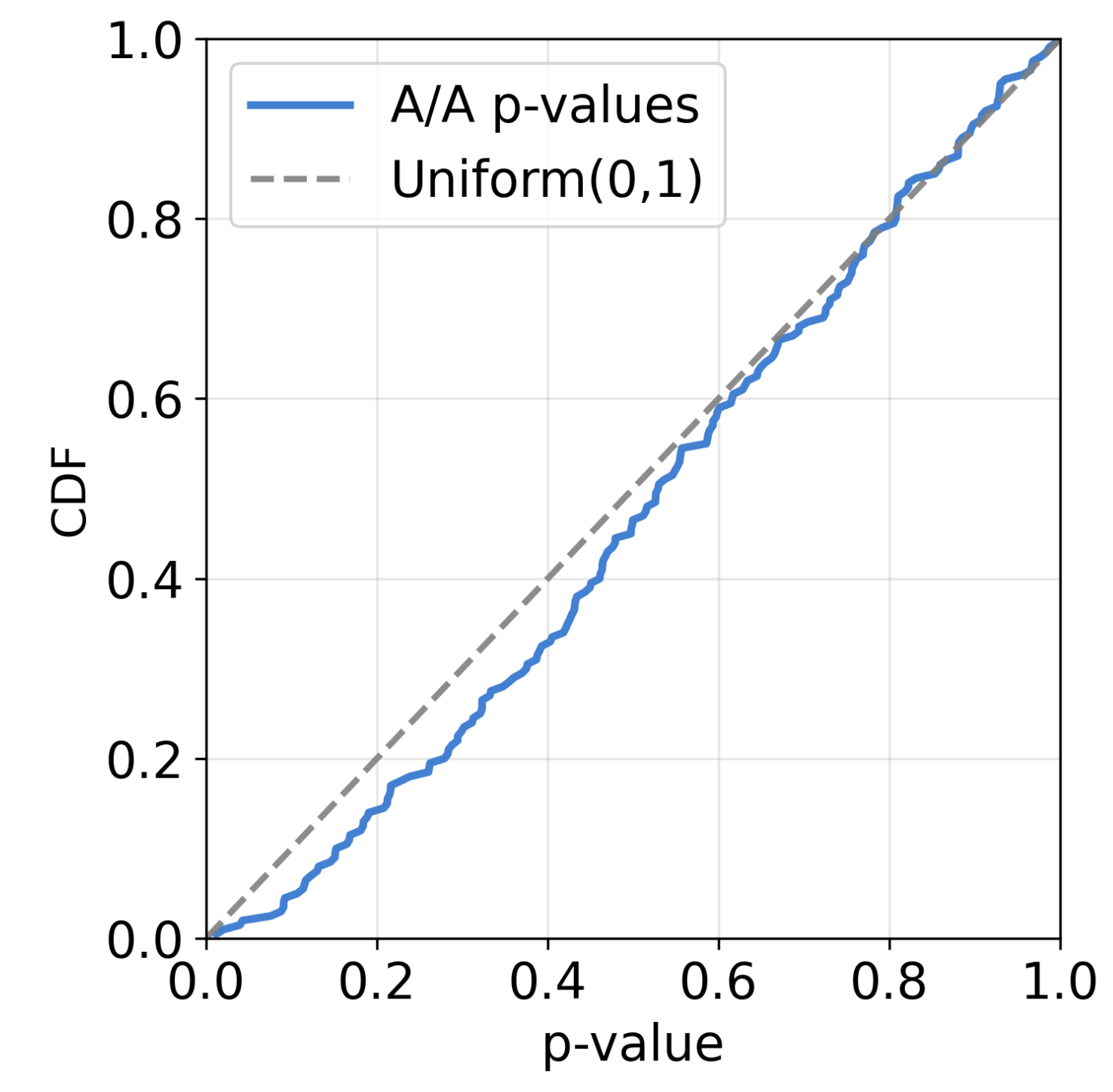
Under standard boundedness and mild downstream homogeneity conditions, the estimator is proven consistent for the platform-level GTE. Moreover, the paper develops a formal inference procedure for valid uncertainty quantification in the presence of interference. Leveraging a finite-population CLT under complete randomization, they show that the A/A test statistic is asymptotically normal, with the variance consistently estimated either for exposed populations or at the group level as necessary.
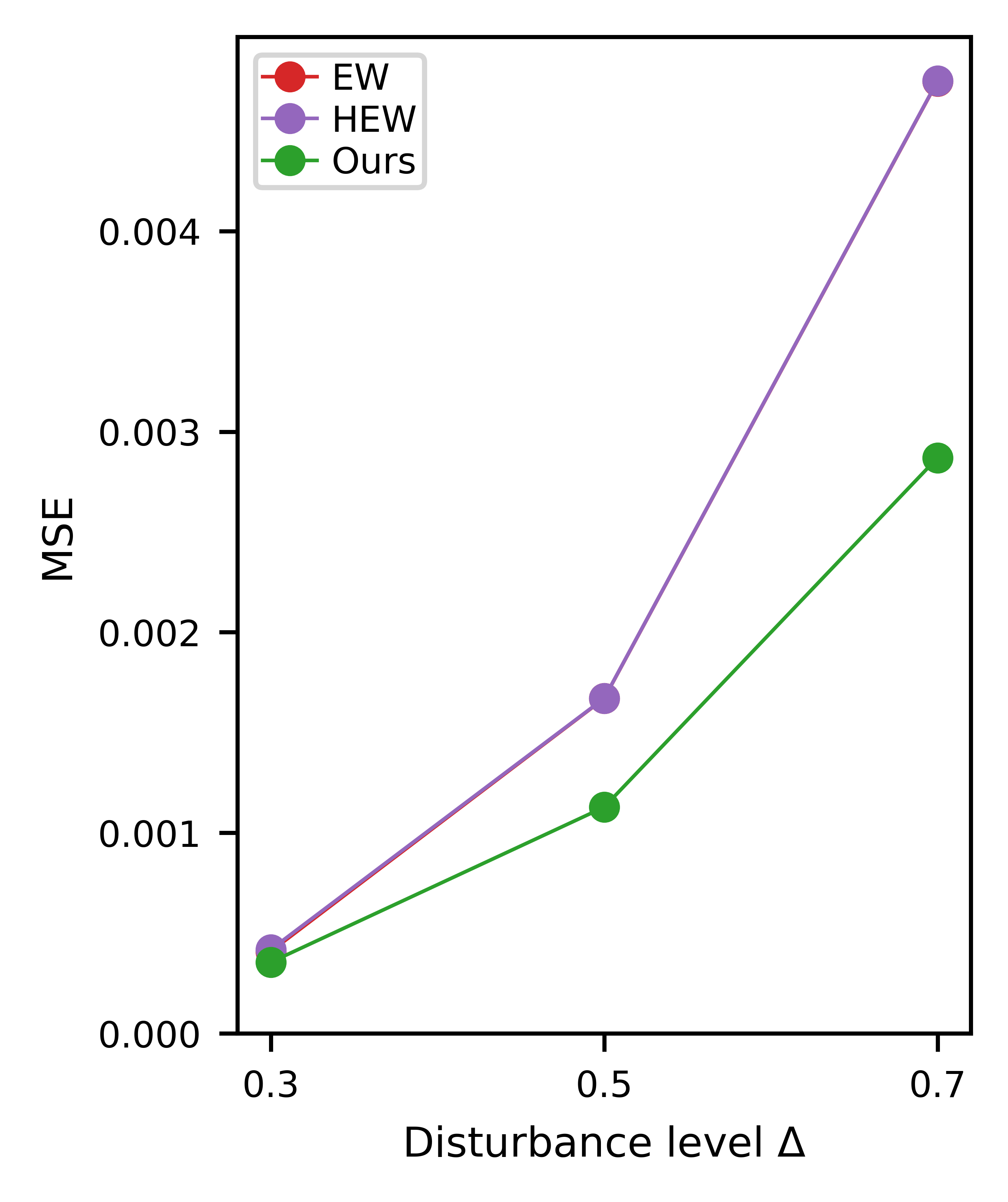
Figure 2: Estimator performance on the reactivation rate, comparing propagation-adjusted and alternative estimators (EW, HEW).
Figure 3: Empirical p-value distribution from 200 A/A tests under the proposed inference procedure, validating nominal Type I error control.
Extension to Reactivation Rate
For user-level reactivation rate metrics (probability a dormant user is reactivated via sharing), direct application of the flow-balance relationship is not feasible due to the nonlinearity of the outcome. The paper derives a Poisson-approximation-based estimator—leveraging mean-field arguments for sparse events—demonstrating superior bias and mean squared error compared to exposure-weighted alternatives, even when homogeneity is violated.
Empirical Evaluation and Real-World Implementation
Extensive simulation studies, including large-scale Barabási–Albert graphs under diverse heterogeneity and propagation strength regimes, demonstrate substantially reduced bias and MSE relative to difference-in-means and cluster-randomization baselines. The method exhibits robustness to user/content heterogeneity, network topologies, exposure probabilities, and propagation strengths.
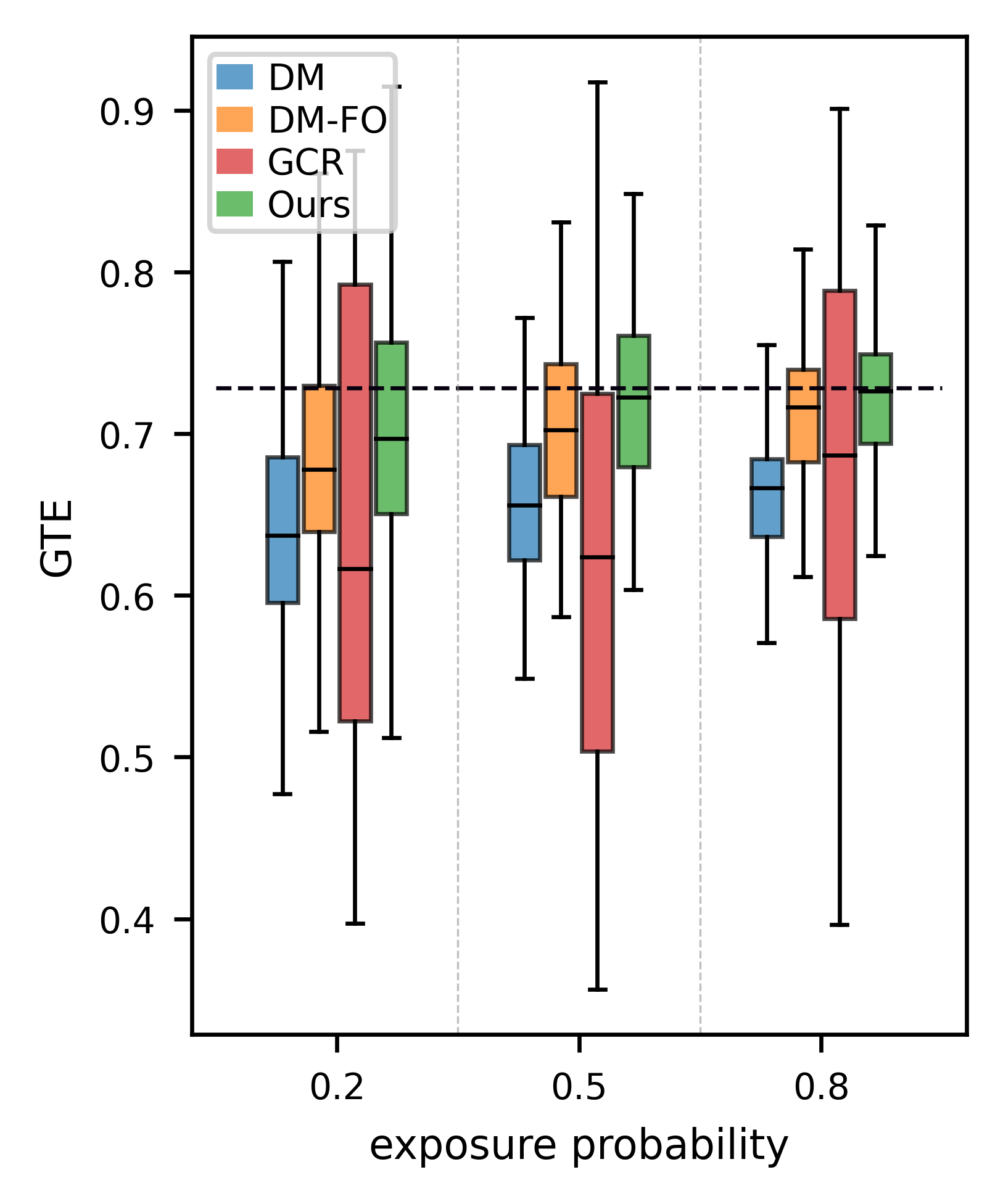
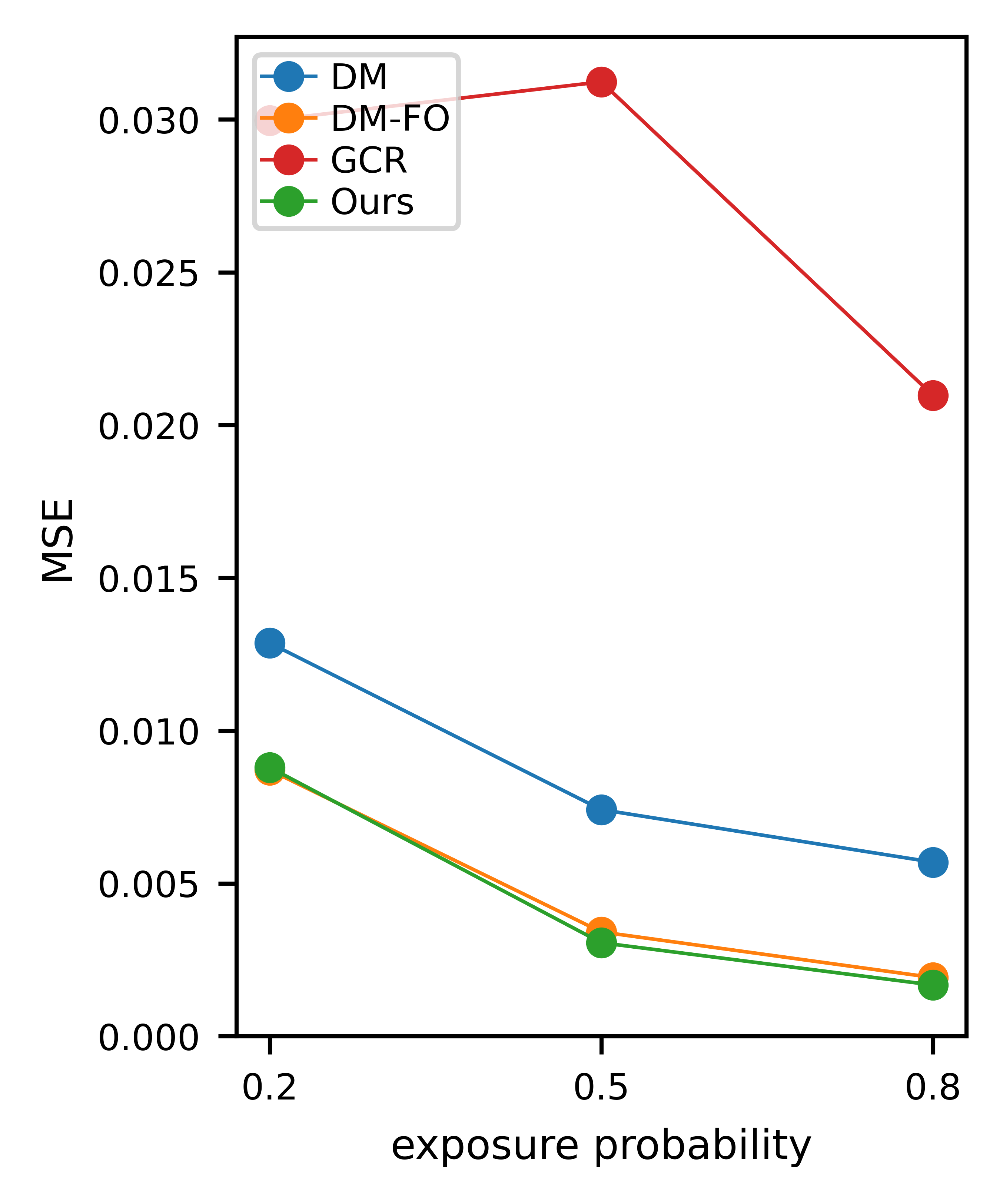
Figure 4: Estimator performance across a range of exposure probabilities, demonstrating robustness.
Deployment on a major global platform with real A/B and A/A experiments yields consistent empirical improvements. For sharing-feature interventions, the propagation-adjusted estimator detects statistically significant effects where benchmarks fail. The empirical p-values from A/A tests validate the theoretical inference apparatus, and post-launch analyses corroborate the business relevance of the gains detected.
Practical and Theoretical Implications
The framework is immediately applicable for large-scale online platforms seeking rigorous evaluation of viral, networked product interventions (e.g., sharing interface, share-promoting ranking). By offering a practical, model-agnostic tool with statistical guarantees, it advances the methodological state-of-the-art for experimentation under network interference and flywheel effects.
On the theoretical front, the propagation adjustment operationalizes the geometric amplification structure of social cascades without requiring structural parameter learning, and the consistency proof handles sparse high-dimensional settings relevant to massive user-content graphs.
Conclusion
This work establishes a rigorous experimental design and inference protocol for quantifying the global effects of share-promoting interventions on online platforms in the presence of complex, recursive social amplification (flywheel) effects. The propagation-adjusted estimator, theoretically justified and empirically validated, allows practitioners to accurately measure platform-level causal impact without succumbing to severe underestimation bias from naive estimators. These methodological advances are expected to enhance both the reliability of online controlled experiments and the empirical foundations for future networked-product innovation.
Reference: "Causal Estimation of Share-Induced Engagement with Flywheel Effects" (2607.10820).