- The paper identifies young clusters associated with ALMA-detected CO clumps using combined NIR and optical photometry to overcome extinction biases.
- It employs Starburst99 models to determine cluster ages (4.5–6 Myr) and masses (700–2400 M☉), revealing low star formation efficiency (<10%).
- The study demonstrates that robust high-mass star formation can occur in the low-density, low-metallicity outskirts of spiral galaxies.
Scientific Context and Motivation
Understanding the process of star formation (SF) in low-metallicity, low-density galactic environments remains unresolved, especially at large galactocentric distances in spiral galaxies. The extended UV (XUV) disks detected by GALEX have introduced evidence for significant SF occurring well beyond the traditionally defined star-forming disks of nearby spirals. M83, a nearby barred spiral galaxy, exhibits such an extended disk, where ALMA has identified compact CO clumps in the low-density XUV regime. These CO(3-2) clumps provide a crucial laboratory to test the onset and properties of SF under environmental conditions that diverge from the canonical inner-disk SF paradigm.
Observational Strategy and Data Synthesis
To probe the SF activity in ALMA-identified CO clumps, the authors combined deep near-infrared (NIR) imaging (Gemini/FLAMINGOS-2, J and Ks bands) with multi-band optical (Subaru Suprime-Cam and HSC, gri and Hα) photometry. Such multiwavelength coverage is critical for minimizing extinction biases and for identifying young cluster counterparts, particularly those that may still be embedded in their natal clouds or rapidly dispersing residual intra-cluster gas. The spatial association of NIR sources with CO clumps, and the assessment of chance realignment probability via control fields, provide a robust mechanism for distinguishing cluster-clump associations from stochastic field star overlaps.
The ALMA field targets a region ∼10 kpc from the M83 center, overlaid in Figure 1.
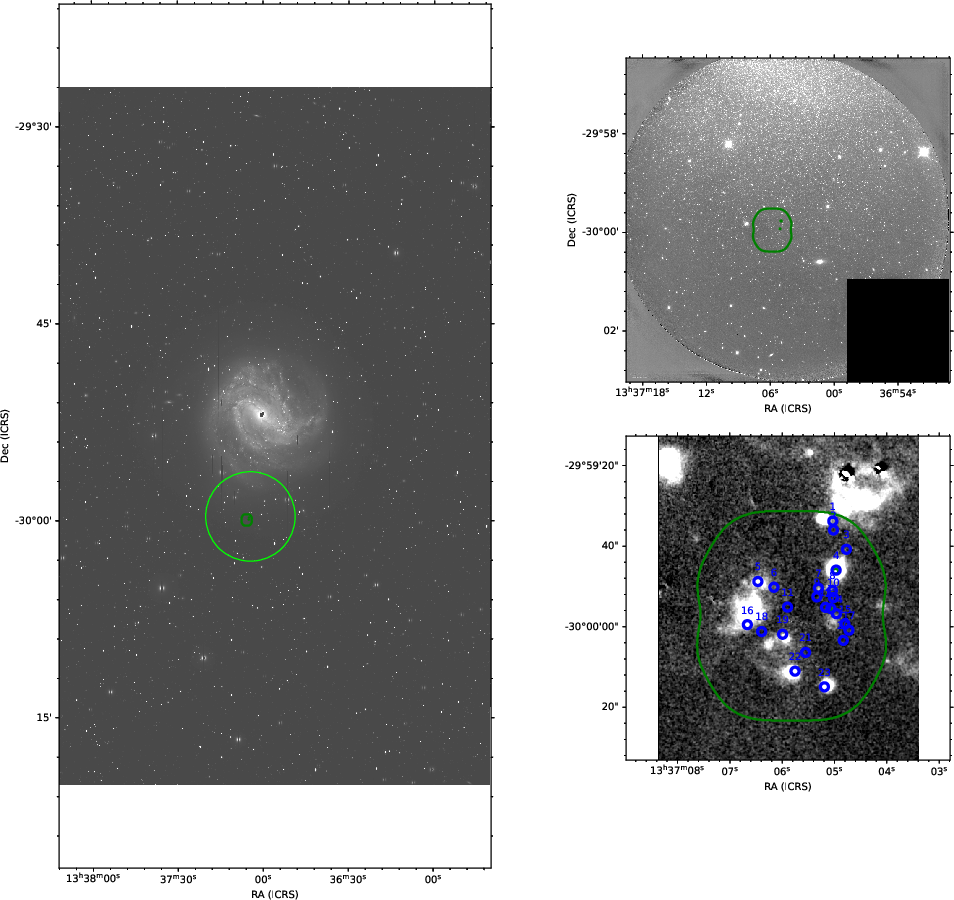
Figure 1: Subaru RC band mosaic of M83 with the ALMA field (green oval), locations of CO clumps (blue), and optical disk boundaries.
The NIR data efficiently probe sources down to ∼300 M⊙ (assuming typical IMF) for cluster ages younger than several Myr, providing sensitivity below the classical mass threshold for young clusters in similar environments.
Detection and Characterization of Cluster Counterparts
A photometric catalog was produced from the J+Ks images, filtered for astrometric coincidence and photometric error (<0.2 mag). A total of 11,055 sources were found, of which four are spatially associated with CO clumps (within 1.5×FWHM of the CO clump center). The color-magnitude distribution, as shown in Figure 2, reveals that these associated sources tend to be among the brighter and redder objects, consistent with expectations for young clusters partially extinguished by residual dust.
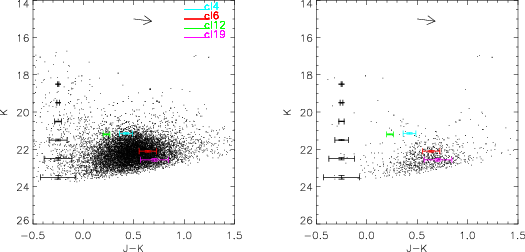
Figure 2: J−Ks vs Ks color-magnitude diagram of the ALMA field, with cluster-associated sources marked and reddening vectors plotted.
For these associations, the probability of being chance alignments is explicitly computed using field source densities from control regions. In two cases (clumps 4, 12), the probabilities are ≤ 3\–4\%, supporting credible physical association. The remaining two associations have higher chance alignment probabilities or are marginal detections at the sensitivity limit.
Morphological and Multiwavelength Counterpart Analysis
Postage stamp analysis in the Ks band (Figure 3) and combined H∼100/∼101-band mapping (Figure 4) were used to study the spatial, morphological, and multiwavelength correspondence of these cluster candidates.
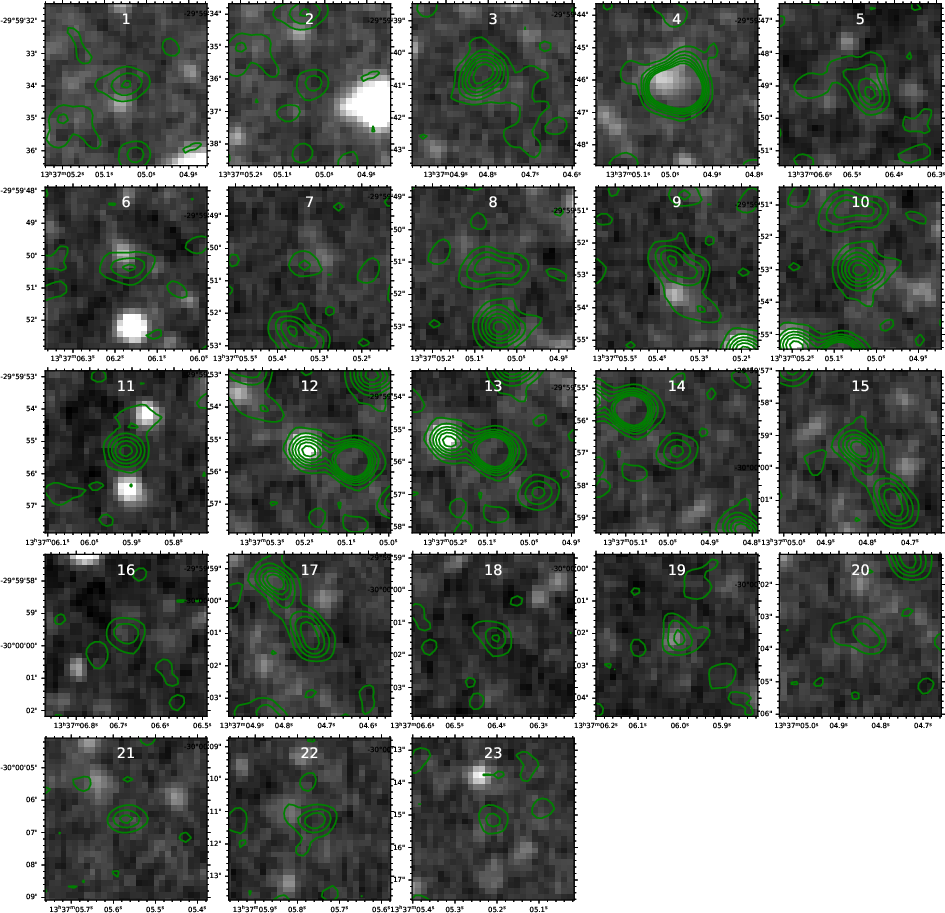
Figure 3: NIR images centered on each CO clump, with CO contours overlayed, highlighting NIR sources detected within the clump FWHM.
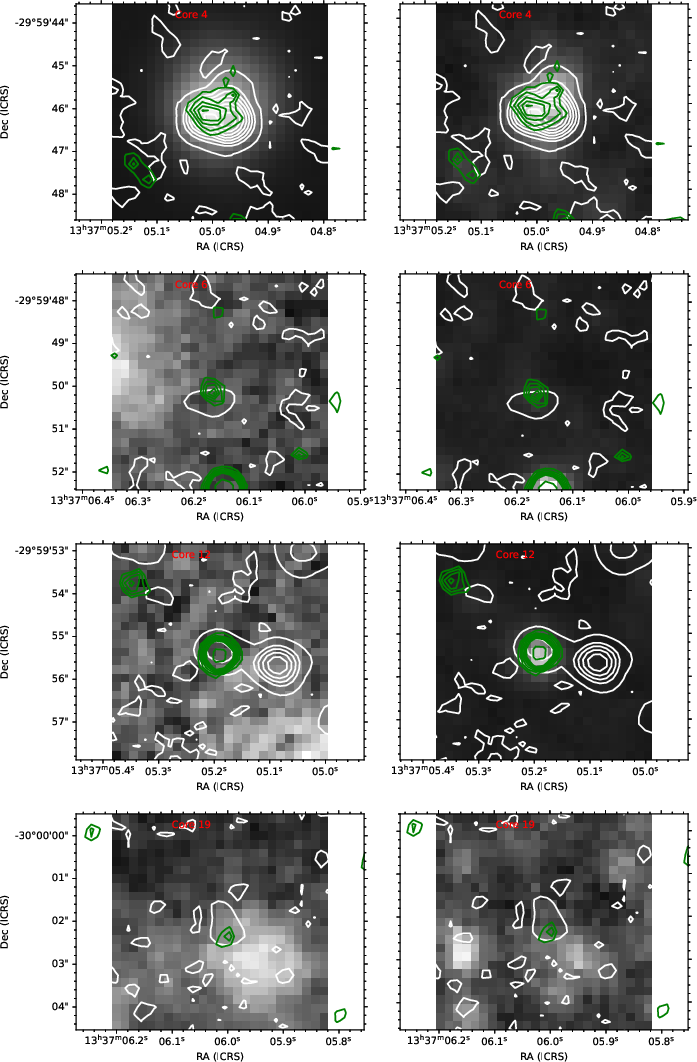
Figure 4: Left: H∼102 images around each NIR-CO associated clump; J-band and CO(3-2) contours overlaid. Right: Subaru ∼103-band counterparts.
Clump 4 exhibits an extended NIR source, consistent with a young, possibly unrelaxed stellar complex (∼10420 pc), coincident with the brightest H∼105 source in the field and showing negligible extinction. Clump 12 is associated with a compact, unresolved source, identifiable in both optical and NIR bands, but is not associated with an H∼106 emission region and displays significant extinction (∼107).
Photometric Modeling, Ages, and Masses
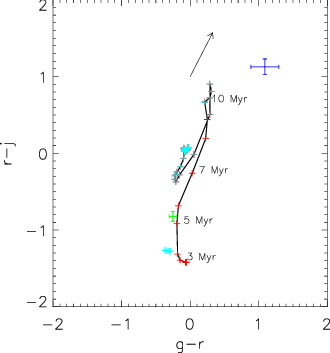
Cluster ages and masses were derived using Starburst99 SSP models (Z=0.008, Kroupa IMF), with optical-NIR color-color diagnostics (Figure 5) and extinction/reddening corrections applied. The analysis confidently yields ages of 4.5–6 Myr and masses of 700–2400 ∼108 for the two prominent associations:
The derived cluster-to-cloud mass ratios are heterogeneous, suggesting that SF efficiency is low (generally RC8), though individual clumps may be consistent with near-unity conversion in some cases, contingent on uncertainties in CO-based mass estimations, completeness, and IMF sampling effects.
Despite deep imaging, only a minority (RC910–15%) of CO clumps present statistically robust young cluster counterparts. This low association fraction, in tandem with the derived SFEs, aligns with the known inefficiency of SF in XUV disks and is consistent with molecular cloud lifetimes and feedback-regulated SF models (e.g., STARFORGE; see also (Suin et al., 2023, Suin et al., 5 May 2025)). The findings reinforce the view that—despite subsolar metallicity and environmental extremes—high-mass SF can occur, but with stochastic and spatially variable efficiency.
Some clusters exhibit intricate morphology with hints of star formation progression and possible feedback-driven structure formation, paralleling what is observed in the outer Milky Way (e.g., Dolidze 25). Age gradients across complexes support the scenario where positive and negative feedback mechanisms affect the sequential progression of SF within and around massive clumps.
Implications and Prospects
Physical Implications
- Young clusters in the XUV disk of M83 can form at masses as low as a few ∼0 ∼1 out to galactocentric radii ∼210 kpc, demonstrating SF under strong environmental constraints.
- The IMF in these regions appears to be fully populated (no evidence for truncation), in line with (Koda et al., 2012).
- The overall low SFE and the stochastic nature of cluster formation across the CO clump population reinforce models where feedback, metallicity, and low pressure conspire to limit SF progression.
Observational and Theoretical Implications
- NIR+optical multi-band imaging offers essential sensitivity for quantifying embedded and unobscured SF even at the low cluster mass end.
- The data validate that the mapping of CO clumps and YSCs in XUV disks can constrain the timescales and efficiency of cloud to cluster conversion, which feed back into global SF laws at low gas densities (Sun et al., 2023, Koda et al., 2024).
- The limited survey area and the uncertainty in associating older clusters with their progenitor clumps (due to differential drift and decorrelation timescales) highlight the importance of wide-field, high-resolution surveys across the entire XUV region.
Future Directions
- Expansion to larger areas of M83’s XUV disk and additional XUV systems for population statistics.
- JWST or adaptive-optics assisted NIR imaging for improved resolution of embedded cluster structure and cluster mass function constraints.
- CO(1-0), CO(2-1), and high-density tracer mapping to better resolve gas mass and distinguish between pre-stellar and post-star formation clump states.
- Integration with PHANGS and similar galaxy-wide surveys to systematize XUV disk SF phenomena.
Conclusion
The study demonstrates that young star clusters with masses as low as a few ∼3 ∼4 can be directly linked to individual molecular clumps in the extended UV disk of M83. Statistically significant associations are rare, and the overall SFE is low, consonant with inefficient SF regimes in outer galaxy disks. Nevertheless, favorable conditions for SF persist even at large galactocentric radii and subsolar metallicity, without evidence for IMF truncation. These results substantiate the diverse modes and outcomes of SF in galactic outskirts, with implications for SF theories under extreme conditions, and affirm the critical role of multiwavelength, high-sensitivity observations in resolving the full cluster-gas connection.