- The paper rigorously establishes criteria for continuous (pitchfork) and discontinuous (saddle-node) phase transitions via bifurcation theory.
- It extends Dawson’s criterion from 1D to multidimensional McKean-Vlasov systems, linking invariant measure multiplicity to covariance eigenvalues.
- Applications to symmetric and asymmetric potentials illustrate the precise conditions under which phase transitions emerge and stabilize.
Bifurcation Structure of McKean-Vlasov Phase Transitions: Continuity and Discontinuity
Introduction and Background
The paper "Continuity and Discontinuity of McKean-Vlasov Phase Transitions via Bifurcation Theory" (2607.10723) develops a comprehensive theory for phase transitions in the mean-field McKean-Vlasov stochastic differential equations (MVSDEs) under general non-convex confining potentials and interaction kernels, rigorously characterizing both continuous (second-order) and discontinuous (first-order) transitions using tools from infinite-dimensional bifurcation analysis.
Focusing on systems in Rn, the authors provide abstract pitchfork and saddle-node bifurcation theorems determining whether phase transitions are continuous or discontinuous. The work extends classical results, notably Dawson’s criterion for the critical transition point, from one-dimensional to multi-dimensional settings, and handles both symmetric and asymmetric potentials, encompassing a wide range of many-particle models—including those in multi-well potentials and with various types of attractive interactions.
The theoretical advancements are corroborated and exemplified through detailed applications to canonical double-well and multi-well models, as well as systems with Gaussian core interactions. The distinctions between mean-field (infinite-N particle) and finite N particle behavior are explicitly discussed, particularly highlighting the difference in invariant measure multiplicity.
The starting point is the gradient-type McKean-Vlasov SDE
dXt=−∇V(Xt)dt−κ∇W∗LXt(Xt)dt+σdBt,
where V and W denote the external and interaction potentials, respectively, and LXt is the law of Xt. The equation is coupled with the nonlinear Fokker-Planck equation for the density evolution:
∂tμt=2σ2Δμt+div(∇Vμt)+div(κ∇W∗μtμt).
Invariant measures are obtained as fixed points of a nonlinear Gibbs map, which can be reduced to a finite-dimensional bifurcation equation for quadratic interactions. For generic n, this analysis essentially revolves around the covariance matrix and moments of these invariant measures.
A critical parameter N0 is introduced, capturing the relative strength of interaction to noise (effective inverse temperature), and phase transitions are identified as bifurcation points in this parameter.
Bifurcation Analysis: Theoretical Framework
The authors establish two principal bifurcation scenarios:
- Continuous Phase Transitions (Pitchfork Bifurcation): Occur in symmetric potentials (e.g., symmetric double-well) with a family of trivial symmetric invariant measures. As N1 crosses a critical value N2, two new, symmetry-broken invariant measures bifurcate continuously from the original branch.
- Discontinuous Phase Transitions (Saddle-Node Bifurcation): Occur in asymmetric potentials (e.g., asymmetric double-well). Here, invariant measures concentrated in the shallower well emerge discontinuously, with pairs of measures created or annihilated at bifurcation.
These theoretical structures are rigorously formulated as abstract bifurcation theorems for operator equations in appropriate Banach spaces. Crucial to this formulation is the reduction of the spectral bifurcation condition to an explicit criterion involving the eigenvalues and eigenvectors of the covariance matrix of the underlying invariant measure. For the quadratic interaction case, this extends Dawson’s 1D criterion to arbitrary dimensions:
N3
with N4 the corresponding critical direction.
Symmetric vs. Asymmetric Double-Well Potentials
For the symmetric double-well potential,
N5
the analysis yields a standard pitchfork bifurcation, as illustrated in (Figure 1).
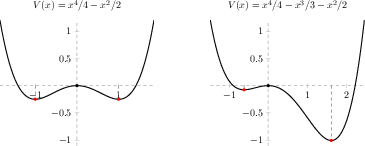
Figure 1: Sketches of symmetric and asymmetric double-well potentials, illustrating the qualitative difference in their landscapes.
For the asymmetric double-well,
N6
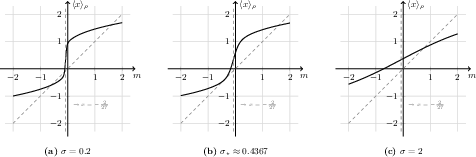
the bifurcation diagram (see below) reveals the emergence of invariant measures in a discontinuous manner.
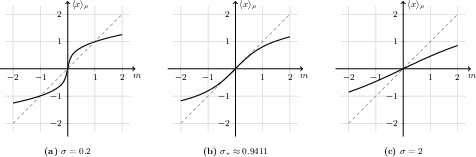
Figure 3: Graphs of N7 and N8 as N9 varies for both symmetric (centrally symmetric about N0) and asymmetric (symmetric about N1) double-well cases, visualizing the fixed-points and their bifurcations as the temperature changes.
In both cases, the branching and local stability of invariant measures are addressed in terms of the variance and higher moments, with bifurcation points identified as tangencies of the order parameter map with the identity.
Explicit Characterization and Examples
The paper provides a suite of worked examples, including:
Methodological Innovations
Key methodological advances include:
- Systematic derivation of bifurcation equations and moment closure for mean-field Fokker-Planck equations in general dimension and for varied potentials.
- Explicit reduction of spectral bifurcation conditions to observable covariance matrix quantities, greatly simplifying practical verification.
- Precise characterization of invariant measure branching types (pitchfork vs. saddle-node), enabling direct linkage between potential symmetry and phase transition order.
- Rigorous extension of Crandall-Rabinowitz theory and spectral projection techniques to noncompact, non-Fourier-analytic settings (full N5) by exploiting the structure induced by confining potentials.
Numerical and Analytical Results
Quantitative results include explicit evaluation of critical parameters for canonical potentials, asymptotic and rigorous inequalities for moments ensuring bifurcation transversality and nondegeneracy, and spectral analysis for Gaussian core models. The work provides both analytic proofs and numerical corroboration for the pitchfork and saddle-node mechanisms.
A notable analytical contribution is the derivation of a monotonicity inequality for the order parameter with respect to temperature, which is used to guarantee the transversality (and thus genericity) of phase transition points.
Implications, Generalizations, and Outlook
The findings consolidate the connection between phase transition structure and bifurcation logic for McKean-Vlasov equations, greatly broadening the scope beyond the special cases previously studied on compact domains or with purely interaction-driven dynamics.
Theoretical implications: The results offer a unifying description of order/disorder phenomena in high-dimensional mean-field systems, clarifying the role of symmetry, interaction form, and potential landscape in determining the order of phase transitions. The explicit covariance-based bifurcation criteria substantially simplify both analytical and numerical checks for criticality, facilitating the study of multiwell and anisotropic models.
Practical and computational relevance: These insights apply directly to models of collective behavior in physics, neural networks, and high-dimensional probabilistic flows, as well as to large-scale inference problems with nontrivial landscape structure. Exact identification of the phase portrait and stability regions aids in designing and controlling such stochastic systems.
Directions for future work:
- Extension to models with jumps or multiplicative noise, where the spectrum of the associated operator may be more intricate.
- Generalization to non-gradient systems (e.g., including rotational dynamics or constraints), or models with partial symmetry breaking.
- Applications to mean-field models of deep learning architectures, Bayesian inference, and robustness of equilibrium selection in high-dimensional settings.
- Further development of numerical spectral analysis for noncompact operators (e.g., for nonquadratic interactions) in line with the presented methods.
Conclusion
This work provides a rigorous and explicit bifurcation-theoretic classification of phase transitions in McKean-Vlasov systems with non-convex confining and interacting potentials, systematically differentiating continuous and discontinuous cases via covariance-based criteria, and charting the emergence and multiplicity of invariant measures in prototypical models. The combined analytic and numerical methodology sets a new standard for the study of phase structures in mean-field SDEs and nonlocal PDEs, with implications across mathematical physics, probability, and complex systems modeling.