- The paper introduces a Schmidt-reference-state framework that computes the nonlocal nonstabilizerness from the sorted entanglement spectrum, bypassing intractable local unitary minimization.
- It demonstrates, with both analytic proofs and numerical simulations on Haar, Ising, XXZ, and PXP models, that the reference state yields the global minimum of stabilizer Rényi entropy.
- The results reveal that nonlocal SRE captures unique quantum resources beyond entanglement, suggesting new applications in quantum many-body simulation and critical dynamics.
Nonlocal Nonstabilizerness for Slightly Entangled Quantum Many-Body States
Introduction and Motivation
This work addresses the quantification of nonlocal nonstabilizerness—the irreducible "magic" resource remaining in a bipartite quantum system after all possible local Clifford operations and general local unitaries are exhausted. Unlike entanglement, which can be extensive in certain states yet still compatible with efficient classical simulation (as for stabilizer states), nonstabilizerness captures quantum computational resources beyond entanglement measures. The primary technical challenge is the computational intractability of minimizing stabilizer Rényi entropies (SREs) over high-dimensional local unitary actions, a process that is, in general, highly nonconvex and scales exponentially with subsystem size.
The authors propose a Schmidt-reference-state-based framework that allows the nonlocal nonstabilizerness to be computed directly from the sorted entanglement (Schmidt) spectrum, bypassing the intractable local unitary minimization. They conjecture, and support with analytical and numerical evidence, that this reference state saturates the lower bound for nonlocal SRE. Their approach is directly applicable to weakly entangled many-body states, such as MPS ground states and low-entanglement dynamics as encountered in the PXP model, and allows direct numerical access to nonlocal resource quantification.
The stabilizer Rényi entropy of a pure state ∣ψ⟩ is defined via moments of state overlaps with Pauli strings, yielding a basis-independent magic monotone for α≥2. For a bipartition (A,B), the nonlocal SRE is defined as
MαNL(∣ψ⟩AB)=UA⊗UBminMα((UA⊗UB)∣ψ⟩AB),
where UA/B are general local unitaries. The computational bottleneck is the minimization over local unitaries.
To circumvent this, the authors define a reference state ∣ψ~⟩ in the computational basis, with the same sorted Schmidt coefficients as ∣ψ⟩, but mapped to the computational basis. They conjecture that
MαNL(∣ψ⟩)=Mα(∣ψ~⟩),
i.e., the reference state's SRE saturates the minimum over local unitaries.
Theoretical support is provided by proving that the reference state is a stationary point of the SRE landscape under local unitary perturbations (i.e., all first derivatives vanish). Extensive numerical manifold optimization studies confirm that for all cases checked (up to rank-4 spectra and beyond), the reference state indeed yields the global minimum.
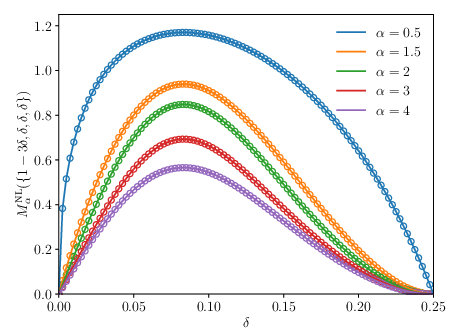
Figure 1: Nonlocal SRE for the entanglement spectrum {1−3δ,δ,δ,δ} as a function of δ and Rényi index, comparing reference state (lines) and manifold-optimized (markers) values; perfect agreement across all parameters demonstrates the validity of the conjectured formula.
The explicit formula for rank-two states is analytic, and for higher ranks they present a closed-form expression involving the sorted Schmidt vector and a sum over four-fold indices with XOR structure, reflecting the Clifford-algebraic underpinning. For low-rank spectra (particularly rank-4), the SRE can also be written as a simple function of low-order standard Rényi entropies for experimental accessibility.
Numerical Results: Haar States and Many-Body Systems
Haar-Random States
Applying the framework to Haar-random states, the authors recover that while the global SRE is extensive, the irreducible nonlocal part is α≥20, i.e., does not scale with subsystem size. This reflects the near-flat entanglement spectrum in Haar states; almost all nonstabilizerness can be removed by local unitary rotations.
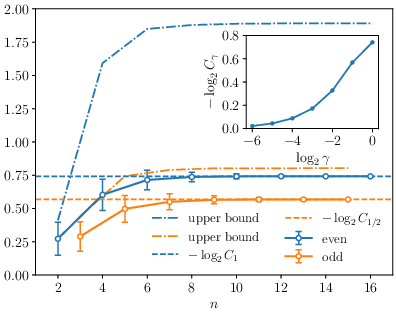
Figure 2: Average nonlocal SRE of Haar-random states as a function of system size; nonlocal SRE saturates at an α≥21 value in the thermodynamic limit and vanishes rapidly with unbalanced partitions.
Ising and XXZ Spin Chains
For the critical one-dimensional transverse-field Ising model (TFIM), nonlocal SRE obtained via DMRG and VUMPS reveals a pronounced peak at the critical point, with logarithmic scaling in the correlation length—a behavior analogous to, but distinct from, the entanglement entropy.
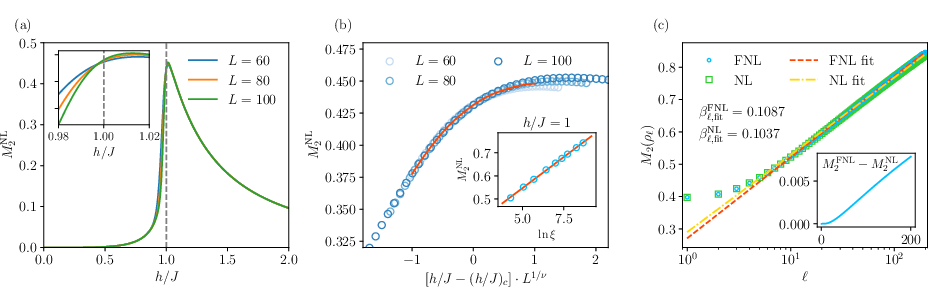
Figure 3: (a) Nonlocal SRE in the Ising chain shows a scaling peak at criticality. (b) Finite-size scaling reveals logarithmic divergence of nonlocal SRE with correlation length at the critical point. (c) Comparison between fermionic NL magic (FNL) and reference-state NL: FNL provides an upper bound, and the gap grows with subsystem size.
For the XXZ model, the nonlocal SRE scaling coefficient shows strong dependence on the interaction parameter α≥22 even for fixed central charge α≥23, highlighting the sensitivity of nonlocal nonstabilizerness to detailed basis structure and XOR correlations in the Schmidt spectrum—not just the entanglement entropy distribution.
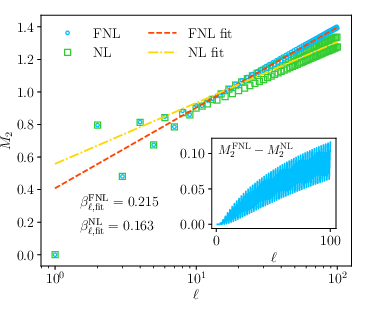
Figure 4: FNL and NL as a function of the subsystem size α≥24 at α≥25 (free-fermion point) in the XXZ chain; FNL consistently upper bounds NL and the gap exhibits subsystem-size dependence.
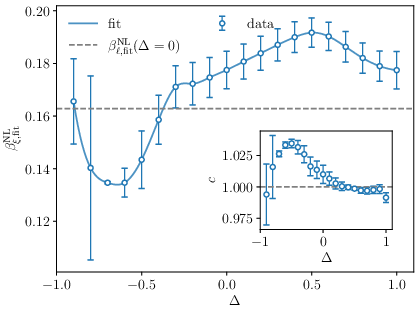
Figure 5: Scaling coefficient of nonlocal SRE across the critical XXZ chain as a function of anisotropy parameter α≥26; variation persists even at fixed central charge, signaling sensitivity to interaction-induced spectral features.
Dynamics in the PXP Model
Analysis of quench dynamics in the PXP model (which features quantum many-body scars and weak ergodicity breaking) reveals that nonlocal SRE growth and entanglement entropy growth can be strongly separated. For scarred initial states, nonlocal SRE exhibits fast, stepwise growth and plateaus, even as the entanglement entropy grows slowly; for generic initial conditions, the entanglement grows rapidly while the nonlocal SRE remains small and saturates early.
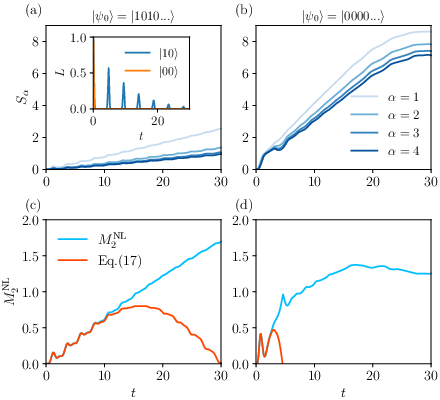
Figure 6: Time evolution of entanglement entropy and nonlocal SRE in the PXP model for different initial states; nontrivial dynamical separation between entanglement and nonstabilizerness growth is evident.
Implications and Perspectives
The main result provides a direct and efficient route to compute irreducible nonstabilizerness using only the sorted entanglement spectrum, enabling large-scale studies in many-body quantum systems, including those with MPS representations. The sensitivity of nonlocal SRE to the binary structure of the spectrum, rather than just the spectra’s distribution, distinguishes it from conventional entanglement measures and even from previously proposed fermionic "Gaussian" nonlocal magic measures (FNL)—the latter only upper bounding the nonlocal SRE.
These findings establish that nonlocal nonstabilizerness captures quantum complexity inaccessible to standard entanglement entropy, especially in critical and constrained dynamics, and that it is robust to removal of all possible local Clifford and generic local unitary structure. The nontrivial scaling across the XXZ phase diagram, independence of central charge, and dynamical disentangling in quantum scar dynamics all suggest that nonlocal SRE is sensitive to detailed features of correlations, interaction effects, and the symmetry constraints.
Future research directions include proving the global minimality of the reference state SRE under local unitaries (establishing the conjecture as a theorem), developing CFT/field-theoretic scaling frameworks for nonlocal SRE, and generalizing methods to higher dimensions, topological and symmetry-protected phases, and open-system or stochastic dynamics. Experimentally, the possibility of approximating nonlocal SRE in settings with low effective Schmidt rank via only low-order Rényi entropies enables implementation on Rydberg atom arrays, trapped ions, and superconducting quantum processors.
Conclusion
The Schmidt-spectrum-based construction offers a rigorous, computationally efficient, and physically insightful approach to quantifying nonlocal nonstabilizerness in weakly entangled and critical quantum matter. It exposes fine-grained quantum correlations that persist after all local and stabilizer manipulations are exhausted, opening a new axis in the study of quantum resources in many-body systems and nonequilibrium dynamics.
Reference:
"Nonlocal nonstabilizerness for slightly entangled quantum many-body states" (2607.10714)