Corrections to inflationary models induced by non-minimal coupling between scalar field and curvature
Published 12 Jul 2026 in gr-qc | (2607.10679v2)
Abstract: In this paper, we consider possible corrections to the characteristics of inflationary models based on a specific parametrization of the non-minimal coupling between the scalar field and curvature. At the inflationary stage, these corrections lead to a deformation of the scalar field potential and a corresponding deviation in the determination of the cosmological perturbation parameters. At the same time, it is shown that the proposed parametrization yields a description of the reheating stage dynamics completely analogous to the case of Einstein gravity with minimal coupling between the scalar field and curvature. For a model-independent analysis of inflationary corrections induced by a non-minimal coupling, a classification of inflationary scenarios based on the expansion in series of the dependence of the tensor-to-scalar ratio on the spectral index of scalar perturbations is considered. It is also shown that this approach allows for the inclusion of well-known inflationary models as special cases.
The paper introduces a GST framework where non-minimal coupling modifies the tensor-to-scalar ratio and slow-roll parameters.
It employs a controlled power-law parametrization to systematically classify inflationary models and ensure consistency with CMB and large-scale structure data.
The corrections preserve standard reheating dynamics while highlighting tensions with observed scalar spectral running and suppression of tensor modes.
Corrections to Inflationary Models Induced by Non-Minimal Coupling Between Scalar Field and Curvature
Introduction
This paper systematically investigates the corrections to slow-roll inflationary models that arise due to a non-minimal coupling between the inflaton and the spacetime curvature, employing a controlled power-law parametrization for the coupling function, F(H)=(H/λ)2n. The analysis is motivated by increasingly stringent CMB and large-scale structure constraints from Planck, ACT, and DESI, which pressure many minimal models and invite a general framework to capture viable deviations. The approach ensures phenomenological calibration with observed scalar fluctuation amplitudes and maintains dynamical equivalence with minimal (Einstein) models in the reheating regime. The work further advances a model-independent classification of inflationary scenarios by considering the expansion of the tensor-to-scalar ratio r in terms of the scalar spectral tilt 1−nS, directly connecting theoretical deviations to observable cosmological parameters.
Scalar-Tensor Inflation and Power-Law Non-Minimal Coupling
The classical inflation scenario with a canonical scalar and Einstein-Hilbert background provides baseline results for the slow-roll parameters ϵ and δ, and for spectral observables nS and r. The modification considered is a generalized scalar-tensor theory (GST), with action:
S=21∫−gF(ϕ)R−∫−g[21ω(ϕ)(∂ϕ)2+V(ϕ)]
The focus is on a power-law functional form for the coupling, F(H)=(H/λ)2n with −1<n<1 ensuring a healthy kinetic term for the scalar in the slow-roll region. This allows a continuous interpolation from minimal coupling (r0) to non-minimal scenarios.
The parameter r1 is directly interpretable: it measures the inflationary potential's deformation relative to the standard minimal theory and parametrizes the shift in predicted spectral observables. The normalization r2 is not a free parameter but is fixed by demanding the scalar amplitude match the observed value for a given r3 and r4.
Modified Slow-Roll Dynamics and Perturbation Spectra
In the slow-roll regime, closed-form analytic results are presented for the inflationary background and for the perturbation power spectra. The most salient effect is a systematic rescaling of the tensor-to-scalar ratio,
r5
while the consistency relation r6 is preserved exactly, distinguishing this GST subclass from generic non-Einsteinian inflation models. The scalar spectral index and its running,
r7
admit a dual parametric dependence on r8 and the background flow, which enables systematic and model-independent analysis.
The computation shows that for r9 the amplitude of tensor modes is suppressed for fixed 1−nS0, directly impacting the observational viability of inflationary scenarios as new experimental upper bounds are established.
A central contribution is the classification of inflationary models via a series expansion of 1−nS2 in the small parameter 1−nS3, enabling a universal analysis regardless of potential shape:
1−nS4
This approach subsumes known models as specific cases and allows analytic expressions for background evolution, e-fold range, and excursions. It also precisely delineates when non-minimal coupling effects can or cannot be probed with current or forthcoming data.
First-Order Models
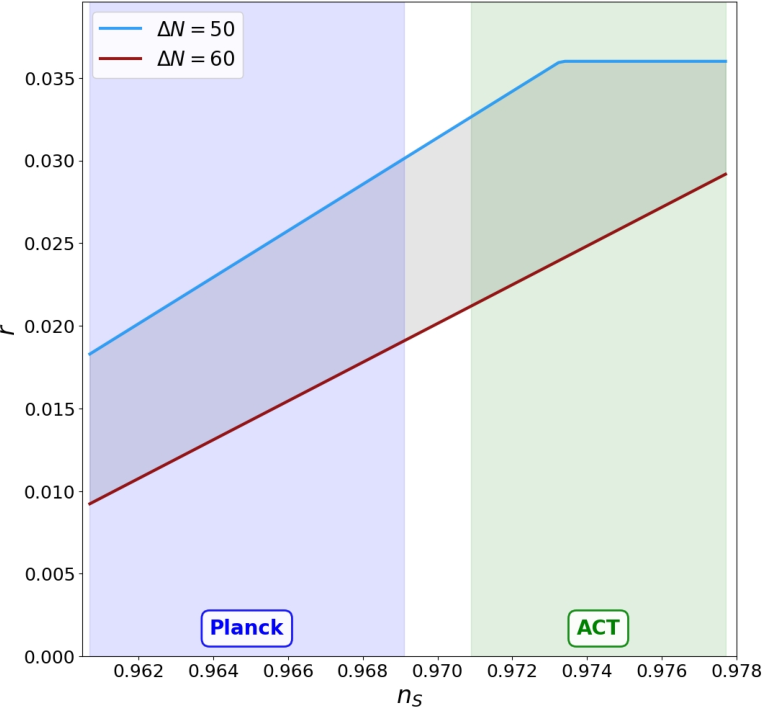
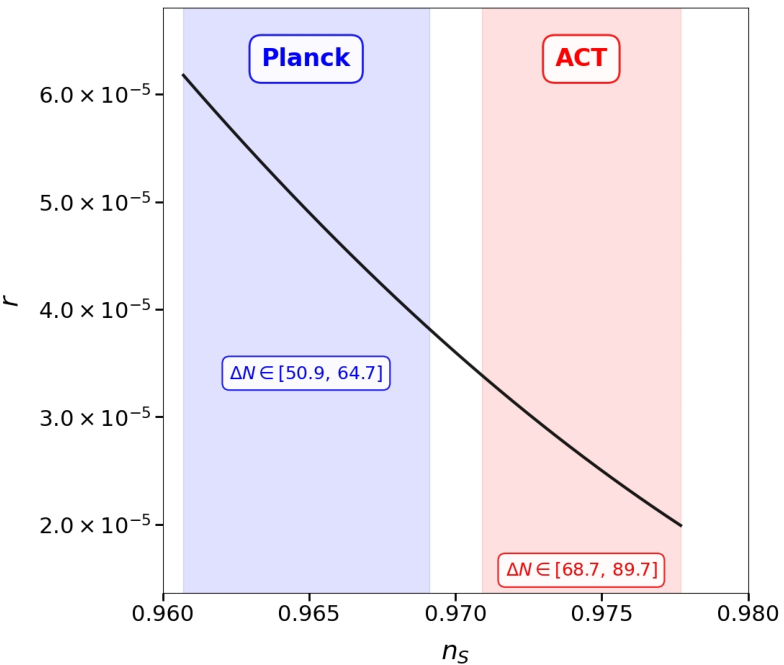
For first-order scenarios (1−nS5), both scalar and tensor sectors receive leading-order corrections in 1−nS6, and the models remain testable for e-folds in the range 1−nS7, corresponding to standard reheating histories. The effect of 1−nS8 is to robustly suppress 1−nS9 as ϵ0 increases, relaxing bounds on classes of models otherwise marginal according to Planck/ACT.
Figure 1: The case ϵ1; ϵ2 vs. ϵ3 for the minimally coupled scenario, demonstrating the linear dependence characteristic of first-order models.
This exhausts the single-field predictive power of first-order models under the GST deformation.
Second-Order and Higher-Order Models
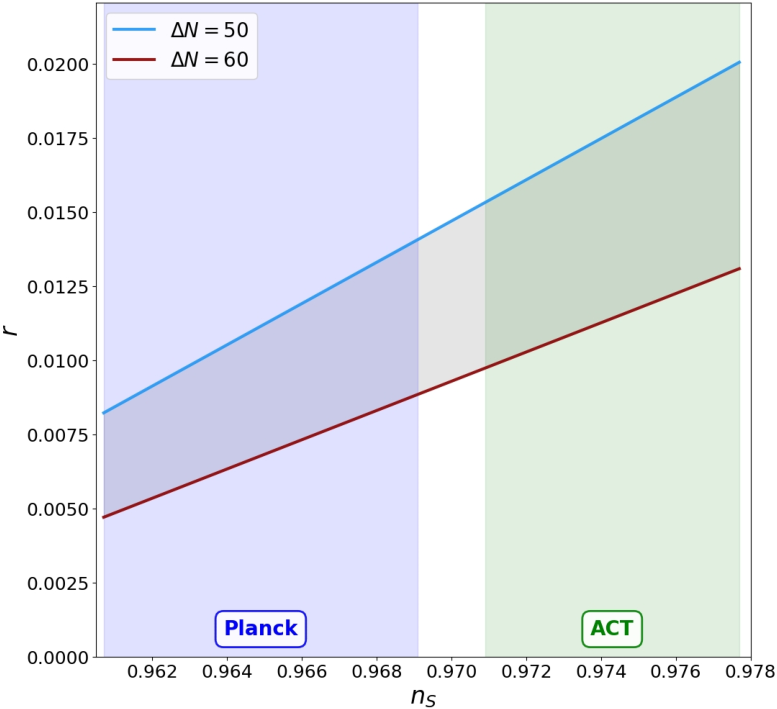
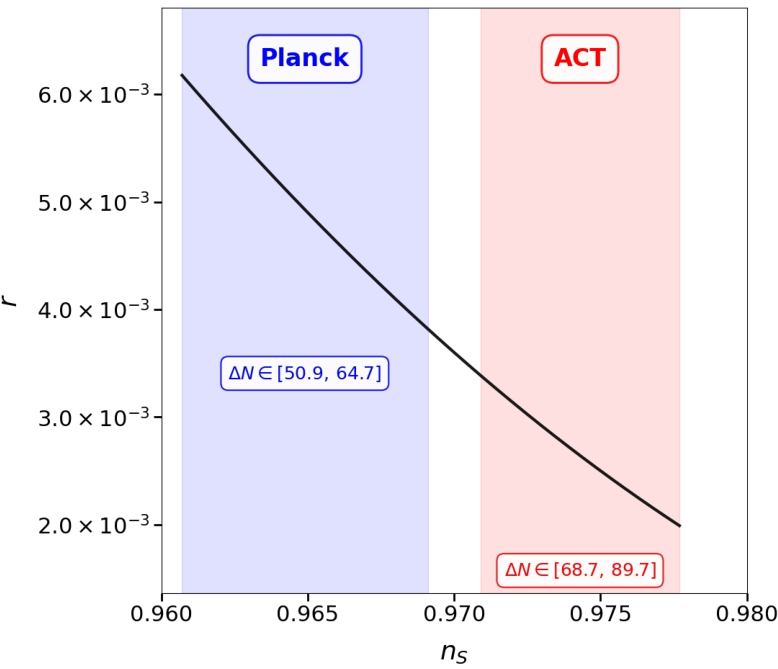
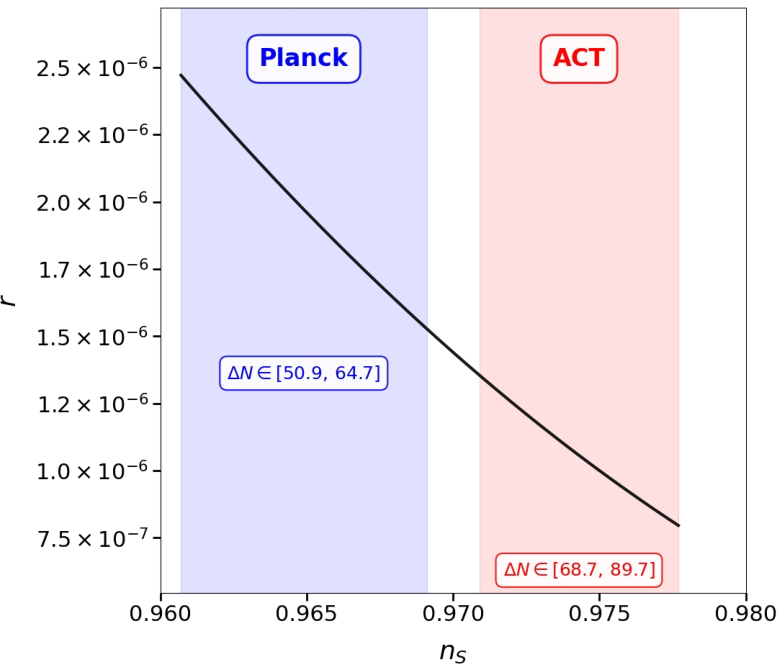
For second-order (ϵ4) and higher, the non-minimal coupling modifies mainly the tensor mode amplitude, while scalar perturbation observables remain essentially unchanged. These models can consistently saturate the new ACT bounds if allowance is made for larger values of e-folds ϵ5 (up to ϵ6). This is feasible via modified reheating scenarios including late time additional fields or delayed thermalization, within current BBN/CMB bounds.
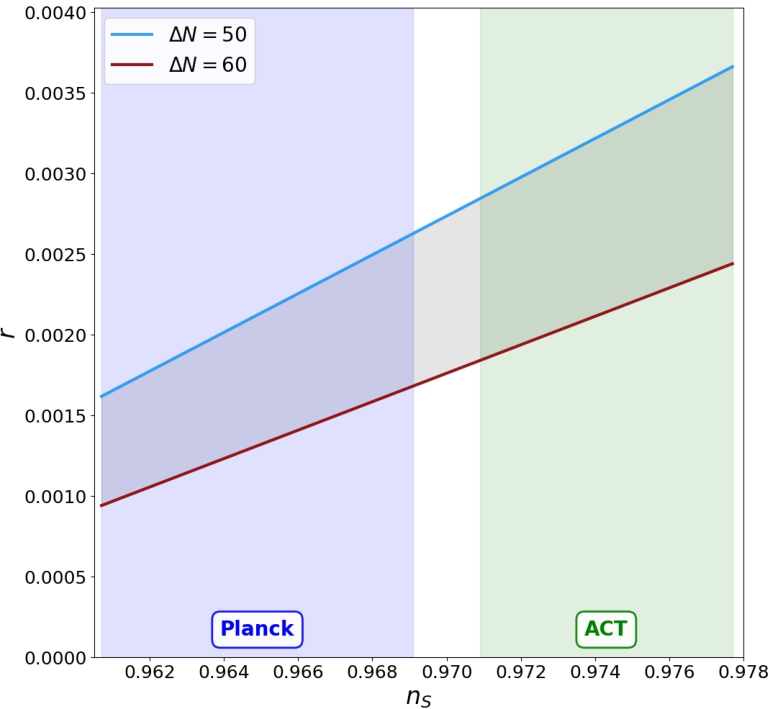
Figure 2: The case ϵ7, ϵ8 between 4.6 and 5.4; representative ϵ9 vs. δ0 for a second-order expansion, illustrating the quadratic suppression of δ1.
Notably, for large δ2, δ3 can become arbitrarily small while all other observables are fixed, pushing such models below the sensitivity thresholds of next-generation CMB polarization experiments.
Theoretical and Observational Implications
The parametrized power-law GST framework provides a minimal modification—preserving slow-roll and canonical reheating but opening a phenomenologically viable δ4-direction—to standard inflation. The theoretical consistency conditions are explicit: the models maintain a positive kinetic sector and support a graceful exit from inflation for δ5. Additionally, the reheating dynamics and field excursion bounds are unchanged from the Einstein gravity case for the power-law class considered.
A critical conclusion is that current and future measurements of δ6 (the running), and multi-parameter fits to the δ7-δ8-δ9 parameter space, are strongly constraining. In this framework, nS0 remains strictly negative (nS1) while current ACT constraints favor slightly positive values, indicating a persistent tension not resolved by non-minimal GST extensions consistent with controlled slow-roll.
The parameter nS2—uniquely—in this class, quantifies both theoretical deformation (potential reshaping) and empirical correction (observable shift):
The scalar and tensor power spectra are rescaled but remain strictly correlated.
The influence on the reheating predictions for nS3 is indirect; standard reheating is preserved.
Higher-order expansion models (nS4 for nS5) are observationally degenerate with minimal inflation for the scalar sector, while the tensor amplitude can unambiguously distinguish non-minimal coupling, provided sufficient sensitivity.
Conclusion
This analysis provides a systematic and comprehensive framework for quantifying and interpreting the phenomenology of non-minimal couplings in inflation, leveraging a universal parametrization and model-independent expansion classification. The dual role of the coupling parameter nS6, as both the measure of potential deformation and the observable deviation in tensor-to-scalar prediction, affords an explicit dictionary for confronting model theory with CMB/large-scale structure data. While non-minimal GST coupling can suppress tensor modes and preserve viability for first- and second-order inflation models under current bounds, it does not accommodate a positive scalar spectral running as indicated by ACT data, leaving a key open challenge for future theoretical development. The approach outlined allows for straightforward extension to more general gravity modifications and multi-field inflation frameworks and highlights the critical need for refined spectral measurements to resolve degeneracies across the inflationary landscape.
Reference: "Corrections to inflationary models induced by non-minimal coupling between scalar field and curvature" (2607.10679).