- The paper constrains progenitor properties using early shock-cooling light curve modeling, determining an envelope mass of 0.017–0.018 M⊙ and a compact radius of 6–9 R⊙.
- The paper demonstrates weak 56Ni mixing through a distinctive U-shaped color evolution and a modest 56Ni yield of 0.033 ± 0.005 M⊙, which shapes the light curve.
- The paper links these observations to binary progenitor channels in a sub-solar metallicity environment, offering critical constraints for future binary evolution models.
Early Observations and Progenitor Constraints of the Faint Type IIb SN 2025aico
Introduction
SN 2025aico offers a rare opportunity to study the physical properties, explosion mechanism, and progenitor configuration of a relatively faint Type IIb supernova characterized by a low-mass envelope. Through extensive optical and UV photometry and time-resolved spectroscopy, the analysis delineates the early shock-cooling phase, the color evolution—a key diagnostic of 56Ni mixing—and the radiative transfer processes dictating the observed light curve and spectral sequence. The context and implications of these findings bear directly on the progenitor scenarios for stripped-envelope supernovae, and provide incisive constraints on binary evolutionary pathways in sub-solar metallicity environments.
Photometric Evolution and Light Curve Modelling
SN 2025aico was discovered at z=0.00455 in the outskirts of the metal-poor dwarf galaxy LEDA 35384, presenting prompt follow-up with both ground-based and space-based facilities. The multi-band apparent light curve exhibits a rapid rise to rM-band maximum at 22.30±0.70 days post-explosion, and a pseudo-bolometric peak luminosity Lopt=(4.07±0.10)×1041 erg s−1, firmly in the faint regime for SNe IIb.
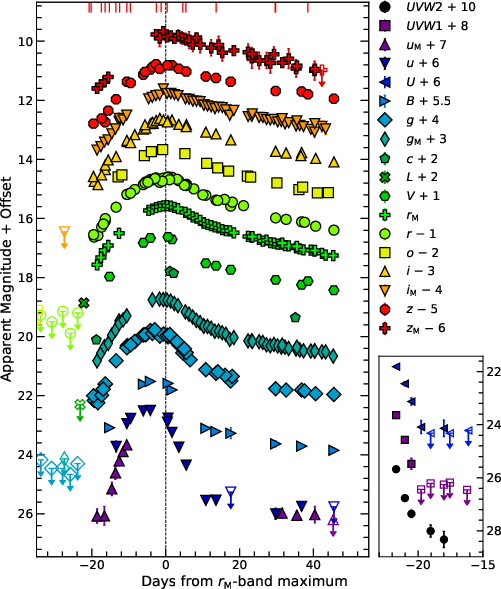
Figure 1: Multi-band UV and optical apparent light curve of SN 2025aico. The dashed vertical line denotes rM-band maximum, with upper limits marked and filter offsets applied for clarity.
A salient feature is the brief, blue shock-cooling phase in the earliest days, yielding a decline of $2.3$ magnitudes in U-band within $3.7$ days post-explosion. Modelling the initial light curve segment with hybrid shock-cooling plus radioactively powered diffusion models recovers strict constraints on the H-rich envelope: the best-fit envelope mass is z=0.004550--z=0.004551, envelope radius z=0.004552--z=0.004553, and expansion velocities in the z=0.004554--z=0.004555 km sz=0.004556 range, consistent across both Piro (2015) and Sapir & Waxman (2017) models.
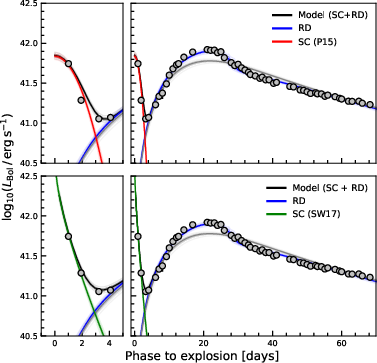
Figure 2: Bolometric light curve model with contributions from radioactive (RD) and shock-cooling (SC) components, illustrating the fits and uncertainty bounds.
The global light curve fit yields ejecta mass z=0.004557, z=0.004558Ni mass z=0.004559, and kinetic energy rM0 erg for moderate opacity and typical velocities (rM1 km srM2). These values are on the low-mass, low-energy tail for SE-SNe.
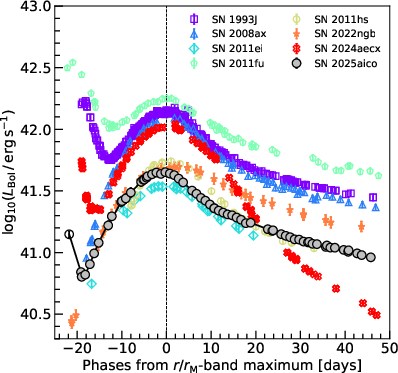
Figure 3: Pseudo-bolometric light curve comparison with other SNe IIb, emphasizing the fainter and shorter shock-cooling phase for SN 2025aico.
Importantly, the rapid post-peak decline and the observed recombination plateau suggest that He-recombination is a non-negligible luminosity contribution, supported by model fits failing when recombination is omitted.
Early Color Evolution and rM3Ni Mixing
The color evolution is critical: SN 2025aico’s intrinsic rM4 and rM5 colors exhibit a pronounced “U-shaped” time evolution, with initial rapid reddening, followed by a transient blueward excursion, and then post-peak monotonic reddening. Comparison with state-of-the-art, parameterized rM6Ni mixing models demonstrates that such color behavior can only be reproduced by weak or, at most, half rM7Ni mixing. Stronger mixing would produce a monotonic color progression inconsistent with the data.
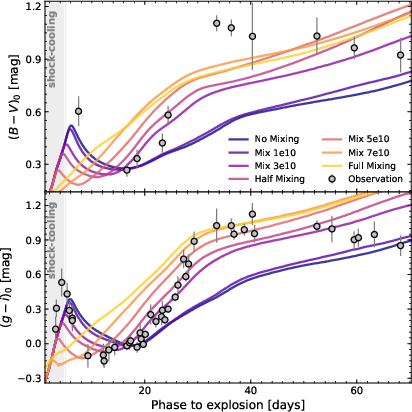
Figure 4: Intrinsic color evolution of SN 2025aico compared to models with varying rM8Ni mixing degrees; the “U-shaped” feature requires weak mixing.
Thus, in conjunction with the modest rM9Ni yield, the results robustly support a weakly mixed explosion, with nickel largely confined to the inner core, which impacts both light curve morphology and the timing of non-thermal excitation in the ejecta.
Spectral Sequence and Line Evolution
The time-series spectroscopy captures the emergence and transformation of Balmer and He~I lines, as well as the transition in line velocities and excitation mechanism. Early spectra (pre-maximum) are dominated by blue continua and broad, blueshifted P Cygni profiles of H22.30±0.700 and He~I~22.30±0.7015876, tracing bulk velocities up to 22.30±0.702 km s22.30±0.703. As the photosphere recedes, both the width and strength of hydrogen lines decrease rapidly.
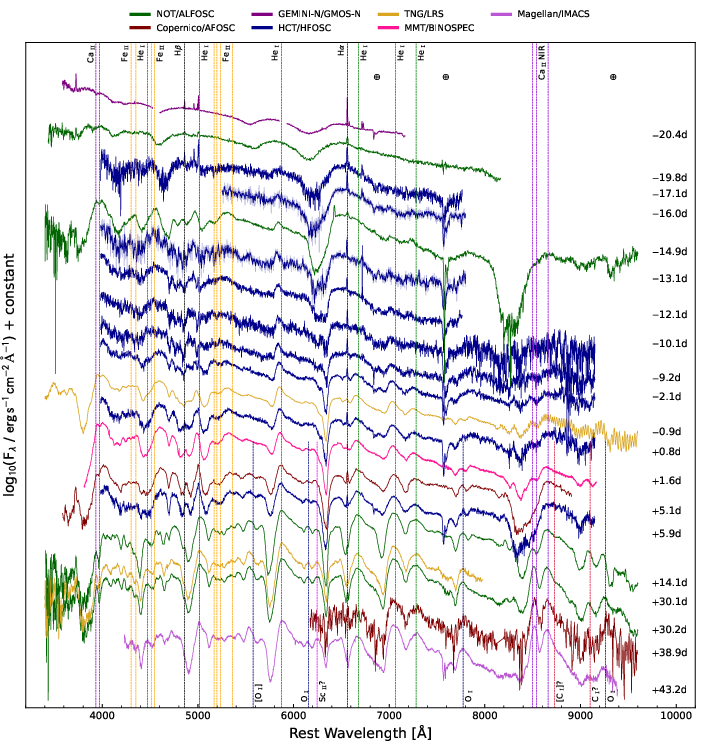
Figure 5: Time-ordered spectral sequence, with Balmer and He~I transitions marked; continuum blue at early times, evolving towards line-rich as temperature decreases.
Ejecta velocity evolution inferred from Fe~II~22.30±0.7045169—regarded as a robust tracer for the receding photosphere—shows an initial increase post-shock-cooling then a gradual decline to 22.30±0.705 km s22.30±0.706 at late times. Comparison with models again supports weak 22.30±0.707Ni mixing.
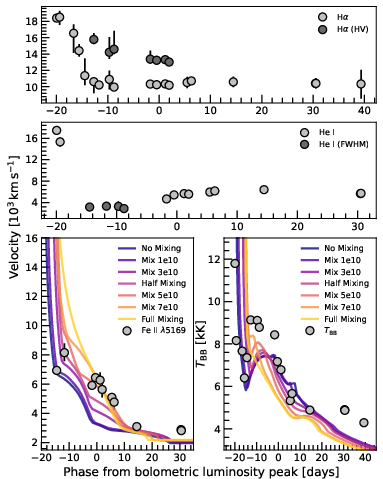
Figure 6: Evolution of line velocities (Fe II, H22.30±0.708, He~I) and blackbody temperature compared to mixing models; only weak/half-mixed scenarios adequately match both the velocity and temperature trends.
A noteworthy line evolution is the appearance of a blueshifted emission peak in He~I post-shock-cooling, with an increasing photospheric/outflow velocity during the rise due to the progression of the non-thermal excitation front as 22.30±0.709-rays penetrate optically thinner helium-dominated layers. Late-time spectra converge to standard SE-SN morphology, with strong P Cygni He~I features and diminishing H content.
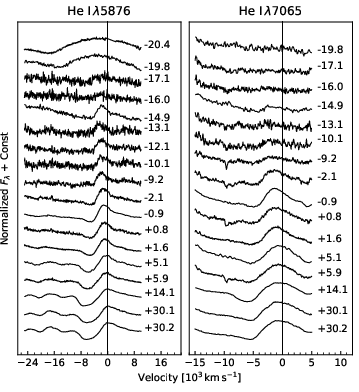
Figure 7: Line profile evolution of He~I~Lopt=(4.07±0.10)×104105876 and Lopt=(4.07±0.10)×104117065, showing early absence of P Cygni absorption (indicative of weak mixing) and subsequent strengthening.
Progenitor Scenario and Host Environment
The inferred total ejected mass, minimal residual hydrogen, compact envelope, and faint shock-cooling peak all support a progenitor that is a compact He star in a close binary, subject to Case B mass transfer. The metallicity of the SN site, measured via nebular emission lines, is Lopt=(4.07±0.10)×10412—significantly subsolar. Such metallicity disfavors strong winds as the main envelope-stripping mechanism, thereby reinforcing a binary interaction path.
Direct comparison of SN 2025aico spectra at maximum with radiative transfer models from synthetic binary progenitors (e.g., Dessart 2024), combined with the low envelope mass from light curve modeling, point toward an orbital period Lopt=(4.07±0.10)×10413--Lopt=(4.07±0.10)×10414 days in the LMC-like metallicity regime as the likely progenitor configuration. Solar metallicity binary models only reproduce the observations for Lopt=(4.07±0.10)×10415 days and predict more massive hydrogen envelopes than observed, which further constrains the evolutionary channel.
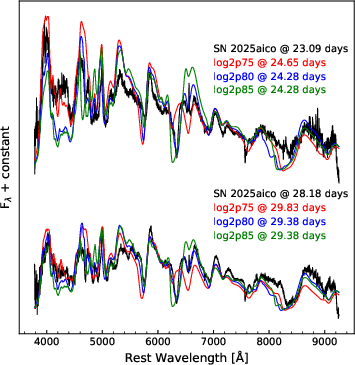
Figure 8: Observed peak spectrum compared to synthetic binary progenitor models with varying periods and hydrogen envelope mass; the best fit corresponds to a short-period, minimal-H envelope system.
Implications and Prospects
These results establish SN 2025aico as a benchmark for cIIb (compact Type IIb) events bridging the classic H-rich (extended IIb) and H-poor (Ib) regimes. The unambiguous evidence for a minimal H envelope, weak Lopt=(4.07±0.10)×10416Ni mixing, and a compact progenitor supports an evolutionary continuum wherein residual hydrogen in stripped-envelope SNe is set primarily by binary interaction timescales and host galaxy metallicity.
In practice, this constrains population synthesis models for SE-SNe and binary star evolution, as well as providing empirical requirements for future hydrodynamical and radiative transfer calculations. The shock-cooling constraint also has direct impact on understanding the first-light properties, informing both SN detection strategies and early-phase explosion physics.
Looking ahead, systems like Mephisto, combined with real-time color data and X-ray monitoring, will be essential in systematically sampling the diversity of early-phase SE-SNe, mapping the Lopt=(4.07±0.10)×10417Ni mixing parameter, and connecting observed transient classes to detailed binary stellar models.
Conclusion
SN 2025aico exemplifies a faint, compact Type IIb supernova from a low-mass, binary-stripped progenitor with a minimal H-rich envelope and weak Lopt=(4.07±0.10)×10418Ni mixing. Its early light curve, color evolution, and spectral sequence critically constrain the progenitor mass, explosion geometry, and chemical mixing processes. The findings underscore the necessity of high-cadence, multi-wavelength follow-up of SE-SNe to robustly link population characteristics to late-stage binary stellar evolution in varying metallicity environments.

