Certified boundary-magic witness for state-dependent proto-area in a holographic code
Published 12 Jul 2026 in hep-th and quant-ph | (2607.10663v1)
Abstract: We study a four-qubit product-EPR holographic code whose reconstructing region contains matter and one leg of a geometry bond. Seven deformations compare local, bipartite, bond-stabilizing, and bond-moving operators. Exact spectra show that only matter-controlled bond motion produces a leading quadratic logical-state dependence of the boundary entropy. We select one state-independent physical recovery by optimizing coherent information of the channel Choi state. A separate semidefinite program maximizes entanglement fidelity over all channels. At fixed coupling the physical recovery attains that optimum to numerical precision, while recovered-entropy subtraction leaves a nonzero variational proto-area response. Total stabilizer Renyi magic is also nonzero for deformations with no boundary response, so it does not characterize the effect. Projecting the exact stabilizer-Renyi quadratic form away from pairwise Pauli tangents defines a leading-order boundary witness. Its global convex minimum is positive for the bond-moving deformation and zero for the six comparisons. For the reference-matter-geometry resource partition, however, pairwise tangents span the full projective tangent space at the product-EPR base, so the witness vanishes for every Hermitian deformation. A two-bound extension retains this degeneracy but exhibits a split-geometry structural residual and a logical-state-dependent cut switch. These results establish a finite-code witness, not a universal magic law or continuum gravitational dynamics.
The paper shows that only matter-controlled bond-moving deformations yield quadratic logical-state dependence in boundary entropy.
It employs semidefinite programming and coherent-information optimization to certify entanglement fidelity and recovery performance.
The study reveals that total stabilizer Rényi magic is insufficient to differentiate boundary-responsive deformations.
Certified Boundary-Magic Witness for State-Dependent Proto-Area in a Holographic Code
Context and Motivation
Quantum error correction (QEC) is a foundational mechanism for modeling bulk reconstruction and area terms in holographic dualities. Random tensor networks and stabilizer codes are pivotal for realizing Ryu–Takayanagi (RT) entropy and entanglement wedge encoding, particularly at semiclassical and large bond-dimension limits. Beyond these frameworks, the Faulkner–Lewkowycz–Maldacena (FLM) prescription incorporates bulk entanglement corrections to geometric area, and operator-algebraic QEC formalizes the connection between holographic R
enyi entropies and area-operator eigenspaces. Existing constructions, especially stabilizer tensor networks, restrict multipartite entanglement, motivating the exploration of controlled, nonstabilizer deformations and their capacity to produce state-dependent geometric responses (2607.10663).
Minimal Code Architecture and Deformation Taxonomy
The primary setting is a four-qubit product-EPR holographic code, with the reconstruction region containing both matter and a leg of a geometry bond. The undeformed code is defined by the encoder and normalized Choi state:
The study systematically compares seven deformation generators, targeting distinctions in locality, bipartite/bond-stabilizing, and bond-moving operations:
Local matter: Hlocal=XM
Local geometry: Hgeometry=XGa
Bipartite inside region: Hbipartite=P1,MXGa
Geometry across cut: Hbipartitecross=P1,GaXGb
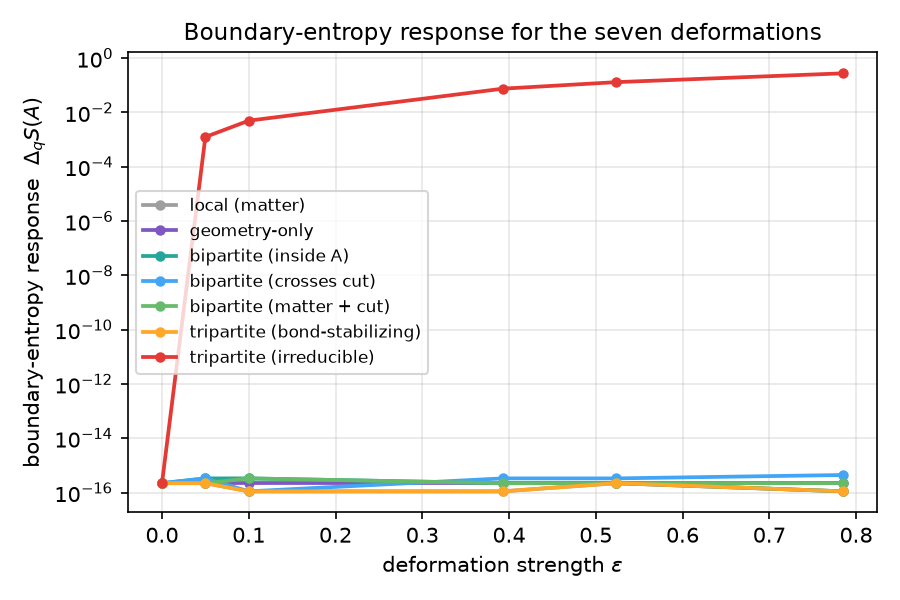
Exact spectra reveal that only the matter-controlled bond-moving deformation induces a quadratic logical-state dependence in boundary entropy, while all other generators exhibit zero response.
Figure 1: Peak-to-peak boundary response S(A) for the seven generators, showing quadratic onset only for matter-controlled bond move.
Exact Entropy Response and Recovery Characterization
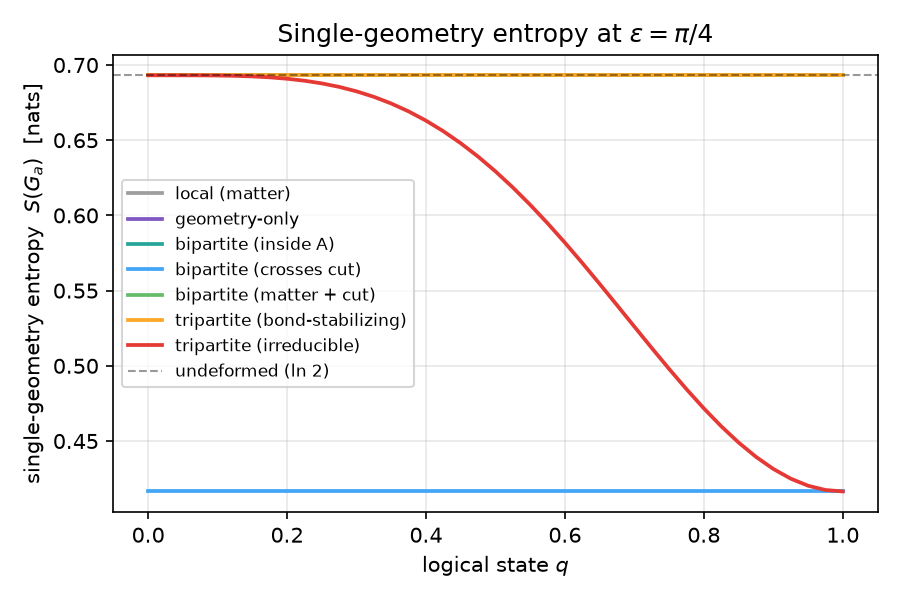
The boundary entropy Φ+=(00+11)/20 and geometry-leg entropy Φ+=(00+11)/21 are computed for each deformation:
The bond-moving generator yields
Φ+=(00+11)/22
resulting in a quadratic onset in boundary entropy:
Φ+=(00+11)/23
Other generators maintain undeformed spectra (strictly zero quadratic response).
Figure 2: Single-leg geometry entropy Φ+=(00+11)/24 along logical meridian, non-flat only for bond-moving deformation.
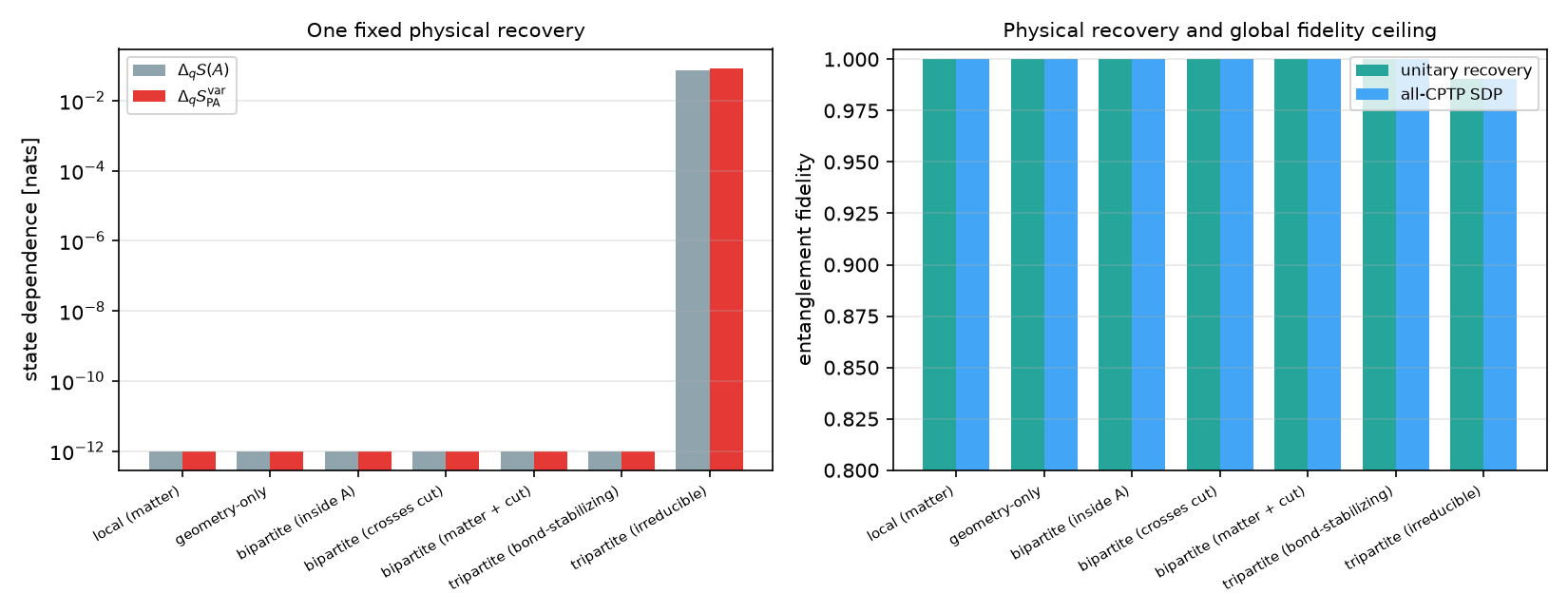
A physical recovery map is selected via coherent-information optimization of the channel Choi state. Entanglement fidelity is certified to global optimum via semidefinite programming (SDP) over all CPTP channels. For Φ+=(00+11)/25 under bond-moving deformation, numerical benchmarks are:
Coherent information Φ+=(00+11)/26 bits
Entanglement fidelity Φ+=(00+11)/27
Recovery-conditioned proto-area (Φ+=(00+11)/28) yields a nonzero variational response (Φ+=(00+11)/29 nats) only in the bond-moving case, with all comparison sets remaining at numerical zero.
Figure 3: Left: boundary and proto-area responses for fixed physical recovery per channel. Right: entanglement fidelity shows agreement between unitary recovery and global SDP optimum.
Certified Boundary-Magic Witness via Quadratic Form Projection
The analysis employs stabilizer R
enyi magic Hlocal=XM0, defined as
Hlocal=XM1
Quadratic expansion at the stabilizer base delivers the exact covariance geometry:
Hlocal=XM2
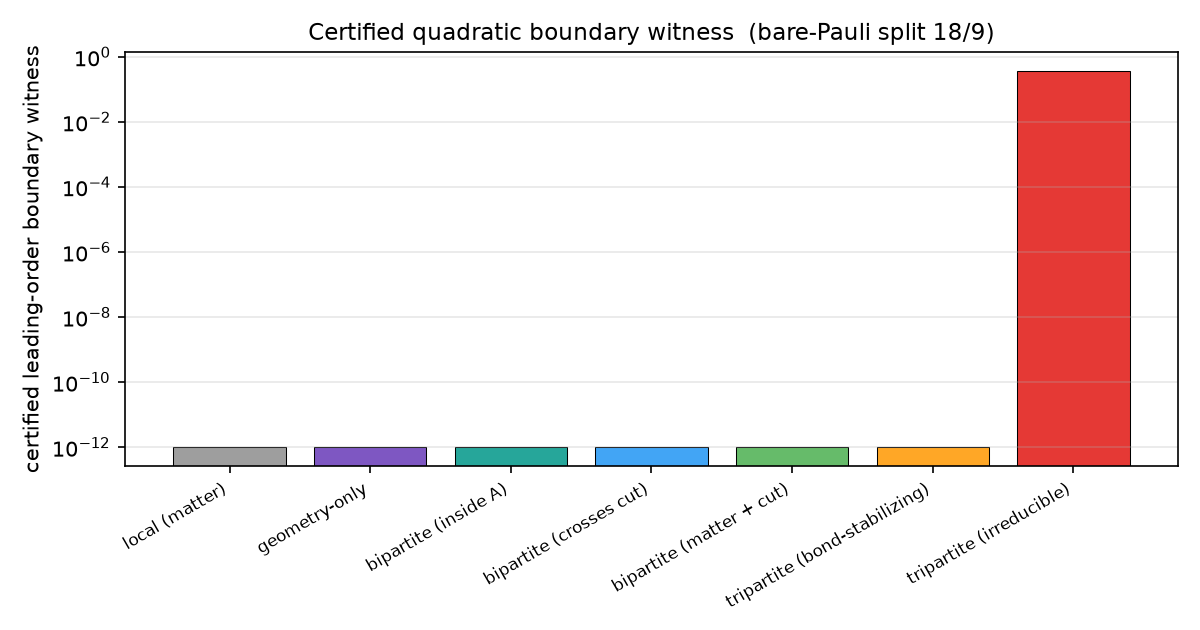
A partition-adapted projection away from pairwise Pauli tangents defines the leading-order boundary witness, certifying positive value for the bond-moving generator alone:
Hlocal=XM3
All comparison generators are strictly zero under this witness.
Total stabilizer R
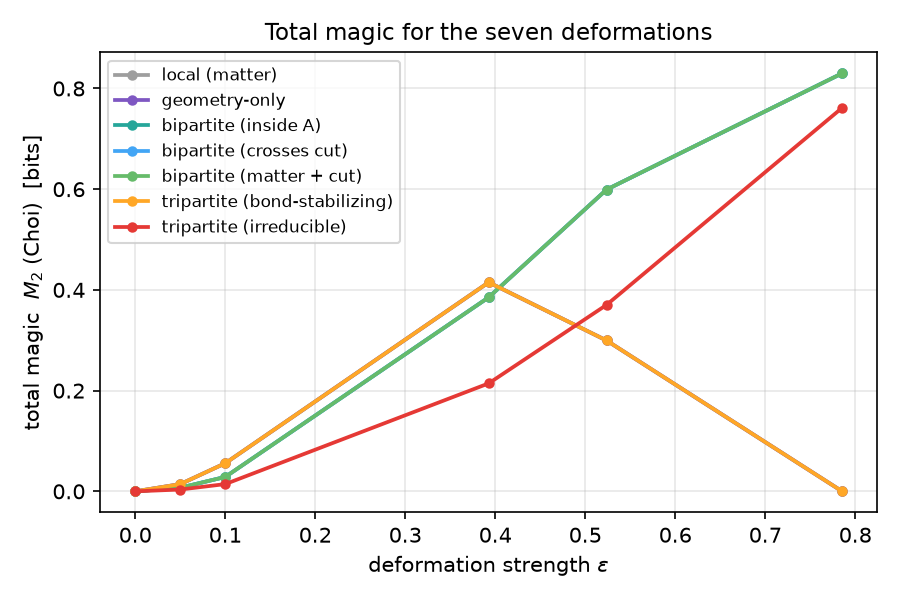
enyi magic is nonzero for both boundary-responsive and nonresponsive deformations, and therefore fails to discriminate—contradicting conventional intuition that magic tracks boundary geometry.
Figure 4: Total stabilizer R
enyi magic of the Choi state, nonzero across multiple deformation classes.
Figure 5: Certified quadratic boundary witness, positive exclusively for bond-moving deformation (bare Pauli 18/9 split).
Structural Degeneracy and Two-Bond Extension
For the single-bond (four-qubit) product-EPR base under the CCKLP resource partition,
Hlocal=XM4
the leading-order witness is degenerate for all Hermitian deformations—the pairwise tangent directions span the full projective tangent space.
Expanding to a two-bond configuration, the structural residual is evaluated:
Hlocal=XM5
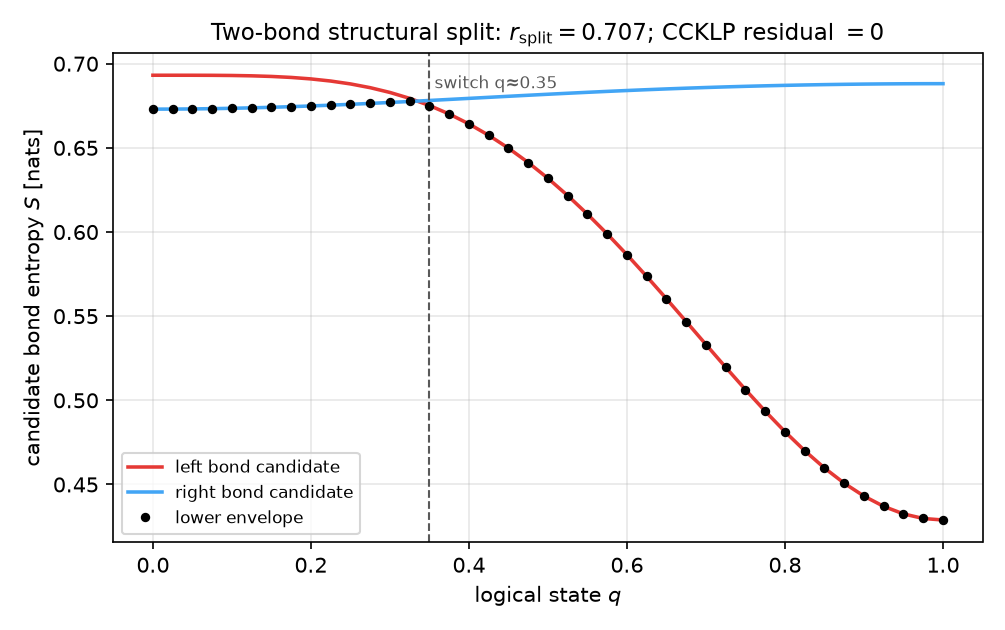
A nonzero split-geometry residual (Hlocal=XM6) is observed for the refined Hlocal=XM7 partition, with cut switches detected at Hlocal=XM8 and a peak-to-peak response Hlocal=XM9 nats. No additive offset is imposed; the lower envelope of candidate entropies provides a finite-code analogue of extremal surface selection.
Figure 6: Two-bond extension—lower envelope of bond entropies; left-winning switch at Hgeometry=XGa0 and Hgeometry=XGa1 nats response.
Implications and Prospects
The study establishes a selection rule for state-dependent boundary responses in finite holographic codes: only matter-controlled bond-moving deformations yield quadratic logical-state dependence quantified by a positive boundary-magic witness. Total magic is not a sufficient classifier. Physical recovery (via coherent-information optimization) and SDP-based certification align numerically, supporting the robustness of the variational proto-area diagnostic.
Resource degeneracy under single-bond partitions implies limitations in constructing universal, finite-coupling magic-based geometric laws from stabilizer codes. The two-bond extension introduces a structural diagnostic for split-geometry and cut switches, but does not break degeneracy nor induce nonzero CCKLP resource magic.
Future directions entail encoding with mirror-breaking structure, multiple recoverable algebras, and dynamically competing candidate cuts to probe universality and causal significance of magic in geometric backreaction. Isolating magic as a causal driver within holographic geometry requires decoupling support and recoverability from bond-motion symmetry.
Conclusion
"Certified boundary-magic witness for state-dependent proto-area in a holographic code" (2607.10663) rigorously demonstrates that only matter-controlled bond-moving deformations in a minimal product-EPR holographic code establish quadratic logical-state dependence in boundary entropy, certified via a leading-order boundary-magic witness. Total stabilizer R
enyi magic does not distinguish boundary-responsive deformations, and single-bond resource partitions are degenerate in this setting. Structural insights from two-bond extensions point to richer diagnostics in finite-code analogues of quantum extremal surfaces. The results delimit the scope of geometric interpretation and underpin future exploration of nonstabilizer effects in holographic QEC.