- The paper reveals that quadratic scalar couplings induce scalarization, leading to multiple distinct horizon branches in Einstein-Euler-Heisenberg black holes.
- It employs linear perturbation analysis and numerical integration to delineate stability boundaries and thermodynamic properties across the L, C, N, and H horizons.
- The results highlight the significance of nonlinear electrodynamics effects in modeling scalar hair and predicting observational signatures in complex black hole spacetimes.
Scalarization Phenomena in Multi-Horizon Einstein-Euler-Heisenberg Black Holes
Introduction
This work conducts a rigorous investigation of scalarization mechanisms and stability in black holes described by the Einstein-Euler-Heisenberg-scalar (EEHS) theory with quadratic scalar coupling to the Maxwell invariant. The focus is on the parameter regime with mass M=1 and Euler-Heisenberg (EH) parameter μ=0.03, where the background Einstein-Euler-Heisenberg black hole (EEHBH) admits up to four distinct horizons—low (L), cold (C), negative (N), and hot (H)—allowing for intricate bifurcation and stability structures not present in models with a single horizon.
The analysis is motivated by the known evasion of the no-hair theorem through nonminimal scalar couplings driving tachyonic instabilities. Both curvature-induced (as in Einstein-Gauss-Bonnet-scalar) and charge-induced (Einstein-Maxwell-scalar) scalarization are referenced as antecedents. Here, attention turns to nonlinear electrodynamics, with the Euler-Heisenberg term providing new phenomenology (2607.10614).
Structure and Classification of Multi-Horizon EEHBHs
The background EEH solution is governed by the metric function
f(r)=1−r2M+r2q2−5r62μq4,
where q is the magnetic charge and μ the higher-order (NED) coupling. For μ<0.08 and fixed M=1, the number of real roots of f(r)=0 (i.e., horizons) depends sensitively on q, with a quadruple horizon structure for q∈[0.95,1.0065]. The horizon taxonomy emerges clearly from the roots' behavior as μ=0.030 varies.
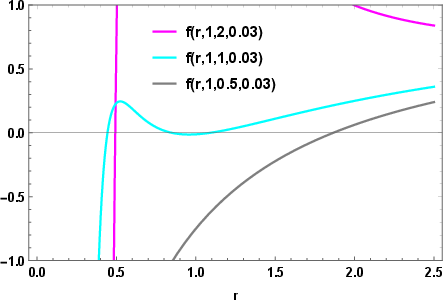
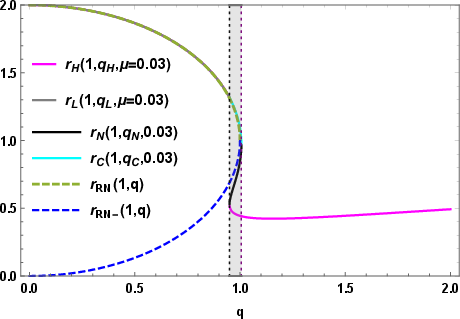
Figure 1: Left: Roots of μ=0.031 for selected μ=0.032; triple real roots (triple horizons) occur for μ=0.033. Right: Locations and classification—L (low), C (cold), N (negative), H (hot)—as μ=0.034 is varied.
The thermodynamics along each branch are distinct: the cold horizon is thermodynamically stable, while the low and hot horizons exhibit instabilities manifested in the heat capacity and reduced Hawking temperature.
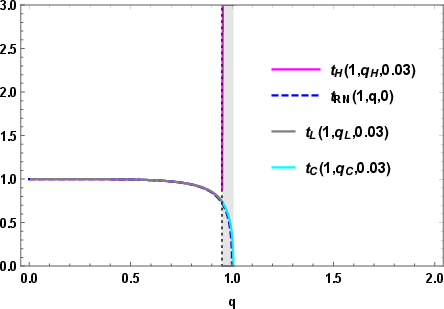
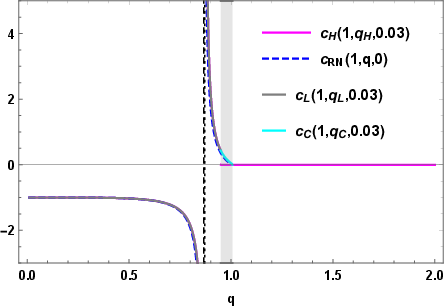
Figure 2: Left: Reduced temperatures μ=0.035 for L, C, H horizons and RN, showing merging and extremality. Right: Heat capacities, exposing Davies transitions and stability windows.
Onset of Scalarization: Linear Analysis
Small scalar perturbations about the EEHBH background are analyzed via the effective mass-squared induced by the quadratic coupling, yielding
μ=0.036
with μ=0.037 the coupling parameter. The μ=0.038-mode potential, including NED and scalarization effects, determines the existence of tachyonic instabilities. The sufficient condition for instability is a negative integral of the effective potential from the horizon to infinity, producing a stability curve in the μ=0.039-f(r)=1−r2M+r2q2−5r62μq4,0 plane.
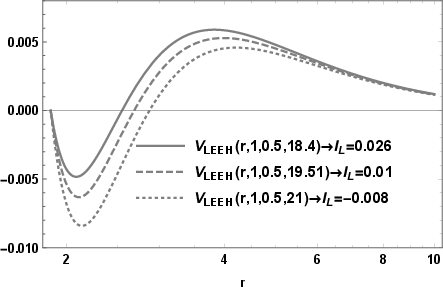
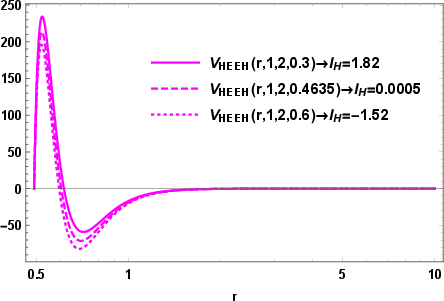
Figure 3: Effective scalar potential f(r)=1−r2M+r2q2−5r62μq4,1 and its integral for f(r)=1−r2M+r2q2−5r62μq4,2 (left) and f(r)=1−r2M+r2q2−5r62μq4,3 (right), showing the onset of tachyonic instability as f(r)=1−r2M+r2q2−5r62μq4,4 increases.
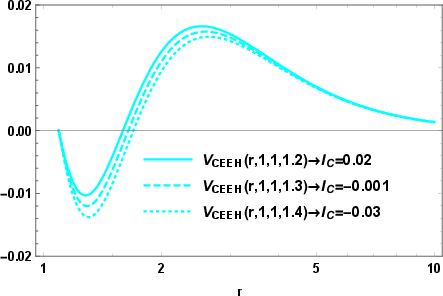
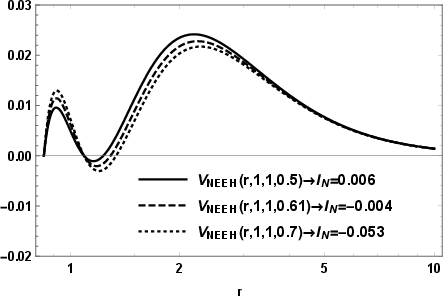
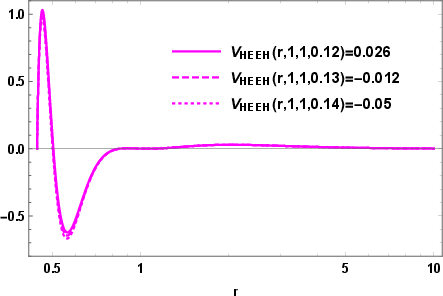
Figure 4: Scalar potentials for triple horizons (f(r)=1−r2M+r2q2−5r62μq4,5) across the cold (left), negative (middle), and hot (right) roots, contextualizing regions where scalar clouds can form.
Critical curves f(r)=1−r2M+r2q2−5r62μq4,6, derived from the sufficient negativity condition for tachyonic instability, separate stable and unstable backgrounds. Notably, for the negative and hot horizons, pathological behavior in the near-horizon limit prevents standard analysis.
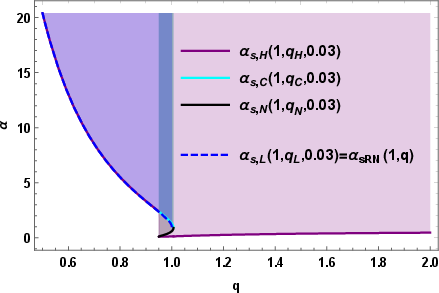
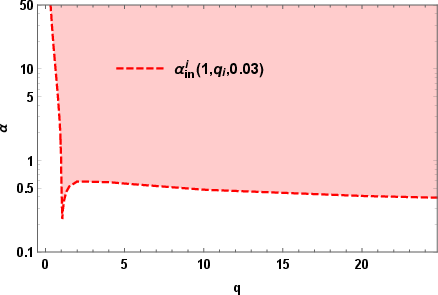
Figure 5: Left: Instability boundaries f(r)=1−r2M+r2q2−5r62μq4,7 for each horizon type as a function of f(r)=1−r2M+r2q2−5r62μq4,8. Right: WKB instability bounds f(r)=1−r2M+r2q2−5r62μq4,9 estimated for higher-q0 scalar cloud bifurcations.
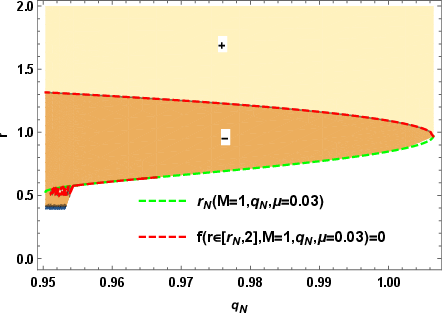
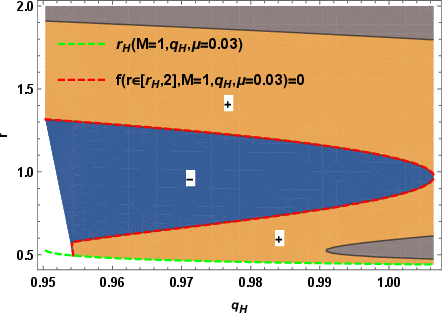
Figure 6: Negative regions of q1 and q2 near the horizon demonstrate the breakdown of the standard horizon structure for H and N branches within the triple-horizon window.
Fundamental Branches of Scalarized Solutions
By numerically integrating the coupled scalar-metric field equations (with regularity enforced at the horizon), the fundamental branch (q3) for each horizon class is constructed, using the bifurcating scalar cloud as the seed.
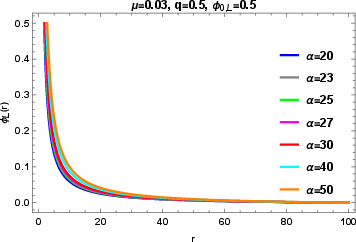
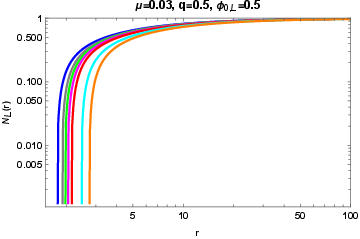
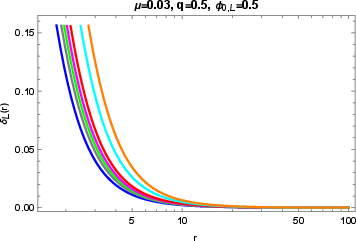
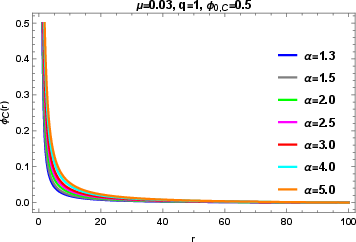
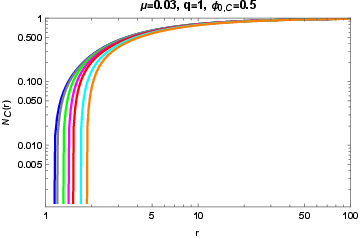
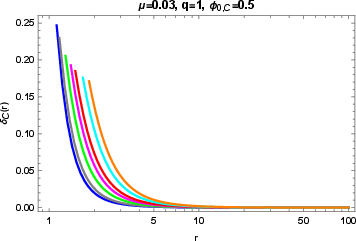
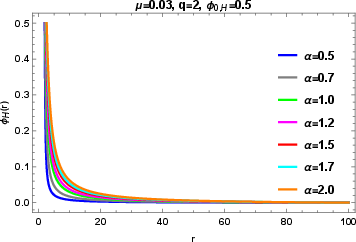
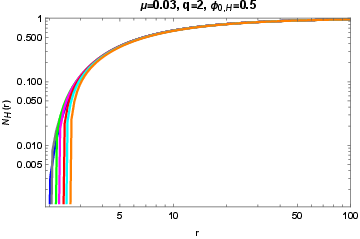
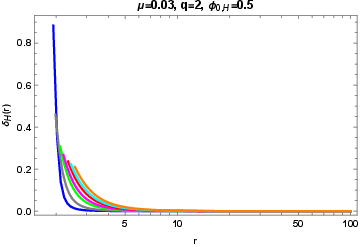
Figure 7: Radial profiles of scalar field q4, metric function q5, and lapse correction q6 for various q7 along the L, C, and H branches. The near-horizon behavior and asymptotic decay elucidate the structure and localization properties of the scalar hair.
Salient features include more rapid decay of q8 with increasing q9, larger μ0 for increasing μ1, and distinct responses in μ2 and μ3 contingent on horizon type.
Thermodynamic Properties of Scalarized Branches
The first law admits modifications due to the scalar field, but mass, Hawking temperature, and entropy remain calculable. For the L and C branches, the black hole mass μ4 decreases monotonically with the primary scalar charge μ5, passing through zero and demarcating unphysical (thermodynamically forbidden) regions at large scalar charge.
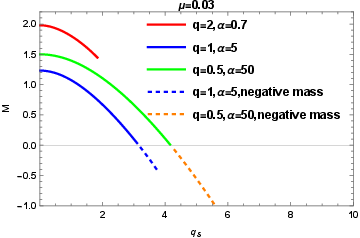
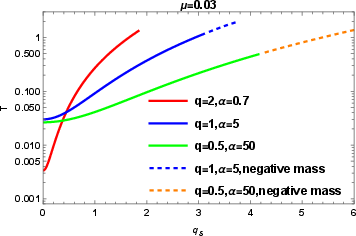
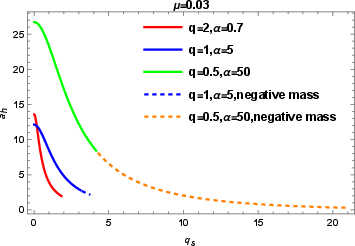
Figure 8: Mass μ6, Hawking temperature μ7, and horizon area μ8 as functions of the scalar charge μ9 for L-, C-, and H-horizon scalarized solutions.
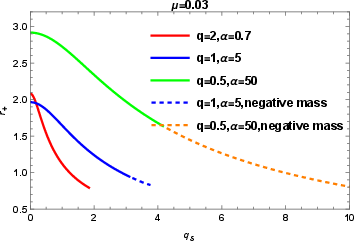
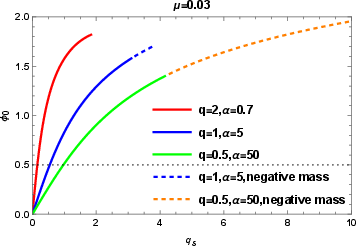
Figure 9: Horizon radius μ<0.080 and horizon scalar μ<0.081 traced as functions of μ<0.082, indicating the parameter domains for physical and unphysical solutions.
The imposed upper bound on μ<0.083 for L and C branches arises from positivity of μ<0.084; for the H branch, solutions are always physical above a critical scalar charge.
Radial Stability: Time-Domain and Perturbative Approach
The stability of the fundamental scalarized branches is assessed via numerical time evolution of radial (μ<0.085) scalar perturbations. For small scalar charge, the effective potential can develop a sufficiently deep negative well to foster exponential growth (instability). Instabilities are found only in the small-μ<0.086 regime, with robust dynamical stability in the intermediate and large-μ<0.087 windows.
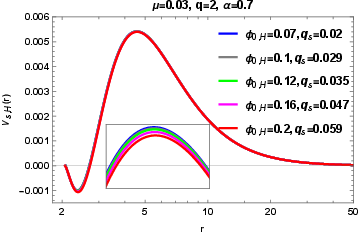
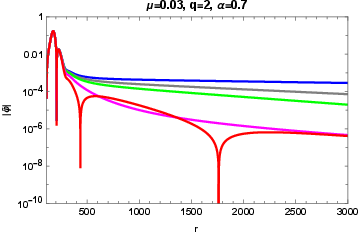
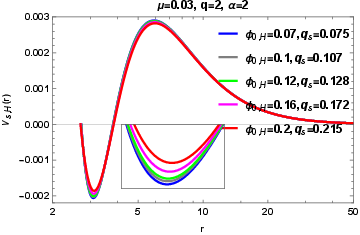
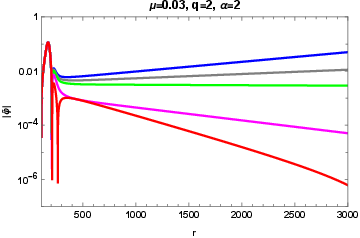
Figure 10: Effective potential μ<0.088 and time evolution of scalar perturbations for H-horizon, small μ<0.089. Instability at small M=10 for larger M=11.
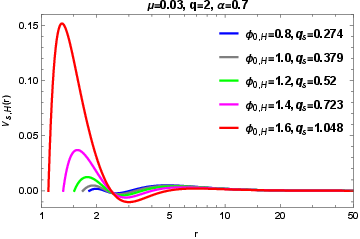
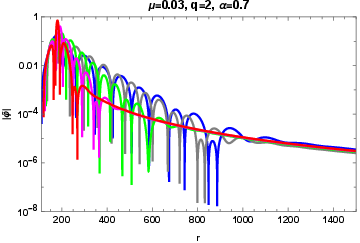
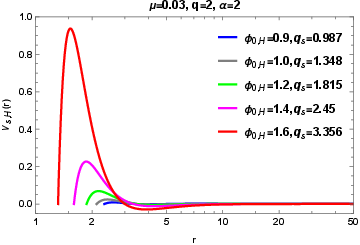
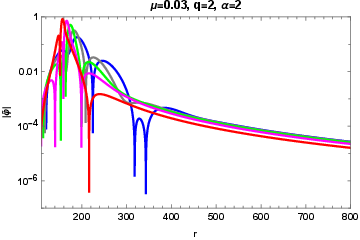
Figure 11: H-horizon, large M=12: uniformly stable and strongly damped behavior as the potential well is supplanted by a sharp barrier.
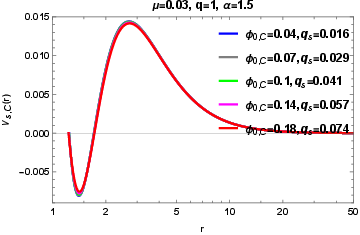
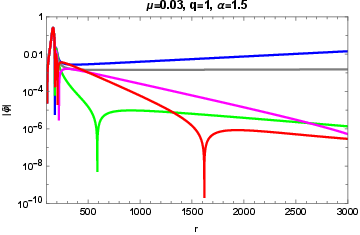
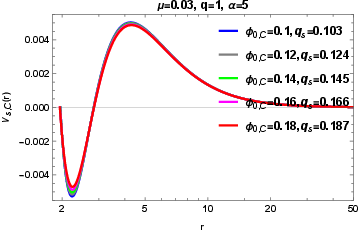
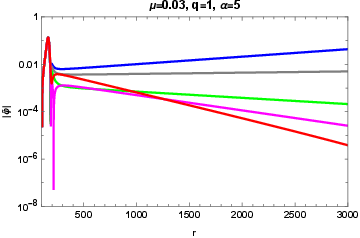
Figure 12: Effective potential and time evolution for scalarized C-horizon, small scalar charge: instability prominent until M=13 crosses a critical value.
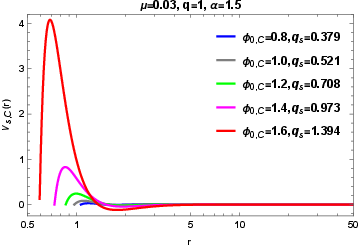
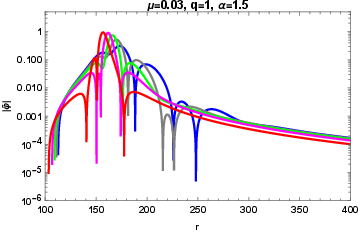
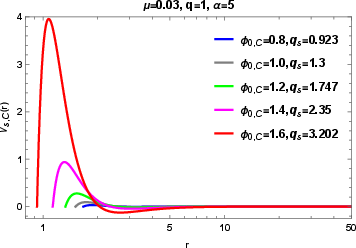
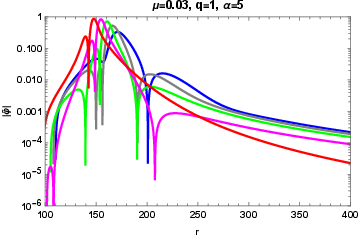
Figure 13: C-horizon, large M=14: scalar perturbations are entirely stable, decaying exponentially.
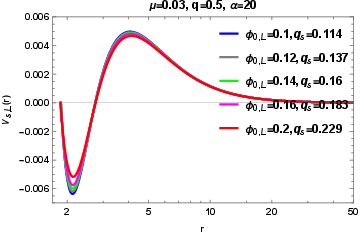
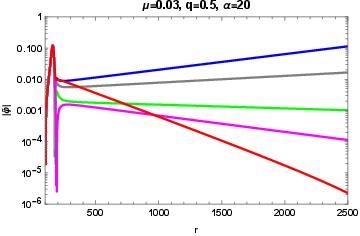
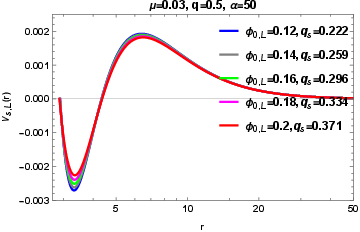
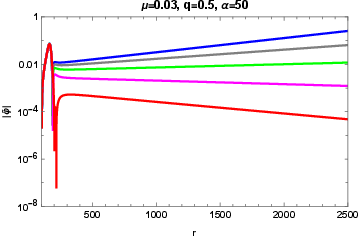
Figure 14: Effective potential and time evolution for L-horizon, small scalar charge. Instability domain delineated as in the C-branch.
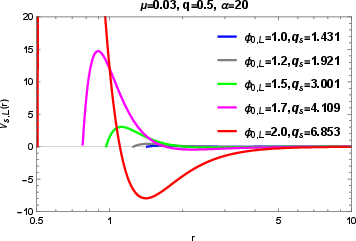
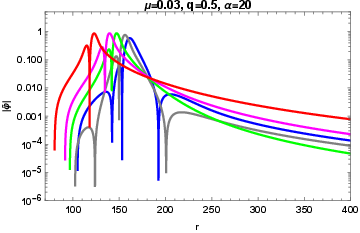
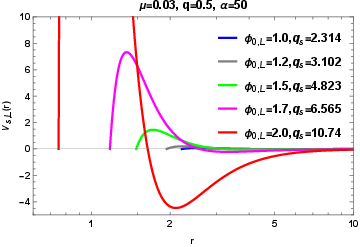
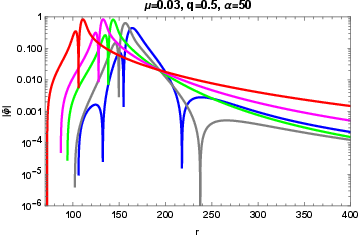
Figure 15: L-horizon, large scalar charge: unequivocal stability with rapid decay.
The connection of these results to QNM spectra is highlighted: non-oscillatory (purely imaginary) QNMs at the instability threshold, gradually acquiring a real part as the scalar charge increases.
Theoretical and Practical Implications
This work demonstrates that fundamental scalarized black hole branches can stably exist in a dynamically accessible, physically meaningful window constrained on both ends—instability for too little scalar hair, unphysicality for too much. The windowed behavior arises as a unique effect of the interplay between nonlinear electrodynamics, the scalar sector, and the multi-horizon geometry, distinguishing this context from both standard Einstein-Maxwell-scalar and Einstein-Gauss-Bonnet-scalar settings.
The nontrivial horizon structure also leads to novel branches and bifurcation scenarios not present in single/dual-horizon cases. The fact that dynamical and thermodynamic stability need not overlap reinforces the necessity of comprehensive analysis before asserting physical preference among solutions.
One practical implication is that searches for scalar hair in black hole spacetimes governed by nonlinear electrodynamics must account for the possible existence of multiple disconnected solution branches with distinct observational consequences such as modified shadow radii or ringdown spectra.
Conclusion
This study achieves a detailed map of the scalarization mechanism in EEHS black holes with multiple horizons, elucidating the dependency of dynamical and thermodynamic properties on the scalar coupling, magnetic charge, and nonlinear parameters. Scalarized solutions form infinite branches bifurcating from critical couplings, but only those within a carefully delimited M=15 window exhibit both physical mass and dynamical stability—an outcome unique to this coupling/NED/horizon structure. This work provides a template for systematic scalarization studies in other multi-horizon, higher-order curvature, or NED black hole contexts and raises new questions regarding formation, uniqueness, and observational signatures of such objects.
Reference: "Scalarization of Einstein-Euler-Heisenberg black hole with multiple horizons" (2607.10614)