- The paper introduces a differentiable gating mechanism (NormSelector) that blends Dynamic Tanh and Layer Normalization to address non-stationary data challenges in Transformers.
- It presents AutoNorm-S, a gate-freezing schedule that mitigates early-stage estimator variance and stabilizes optimization in stationary and non-stationary regimes.
- Empirical results demonstrate state-of-the-art performance in NLP and competitive gains in vision tasks, validating the adaptive normalization strategy.
Motivation and Context
Modern deep learning pipelines for NLP and vision overwhelmingly rely on normalization techniques to stabilize and scale training dynamics. Transformers, in particular, utilize Layer Normalization (LN) as a fixed backbone component. However, the capacity of static normalization to generalize across non-stationary data modalities is limited. Recent advances, such as learnable normalization policies (e.g., Dynamic Tanh, Switchable Normalization), have shown that adaptive strategies can yield competitive or improved outcomes, but the design and optimization of these mechanisms remain poorly understood, especially when selection is governed by differentiable routing. The work of Bhattacharyya et al., "AutoNorm: Understanding Adaptive Normalization in Transformers through Differentiable Gating" (2607.10593), systematically analyzes the operational regimes, bottlenecks, and practical implications of dynamic normalization via a Gumbel-Softmax-gated selection mechanism.
Methodological Contributions
Differentiable Gating Mechanism
AutoNorm introduces a NormSelector module that employs a two-layer MLP to produce differentiable Gumbel-Softmax weights corresponding to LN and Dynamic Tanh (DyT) normalization options. Given input activations X, the normalized output is a convex combination:
AutoNorm(X)=wDyT(X)⋅DyT(X)+wLN(X)⋅LN(X),wDyT+wLN=1
where wDyT,wLN are inferred adaptively per block. This configuration is visualized schematically as follows:

Figure 1: The NormSelector leverages a two-layer MLP to compute Gumbel-Softmax weights w0 and w1, which blend DyT and LN outputs for each residual transformation.
NormSelector is a lightweight, fully differentiable selector that can be seamlessly inserted into each Transformer sub-layer.
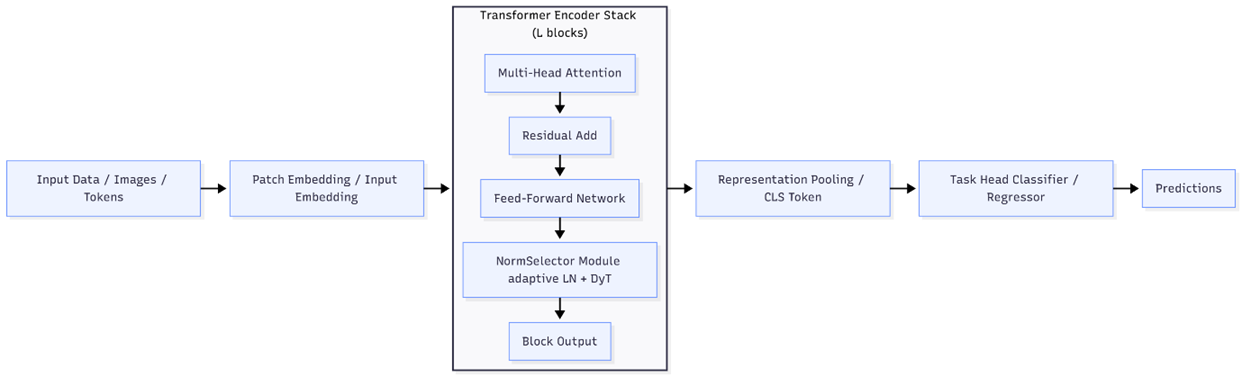
Figure 2: AutoNorm integration within a Transformer block replaces static LN with the NormSelector, enabling dynamic layer-wise normalization.
Stabilization Bottleneck and AutoNorm-S
A surprising discovery is that the optimization landscape of Gumbel-Softmax gating is highly sensitive to input distribution stationarity. On stationary vision tasks, early gradient variance leads to poor specialization, allowing simple baselines such as uniform RandomSelector to outperform learned routing policies. The authors formalize this as a stabilization bottleneck: stationary input statistics lead to rapid convergence of the gating entropy, but inject high estimator variance before normalization specialization can emerge.
To address this, AutoNorm-S introduces a gate-freezing schedule: gating weights are updated only during an initial warm-up phase; once gating entropy falls below a threshold or a specified number of epochs is reached (Tfreeze), weights are frozen, decoupling further normalization selection from downstream optimization noise. This schedule is simple (single hyperparameter per modality) and robustly restores competitive or improved accuracy on vision datasets while preserving the full adaptive bias on NLP.
Experimental Protocol
All experiments are standardized, using ViT-Lite backbones for vision and corresponding Transformer configurations for NLP. Evaluation covers a spectrum of input stationarities: MNIST, Fashion-MNIST, CIFAR-10/100, SVHN for vision; PTB and SST-2 for NLP; Energy Efficiency/California Housing for regression. Models are benchmarked across validation accuracy, corruption robustness, and computational cost with all reported results averaged over five seeds.
Empirical Analysis
Vision and Stationary Domains
On stationary data (MNIST, Fashion-MNIST, SVHN), static LN and even RandomSelector perform as well or better than unfrozen gating. AutoNorm-S (with freezing) is competitive, but the theoretical margin remains small, validated by the rapid collapse of gating entropy and the consistent selection of LN across all layers.
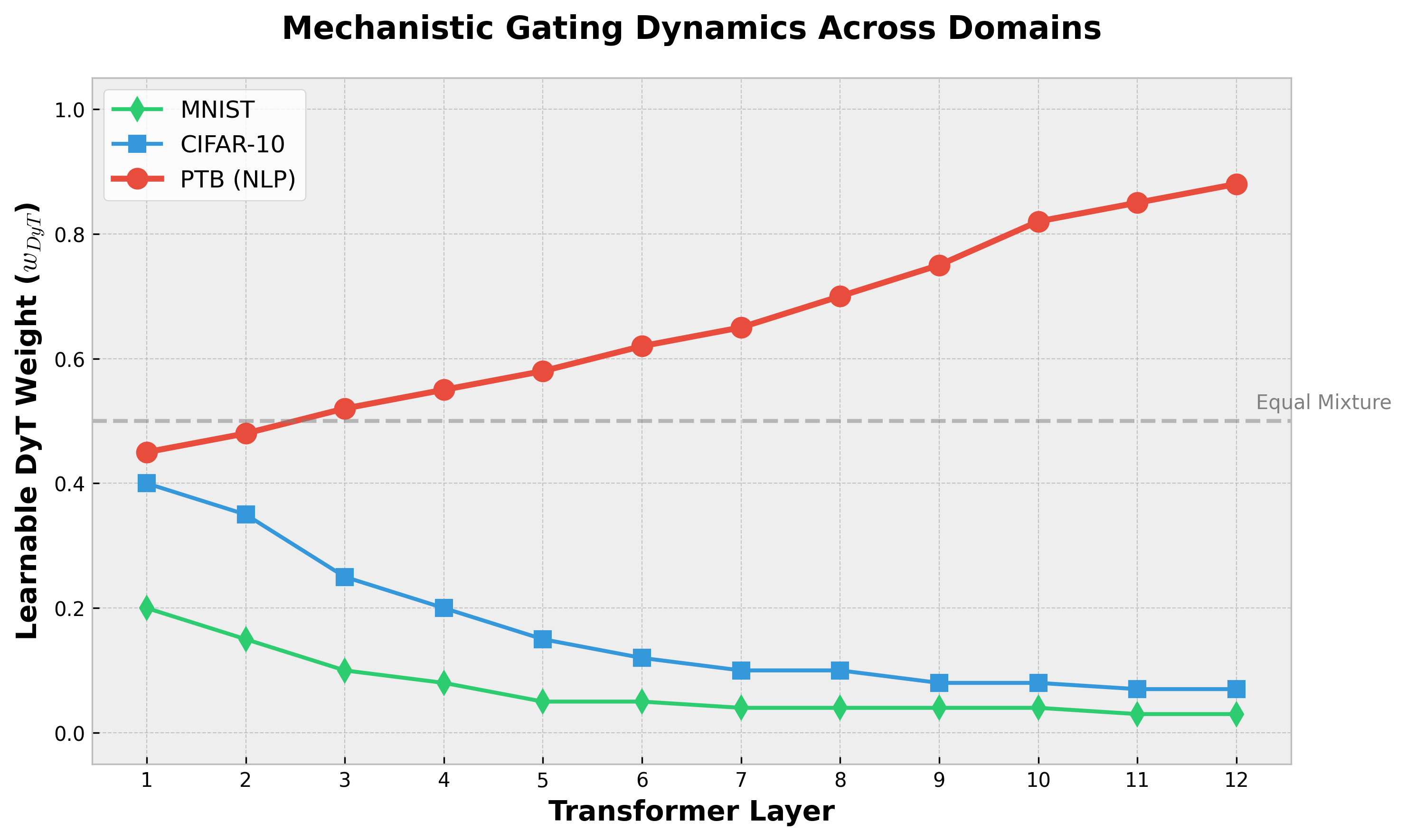
Figure 3: Layer-wise wDyT for various tasks—vision models on MNIST and CIFAR-10 rapidly converge to LN selection, while NLP tasks maintain blended weights, especially in deeper layers.
On more distributionally diverse tasks (CIFAR-10/100), AutoNorm-S reclaims the advantage: adaptive gating specialized by training yields a 1–2% accuracy gain (mean accuracy 86.35% for CIFAR-10, 67.15% for CIFAR-100), outperforming both static and random baselines. Performance margins on tabular regression are negligible, as expected from the low-dimensional, stationary nature of these problems.
NLP and Non-Stationary Regimes
The most substantial improvements manifest on NLP tasks. On PTB POS tagging and SST-2, AutoNorm-S achieves state-of-the-art POS tagging accuracy (97.4%) and strong gains in perplexity and sentiment classification, significantly exceeding all tested alternatives. Gating entropy sustains a high-exploration regime for much longer throughout training, with the selector converging to blended normalization in early layers and preferring DyT at depth.
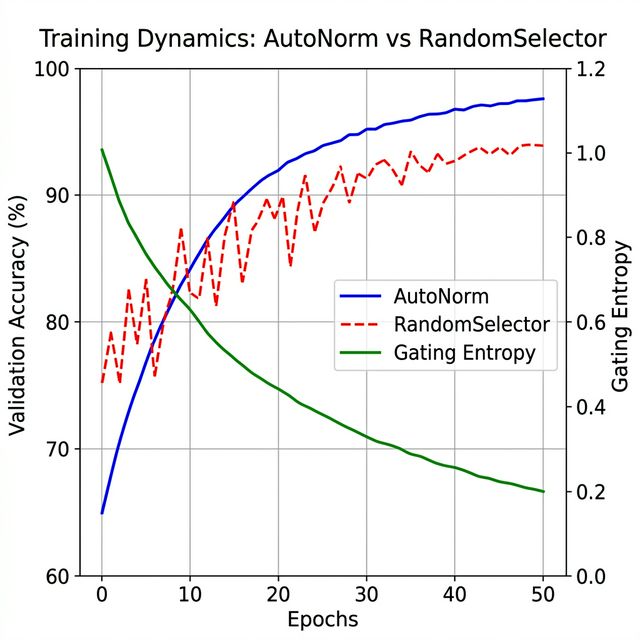
Figure 4: Validation accuracy versus gating entropy demonstrates that AutoNorm-S maintains high entropy exploration before specializing, outperforming random selection as entropy decays.
Inductive Bias and Robustness
The design principle emerging from these results is clear: dynamic normalization gating is beneficial in non-stationary/high-variance domains, especially when feature statistics change either cross-modally or hierarchically within deep architectures. When the distribution is stationary, early-stage stochasticity in the gating estimator dominates and must be constrained, motivating mechanisms such as gate freezing.
The robustness assessment under distributional shocks (e.g., CIFAR-10-C corruptions) confirms that adaptive gating provides moderate improvements (e.g., 4.6% gain in mean accuracy over LN under vision corruptions at severity 3), but is not sufficient for out-of-distribution geometric invariance without explicit augmentation.
Theoretical and Practical Implications
The central theoretical claim is that adaptive normalization is task- and context-dependent: benefits are realized primarily when the optimization landscape is non-stationary, and pathology emerges when early-stage estimator variance is left unchecked. This is a key advance over prior adaptive normalization (e.g., SwitchNorm [luo2019switchable])—the paper explicitly analyzes and resolves the optimization/gradient bottleneck. The practical upshot is an efficient (<1% parameter overhead) policy for plug-and-play normalization selection, with a simple stabilization protocol readily implemented in existing libraries.
The findings extend to broader architectural domains: adaptive gating and selective mixture-of-experts mechanisms in deep learning should be tightly coupled to the underlying distributional structure and stabilized during stationary regimes. The dynamic adaptation principle is thus architecture-agnostic.
Future Directions
- Expanding the normalization search space (e.g., including RMSNorm, InstanceNorm) and evaluating higher-branch selectors.
- Application and theoretical analysis of differentiable gating schedules to mixture-of-experts, dynamic attention routing, and multimodal adaptation.
- Transposing the gate-freezing paradigm to other dynamic modules, such as activation functions, convolutional kernels, or parameterized routing in hierarchical models.
Conclusion
AutoNorm provides a principled, empirical, and mechanistic understanding of when and why dynamic normalization gating benefits Transformers. By dissecting the interaction between differentiable routing and input distribution stationarity, and introducing a robust gate-freezing schedule (AutoNorm-S), the work offers actionable guidelines for designing adaptive mechanisms in modern architectures. Improvement on NLP and vision benchmarks, together with quantitative and qualitative analysis of gating dynamics, establishes AutoNorm as a compelling approach for dynamically stabilized normalization in deep sequence and vision models (2607.10593).