- The paper presents a comprehensive multi-wavelength study, identifying IRAS 19312+1950 as a massive protostellar object with Orion KL–like characteristics.
- It combines dust continuum imaging, deuterium chemistry, and high-resolution outflow mapping to differentiate between evolved stars and active star-forming regions.
- Molecular abundances and kinematic analyses affirm active protostellar feedback and diverse maser activity, refuting a purely evolved stellar origin.
Dissecting the Nature of IRAS 19312+1950 (NDO): A Multi-wavelength Characterization Toward an Orion KL Analog
Introduction
The Nakashima-Deguchi object (NDO; IRAS 19312+1950) presents a unique set of physical and chemical signatures, with an ambiguous classification as either a mass-losing evolved star or a massive star-forming region. Disentangling these competing classifications is critical for understanding extreme phases of stellar evolution and the early stages of high-mass star formation. This study undertakes an extensive campaign of (sub)millimeter and infrared mapping using IRAM 30m, APEX, and SMA, in combination with archival data, to determine the dust, molecular, and dynamical properties of the NDO and its environment (2607.10587).
Dust Continuum Structure
Single-dish continuum imaging at 1.2 mm (250 GHz) and 870 μm (345 GHz) reveals that NDO is associated with an isolated, elongated dust structure.
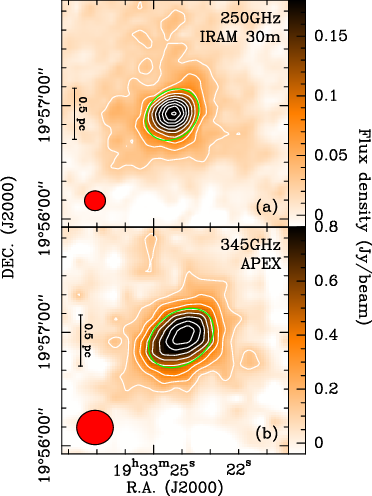
Figure 1: Continuum emission at 250~GHz (panel a) and 345~GHz (panel b) of NDO. Both are fitted with a single 2D Gaussian; green ellipses show fits, with contour levels in increments of 3σ.
Through SED-fitting using data from 60 μm to 870 μm, the study derives a dust temperature Tdust=25±2 K, an average column density N(H2)=(4.4±0.6)×1022 cm−2, dust emissivity index β=1.7±0.2, and a total gas mass Mgas=220±21 M⊙—numbers commensurate with high-mass star-forming clumps. The SED is reproduced with a single modified blackbody in this cold regime, indicating the bulk of dust emission is from non-stellar ISM.
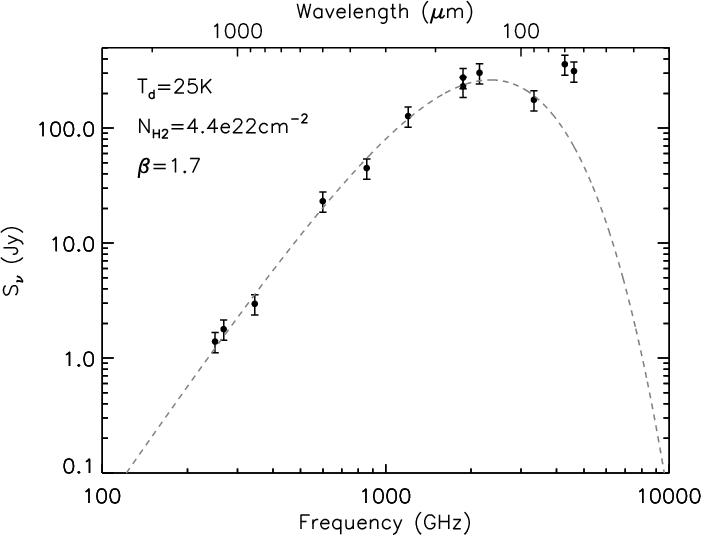
Figure 2: SED of NDO fitted with a single modified blackbody model. The fitted values are shown, emphasizing the exclusion of short-wavelength points representing potential hotter dust.
SMA 1.27 mm continuum imaging resolves the clump into at least four compact cores (MM1–MM4), with MM1 coincident with the SiO maser source and dominant in mass.
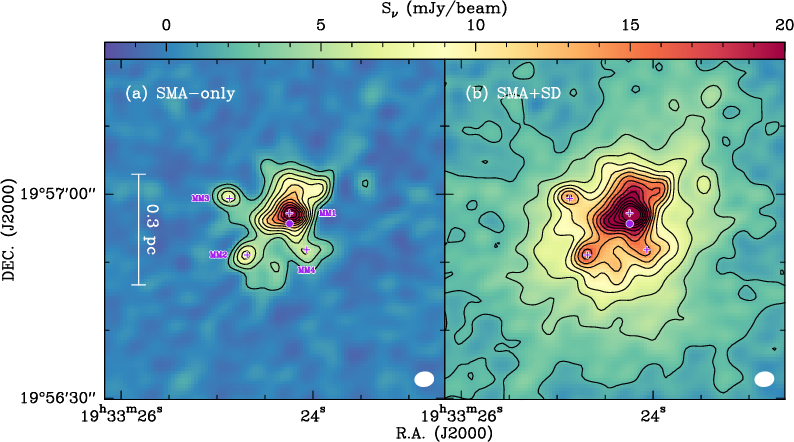
Figure 3: Comparison between SMA-only and SMA+single-dish (SD) 1.27 mm continuum. Both the core multiplicity and the recovery of extended flux are evident.
The mass and luminosity contrast with evolved star envelopes, even massive RSGs, makes a single stellar wind origin for the dust implausible.
Molecular Inventory and Spatial Chemistry
The molecular line survey achieved detections of 59 transitions from 12 species (and isotopologues), including clear detections of the deuterated molecules DCO+, DCN, DNC, and HDCO. The detection of these deuterated species is notable; their formation and survival require cold (3σ0 K), dense ISM conditions and are not compatible with circumstellar envelopes of evolved stars, which destroy deuterium rapidly.
SMA observations toward MM1 yielded 75 spectral features, assigned to the same 12 species, including high-excitation lines, revealing molecular emission closely associated with the massive core and SiO maser position.
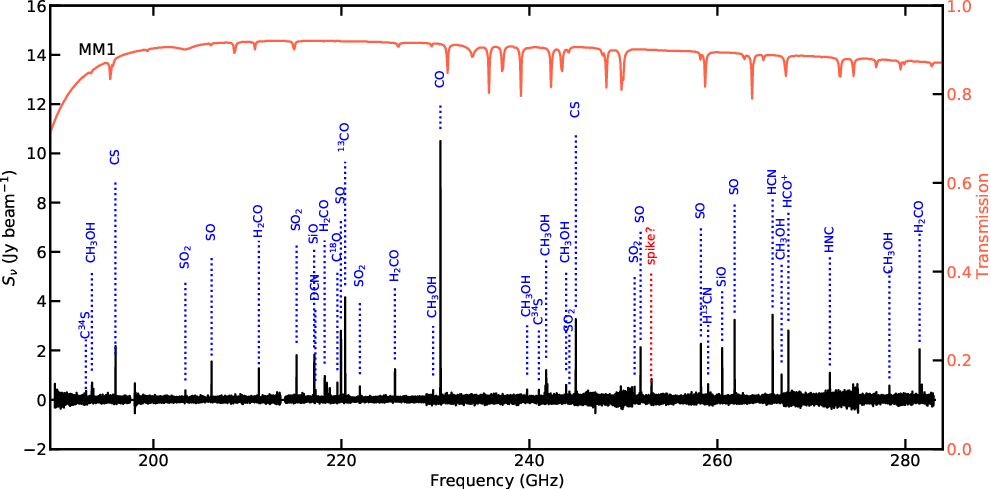
Figure 4: SMA line survey toward MM1 displaying the molecular complexity in the 190–280 GHz window, with the telluric transmission curve overplotted.
Spatial maps show that most bright molecular transitions are centered within 3σ1 pc of MM1, yet exhibit morphology influenced by outflow/jet interaction.
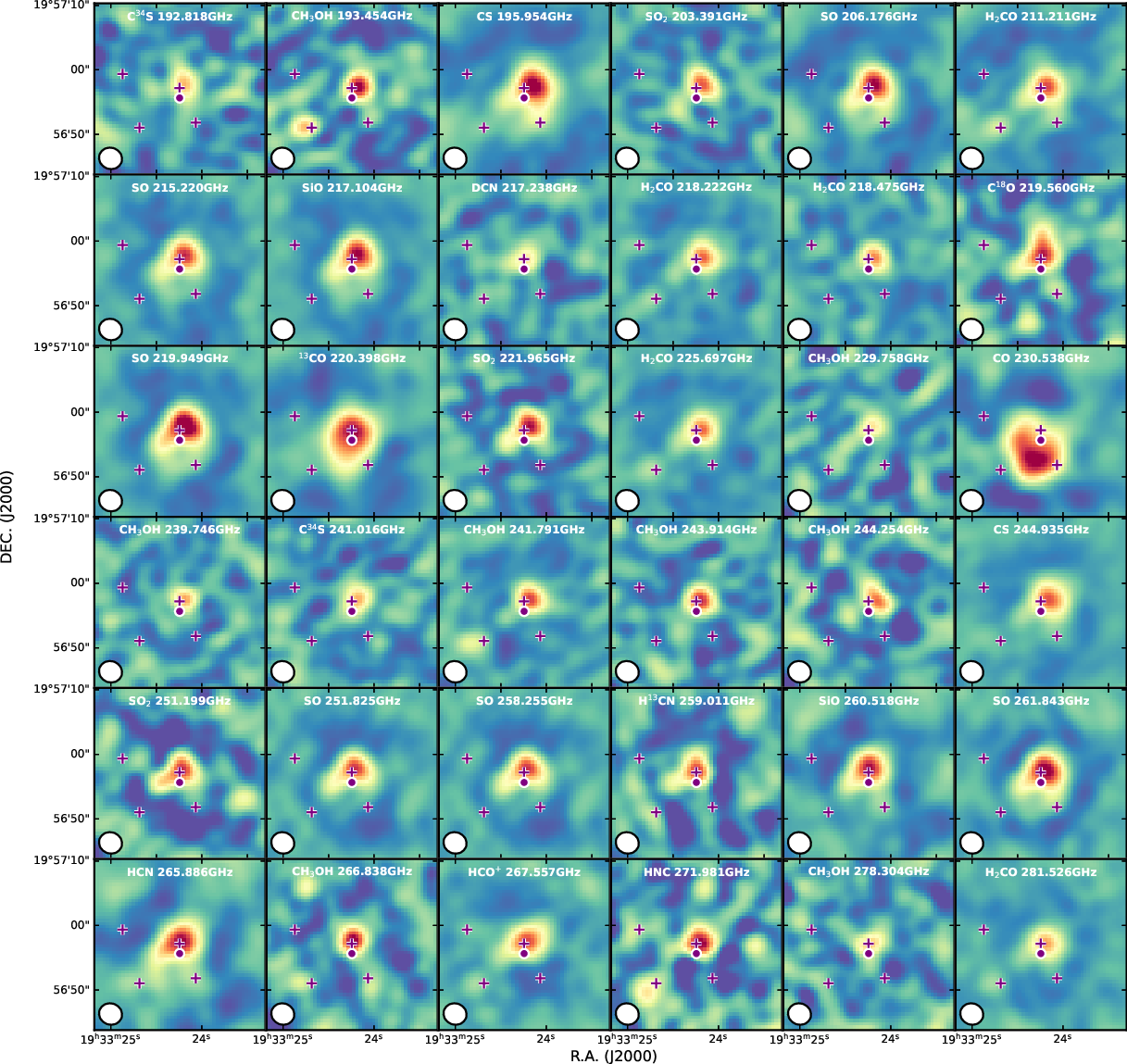
Figure 5: Distribution of 36 molecular transitions; dust peaks and SiO maser locations are marked. The spatial chemical differentiation is apparent on sub-parsec scales.
DCN (3–2) overlays on UKIRT near-infrared imaging demonstrate that molecular deuteration is concentrated close (projected 3σ2 pc) to the infrared source, further supporting the ISM origin.
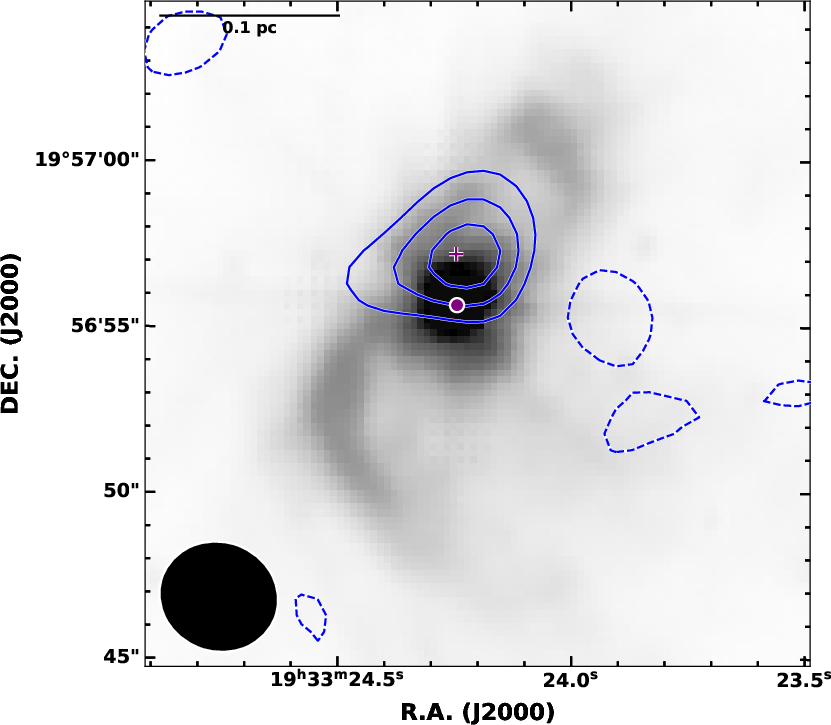
Figure 6: 2.12 3σ3m UKIRT image with SMA DCN contours highlighting deuterium-rich gas near the central source.
Outflow Properties and Kinematics
Wide-field and high-resolution mapping of CO (2–1), (3–2), and (4–3) reveals a powerful outflow, spanning velocities of up to 3σ4150 km/s. The outflow possesses a wide-angle, bipolar morphology, distinct from typical spherically-symmetric AGB envelopes.
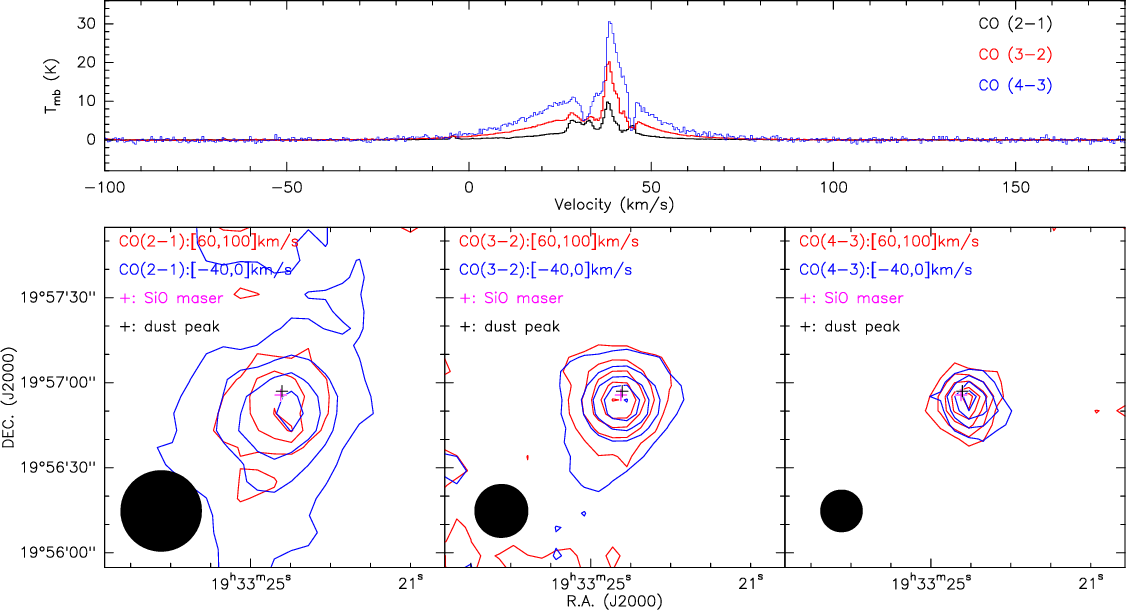
Figure 7: APEX CO views of the outflow; spectra and velocity-integrated maps show both blue and redshifted emission, indicating the outflow structure.
Overlaying NIR H3σ5 imaging and CO outflow contours confirms that the outflow is not point-symmetric, and the blueshifted lobe is aligned with a southern NIR shock feature. The dynamical source is spatially close to both the NIR peak and SiO maser.
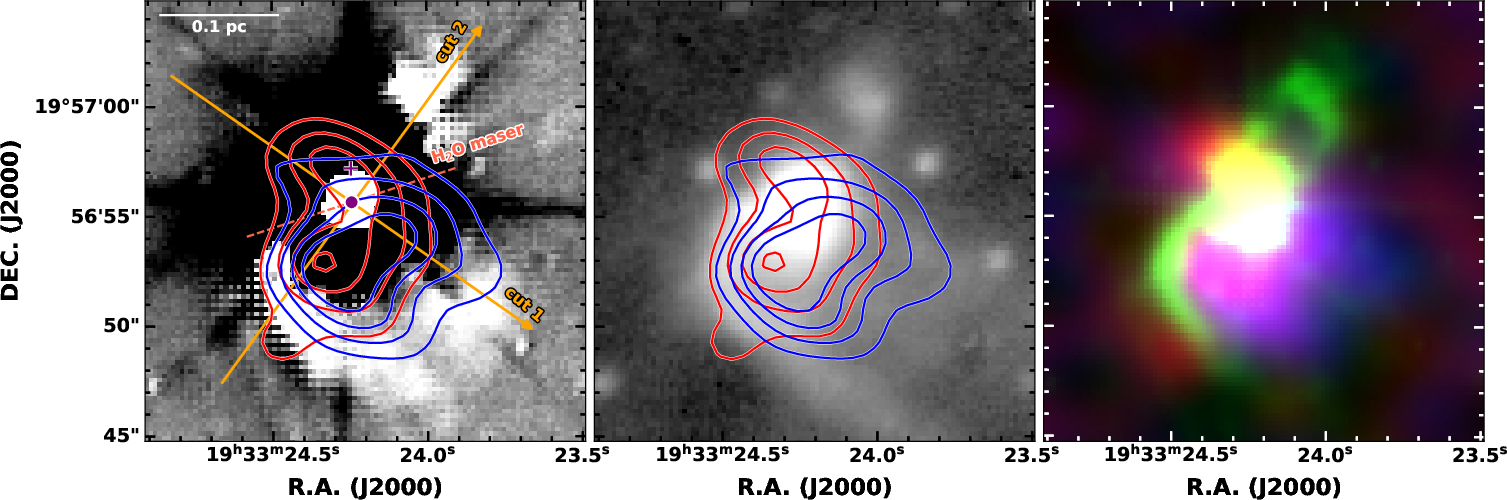
Figure 8: Combined view of NIR H3σ6, dust, and CO outflow lobes, emphasizing geometry and source associations.
Detailed position–velocity diagrams reveal high-velocity features confined to compact (3σ70.2 pc) scales, further indicating that the molecular acceleration is not a remnant of AGB evolution but is instead a massive protostellar outflow.
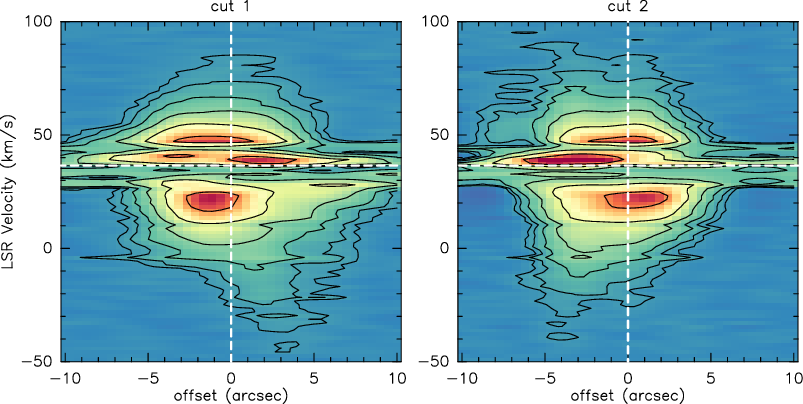
Figure 9: PV diagrams of CO (2–1) along cuts through the outflow axis. High-velocity, compact emission dominates.
Molecular Abundances and Isotope Diagnostics
Measured abundances for most detected molecules are in broad agreement (within an order of magnitude) with those in archetypical low-mass and high-mass star-forming sources (IRAS 16293-2422 and Orion KL). However, the 3σ8SiO abundance is enhanced, likely shock-driven. SO, SO3σ9, CHμ0OH, Hμ1CO, and HCμ2N are less abundant than in Orion KL, suggestive of less extreme shock heating.
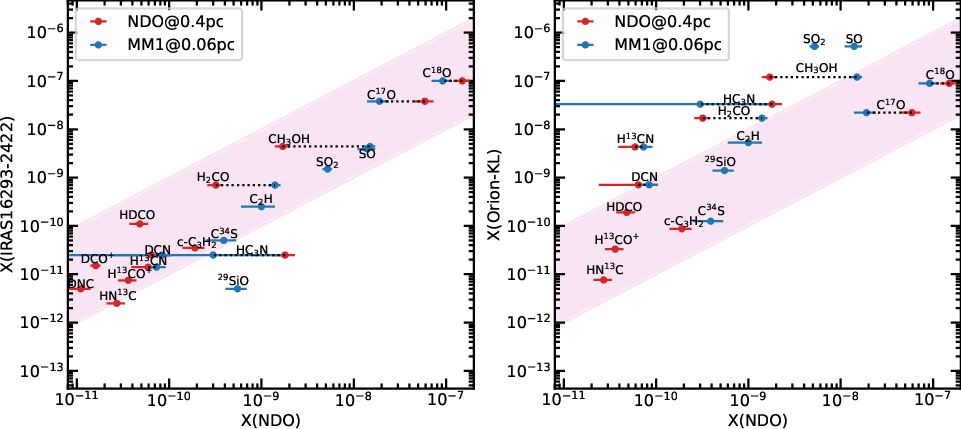
Figure 10: Fractional abundances for NDO (large and small scale), IRAS 16293-2422, and Orion KL. Disparities in S- and O-bearing species abundance are highlighted.
Isotope ratios—e.g., μ3C/μ4Cμ5, μ6O/μ7Oμ8—are broadly consistent with ISM values and inconsistent with the values from post-AGB envelopes or merger remnants. The derived deuterium fractions (e.g., DCN/HCN μ9\%, HDCO/Hμ0CO μ1\%) are orders of magnitude above cosmic [D/H] and are not seen in circumstellar gas of evolved stars, directly refuting a purely stellar origin for the molecular gas in NDO.
Maser Characteristics and Non-thermal Emission
NDO is an exceptionally rare case of a non-evolved object hosting strong SiO, Hμ2O, and possible CHμ3OH masers—all typically associated with either very massive star-forming regions (Orion KL, Sgr B2, W51N) or evolved stars. The SiO maser exhibits a double-peaked profile closely paralleling that of Orion KL Source I, reinforcing the analogy.
The absence of detectable radio continuum down to stringent limits precludes the existence of a classical H II region, placing the central source below the threshold for an early B-type ZAMS star in ionizing photon output and suggesting either youth or ongoing high accretion rates suppressing ionization.
Synthesis: Evolutionary State and Phenomenological Classification
The inferred large clump mass (μ4), resolved core structure, spatially differentiated chemistry, powerful and compact outflow, abundance of deuterated molecules, and maser inventory collectively argue in favor of a massive protostellar object in an early evolutionary state.
The closest analog appears to be Orion KL (specifically Source I) viewed at greater distance and earlier formation stage: a system characterized by a compact, massive, chemically rich core, strong outflow feedback, and diverse maser activity, yet lacking an observable H II region due to ongoing high-mass accretion. The observed properties are inconsistent with classical AGB/post-AGB stars, red supergiants, or merger remnant envelopes.
Theoretical and Practical Implications
Theoretical Implications
- Deuterium Chemistry as a Diagnostic: The presence of high D/H isotopologs provides compelling temporal constraints on the ISM processing and star formation.
- Protostellar Feedback: The observed wide-angle, high-velocity outflow, together with complex shock chemistry, provides a laboratory for studying massive protostellar accretion and feedback, with implications for the disruption of natal cores.
- Maser Rarity and Geometry: The morphological and kinematic parallels between NDO and Orion KL Source I highlight the role of rotation, accretion, and disk-wind interactions in early massive star evolution.
Practical Implications and Future Directions
- Extragalactic Analogs: NDO, at a distance μ5 that of Orion KL, functions as a direct analog for similar objects unresolved in extragalactic environments.
- Advancing High-resolution Studies: The current angular resolution (μ6 pc) partially resolves the dynamical and chemical structures; ALMA-scale observations could fully disentangle disk-outflow interactions and trace accretion processes at the 100–1000 AU scale.
- Revising Masers as Evolutionary Tracers: The diverse maser population in NDO, in combination with its non-evolved status, calls for refined criteria in using maser phenomenology to classify massive YSOs and post-AGB stars.
- Comprehensive ISM–Stellar Feedback Models: Analogous studies in other early-phase high-mass star-forming clumps will be essential for constructing evolutionary sequences and establishing diagnostic markers applicable to unresolved star-forming complexes within and beyond the Milky Way.
Conclusion
Through comprehensive multi-wavelength mapping and spectral characterization, this study establishes IRAS 19312+1950 (NDO) as a chemically and morphologically complex, massive star-forming environment, exhibiting decisive evidence for cold deuteration chemistry, powerful outflows, and rare maser excitation. The system is classified as a strong candidate for an Orion KL–like cluster in an earlier evolutionary window, at larger distance. The results robustly refute the evolved stellar scenario for the enveloping molecular material. Remaining ambiguities about the central IR source’s detailed nature (e.g., merger or peculiar YSO) require future ultra-high-resolution observations, but the present work positions NDO as a critical reference point for understanding high-mass star formation within dense, chemically rich, and dynamically active cores (2607.10587).