- The paper introduces a physics-inspired pseudo-anomaly generator and prototype anchoring that enhance the detection of subtle defects in 3D point clouds.
- It employs a unified backbone with local-global attention modules to robustly capture both fine-grained details and global context, achieving high AUROC on benchmark datasets.
- The framework bridges the synthetic-real gap by leveraging controlled geometric deformations and a momentum-updated normal prototype for effective anomaly localization.
Physics-Inspired Pseudo-Anomaly Generation and Prototype Feature Guidance for 3D Anomaly Detection
Introduction
Accurate 3D point cloud anomaly detection is critical for industrial inspection, automated quality assurance, and failure analysis. However, this task is fundamentally constrained by the scarcity and high cost of acquiring annotated real-world anomalies. Typical training data is anomaly-free, hindering discriminative representation learning. Existing 3D anomaly detection methods rely on feature retrieval, reconstruction error, or random pseudo-anomaly generation, but lack both physical plausibility and strong prototype guidance. The paper "Physics-inspired Pseudo Anomaly Generation and Prototype Feature Guidance for 3D Anomaly Detection" (2607.10544) introduces PA3AD, a novel framework that generates physically motivated pseudo-anomalies and employs prototype-based feature anchoring with shared-parameter representation learning. The approach addresses both the shortage of real anomalies and the difficulty of distinguishing nuanced geometric deviations.
Methodology
PA3AD consists of several integrated components: a multi-physics anomaly generator (MP-AG), a backbone with local-global attention, a momentum-based prototype feature anchor, and a difference-aware fusion/offset prediction head.
Multi-Physics Pseudo-Anomaly Generation
PA3AD introduces a physically inspired pseudo-anomaly generator that synthesizes defects based on domain-specific geometric priors. The generator produces five canonical morphologies — bulge, concavity, hole, crack, and bend — using parameterized deformation functions grounded in physical intuition (e.g., radial basis for bulge/concavity, tanh transition for holes, PCA-based slit for cracks, and analytic profile for bents). This process creates spatially continuous, realistic anomalies that match observed defect classes in industrial practice.
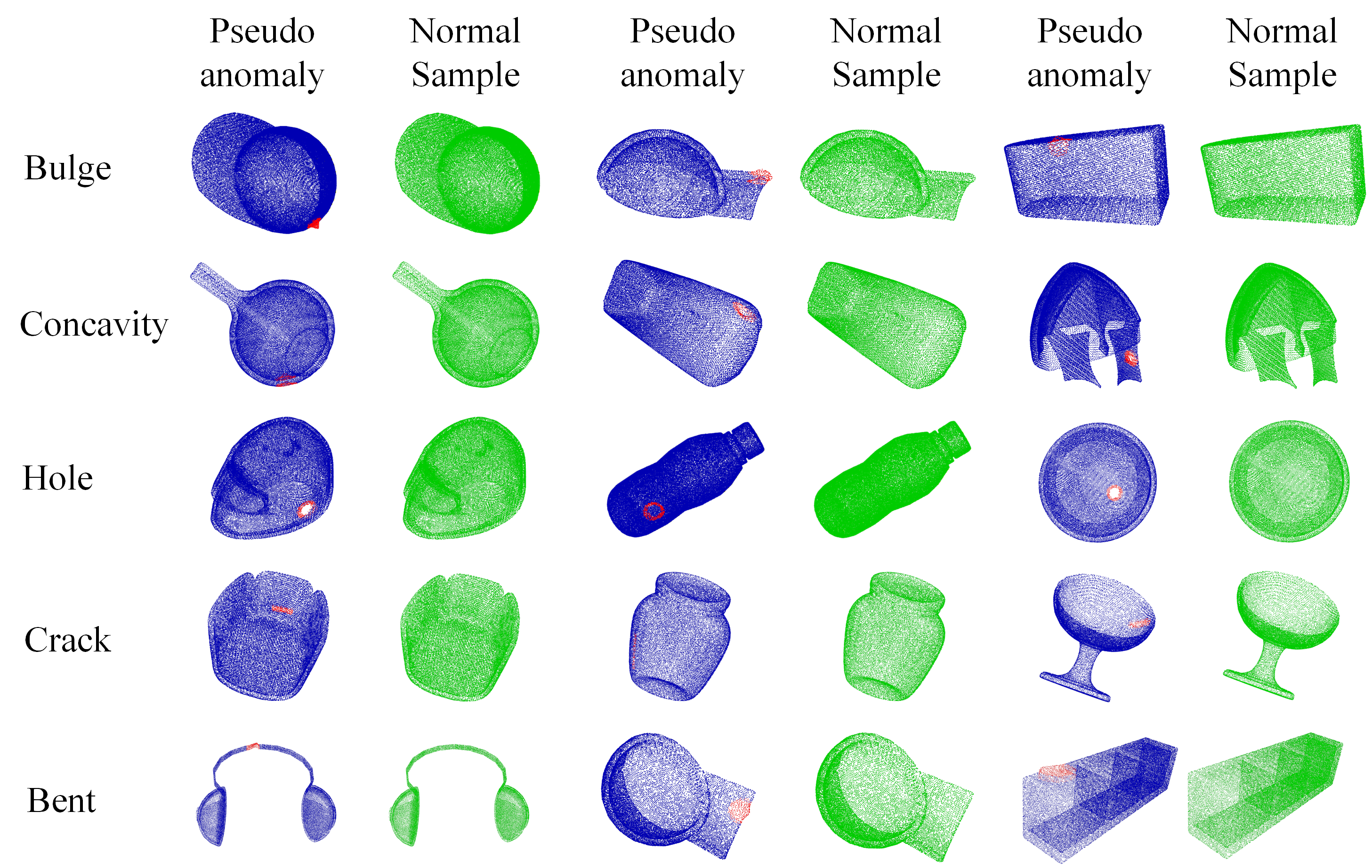
Figure 2: Visualization of pseudo-anomaly generation using distinct physical deformation models compared to intact samples (green: normal, blue: anomaly, red: abnormal area).
The generator's hyperparameters control strength, spatial support, and orientation, allowing precise, class-conditional supervision and supporting ablation over the impact of each anomaly type and deformation magnitude.
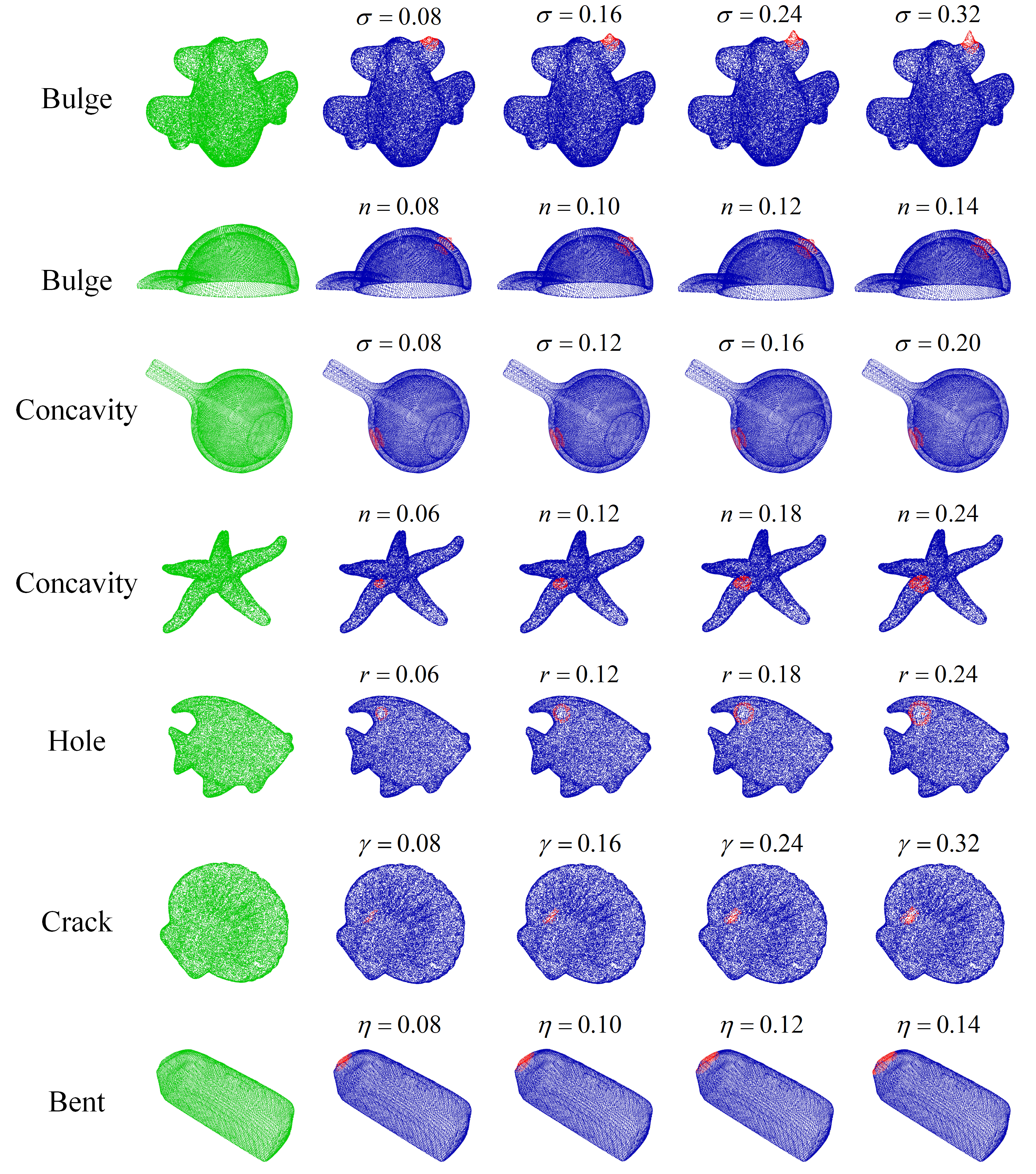
Figure 4: Parameter variation enables controlled generation of distinct morphologies — bulge, concavity, hole, crack, bent — for systematic ablation and robustness study.
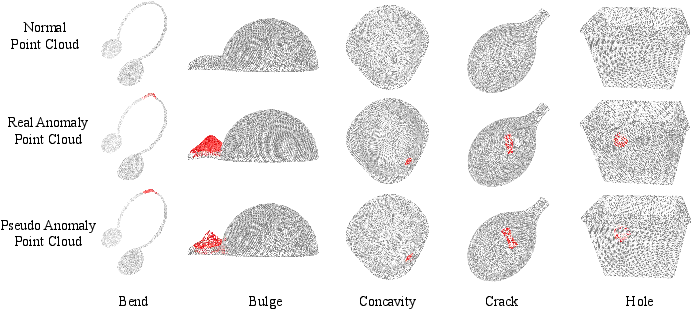
Figure 6: Real-world and physics-driven synthetic anomalies exhibit high morphological correspondence for all canonical defect types.
Shared-Weight Backbone and Local-Global Attention
Normal and generated anomalous point clouds are both voxelized and input to a unified parameter-shared backbone, ensuring embeddings are directly comparable. Local-global attention modules (stacked transformer layers) at the network bottleneck explicitly model both local geometric details (sliding window, relative position encoding, multi-head self-attention) and global context (linear attention). This dual-branch structure is crucial for distinguishing subtle, spatially extended defects from textural variations or sensor noise.
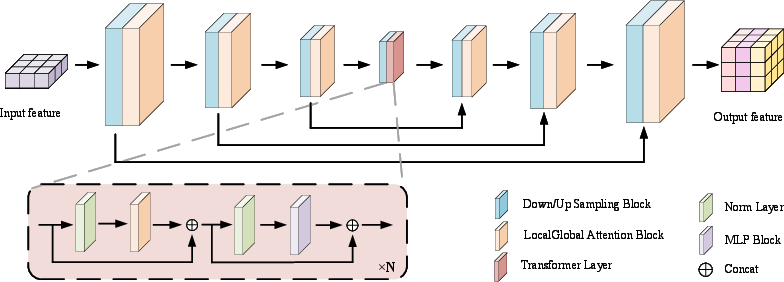
Figure 1: Shared-weight backbone: voxelized point clouds are processed through an encoder-decoder with local-global attention at the network's bottleneck.
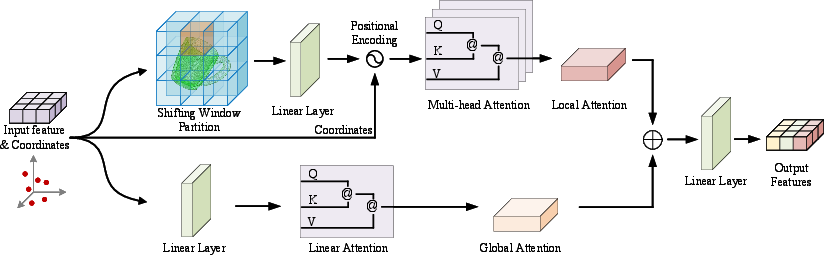
Figure 3: The local-global attention fuses window-based multi-head self-attention (local) with global linear-attention context for robust multi-scale encoding.
Prototype Feature Construction with Momentum Update
Stable, reliable modeling of normality is achieved by constructing an explicit normal feature prototype using an exponential moving average (EMA) update. The momentum schedule is annealed from 0.1 to 0.999, balancing rapid adaptation early in training with high stability in later stages. The prototype acts as a dynamic, history-aware anchor, facilitating robust detection under domain shift, batch noise, and intra-class variability.
Difference-Aware Fusion and Offset Head
The normal and pseudo-anomalous features are concatenated and fused via a difference-aware block, which applies adaptive, learned weighting to amplify salient discrepancies. Pointwise offsets, predicting the geometric displacement needed to transform a normal surface to its (pseudo-)anomalous counterpart, are regressed through a multi-layer perceptron. The training loss combines norm error, directional alignment, feature discrepancy regularization, and weight normalization, ensuring precise localization and robust outlier suppression.
Experimental Results
Quantitative Benchmarks
Experiments on Anomaly-ShapeNet and Real3D-AD cover both synthetic and real-world data with highly variable geometry, material, sampling density, and acquisition protocol. PA3AD demonstrates state-of-the-art performance, achieving mean object-level AUROC of 93.3% and 78.9% on Anomaly-ShapeNet and Real3D-AD, respectively, outperforming published baselines across almost all classes.
Detection remains strong even in the presence of severe domain shifts and underrepresented anomaly morphologies. Ablation of the physics-inspired generator (replacing it with naive perturbations) causes substantial AUROC degradation (Table 9). Parameter sensitivity analysis confirms optimal performance for moderate, physically plausible deformations.
Qualitative Analysis
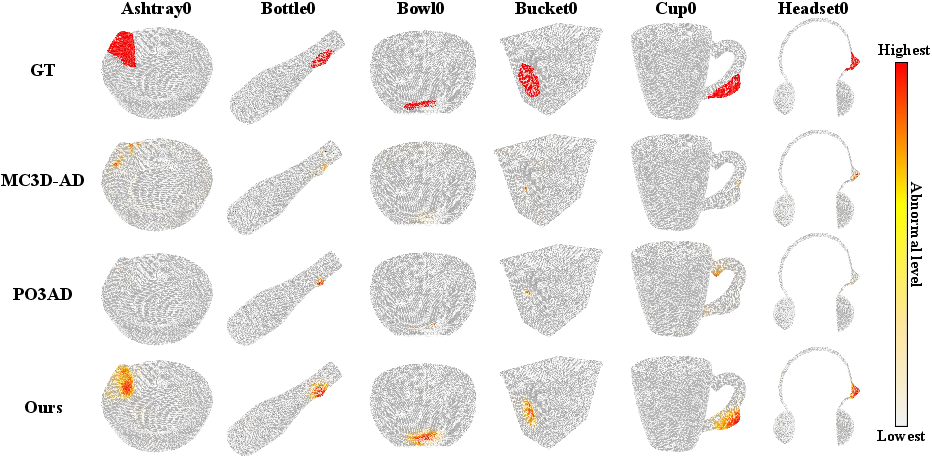
Figure 5: PA3AD produces highly precise anomaly localizations (red: anomalous, white: normal) and closely matches ground truth, outperforming MC3D-AD and PO3AD.
Visualization of pseudo-anomalies and ground-truth anomalies, including per-point anomaly heatmaps, confirms that the synthesized defects are spatially and morphologically consistent with real-world observations.
Key Claims and Contributions
- PA3AD establishes the necessity and value of physically inspired, parameterized pseudo-anomaly synthesis. Arbitrary perturbations are suboptimal and do not generalize to real defect structures.
- The introduction of a momentum-based normal prototype anchor results in more stable discrimination under varying density and acquisition conditions than static or teacher-student solutions.
- The local-global attention backbone is essential for effective object-level and point-wise discrimination, outperforming pure convolutional or single-scale attention models.
- Difference-aware loss design, especially when combining feature discrepancy and weight regularization, is critical for robustness and small-defect recall.
Theoretical and Practical Implications
The integration of multi-physics anomaly generation provides a practical route for anomaly detection in regimes where defective training samples are fundamentally unavailable. The adoption of feature anchoring via EMA-driven prototypes bridges the gap between transfer learning and domain-specific one-class modeling. Local-global attention and explicit offset regression provide interpretable anomaly explanation — critical for deployment in manufacturing and quality assurance.
By achieving high performance on challenging open-set settings, PA3AD supports broader adoption of automated 3D inspection pipelines, even with only normal data available for model development. The physics-inspired strategy also illuminates a plausible extension path: more precise solid-mechanics modeling, dynamic anomaly simulation, or adaption to multi-modal sensor fusion.
Conclusion
PA3AD constitutes a principled and systematically validated framework for physically informed, prototype-anchored 3D anomaly detection (2607.10544). The approach robustly resolves limitations of prior random or weakly supervised pseudo-anomaly generation, and sets new baselines for open-world, geometry-centric defect localization. Remaining challenges include extension to multi-modal fusion, further reduction of the synthetic-real gap for rare, highly local defects, and adaptation to out-of-distribution domain drift in unconstrained real-world deployments.