- The paper establishes a rigorous connection between glassy Gibbs geometries and spectral signatures of replica symmetry breaking using two-replica difference matrices.
- It demonstrates that while single-instance spectra show universal behavior, two-replica observables directly encode detailed Parisi overlap information.
- Numerical simulations and analytical results validate that induced random matrix ensembles serve as powerful probes for detecting RSB in high-dimensional inference problems.
Spectral Encodings of Replica Symmetry Breaking in Optimization-Governed Random Matrix Ensembles
Introduction
The work "Spectral Signatures of Replica Symmetry Breaking in Optimization-Induced Random Matrices" (2607.10513) develops a rigorous connection between glassy Gibbs geometries and spectral statistics of random matrices constructed via optimization-induced sampling. Focusing on the dense Boolean p-MAS (maximum-average subtensor) model, the paper elucidates which aspects of the underlying replica-symmetry-breaking (RSB) structure survive in the spectral data of matrices formed from thermalized Gibbs samples in a fixed disorder instance.
This analysis does not merely explore conventional random matrix theory with independent entries, but rather investigates the case where the constraints of the optimization landscape, defined by a glassy Hamiltonian, determine not only the sampled configurations but also the matrix contractions themselves. The implications of these findings extend to the statistical mechanics of random optimization problems, high-dimensional inference, and the direct probing of Parisi-style order parameters via spectral observables.
Spectral Observables, Gibbs Geometry, and Matrix Ensembles
An optimization-induced random matrix ensemble is constructed by first defining a glassy Gibbs measure—here, for the dense Boolean p-body Hamiltonian—and then contracting the associated random disorder tensor along thermally sampled configurations. This dual role of disorder requires careful analysis of how the glassy structure, codified in the overlap statistics between states, influences induced spectral laws.
Crucially, in the dense p-MAS, the bulk spectrum of a single matrix induced from a typical Gibbs configuration is shown to be universal at leading order—dependent only on p and the configuration density m, but not on the finer overlap structure between states. This universality illustrates the insensitivity of naive spectral statistics to glassy organization when only single-matrix data are considered.
However, when a two-replica observable is constructed—by forming matrices from independent thermal samples (replicas) in the same realization of disorder—the mutual overlap between replicas modulates the spectrum of their difference. These spectra encode the Parisi overlap order parameter directly, allowing for the resolution of glassy features otherwise invisible to conventional spectral diagnostics.
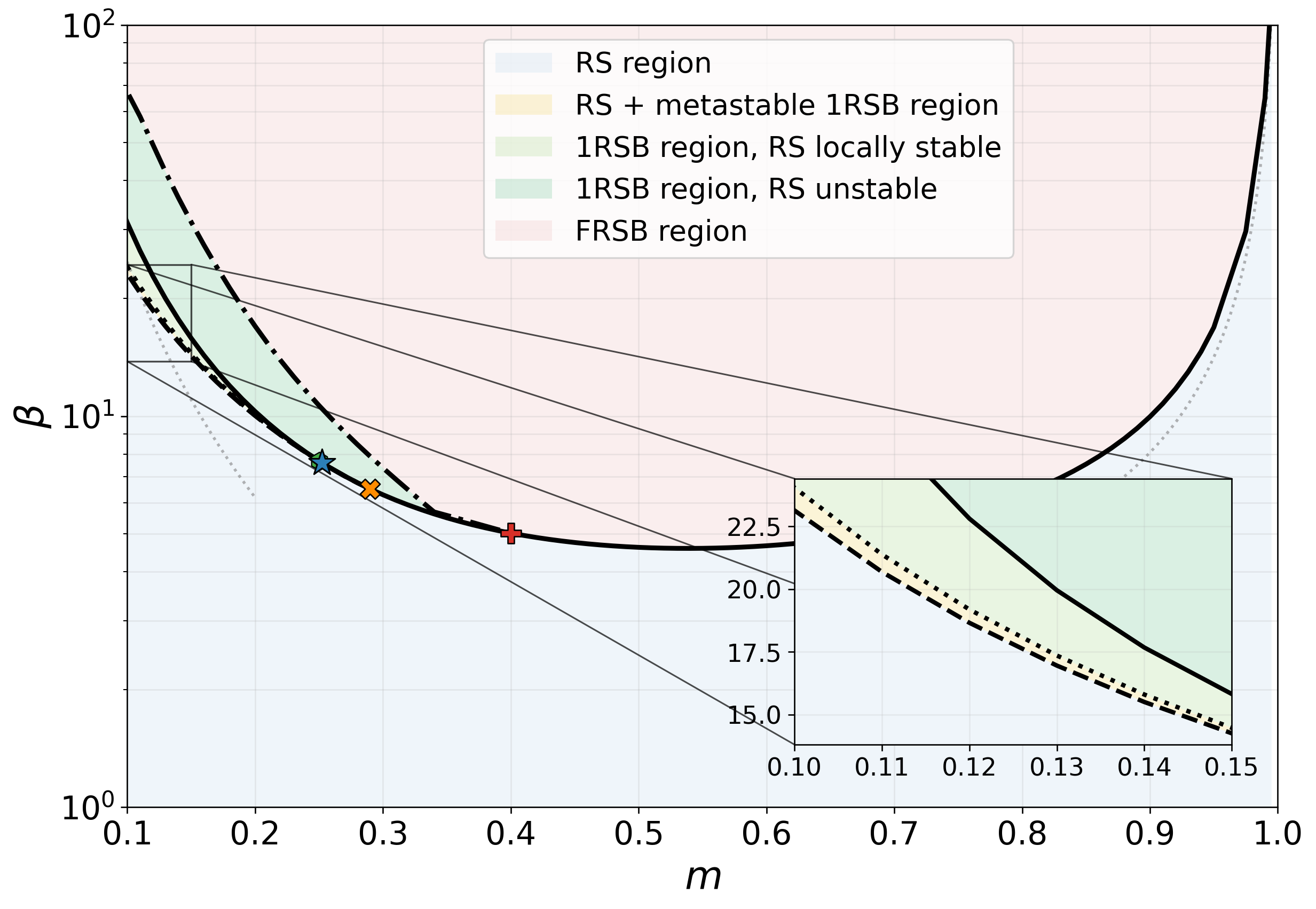
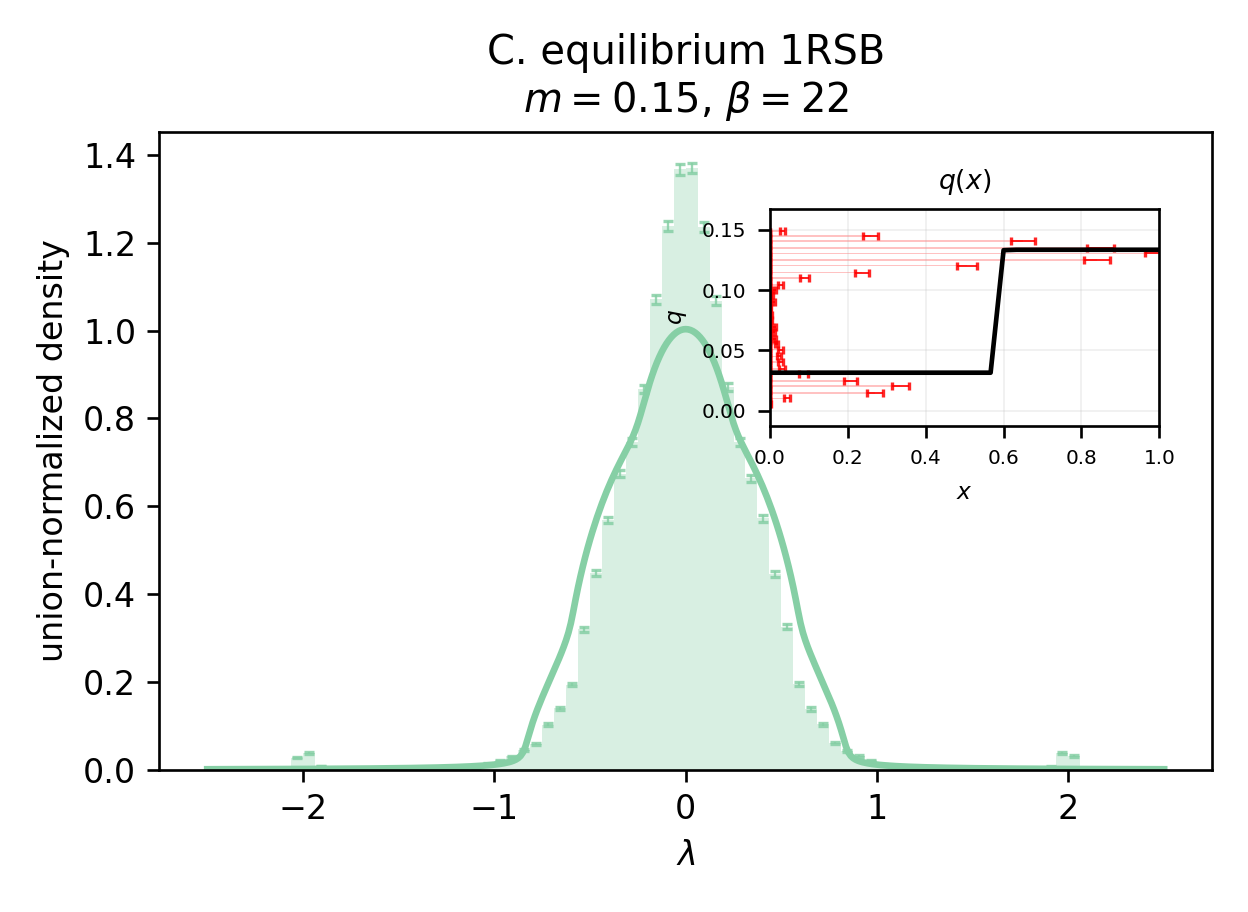
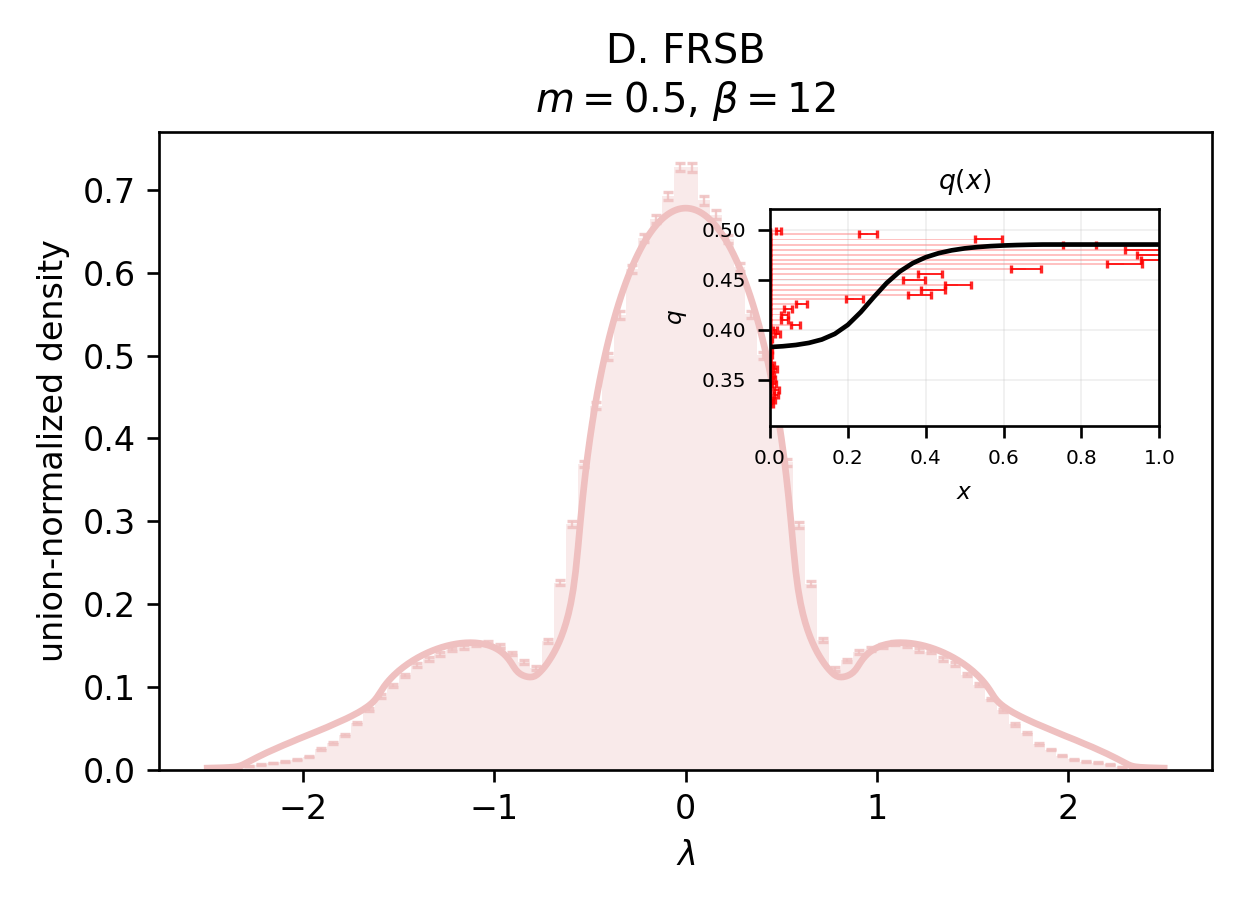
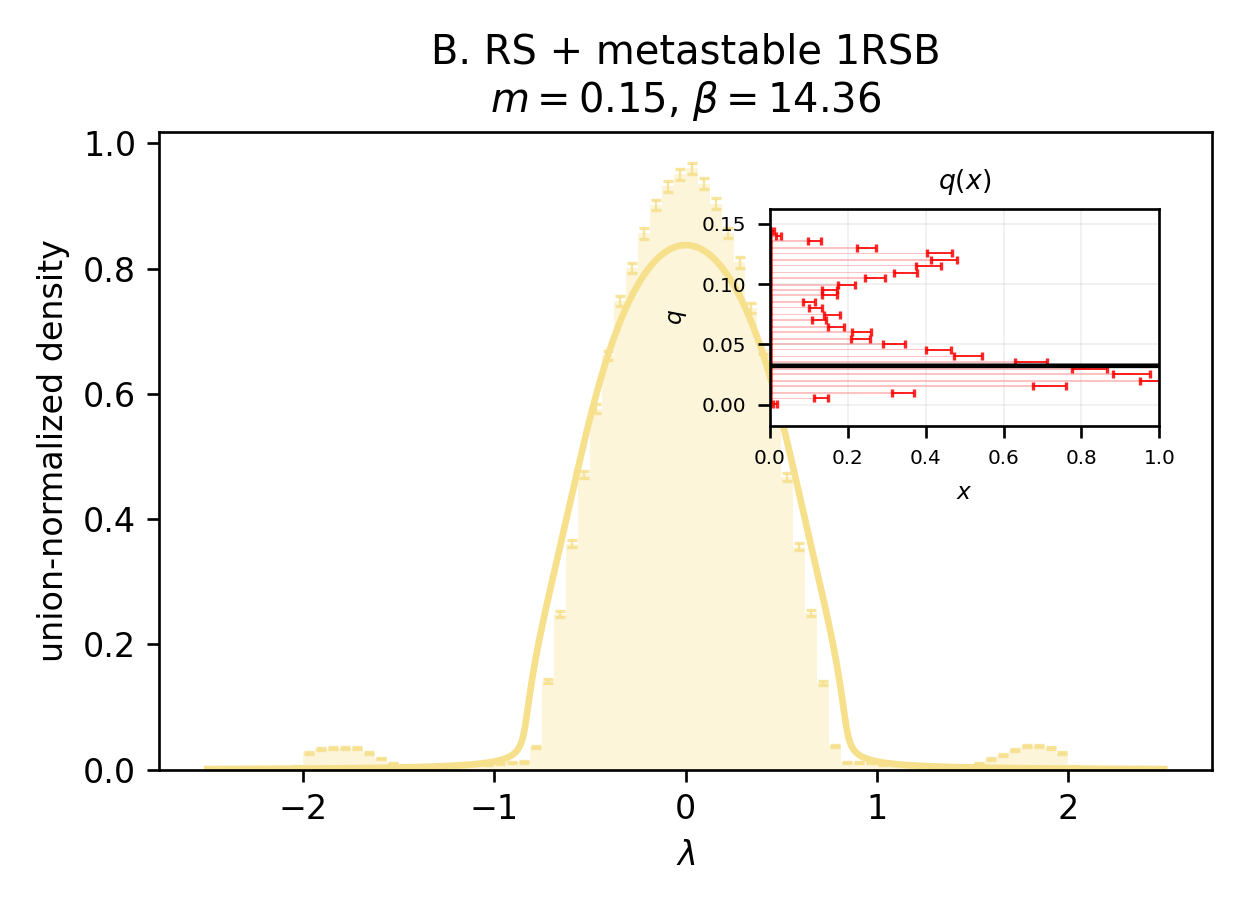
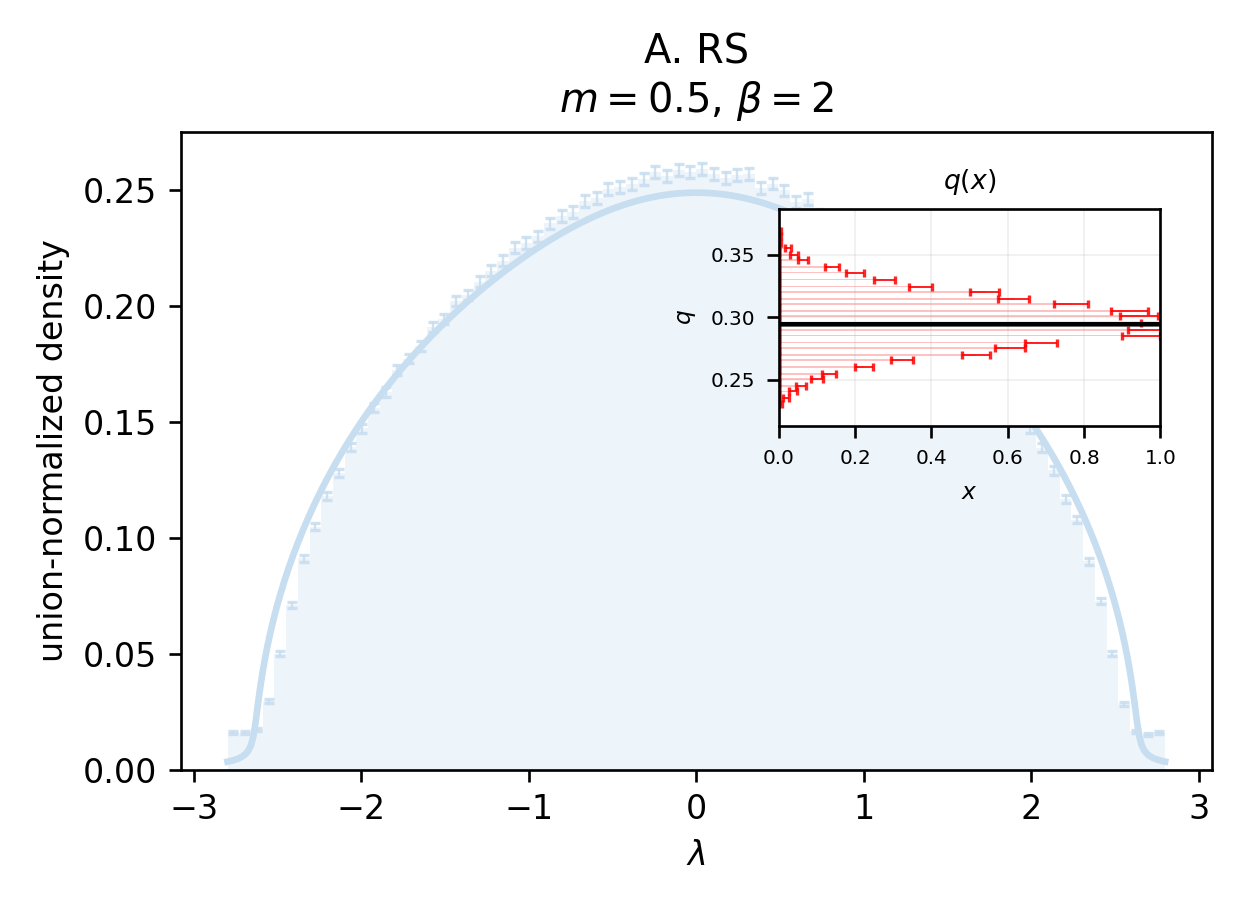
Figure 1: Phase diagram for the dense Boolean p-MAS (p=3) showing dynamical and static transitions in the density–inverse-temperature (m,β) plane, together with union-normalized two-replica spectral densities of Y−1=M1−M2 at representative RS, 1RSB, and FRSB points, as obtained by the spectral transform of the Parisi overlap order distribution and validated by Monte Carlo.
Theoretical Framework and Main Results
Consider a symmetric p-order Gaussian tensor p0 and Boolean indicator vectors p1 parameterizing sub-tensor selections. The p2-MAS Hamiltonian is defined as
p3
with the Gibbs weight p4 at fixed density p5. The disorder self-correlation, p6, induces a thermodynamic overlap law described by Parisi theory with overlap order parameter p7.
The induced matrix p8 is constructed by contracting the tensor with two indices p9 uncontracted:
p0
The active block of p1 is thus determined by the support of p2; its empirical spectrum, at leading order, only depends on p3, with bulk confined to a Wigner-like law rescaled by p4 and p5.
A single such spectral law is therefore blind to RSB; spike and finite-rank corrections do not generically reveal the overlap geometry, barring atypical alignment effects. In contrast, by analyzing the difference matrix p6 for two independent Gibbs samples, one accesses a block-resolvent problem whose statistics depend explicitly on the overlap p7.
For fixed overlap, the spectrum of p8 is given by a block-variance profile, controlled by p9 and thus by the entire Gibbs overlap distribution. Averaging over the thermodynamic two-replica Parisi order parameter p0 produces a "spectral transform" of the overlap law. This transform interpolates from pure replica-symmetric (RS) behavior to one-step RSB (1RSB; distinct intra- and inter-state overlaps producing spectral mixtures) and full-RSB (FRSB; continuous spectral superpositions indexed by Parisi profiles).
Numerical tests conducted via finite-temperature Monte Carlo at fixed disorder and constrained density, employing parallel tempering and Kawasaki dynamics, show good agreement with theoretical predictions for spectral densities and overlap histograms across all glassy phases (see Figure 1).
Implications and Extensions
The selective sensitivity of spectral observables to RSB shown here has broad implications:
- Spectral invisibility of glassy organization in single-instance bulk laws: For dense ensembles, unless spike-induced effects or edge statistics are considered, the leading empirical spectrum cannot resolve detailed Parisi geometry. This implies limitations for spectral inference in high-dimensional statistics when using only single-replica data from glassy signal models.
- Direct spectral access to Parisi order parameters: The two-replica difference spectrum provides a direct probe of the overlap distribution, allowing for experimental or numerical access to RSB features in optimization or inference problems via spectral data.
- Generalization to sparse and topologically structured ensembles: The paper outlines that in diluted regimes, where the support structure itself is nontrivial, the spectral bulk may retain richer geometric information, aligning with phenomena seen in sparse random matrix theory and spectral graph theory.
- Potential in out-of-equilibrium and algorithmic sampling: Since optimization-induced ensembles include out-of-equilibrium configurations, spectral probes could serve as diagnostics for algorithmic sampling quality, energy landscape exploration, and transitions in large combinatorial systems.
This approach effectively translates intricate statistical mechanics order parameters into random matrix observables, advancing the intersection of these two fields.
Conclusion
This work establishes that induced random matrix spectra are selectively sensitive to the glassy geometry of the underlying Gibbs measure. In dense ensembles, one-matrix bulk laws are universally blind to replica symmetry breaking, while two-replica difference spectra encode the Parisi overlap distribution directly. This provides a robust spectral observable for detecting RSB in random optimization and inference problems, offering both a diagnostic for glassy regimes and a practical method for mapping statistical order to measurable spectra. Future work targeting sparse, structured, or dynamically sampled systems promises to further develop these connections and to expand the set of tools for probing complex high-dimensional landscapes via random matrix techniques.