A Cascade of Volterra-Operator BBP Transitions in a Correlated Wigner Matrix
Published 11 Jul 2026 in cond-mat.stat-mech and q-fin.MF | (2607.10503v1)
Abstract: We study a Wigner-type random matrix in which the off-diagonal correlation between entries is generated by a random factor shared among all entries in a given row and column, with the coupling strength held fixed as the matrix size grows. Although the bulk spectral moments remain those of the pure semicircle law, we show that the underlying correlation matrix decomposes into a vanishing bulk together with a countable family of outlier eigenvalues that, at fixed rank k, converge to the singular values of a compact Volterra (cumulative-sum) integral operator -- obtained in closed form via the classical Karhunen--Loève expansion of Brownian motion and confirmed numerically to better than one percent across the top twenty such values. Each singular value drives an independent Baik--Ben Arous--Péché (BBP) transition as the coupling strength increases, producing an evenly spaced, discrete hierarchy of critical points -- rather than a single transition -- at each of which one further eigenvalue detaches from the semicircle edge, in close agreement with direct diagonalization. We show that this mechanism generalizes to a broader family of correlation structures, with the critical hierarchy in every case set by the spectrum of an associated compact integral operator.
The paper establishes that correlated Wigner matrices exhibit an infinite cascade of BBP transitions governed by the singular values of a compact Volterra operator.
It links the matrix eigenvalue behavior to a Sturm–Liouville problem, deriving critical coupling thresholds that underlie the operator-driven edge transitions.
The study combines numerical diagonalization and analytic techniques to show that operator-level perturbations alter the spectral properties, impacting high-dimensional inference.
Cascade of Volterra-Operator BBP Transitions in Correlated Wigner Matrices
Introduction
The study addresses the spectral properties of a Wigner-type random matrix ensemble, where correlations among matrix elements are induced by random factors shared per row and column with fixed coupling as N→∞. The main observation is the emergence of a discrete, infinite hierarchy of Baik–Ben Arous–Péché (BBP) phase transitions governed by the singular values of a compact Volterra integral operator, as opposed to the standard scenario of a finite-rank perturbation leading to a single BBP transition. This framework elucidates how a class of correlated random matrices supports multiple, evenly spaced spectral transitions, with broad implications for inference in high-dimensional statistics, operator theory, and random matrix deformations.
Model Construction and Bulk Spectral Behavior
The key matrix ensemble considered is
H=NbM+Nση,
where Mij=Zmax(i,j), Zj are i.i.d., and ηij standard Wigner noise. Notably, the off-diagonal entries are correlated through column-wise random factors, distinguishing the model from both the standard Wigner ensemble and finite-rank (spiked) deformations.
The bulk spectral moments of H match the Wigner semicircle law independently of b (e.g., N−1ETrH2→σ2), indicating the bulk of the spectrum is unaffected by the parameter that controls correlation strength. This initial observation would suggest irrelevance of b, had the analysis stopped at the level of bulk moments. However, analysis of the full spectrum uncovers significant deviations at the edge.
Spectral Decomposition and the Emergence of Outliers
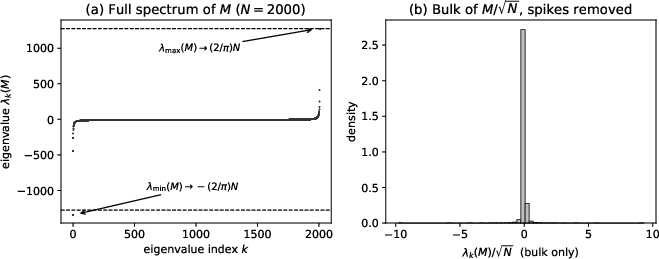
Numerical diagonalization of M reveals that, as H=NbM+Nση,0 increases, the spectrum splits sharply into:
An H=NbM+Nση,1 dimensional bulk of order H=NbM+Nση,2,
Two extreme outliers scaling as H=NbM+Nση,3, H=NbM+Nση,4.
Figure 1: The left panel shows the full eigenvalue spectrum for H=NbM+Nση,5 with H=NbM+Nση,6, highlighting two eigenvalues detached near H=NbM+Nση,7; the right panel presents the histogram of the remaining bulk eigenvalues, rescaled by H=NbM+Nση,8.
These observations motivate a mapping to operator theory: under continuum limits, the scaling and distribution of eigenvalues of H=NbM+Nση,9 are governed by the singular values of the Volterra (cumulative-sum) integral operator Mij=Zmax(i,j)0 acting on Mij=Zmax(i,j)1. Specifically, the spectral problem reduces to a classical Sturm–Liouville problem whose solution gives
Mij=Zmax(i,j)2
This spectrum is compact, discrete, and accumulates only at zero. Consequently, the full edge spectrum of Mij=Zmax(i,j)3 converges numerically (within 1% for the top 20 eigenvalues) to the Mij=Zmax(i,j)4 singular values.
Hierarchy of BBP Transitions: Operator-Theoretic Extension
In classical BBP theory, a single finite-rank perturbation can induce a phase transition, causing the top eigenvalue to detach from the semicircular bulk and develop Gaussian rather than Tracy–Widom fluctuations. Here, in contrast, each singular value Mij=Zmax(i,j)5 defines an independent BBP transition, leading to an infinite and evenly spaced sequence of critical points:
Mij=Zmax(i,j)6
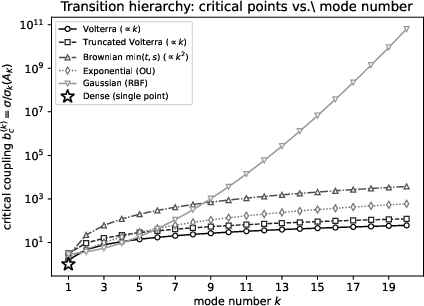
Figure 2: Hierarchies of critical coupling Mij=Zmax(i,j)7 for several kernel types; for the Volterra kernel, the hierarchy grows linearly in Mij=Zmax(i,j)8 due to the singular value decay.
As Mij=Zmax(i,j)9 surpasses Zj0, the Zj1-th eigenvalue detaches from the bulk, converging to
Zj2
while the bulk remains pinned to the semicircle edge Zj3. The width of each transition region around Zj4 is Zj5 at finite Zj6, and the universal random-matrix-to-deterministic crossover is described by Bloemendal–Virág scaling.
Generalization to Arbitrary Delocalized Kernels
The mechanism generalizes to any sufficiently delocalized compact kernel Zj7, with Zj8. The critical hierarchy becomes
Zj9
where ηij0 are singular values of the associated integral operator ηij1. The behavior holds for kernels such as the dense kernel (ηij2), banded kernels, and self-adjoint kernels (e.g., Brownian-motion kernel ηij3), with spacing and growth rate of ηij4 set by whether ηij5 is trace class. For the dense kernel, only a finite rank (here, rank 2) BBP transition occurs; for trace class kernels (e.g., Brownian-motion), ηij6 grows quadratically, leading to slower accumulation of outliers.
Numerical and Analytic Verification
The convergence of ηij7's extreme eigenvalues to the deterministic ηij8 is supported by direct diagonalization across kernel types and by matching higher trace moments to closed-form analytic expressions involving ηij9 and Bernoulli numbers. The cascade persists for kernels lacking closed-form spectra (e.g., Ornstein–Uhlenbeck, Gaussian/RBF), up to subpercent error.
Implications and Theoretical Perspective
This joint random matrix/operator-theoretic result signifies that, for delocalized compact perturbations, random matrix spectra encode the singular value structure of their generators through an infinite sequence of critical transitions. This operator-level BBP extension provides a framework for understanding intricate transitions in covariance estimation, signal detection, inference, and neural network spectral theory, where the underlying covariance can be described by a structured, possibly continuous operator.
Practically, this mechanism implies analytic tractability for the emergence of multiple isolated eigenvalues—beyond single-spike theory—in high-dimensional systems. The dependence of the outlier growth and detachment rates on kernel delocalization and trace class properties suggests that inference procedures, such as principal components analysis, may have very different thresholds and fluctuation behaviors in systems with structured noise or hidden-factor models.
Conclusion
The analysis of the correlated Wigner matrix ensemble with Volterra-type dependencies demonstrates a cascade of BBP transitions corresponding to the singular values of a compact operator, establishing an operator-theoretic underpinning for the sequential emergence of outlier eigenvalues. This extends classical finite-rank perturbation theory to encompass structure-rich, high-rank, yet operator-compact deformations, and supports the conjecture that such cascades—structured by the compact spectrum—are universal across a broad class of delocalized kernels. Future work should address rigorous probabilistic proofs and examine theoretical consequences for statistics, learning, and high-dimensional phenomena.
Reference: "A Cascade of Volterra-Operator BBP Transitions in a Correlated Wigner Matrix" (2607.10503)