- The paper introduces a categorical framework that lifts static graph invariants to dynamic, temporal analogues via structured decompositions.
- It models time-varying data as persistent narratives using spined sd-categories, ensuring invariant widths are tracked across time slices.
- Results confirm that temporal decompositions recover classical invariants and provide new insights into dynamic graph algorithmics.
Structured Decompositions of Time-Varying Data: Categorical Lifting of Graph Parameters
Introduction and Motivation
The paper "Decomposing time-varying data into simple pieces: structured decompositions of narratives" (2607.10442) presents a foundational framework for decomposing time-varying combinatorial data—specifically, temporal graphs—via a systematic, categorical procedure. The approach is grounded in the intersection of structured decompositions (generalizing tree-decompositions within applied category theory) and persistent narratives (sheaf-theoretic models of time-indexed data). This construction enables a principled, compositional treatment of dynamic objects, facilitating the extension of classical static graph parameters to their temporal counterparts.
The need for such a formalism is underscored by the ubiquity of data streams and networks evolving over discrete time, from social and communication networks to biological and epidemiological systems. While static decompositions and associated width parameters (e.g., tree-width, clique-width) are extensively developed, their appropriate analogues for temporal or time-varying data remain an open and subtle problem space. This work addresses that gap by providing a rigorous categorical mechanism for "lifting" any static decomposition theory to a temporalized version, capturing meaningful temporal analogues of graph invariants.
Theoretical Framework
Persistent Narratives
Time-varying structures are modeled as persistent narratives—diagrams (presheaves) F:Top→C indexed by a discrete time category T (formed from closed, bounded intervals of N0 and inclusions). The essential property of a persistent narrative is that for every "square" of intervals (corresponding to overlapping time windows), the data assignment produces a pullback square in C. Equivalently, persistent narratives are sheaves on T with respect to the Johnstone coverage.
Structured Decompositions and Spined SD-Categories
Structured decompositions extend classical notions such as tree-decompositions into the categorical setting. For a graph J, decompositions are formalized as functors d:∫J→C, where ∫J is the barycentric subdivision (i.e., a category whose objects are graph elements and edges), mapping each arrow to a monomorphism in C.
A spined sd-category (C,G,Ω) consists of a base category T0, an index class T1 of graph shapes (e.g., trees), and a spine structure T2, where each T3 is a subcategory of T4 closed under isomorphism and satisfying natural categorical closure and covering conditions. The "width" of decomposition is then measured using the T5-size function, which captures, for example, classical tree-width in the case where T6 is the category of graphs.
Temporalization: Lifting Static to Dynamic Theories
A central technical accomplishment is the theorem establishing that, under mild categorical assumptions (finite cocompleteness, existence of suitable adjunctions, pushout stability, etc.), one can consistently define temporalized spined sd-categories T7, where T8 denotes the category of persistent narratives over T9. The construction carefully tracks how object-wise width measures can be lifted to yield temporal analogues, where, crucially, the width at the level of a time-varying object is computed as the maximum (or supremum) over the widths of its "time slices" or snapshots.
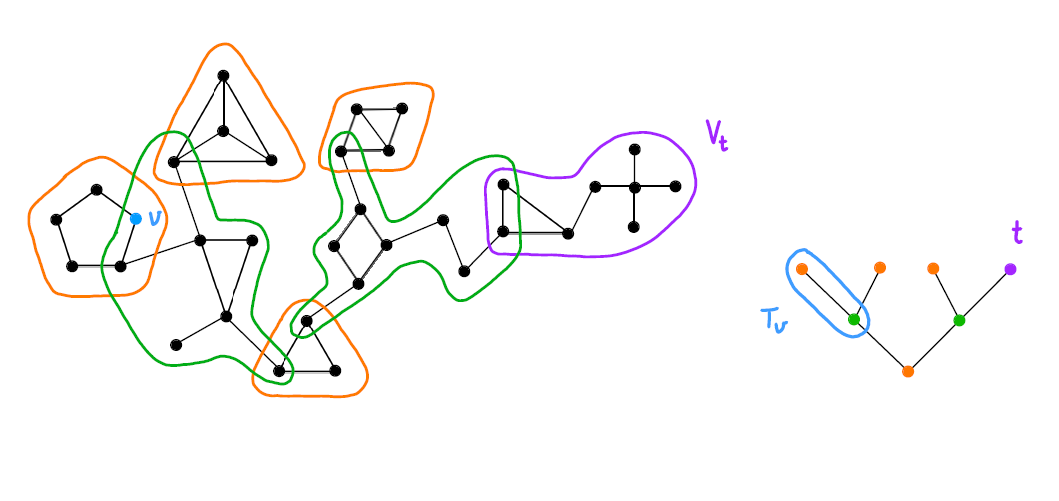
Figure 1: A tree-decomposition of a graph and its decomposition tree, illustrating the local-to-global structure essential for both static and temporal decompositions.
Main Results and Case Studies
The principal theorems provide a functorial method to transfer any static decomposition theory to its temporal version:
- Temporalization Theorem: Given a spined sd-category N00 and a suitable time category N01, the category of persistent narratives inherits the structure of a spined sd-category with a naturally defined temporal spine N02. The width of a temporal object is the pointwise supremum of the widths of the individual time slices.
- Universality: Any static decomposition-based invariant (e.g., tree-width, complemented tree-width, tree-independence number) is shown to admit a temporal extension under this lifting, with the dynamic parameter taking the maximal value over the respective invariants of individual temporal snapshots.
Temporal Tree-Width
For the case of ordinary tree-width, the authors construct the temporalized spined sd-category using the category of reflexive graphs (addressing cocompleteness issues), and show:
N03
with temporalized width defined as the maximal tree-width of the graphs N04 over all N05 in N06. Thus, a temporal decomposition essentially tracks the hardest-to-decompose snapshot.
Complemented Tree-Width and Tree Independence Number
Analogous constructions are provided for complemented tree-width (using complement morphism categories) and the tree independence number, with temporal parameters taking the maximum over the corresponding static parameters at each time point.
This framework thus illustrates how various parameterizations of combinatorial complexity in static graphs can be extended coherently to their temporal versions, without the need for ad hoc adjustments or fragile combinatorial definitions.
Numerical and Structural Claims
- The temporalized width parameters recover the classical (static) invariants when restricted to constant narratives.
- All temporal widths are computed as the maximum over time of the widths of the corresponding static "sections."
- Any temporal decomposition reducing the width at all time-points simultaneously yields an improvement in the global temporal width.
This categorical approach provides a complete transfer principle: every static width measure for decompositions has a temporal analogue with clear structural and computational meaning, and these analogues behave functorially with respect to morphisms and embeddings.
Implications and Future Directions
The results have both theoretical and practical impact for the study of temporal graph algorithmics, logical meta-theorems for time-varying structures, and sheaf-theoretic approaches to complex data. In particular, the identification of the precise way temporal invariants depend on the set of considered intervals N07 allows for nuanced measures (e.g., temporal tree-width over intervals of certain minimal length), giving practitioners fine control over the granularity of the temporal width measurements.
Potential future advances include:
- Extending the cumulative (dual, pushout-based) notion of narrative and understanding its relation to the persistent (pullback-based) construction.
- Clarifying categorical adjunctions between persistent and cumulative formation and their implications for invariants.
- Exploring the embedding and functorial relations between the categories of structured decompositions of persistent narratives and persistent narratives of structured decompositions, as conjectured in the text.
- Applying the formalism to more general kinds of time-varying data (beyond graphs), including hypergraphs, simplicial complexes, and statistical-relational structures.
Conclusion
This work establishes a robust, compositional, and highly general framework for transferring decomposition-based invariants from static to time-varying data. By leveraging categorical tools—especially the machinery of persistent narratives and structured decompositions—it provides a systematic path for temporalizing complexity measures such as width invariants in graphs. The implications for both theoretical graph theory and for the algorithmic analysis of temporal systems are significant, offering a formal baseline for future research and practical applications (2607.10442).