- The paper demonstrates that polyatomic anions, notably NO₃⁻, display measurable Wigner time delays up to 1 fs at shape resonances.
- It employs advanced ab initio methods including R-matrix, TDSE, and RABBIT simulations to accurately model electron-molecule scattering dynamics.
- The study reveals that negligible continuum-continuum delays enable direct extraction of intrinsic photoelectron delays, refining attosecond experimental techniques.
Measurability of Wigner Time Delays at Shape Resonances in Photodetachment of Polyatomic Anions
Introduction and Motivation
This paper delivers a rigorous ab initio theoretical analysis of time delays in electron photodetachment from polyatomic molecular anions, focusing on the nitrate anion, NO3−. Attosecond laser experiments—particularly those deploying RABBIT (Reconstruction of Attosecond Beating By Interference of Two-photon transitions) and streaking techniques—can in principle measure the energy dependence of scattering phase shifts, hence quantifying Wigner (Eisenbud-Wigner-Smith) time delays. However, in conventional atomic/molecular cations, strong long-range Coulomb fields dominate low-energy electron dynamics, introducing continuum-continuum delays that obscure the intrinsic single-photon (Wigner) delay. Anionic photodetachment circumvents this problem—absence of a residual Coulomb tail yields the prospect of directly accessing Wigner delays and corresponding ultrafast electron-molecule scattering dynamics, especially around shape resonances.
The paper proceeds with a systematic comparison between simple atomic anions (H− and Cl−) and the polyatomic NO3−, analyzing valence and K-shell (N 1s, O 1s) detachment with both time-independent and time-dependent (TDSE/RMT) methods. Theoretical modeling establishes the angular and energetic dependence of observable delays in both laboratory and molecular frames, also simulating all relevant pump-probe spectroscopies. The implications extend to benchmarking experimental strategies for observing attosecond time delays in polyatomic anions.
Theoretical Framework
The photodetachment process is modeled via close-coupling multielectron approaches, using UKRmol+, ePolyScat, and complex Kohn implementations. The R-matrix formalism in the fixed-nuclei approximation, with accurate Gaussian and B-spline basis representations, enables calculation of both dipole matrix elements and scattering states.
Single-photon Wigner time delays are computed as the energy derivative of the complex dipole transition amplitude. Two-photon (RABBIT) delays are evaluated both perturbatively and by explicit TDSE propagation using RMT, simulating experimental observable signals and extracting delays via Fourier analysis of sideband oscillation phases. Transformation to the laboratory frame involves orientation-averaging of laboratory-fixed observables. Both valence and core transitions are analyzed using channel-resolved and coupled-channel models.
Atomic Case Studies: H− and Cl−
The photodetachment of H− (1s2) constitutes the reference case—single partial wave (p0) dominates, resulting in analytically trivial (angle-independent) Wigner and RABBIT delays for energies above a few eV. All methods and Born approximation results agree: continuum-continuum phases are constant, so measured RABBIT delays reproduce intrinsic single-photon delay except for non-universal, minor corrections below ∼5 eV.
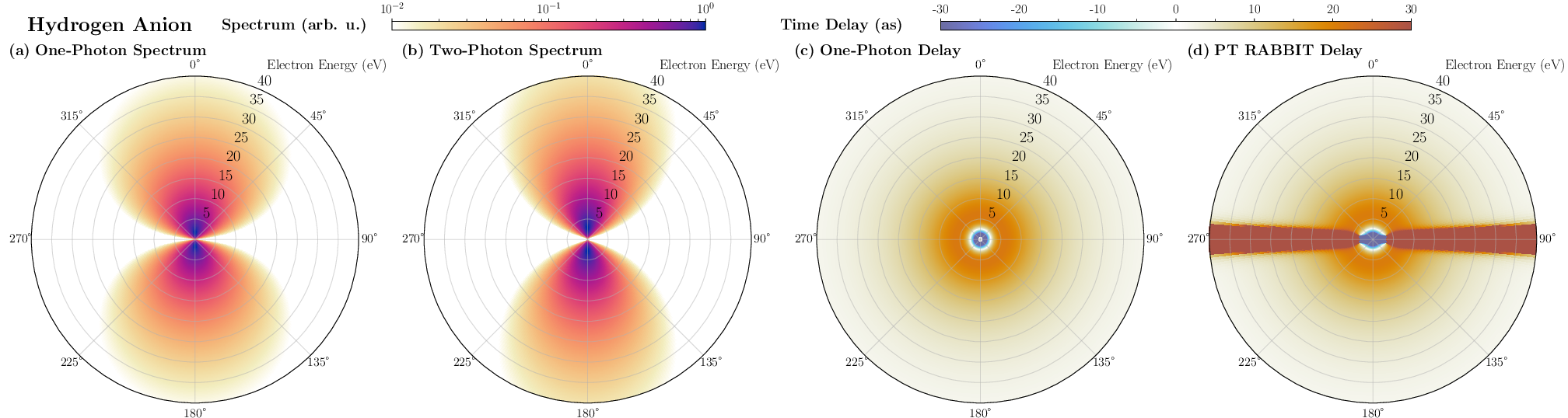
Figure 1: Polar and energy dependence of one- and two-photon photodetachment yields and delays for H−0. The RABBIT time delay as a function of angle and energy demonstrates near isotropy and one-to-one correspondence with Wigner delays above −15 eV.
In contrast, Cl−2 (−3) photodetachment features interference between −4 and −5 angular momentum channels, yielding strong angular structure and pronounced Cooper minima in energy-dependence. Here, Wigner and RABBIT delays are no longer generally identical; the angular dependence of the observable delay reflects coherence and geometric factors from multiple partial waves.
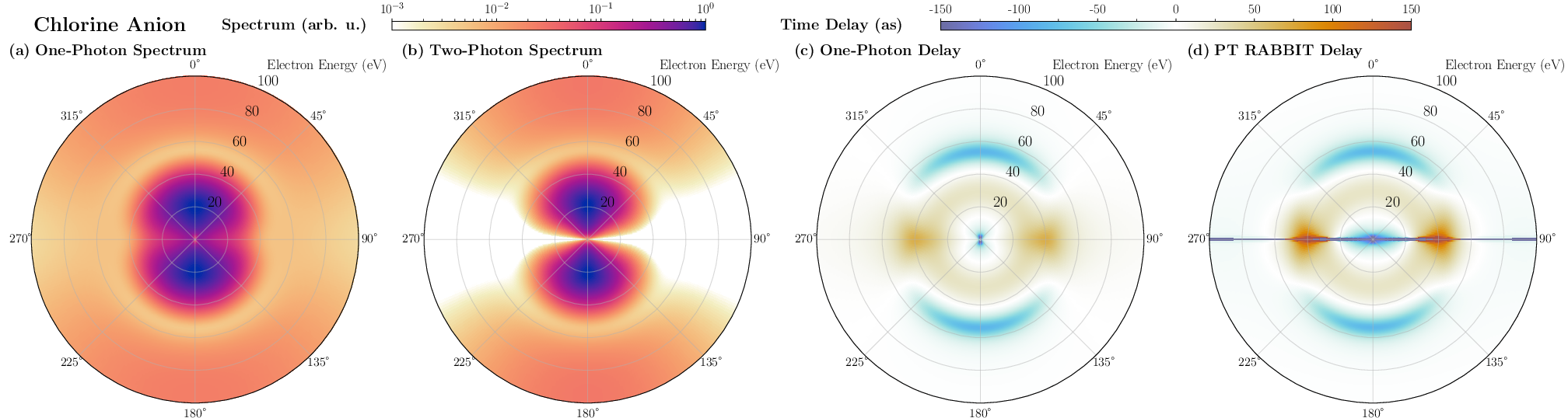
Figure 2: For Cl−6 photodetachment, multiple interfering partial waves lead to pronounced angular and energetic structure in both the yield and measured delay, with strong deviations between single-photon and RABBIT delays except along the polarization direction.
These atomic models provide a baseline for interpreting the molecular anion results.
Valence Photodetachment of NO−7
Photodetachment from NO−8 is characterized by two dominant shape resonances:
- Narrow −9 (−0-symmetry) resonance at −15.5 eV,
- Broader higher-lying (−2-symmetry) resonance at −323 eV.
Interchannel coupling modifies resonance positions and widths, illustrated by coupled-channel complex Kohn calculations using correlated MCSCF and HF representations. Both types of resonances manifest large Wigner delays (up to 1 fs for the low-energy resonance), directly reflecting the lifetimes of electron trapping in centrifugal barriers.
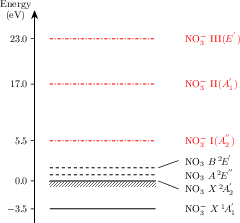
Figure 3: Energy diagram for NO−4 valence photodetachment, illustrating detachment thresholds and associated shape resonances, with schematic indication of dominant resonant channels.
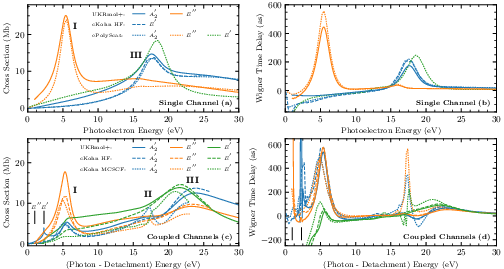
Figure 4: Integrated orientation-averaged cross sections and Wigner time delays for detachment into the three lowest states of NO−5, showing strong delays at shape resonances.
The calculated orientation-averaged (laboratory-frame) delays reveal that, except for emission directions nearly perpendicular to the polarization, the measured two-photon (RABBIT) delays coincide with Wigner delays for all practical experimental geometries and energies above −65 eV. Interference between competing angular momentum channels does introduce significant angular dependence in the measured delay for off-axis directions, but not along the polarization vector.
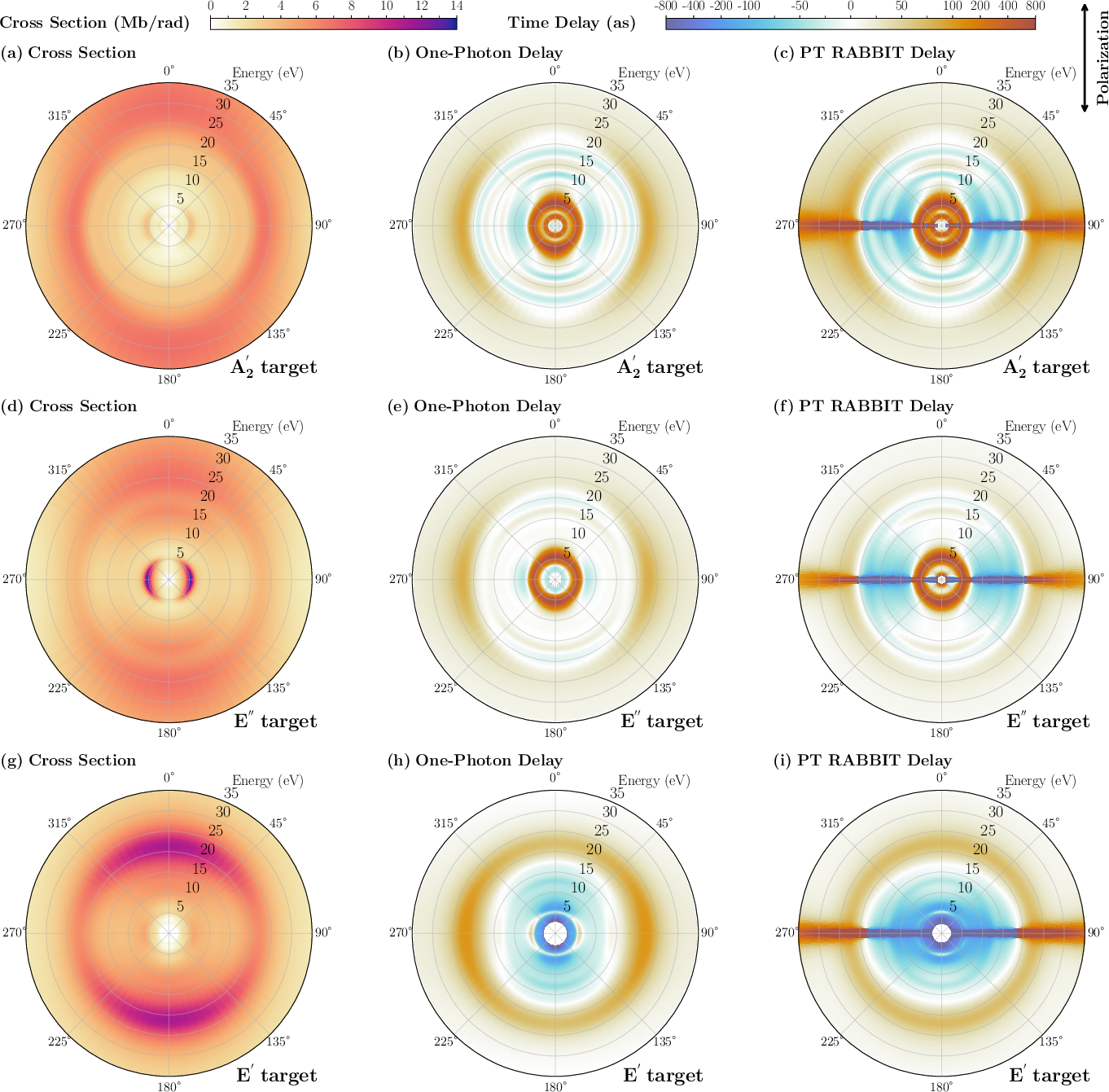
Figure 5: Energy- and angle-resolved one-photon and RABBIT time delays for NO−7 valence detachment in the laboratory frame; large delays at resonances correspond to directions parallel to the polarization.
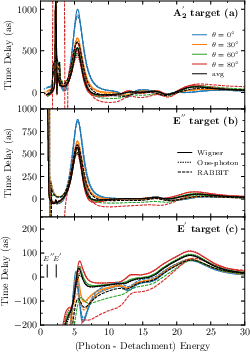
Figure 6: Comparison of Wigner, finite-difference one-photon, and full RABBIT delays at varying emission angles, confirming agreement along the polarization and growing deviations at larger angles.
TDSE-based simulations confirm these findings: measured RABBIT and streaking delays are in quantitative accord with time-independent Wigner delays for electrons emitted close to the polarization axis and above the low-energy threshold (−85 eV). Large, direct delays at shape resonances will thus be accessible to experiment in anion beams or traps if sufficiently high densities are achieved.
Core Photodetachment: N and O 1s Electrons
Core photodetachment from N 1s and O 1s in NO−9 yields new, sharp shape resonances (again associated with centrifugal barriers in the outgoing channel) at 3–7 eV above threshold, with large corresponding Wigner delays (0.5–1.6 fs for N 1s, 0.3–0.9 fs for O 1s depending on the employed orbital set and correlation treatment).
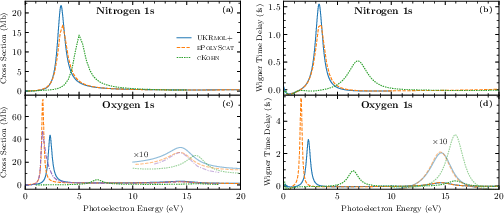
Figure 7: Laboratory-frame, target-state-averaged Wigner time delays for nitrogen and oxygen 1s photodetachment, demonstrating long trapping times at shape resonances.
For the nitrogen K-edge, emission occurs almost entirely via a single continuum partial wave, so RABBIT and Wigner delays are essentially identical for all directions and energies (see angular lineouts in Figure 8). The O 1s case is more intricate, with multiple partial waves and noticeable angular structure in the measured delay, but the observable RABBIT delay along the polarization direction still directly reflects the intrinsic Wigner delay.
Experimental Implications
The theoretical results indicate that (i) shape resonance delays in anion photodetachment, on the order of hundreds of attoseconds to femtoseconds, are directly measurable by attosecond pump-probe (streaking or RABBIT) spectroscopy, and (ii) auxiliary continuum-continuum delays that complicate analysis in cationic photoionization are negligible above 5 eV in polyatomic anions. Attosecond K-edge photodetachment using X-ray free-electron lasers is experimentally attractive: self-referencing is possible by utilizing the nearly instantaneous delay (~0) from N 1s as a benchmark for measuring long, resonance-induced delays from O 1s detachment.
The current bottleneck is producing polyatomic anions at sufficient density for ultrafast spectroscopy—demonstrated for small anions but challenging for larger polyatomic species. Nevertheless, the nitrate anion exhibits highly favorable energetic structure for benchmarking the technique.
Theoretical and Practical Outlook
The results provide a rigorous foundation for interpreting measured time delays in future anion photodetachment experiments. From the perspective of quantum scattering theory, they verify that (in the absence of long-range Coulomb terms) the energy derivative of dipole matrix elements—evaluated at the detachment threshold and along the polarization vector—directly probes the attosecond electron-molecule scattering dynamics around shape resonances. These measurements can thus benchmark ab initio descriptions of electron correlation and molecular structure.
Practically, these findings suggest that valence and K-shell detachment from polyatomic anions constitute ideal systems for clean attosecond dynamics studies. The minimal influence of field-induced and continuum-continuum phases simplifies extraction of state- and angle-resolved time delays. Future work may focus on refining correlated wavefunction treatments, accounting for nuclear motion, and extending time-dependent simulations for higher-fidelity modeling of realistic pump-probe pulse shapes.
Conclusion
The paper conclusively demonstrates that, for polyatomic anions with shape-resonant structure—exemplified by NO3−0—Wigner time delays of up to one femtosecond can be directly observed via attosecond pump-probe methods. In the absence of long-range Coulomb potentials, the experimentally measured (RABBIT/streaking) delays access the true molecular scattering time with negligible contamination from continuum-continuum effects. This sets the stage for detailed, time-resolved studies of electron-molecule scattering and correlation phenomena in polyatomic anions in the attosecond regime.