- The paper demonstrates that itinerant electrons in honeycomb lattices can exhibit sublattice-resolved orbital order, including OFM, OAFM, and OFiM phases.
- It employs both standard and modified Haldane models along with analytical low-energy theory and Chebyshev polynomial numerical methods to probe orbital magnetization.
- The results indicate tunable orbital magnetization with potential for orbitronic device applications and advances in two-dimensional material design.
Itinerant Orbital Magnetization and Staggered Phases on the Honeycomb Lattice
Introduction
The paper "Staggered orbital magnetization from itinerant electrons: orbital antiferro- and ferrimagnetic phases" (2607.10355) systematically explores the emergence and classification of sublattice-resolved itinerant orbital magnetic orders—ferromagnetic (OFM), antiferromagnetic (OAFM), and ferrimagnetic (OFiM)—within honeycomb-lattice systems described by the standard and modified Haldane models. Through the modern theory of orbital magnetization and advanced real-space numerical techniques, the analysis reveals that orbital magnetic order, typically discussed in connection with net orbital moments or orbital currents, can manifest compensated (staggered) and partially compensated patterns, analogous to spin-based antiferro- and ferrimagnetism, in itinerant electronic systems.
Models: Standard and Modified Haldane Hamiltonians
The study utilizes two minimal two-band lattice models:
- Standard Haldane model: Exhibits a topological phase with Chern insulating behavior due to a complex phase on next-nearest-neighbor (NNN) hopping; this mass term acts as a valley-dependent Dirac mass.
- Modified Haldane model: Differs only in the convention for the complex hopping phase; it produces a valley-dependent energy shift and supports antichiral edge states.
The main structural distinction is in the phase factor νij assigned to NNN hoppings: the standard Haldane convention assigns opposite phases for sublattices A and B, whereas the modified version uses the same phase for both.
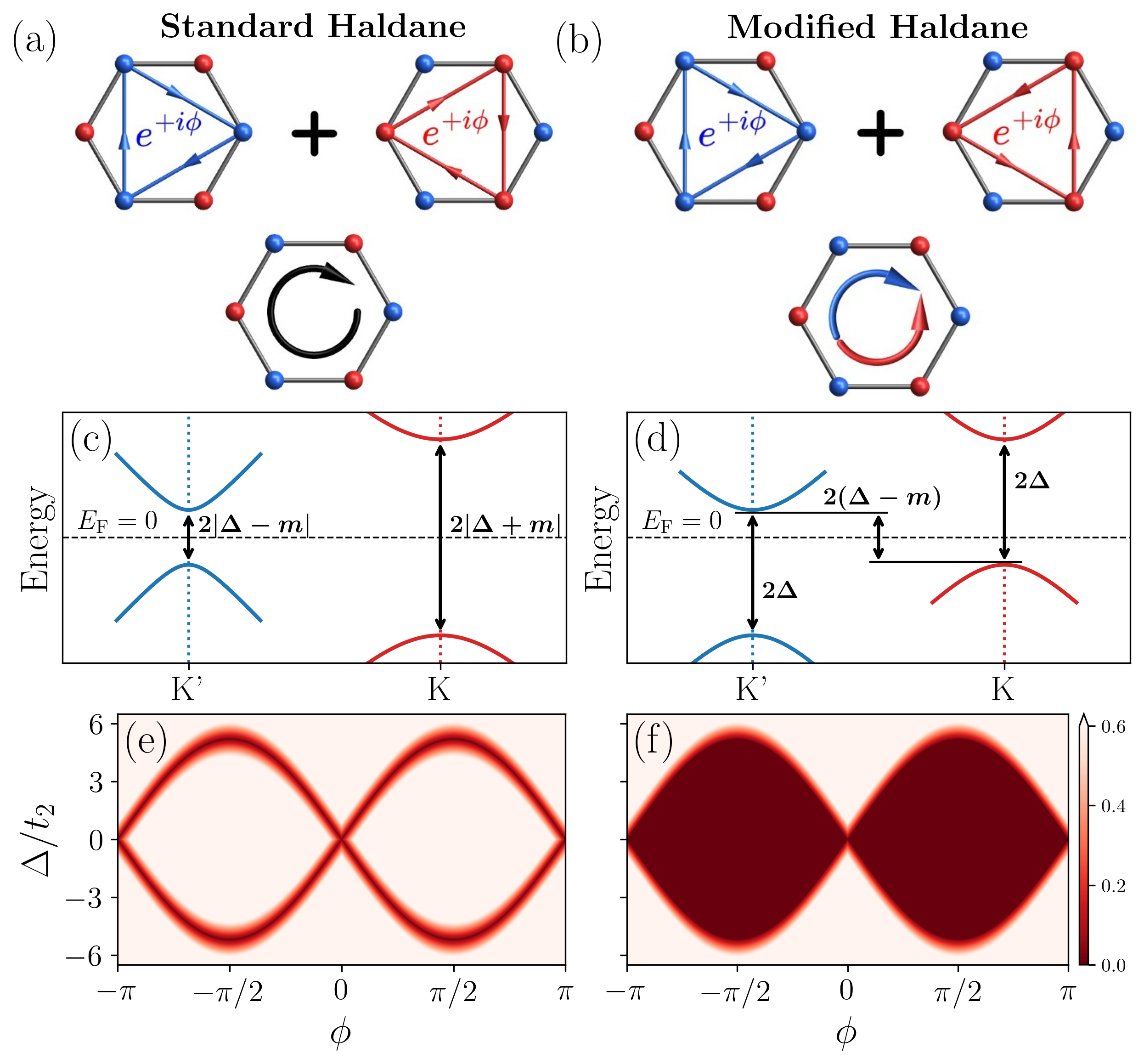
Figure 1: Convention for the complex phase ϕ in the t2 NNN term for (a) standard and (b) modified Haldane models, and the corresponding gap structures over Δ/t2–ϕ parameter space.
The bulk band topology, gap closing transitions, and symmetry operations (P, T, PT) are fully controlled by A0, A1, and A2, which enables tuning between distinct orbital magnetic orders.
Itinerant orbital magnetization is inherently non-local. Unlike atomic orbital moments, its proper description leverages Berry-phase and Fermi-energy contributions via the modern theory of orbital magnetization. The real-space formulation uses sublattice-resolved operators, whose sum (A3) and difference (A4) probe net and staggered orbital order, respectively.
Numerical evaluations are performed with the Chebyshev polynomial spectral method, which allows computation of A5 and A6 for finite systems with full inclusion of bulk and edge contributions.
Phase Diagram: Sublattice-resolved Orbital Magnetization
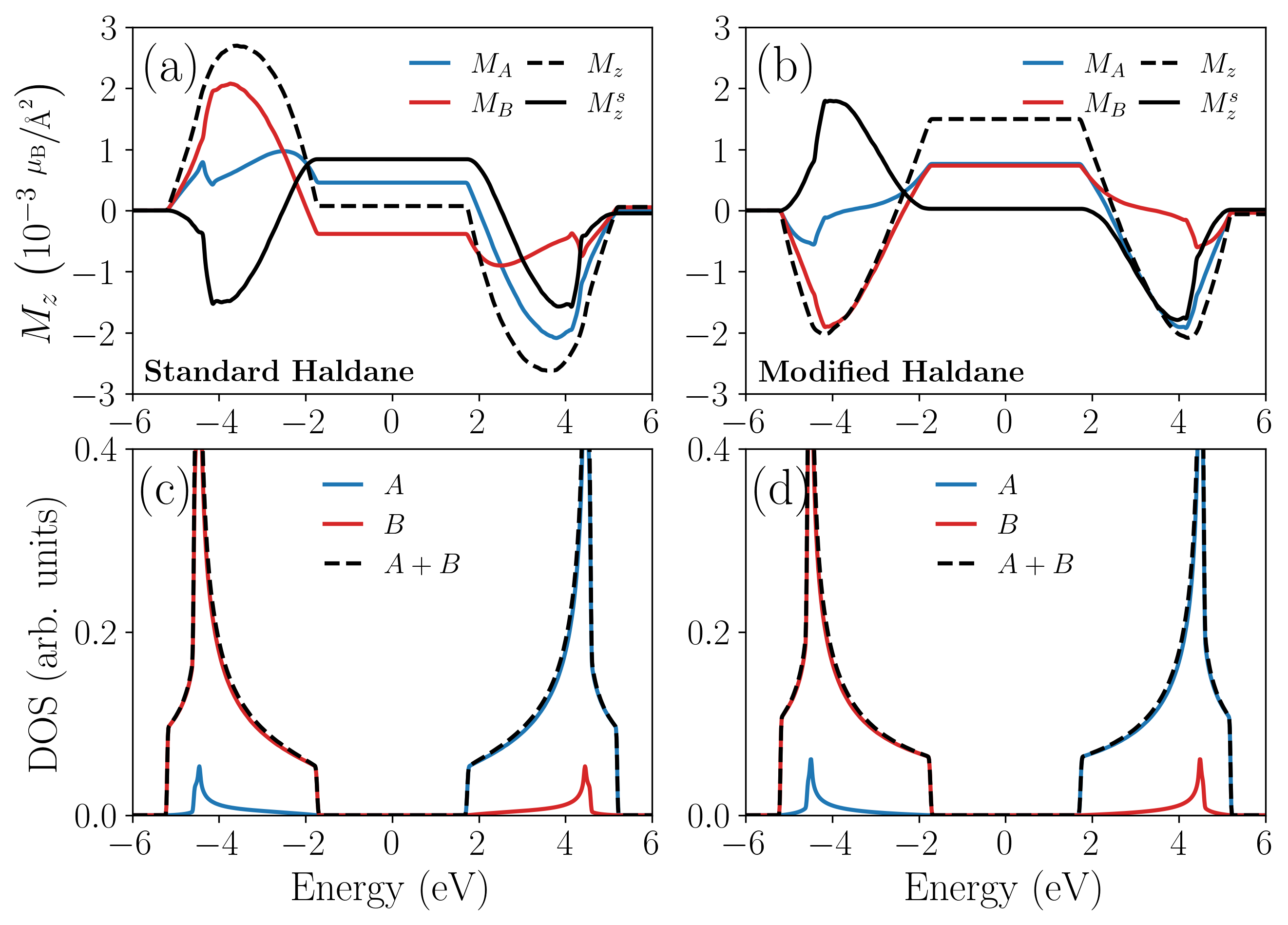
For A7, the orbital order is dictated by the model's symmetry:
- Standard Haldane model: A8 at all Fermi energies, leading to finite A9 (net OFM), B0.
- Modified Haldane model: B1, so B2 (OAFM), B3.
Upon breaking sublattice equivalence (B4), both models exhibit B5, leading to nonzero B6 and B7 (OFiM). This is shown for weak sublattice potentials B8:
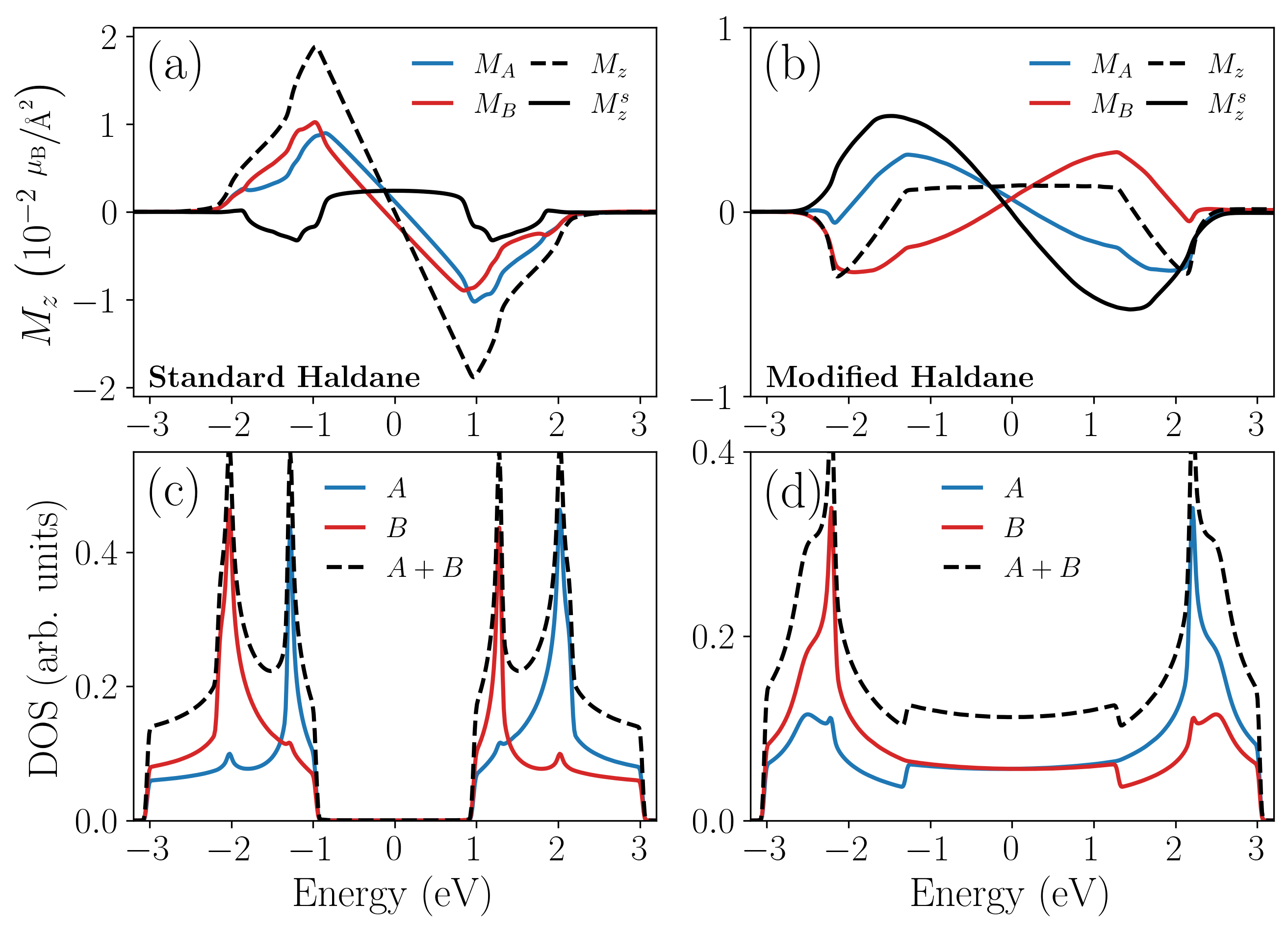
Figure 2: Variation of B9, ϕ0, ϕ1, ϕ2, and DOS with Fermi energy for both models at ϕ3 and ϕ4.
In the regime ϕ5, the orbital character reverses inside the gap:
Theoretical Interpretation: Valley-Dependent Mechanisms
The analytical low-energy theory elucidates the distinct mechanisms behind the observed plateaus:
- In the standard Haldane model, the valley-dependent Dirac mass leads to net Berry curvature-induced orbital magnetization that cancels between valleys in the trivial insulator. However, sublattice projection reveals a finite staggered (t24) response.
- In the modified Haldane model, only valley-dependent energy shifts are present, producing a finite net (t25) orbital magnetization plateau even when the system is trivial and insulating.
Analytical calculations show that, for models with sublattice symmetry and t26, the magnitude of the plateau is t27, where the sign and nature (staggered or net) is dictated by the valley structure inherent to the Hamiltonian.
Symmetry Analysis
Order parameters correlate with symmetry properties:
- OFM: t28, t29; breaks Δ/t20 and Δ/t21, preserves Δ/t22
- OAFM: Δ/t23, Δ/t24; breaks Δ/t25 and Δ/t26, preserves Δ/t27
- OFiM: Δ/t28, Δ/t29; all symmetries broken
The symmetry classification aligns precisely with the low-energy valley analysis, and with the phase mapping of orbital and spin ferro-, antiferro-, and ferrimagnetism.
Density of States and Orbital Magnetization
The density of states (DOS) is systematically linked to the onset and nature of the orbital magnetic order. For metallic regimes with nonzero DOS at the Fermi level, all three types (OFM, OAFM, OFiM) can appear depending on the model and parameter values.
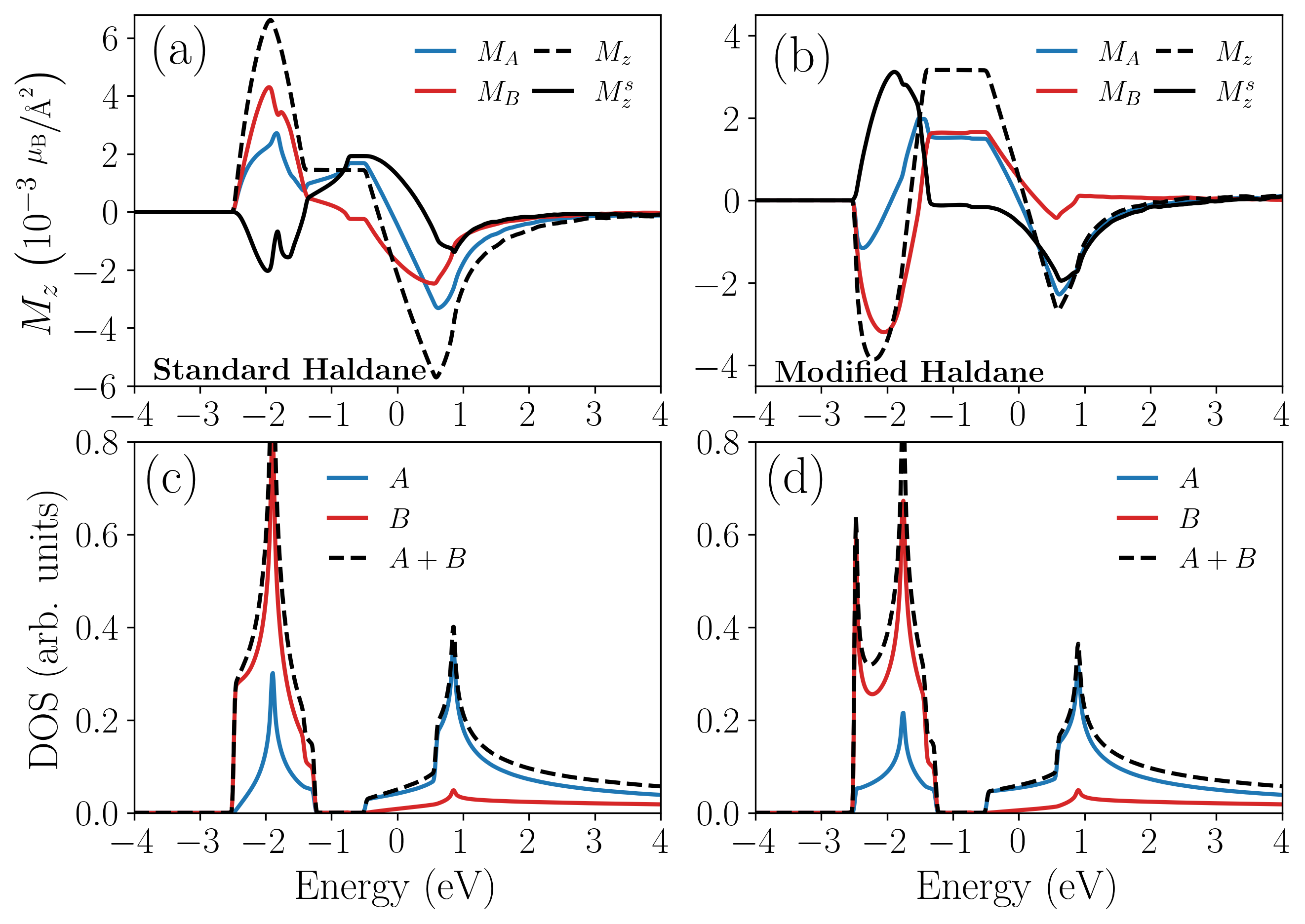
Figure 4: Sublattice and total/staggered orbital magnetization and DOS, demonstrating the interplay between sublattice-resolved responses and spectral characteristics at ϕ0, ϕ1 eV, ϕ2 eV.
Implications and Outlook
These findings demonstrate that itinerant models, without localized atomic moments, can exhibit robust ferro-, antiferro-, and ferrimagnetic orbital order, which can be controlled via sublattice potentials and complex electronic hoppings. The results establish a rigorous framework for classifying and engineering orbital order in multi-sublattice and multi-valley systems, advancing the fundamental understanding of itinerant magnetism beyond the standard spin paradigm.
Practically, these insights have substantial implications for orbitronics: they suggest routes for manipulating and detecting staggered or net orbital angular momentum, impacting potential device architectures where edge currents, orbital torques, or compensated magnetization are desired. Direct applications to systems such as graphene-based heterostructures, engineered photonic lattices, and two-dimensional transition metal dichalcogenides are likely, with further relevance to novel transport and magnetoresistance phenomena.
Theoretically, the equivalence classes mapped out here could inform the design of new materials and artificial lattice systems (e.g., moiré materials, optical lattices) with targeted orbital magnetic responses and tunable symmetry breaking, potentially impacting the ongoing search for altermagnetic, multiferroic, and other unconventional magnetic phases.
Conclusion
The study experimentally and theoretically demonstrates that itinerant, sublattice-resolved orbital magnetization can be tuned to realize analogues of spin ferro-, antiferro-, and ferrimagnetism on the honeycomb lattice. These results generalize the modern theory of orbital magnetization to encompass compensated and partially compensated itinerant order and provide a foundation for future work on orbitronic functionalities in multivalley and multi-sublattice materials (2607.10355).