- The paper introduces a geometric optimization framework to derive explicit formulas for the unique minimum of geodesic length functions.
- The paper employs fat graph combinatorics and hyperbolic trigonometry to characterize triangle and Bolza-type surface minimizers.
- The paper extends Kerckhoff's theorem to non-uniform fillings, bypassing complex algebraic machinery and enhancing numerical evaluation.
Introduction
This paper provides an in-depth analysis of the minimal values of geodesic length functions associated with filling curve systems on closed orientable surfaces of genus g≥2, with a particular emphasis on non-uniform fillings. The work supplements and, in some settings, simplifies prior results on uniform fillings by circumventing the extensive machinery of dessins d'enfants and Grothendieck-Belyi theory. Instead, the authors leverage geometric combinatorics of fat graphs and explicit hyperbolic optimization techniques to determine both the minimal loci and the actual minimal values of these length functions. The core technical finding is that for certain prominent classes of non-uniform fillings, the geodesic length function achieves its unique minimum at special triangle or Bolza-like surfaces, with closed-form formulas given.
Preliminaries: Fillings, Geodesic Length Functions, and the Teichmüller Setting
Let Sg be a closed orientable surface of genus g≥2, and Ω={γ1,…,γd} a collection of pairwise non-homotopic simple closed curves with minimal intersection such that Sg∖Ω is a union of topological discs. The complementary regions correspond to polygons under the uniformization theorem. For such fillings, the geodesic length function ℓΩ assigns to each marked hyperbolic structure in Teichmüller space the sum of geodesic representatives of the curves in Ω.
Kerckhoff's theorem ensures that the function ℓΩ attains a unique minimum in Teichmüller space, even in the non-uniform case. Classic works established strict convexity and uniqueness in the uniform case, where all complementary regions are regular n-gons. The non-uniform scenario, where polygonal types vary, presents deeper combinatorial and geometric complexity.
The technical machinery draws on explicit hyperbolic trigonometry for polygons, the Gauss–Bonnet area constraint, and combinatorial models using fat graphs encoding the surface and its decomposition.
Optimization Principles and Analytical Framework
A primary technical device is the identification of the minimum perimeter realization for a sequence of hyperbolic polygons given constraints on the sum of their angles, leveraging (generalized) Lagrange multipliers. The optimality criteria demonstrate that, within each combinatorial type, a sum of perimeters is minimized if and only if the corresponding polygons are regular and, when required, supplementary.
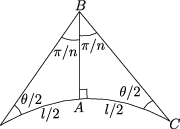
Figure 1: A hyperbolic triangle sector, foundational to perimeter computations used in the optimization of filling length.
Explicit perimeter formulas for regular hyperbolic n-gons in terms of the interior angles are pivotal in deriving closed expressions for the extrema. The combinatorial structure of the fillings is encoded in fat graphs, which track the incidence and combinatorics of the decomposition.
Type I: Triply Bordered Decomposition
The authors construct a prominent family of non-uniform fillings—denoted Sg0—where Sg1 consists of three polygons: two Sg2-gons and one Sg3-gon. This is combinatorially encoded in a 4-regular fat graph, with precise cycle decompositions and vertex/edge structures given. The minimal length of such a filling is achieved when the component polygons are regular and their side lengths match, thereby imposing a transcendental equation for the common angle via hyperbolic trigonometry:
Sg4
The total minimal length is then given by
Sg5
with equality if and only if the hyperbolic surface is the triangle surface of type Sg6, supporting a cyclic automorphism of maximal order Sg7.
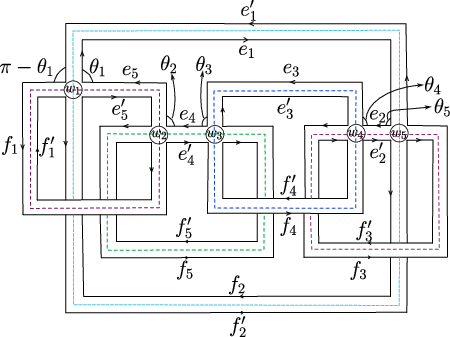
Figure 2: Fat graph, annotating the combinatorial and geometric data underlying a non-uniform filling.

Figure 3: The explicit three-boundary decomposition corresponding to the triply non-uniform case.
Type II: Quadrilaterals and Large Polygons
A second family, denoted Sg8, yields a decomposition into Sg9 quadrilaterals and two g≥20-gons. The side-pairing restrictions again force regularity, but with a different angle equation:
g≥21
and the minimal length is
g≥22
The minimum is uniquely realized on a Bolza-like surface, i.e., the hyperbolic surface with automorphism group of order g≥23, coinciding with the classical Bolza surface for g≥24.

Figure 4: Local fat graph structure, exhibiting how local angles propagate into global hyperbolic polygons for the minimization.

Figure 5: The six-boundary realization for genus g≥25, illustrating the decomposition corresponding to g≥26.
The primary results are sharp and explicit:
- For the g≥27 case, the minimal geodesic length is given above, achieved precisely when the surface is the triangle surface with cyclic automorphism of order g≥28.
- For the g≥29 case, the minimal geodesic length is as above, realized at Bolza-like surfaces.
- In both cases, the minima are attained at highly symmetric, explicitly constructed surfaces, determined by the unique solution to the angle system imposed by combinatorial regularity and polygon side-matching.
These findings—explicitly validating and extending the Kerckhoff uniqueness result—demonstrate that, even in non-uniform cases, the minimum of the geodesic length function for natural combinatorial filling systems is realized on surfaces of maximal symmetry. The explicit angle equations and length formulas permit numerical evaluation for arbitrary genus.
Implications and Further Directions
From a theoretical perspective, this work demonstrates that the global structure of Teichmüller space, as encoded in geodesic length functions for non-uniform fillings, retains the unique-minima property, with the minimizers being essentially "triangle" or "Bolza-type" Riemann surfaces for a wide collection of combinatorial types. The explicit optimization framework presented can be generalized to other fat graph decompositions and suggests a framework for the analysis of more complicated non-uniform cases.
In moduli space, surfaces minimizing the geodesic length functions for fillings are natural candidates for extremal objects with large automorphism groups, connecting to the theory of maximally symmetric Riemann surfaces and to the study of hyperbolic polygons with isoperimetric constraints. These results have ramifications for the calculation of systolic invariants, study of the Thurston spine, and stratification of moduli space by extremal properties.
The explicit minimization and construction provide a template for approaches in other moduli-theoretic optimization problems where algebraic and combinatorial data must be matched to concrete geometric realization.
Conclusion
This paper establishes definitive, closed-form results for the location and value of the minimal geodesic length function for key classes of non-uniform fillings of closed surfaces, demonstrating that the minima are achieved on maximally symmetric surfaces with explicitly described geometric and combinatorial structure. The analysis combines fat graph combinatorics, hyperbolic geometry, and convexity optimization to bypass heavy algebraic machinery, thereby enhancing both the accessibility and precision of minima computations in Teichmüller theory. The techniques and results open further directions for the study of geometric optimization over moduli spaces and for embedding combinatorial surface structures into hyperbolic geometry.
(2607.10344)