Interwoven long-range order induced by random fields
Abstract: We propose a distinct type of long-range ordered phase that can occur in classical and quantum many-particle systems. It is induced by impurities and defects that locally break a subset of the order-parameter symmetries, i.e., by random-field disorder that couples to a composite vestigial order parameter. The proposed ``implectic'' phase is characterized by spontaneous symmetry breaking on the background of the spatially interwoven domain structure created by the random fields. We explicitly demonstrate the existence of this phase in a layered J1−J2 Ising magnet by means of large-scale Monte Carlo simulations. We then discuss numerous potential applications in systems featuring charge and spin density wave order including frustrated magnets, cuprate and iron-based superconductors, and ultracold atoms.
- Fluctuation-induced spin nematic order in magnetic charge-ice (2023)
- Stripe order, impurities, and symmetry breaking in a diluted frustrated magnet (2021)
- Higher-order topological quantum paramagnets (2021)
- The phase diagram of a frustrated Heisenberg model: from disorder to order and back again (2021)
- Long-range order induced by random fields in two-dimensional O(n) models, and the Imry-Ma state (2019)
- Destruction of long-range order in non-collinear two-dimensional antiferromagnets by random-bond disorder (2019)
- Random-Singlet Phase in Disordered Two-Dimensional Quantum Magnets (2018)
- Tuning a random field mechanism in a frustrated magnet (2018)
- Random-field-induced disordering mechanism in a disordered ferromagnet: Between the Imry-Ma and the standard disordering mechanism (2017)
- A Mechanism of Long-Range Order Induced by Random Local Fields: Effective Anisotropy Created by Defects (2016)
Summary
- The paper introduces the implectic phase, where composite random-field disorder induces coexistence of interwoven x- and y-stripe orders.
- It employs a layered J1-J2 Ising model with Monte Carlo simulations to reveal sharp thermal transitions and percolating domain networks.
- Results clarify how domain-induced symmetry breaking reconciles local disorder with global order, offering insights for high-Tc cuprates and iron pnictides.
Interwoven Long-Range Order Induced by Random Fields
Introduction and Theoretical Framework
"Interwoven long-range order induced by random fields" (2607.10337) presents a theoretical and computational study of a novel long-range ordered phase—termed the implectic phase—arising in the presence of specific random-field disorder in many-body systems. The disorder considered couples not to the primary order parameter but to a composite vestigial order parameter. The work leverages and extends symmetry-based classifications, as well as Imry-Ma/Aizenman-Wehr disorder arguments, focusing on three-dimensional systems where standard wisdom posits the destruction of long-range order at strong random field via domain formation.
Central to the work is the identification that for multi-symmetry-breaking order parameters, disorder can selectively break real-space symmetries locally, leading to composite domains. In three dimensions, these domains can percolate and themselves undergo sharp symmetry-breaking transitions for the remaining parameters, resulting in coexisting long-range order that is globally disorder-configurationally interwoven.
Prototypical Model: J1-J2 Layered Ising Magnet
The main platform is the layered J1-J2 Ising model on a cubic lattice, with Hamiltonian
H0=−J1⟨ij⟩∑SiSj−J2⟨⟨ij⟩⟩∑SiSj−J⊥⟨ij⟩⊥∑SiSj,
where Si=±1 and J1>0 (ferromagnetic nearest-neighbor), J2<0 (antiferromagnetic next-nearest-neighbor), and J⊥>0 (interlayer). For ∣J2∣/J1>1/2, the ground state spontaneously breaks both Ising and J20 lattice rotation symmetry, resulting in stripe order—stripes can be oriented along J21 or J22.
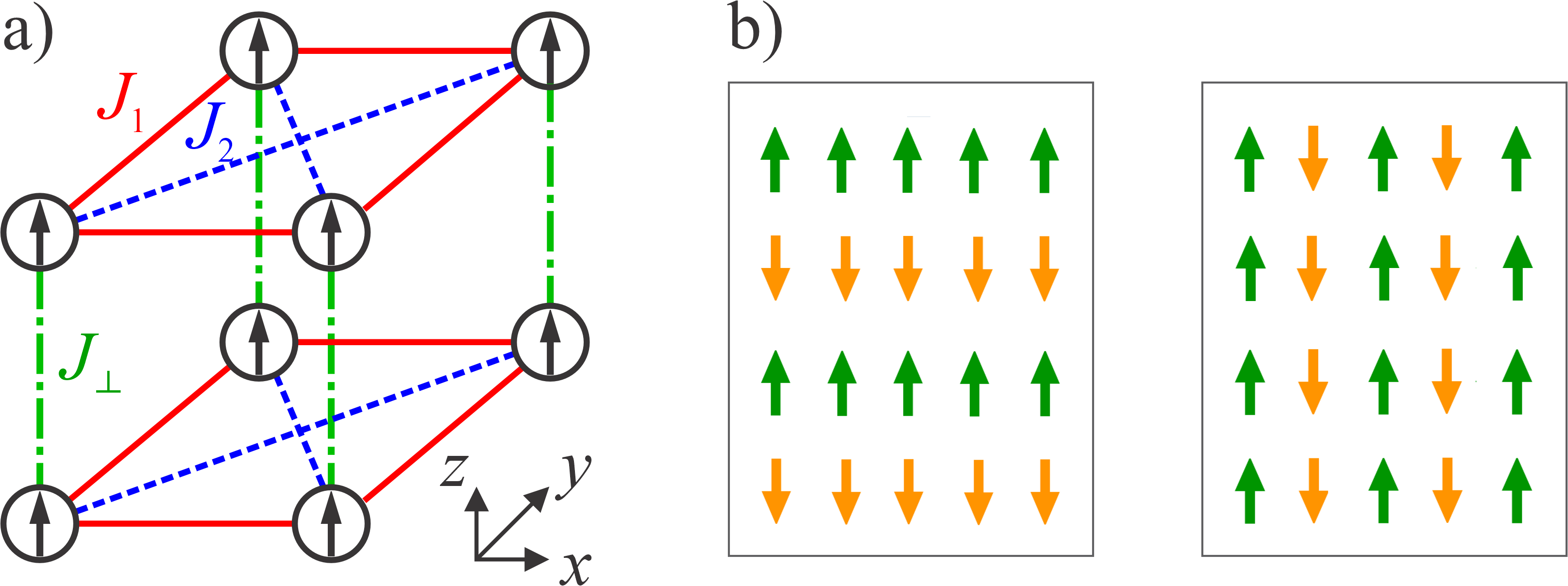
Figure 1: (a) Couplings in the layered J23-J24 model. (b) Schematic of the stripe order in the J25 plane with orientation degeneracy for J26.
Stripe order is described by the two-component vector order parameter J27, which distinguishes the two degenerate stripe orientations. The vestigial nematic order parameter J28 captures breaking of the J29 symmetry independent of spin order.
Upon the introduction of a random field J10 coupling locally to the nematic order parameter, the system's Hamiltonian becomes
J11
This type of quenched disorder arises naturally in real systems via strain, site dilution, or defects creating local lattice anisotropy, distinguishing it fundamentally from random-field Ising models that couple directly to the magnetic order.
Monte Carlo Results and Characterization of the Implectic Phase
Behavior Without Random Field
Simulations at J12 demonstrate a conventional phase transition into uniform stripe order at J13, signaled by the nematic order parameter and the Binder cumulant.
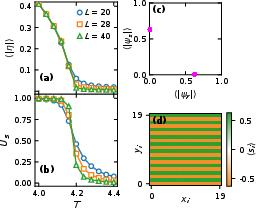
Figure 2: (a) Nematic order parameter and (b) stripe Binder cumulant versus temperature for various system sizes. (c) J14 vs. J15 for individual samples at J16, with each sample aligned along J17 or J18, but not both. (d) Local magnetization profile.
The histogram in Figure 2(c) collapses along pure J19 or J20 axes, with domain formation absent.
Interwoven Phase at Strong Random Field
At strong random field J21, simulations uncover a sharp thermal transition at J22 indicated by the crossing of the average stripe Binder cumulant and divergent stripe susceptibility:
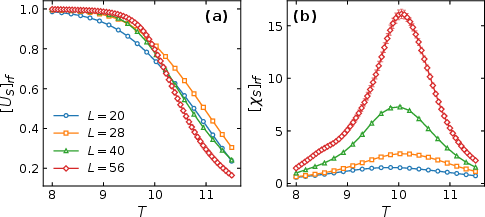
Figure 3: (a) Stripe Binder cumulant J23 and (b) stripe susceptibility J24 versus temperature for J25 and J26.
However, the nematic order parameter is suppressed, and direct spatial maps (Figure 4) show the existence of finite-size nematic domains of characteristic J2710 lattice constants, with the global average vanishing for large J28:
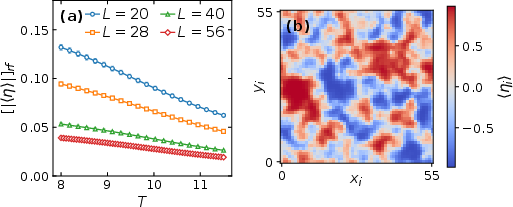
Figure 4: (a) Absence of nematic long-range order: J29 versus H0=−J1⟨ij⟩∑SiSj−J2⟨⟨ij⟩⟩∑SiSj−J⊥⟨ij⟩⊥∑SiSj,0, decaying with increasing H0=−J1⟨ij⟩∑SiSj−J2⟨⟨ij⟩⟩∑SiSj−J⊥⟨ij⟩⊥∑SiSj,1; (b) real-space nematic domain structure in a typical layer.
Strikingly, the joint distribution of H0=−J1⟨ij⟩∑SiSj−J2⟨⟨ij⟩⟩∑SiSj−J⊥⟨ij⟩⊥∑SiSj,2 and H0=−J1⟨ij⟩∑SiSj−J2⟨⟨ij⟩⟩∑SiSj−J⊥⟨ij⟩⊥∑SiSj,3 at low H0=−J1⟨ij⟩∑SiSj−J2⟨⟨ij⟩⟩∑SiSj−J⊥⟨ij⟩⊥∑SiSj,4 (Figure 5) reveals that every disorder realization exhibits coexisting H0=−J1⟨ij⟩∑SiSj−J2⟨⟨ij⟩⟩∑SiSj−J⊥⟨ij⟩⊥∑SiSj,5- and H0=−J1⟨ij⟩∑SiSj−J2⟨⟨ij⟩⟩∑SiSj−J⊥⟨ij⟩⊥∑SiSj,6-stripe order. As H0=−J1⟨ij⟩∑SiSj−J2⟨⟨ij⟩⟩∑SiSj−J⊥⟨ij⟩⊥∑SiSj,7 increases, the points cluster around the bisector H0=−J1⟨ij⟩∑SiSj−J2⟨⟨ij⟩⟩∑SiSj−J⊥⟨ij⟩⊥∑SiSj,8, indicating percolation and coexistence. This is the diagnostic hallmark of the implectic phase.
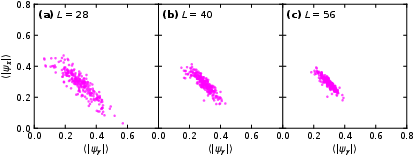
Figure 5: Distribution of H0=−J1⟨ij⟩∑SiSj−J2⟨⟨ij⟩⟩∑SiSj−J⊥⟨ij⟩⊥∑SiSj,9 vs.\ Si=±10 for Si=±11 random-field samples at Si=±12, Si=±13, Si=±14. All samples exhibit simultaneous order in both variables.
Order parameter products and coexistence metrics (Figure 6) quantitatively confirm the emergence of this interwoven order below Si=±15. The coexistence parameter Si=±16 approaches unity for large Si=±17, consistent with a Si=±18 equal mixing of Si=±19 and J1>00 stripe orders.
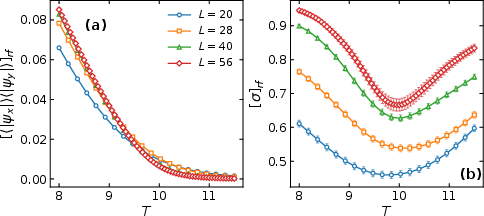
Figure 6: (a) Product J1>01 vs.\ temperature, and (b) coexistence parameter J1>02, both indicating a sharp onset of simultaneous order below J1>03.
Domain Structure and Percolation
The picture emerging is that strong vestigial random field breaks nematic long-range order by forming finite domains, but in three dimensions, domains favoring J1>04 and J1>05 stripes percolate—each forms an interpenetrating network supporting long-range order of the corresponding stripe orientation. The implementation is fundamentally distinct from macroscopic phase coexistence: the symmetry is broken only within percolating subnetworks, not globally, and the system as a whole remains isotropic on average.
Weak random field (J1>06) does not support this architecture: in that case, the system reverts to conventional uniform stripe order, affirming the role of a disorder threshold predicted via Imry-Ma scaling and observed numerically.
Sufficient Conditions and Distinction from Conventional Phases
For the realization of implectic order, three conditions must be fulfilled:
- Quenched disorder must couple to a composite vestigial order: In practice, this often means random fields that break spatial but not time-reversal or other non-geometric symmetries.
- Dimensionality J1>07: Only then can independent percolating domain networks coexist; two dimensions cannot support such mutual spanning.
- Random-field strength must exceed J1>08: Sufficient to nucleate robust domain formation.
The phase diagram thereby involves three possibilities: a conventional stripe state (uniform, both spin and lattice symmetry broken), a paramagnet, and the implectic phase, where Ising symmetry is broken within percolating subnetworks but lattice symmetry remains unbroken globally. No vestigial nematic-only phase is realized in this model.
Experimental and Broader Implications
The physical mechanism uncovered has direct implications for charge and magnetic order in high-J1>09 cuprates, iron pnictides, and other systems characterized by intertwined orders. Many such materials display sharp macroscopic thermodynamic transitions (e.g., signatures of magnetic or charge order) while local probes report disrupted nematicity and nanoscale inhomogeneity—an apparent contradiction naturally resolved by the implectic order scenario.
Specifically, in systems like GdRhInJ2<00, where X-ray data report no global orthorhombic distortion yet magnetic stripes are observed, the phase inferred here provides a symmetry-consistent explanation: domain-level lattice symmetry breaking and interwoven order coexisting with global J2<01 invariance.
The results also open a route to engineering and observing such phases in ultracold atomic gases and provide guidance for interpreting domain-dominated local probe results in correlated electron materials. Detection of implectic order requires both observation of percolating domain structures and measurements establishing sharp transitions in observables tied to the residual symmetry breaking.
Numerical Techniques
The computational advances enabling this analysis include highly parallelized replica-exchange Monte Carlo (parallel tempering) permitting reliable equilibration on large systems with complex energy landscapes. Internal diagnostics (acceptance rates, observable convergence from distinct initial states) confirm equilibrium and accurate sampling of the physical properties in the thermodynamic limit.
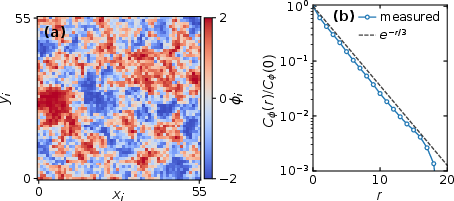
Figure 7: (a) A slice of the constructed correlated random field J2<02 for J2<03, J2<04, exhibits domain structure. (b) The measured radial correlation function agrees with targeted exponential decay.
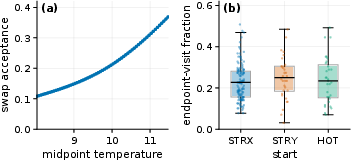
Figure 8: Parallel-tempering diagnostics for J2<05—mean replica swap acceptance (a), and visited temperature-span fractions for different initialization protocols (b) ensure correct sampling.
Conclusion
The work establishes the existence and robust characterization of a disorder-induced interwoven long-range ordered phase, the implectic phase, in the layered J2<06-J2<07 Ising model and, by extension, multi-component order systems under composite random-field disorder (2607.10337).
Key conclusions:
- Strong, locally symmetry-breaking (vestigial) random field in J2<08 dimensions leads to spatially interwoven, percolating domain networks supporting coexistence of several long-range orders.
- The phase transition is sharp and spontaneous, despite the absence of long-range vestigial order—contradicting conventional unwritten assumptions about disorder-induced destruction of order.
- The interplay between local domain structure and macroscopic global invariance provides a prescription for interpreting apparently paradoxical experimental results in quantum materials.
- Future work may extend these ideas to clock models, random anisotropy systems, and other multi-symmetry-broken phases, and develop experimental probes capable of unambiguously distinguishing implectic order from macroscopic phase separation.
The conceptual framework established prompts further investigation into the nature of domain-spanning transitions, real-space topology of interwoven phases, and the effect of anisotropies and correlated disorder—matters of both fundamental and applied significance in modern strongly correlated systems.
Paper to Video (Beta)
No one has generated a video about this paper yet.
Whiteboard
No one has generated a whiteboard explanation for this paper yet.
Paper Prompts
Sign up for free to create and run prompts on this paper.
Top Community Prompts
Open Problems
We haven't generated a list of open problems mentioned in this paper yet.
Continue Learning
- How does the implectic phase differ from traditional long-range order in disordered systems?
- What is the significance of composite random-field coupling in establishing interwoven stripe orders?
- How do the Monte Carlo simulation results support the existence of percolating domain networks?
- What experimental techniques could best detect the interwoven order described in the paper?
- Find recent papers about disorder-induced intertwined orders.
Tweets
Sign up for free to view the 1 tweet with 0 likes about this paper.