- The paper introduces PnP-IPA, a novel algorithm that removes parameter constraints by integrating deep denoisers into an inexact proximal framework for nonconvex imaging.
- It employs a dual-based splitting strategy with an Armijo-type line search, ensuring global convergence to stationary points via a surrogate merit function and the KL inequality.
- Empirical results demonstrate enhanced PSNR and faster convergence in image deblurring under both Gaussian and Cauchy noise, outperforming prior provable PnP methods.
PnP-IPA: A Provably Convergent Plug-and-Play Inexact Proximal Algorithm for Nonconvex Imaging Problems
Introduction and Background
This paper presents PnP-IPA, a Plug-and-Play Inexact Proximal Algorithm tailored for nonconvex imaging inverse problems (2607.10223). Plug-and-Play (PnP) approaches, which replace traditional proximal operators with deep neural denoisers inside optimization algorithms, have demonstrated empirical success in imaging tasks. However, obtaining theoretical convergence guarantees for PnP methods, especially in the presence of nonconvex data fidelity terms, remains challenging. Existing provable schemes (notably those relying on the Gradient-Step denoiser) impose restrictive bounds on regularization parameters, require fixed or impractical step size, and typically cannot handle nonconvex scenario rigorously.
Proposed Method: PnP-IPA Algorithmic Framework
PnP-IPA introduces a provably convergent optimization framework based on a new analytic splitting of the composite objective F(x)=fdata(x)+λϕσ(x), where fdata is a possibly nonconvex data-fidelity term and ϕσ is a weakly-convex regularizer associated to a parameterized deep denoiser. The method is built upon the analytic structure provided by the Gradient-Step denoiser, yet crucially avoids previously necessary constraints on the regularization weight λ and allows data-fidelity fdata to be nonconvex.
Key technical contributions include:
- A novel dual-based splitting utilizing the Fenchel conjugate of a strongly convex function hσ(x), allowing inexact computation of the proximal operator proxτhσ∗ via an efficient inner loop involving the denoiser.
- An Armijo-type line search, not requiring exact function values, enabled by a surrogate merit function that upper bounds the objective and is recursively computable along the iterates.
- Convergence analysis relying on the Kurdyka–Łojasiewicz inequality, proving global convergence to stationary points for general nonconvex composite functionals.
This splitting is formulated to overcome the main limitations of prior methods: it removes any requirement for closed-form expressions for the proximity operator of the regularization term, supports variable step sizes, and can be tuned to optimal restoration parameters in practice.
Theoretical Analysis
The main convergence results are established via abstract composite optimization schemes coupled with variable-metric, inexact, and line-searched proximal steps. For the sequence generated by PnP-IPA:
- Any cluster point is shown to be stationary for the full nonconvex objective.
- If the Kurdyka–Łojasiewicz property holds (as for weakly-convex and analytic functionals), global convergence of the entire sequence is proved, even in the absence of strong convexity or smoothness in the regularization term.
Furthermore, the regularization parameter λ is left unconstrained, in contrast to previous literature where it is tightly coupled to the (potentially unbounded) Lipschitz constant of the data-fidelity gradient.
Empirical Results
The empirical evaluation includes extensive benchmarks on image deblurring under both Gaussian (convex data-fidelity) and Cauchy (nonconvex) noise models. The main findings are as follows:
- Deblurring under High Gaussian Noise: PnP-IPA achieves restoration PSNR comparable to other provably-convergent PnP algorithms and marginally slower than heuristic (non-robust) methods. However, it converges faster in wall-clock time compared to previous convergent PnP methods.
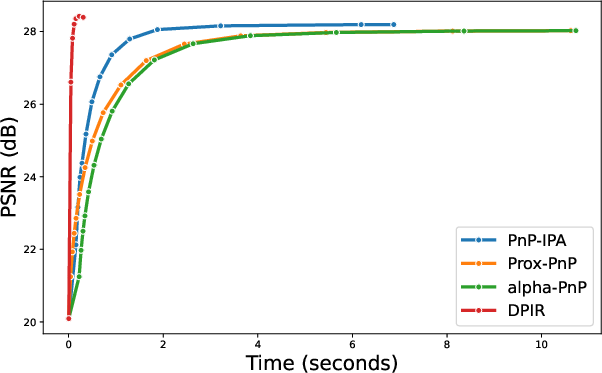
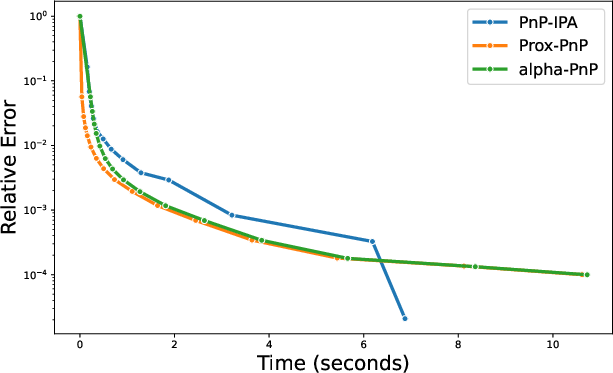

Figure 1: PSNR evolution along time for all compared methods on deblurring under high-level Gaussian noise.
- Deblurring under Low Gaussian Noise: PnP-IPA substantially outperforms all gradient-based, provably-convergent methods due to its ability to utilize the optimal regularization strength. Competing algorithms, restricted by theoretical parameter constraints, cannot exploit the best denoiser weights, leading to suboptimal PSNR.
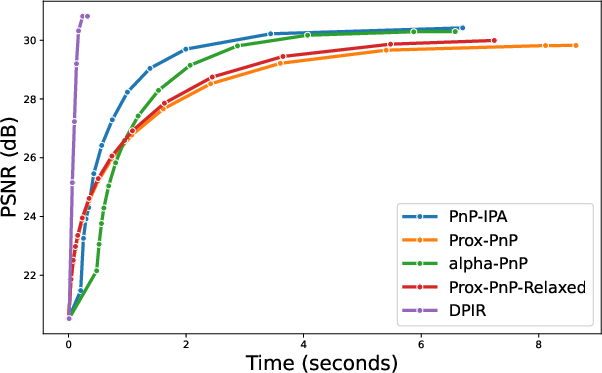
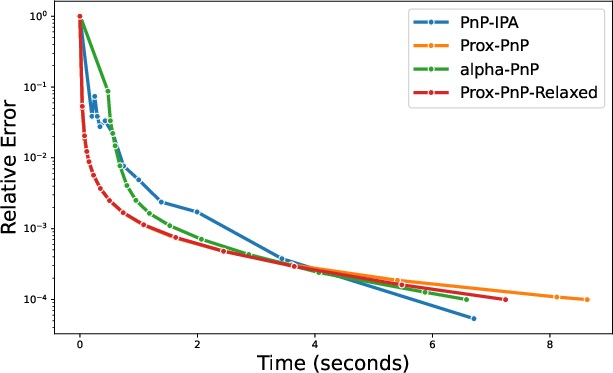

Figure 2: PSNR evolution along time for all methods under low-level Gaussian noise. The performance gap emphasizes the practical benefit of removing restrictions on λ.
- Deblurring under Cauchy Noise (Nonconvex Data Fidelity): PnP-IPA demonstrates robust convergence and state-of-the-art restoration. Competing methods fail when the Lipschitz constant is large (as with heavy-tailed noise), whereas PnP-IPA achieves higher PSNR in shorter time, reflecting its theoretical flexibility.
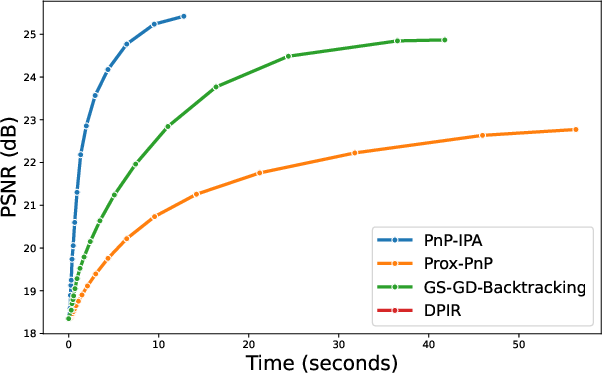
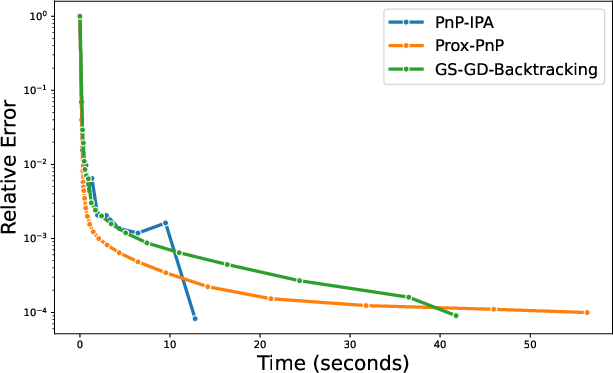

Figure 3: PSNR evolution for Cauchy noise deblurring—a nonconvex inverse problem setting showing accelerated and stable convergence for PnP-IPA.
For all noise scenarios, PnP-IPA's inner denoising loop typically requires 1–4 iterations, and the number of line-search backtracking reductions is low, indicating practical efficiency.
Strong and Contradictory Claims
- PnP-IPA removes all constraints on the regularization parameter λ: Unlike previous provable methods, fdata0 can be freely tuned for optimal restoration quality, irrespective of the data-fidelity Lipschitz constant.
- PnP-IPA guarantees global convergence to stationary points for a general class of nonconvex functionals, not requiring convexity in the data fidelity (a major theoretical advance for neural PnP schemes).
Practical and Theoretical Implications
The PnP-IPA framework provides the first provably convergent line-search-based PnP method that is both practical and as flexible as required for real inverse imaging tasks, including those with nonconvex likelihoods (e.g., heavy-tailed/noise-robust reconstructions). Its design enables the use of modern deep denoisers as regularization surrogates in challenging settings. In practice, the removal of artificial parameter constraints directly translates to higher restoration quality under broad noise models.
Theoretically, this work bridges inexact proximal splitting schemes, surrogate merit-based line-search techniques, and nonconvex analysis via KL inequalities, suggesting a general framework potentially extensible to other deep priors (e.g., Flow-Matching denoisers, parametrized scores).
Future Directions
Possible future research includes adapting the inexact inner loop to exploit momentum or acceleration, and expanding the class of admissible denoisers to those not admitting a closed-form analytic prior (e.g., diffusion-based models).
Conclusion
PnP-IPA represents a pivotal advance in plug-and-play algorithm design for inverse imaging, enabling the utilization of deep denoisers for nonconvex problems with full convergence guarantees and practical restoration optimality. The introduced analytic framework is broadly adaptable and has significant implications for the development of future deep optimization algorithms under real-noise conditions.

