- The paper demonstrates that M dwarfs with wide companions show a six-fold increase in hosting short-period giant planets.
- It employs joint TESS photometry and SPIRou NIR radial velocity measurements along with GP regression to characterize TOI-5628Ab.
- The study implicates companion-induced density waves and Kozai-Lidov cycles in planet formation and migration around low-mass stars.
Stellar Multiplicity of M Dwarfs with Short-period Giant Planets and the TOI-5628Ab System
Introduction and Scientific Motivation
The multiplicity of M dwarfs and their role in planet formation has key implications for the architectures of planetary systems. While binarity is common among Sun-like stars, the effect of wide companions on the evolution and occurrence of hot Jupiters—especially around low-mass stars—has remained unclear, in part due to the comparative rarity of giant planets around M dwarfs. This study provides a homogeneous characterization of stellar multiplicity among M dwarfs hosting short-period giant planets (P≤10 d, Rp≥0.7RJ), leveraging both new and archival datasets and establishing a quantitative contrast with the wide-binary fraction among field M stars (2607.10177).
The paper also presents the discovery and detailed analysis of TOI-5628Ab, a Saturn-mass planet transiting an M3 dwarf in a hierarchical system with a wide white dwarf component. This composite dataset constrains not only the system-level properties but also provides a pivotal data point for population-level statistical analyses.
Discovery and Characterization of TOI-5628Ab
TOI-5628Ab was identified through TESS photometry and confirmed via SPIRou NIR radial velocities, supported by comprehensive ground-based follow-up and high-angular-resolution imaging. The host star is a mid M3 dwarf (M⋆=0.36±0.02M⊙, R⋆=0.35±0.02R⊙, Teff≈3310 K; [Fe/H] =−0.10±0.14), with a co-moving white dwarf companion at a projected separation of 2500 AU.
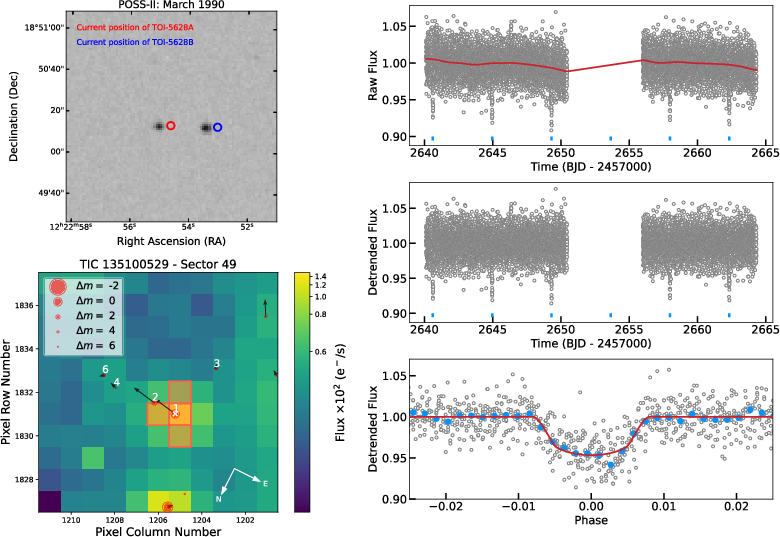
Figure 1: Imaging and time series photometry for TOI-5628 A and its wide WD companion, with light curves and best-fit transit models.
Joint modeling of photometry and RVs (including flexible GP regression to address stellar activity) yields a precise orbital period of $4.34166$ d and an orbital inclination of 88.98∘. The planetary mass is constrained to 0.09±0.04MJ (with a 3σ upper limit of Rp≥0.7RJ0) and a radius of Rp≥0.7RJ1. The measured semi-amplitude in RV (Rp≥0.7RJ2) is robust to the inclusion of activity modeling.
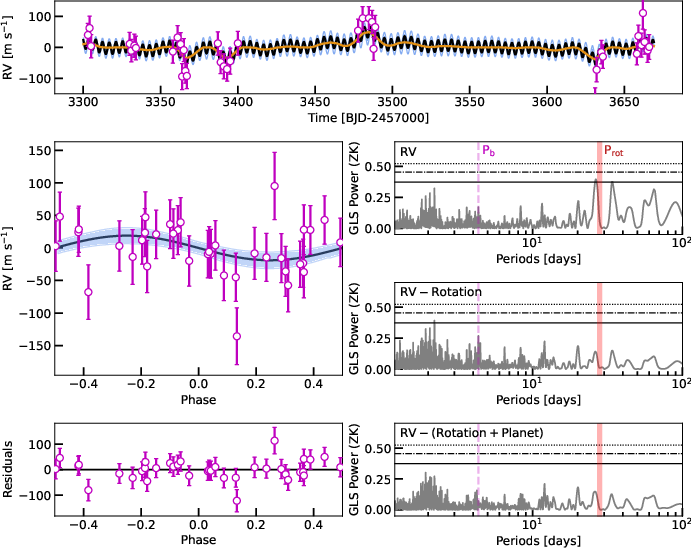
Figure 2: SPIRou RV sequence, GP+Keplerian joint fit, phase-folded RVs, and associated periodograms, demonstrating the distinction between planetary and rotational modulation.
Comprehensive SED analysis (PHOENIX and Koester models) and NIR+optical spectroscopy confirm the nature of both stellar components:
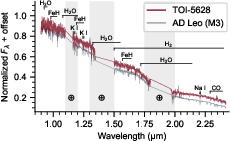
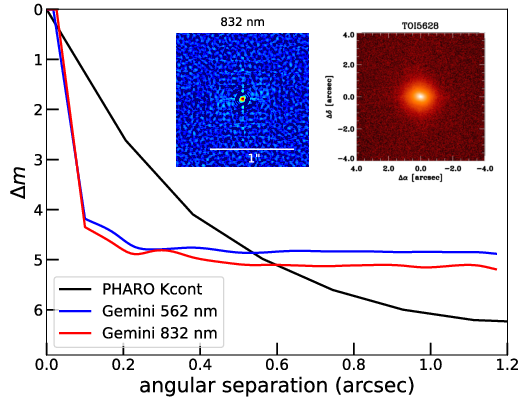
Figure 3: SXD NIR spectrum confirming the M3V type of TOI-5628 A against the AD Leo standard.
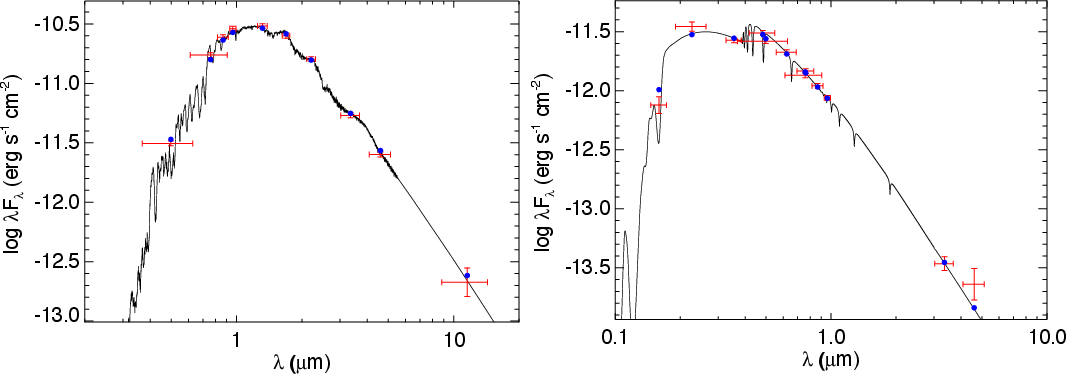
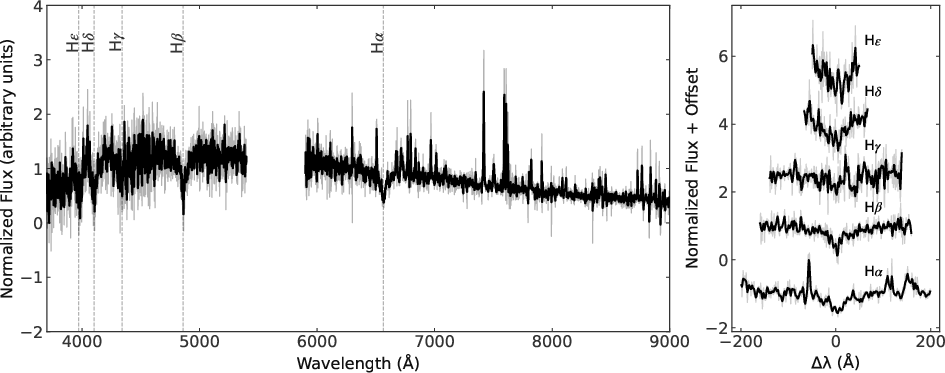
Figure 4: SED fits for TOI-5628A (M dwarf) and TOI-5628B (WD), confirming temperature, gravity, and radius via multi-band photometry.
No additional close companions were detected in deep high-resolution imaging, establishing the system as a wide binary with only the WD as a bound companion.
Stellar and Planetary Properties: Rotation and Stellar Activity
Rotation period analysis using ZTF long-baseline photometry provides Rp≥0.7RJ3 d, supported by both photometric and RV periodograms.
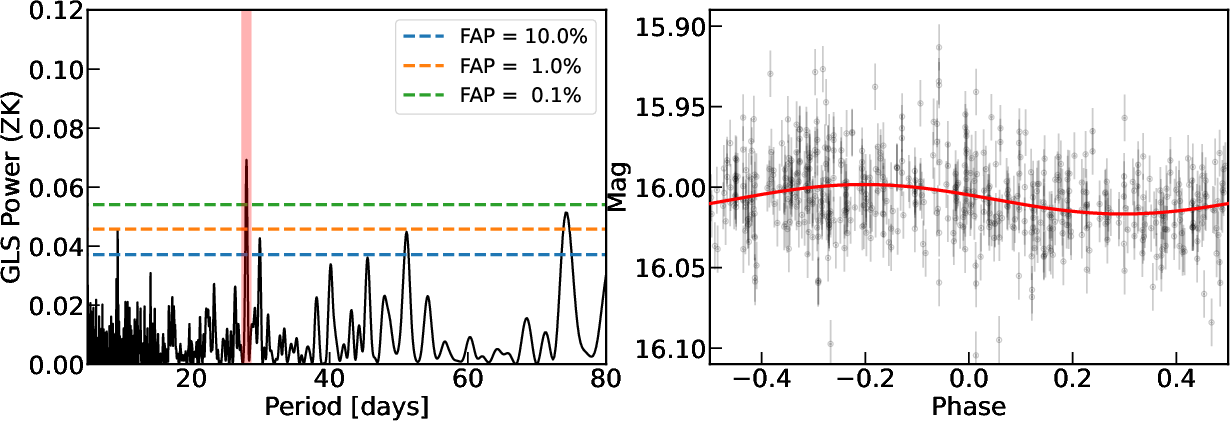
Figure 5: ZTF GLS periodogram and phase-folded long-term light curve, confirming rotational modulation signal at 27.9 d.
The planet's transit timing does not show significant TTVs, and no additional planets are detected.
Population Analysis: Multiplicity of M Dwarfs With and Without Hot Jupiters
A systematic search was conducted for co-moving companions in all known M dwarfs (Rp≥0.7RJ4 K, Rp≥0.7RJ5) hosting confirmed short-period (Rp≥0.7RJ6 days) giant planets. Using Gaia DR3 kinematics and a consistent 100–10,000 AU projected separation criterion, the companion fraction in this sample is determined.
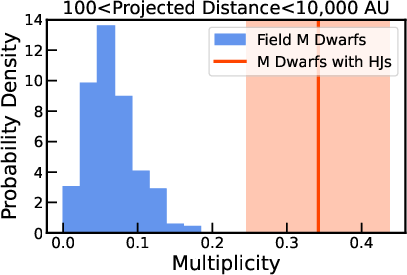
Figure 6: Comparative histogram of multiplicity rates between M dwarf hot Jupiter hosts and field M stars for 100–10,000 AU separations.
The measured multiplicity among planet hosts is Rp≥0.7RJ7, versus Rp≥0.7RJ8 for field M dwarfs matched in magnitude, Rp≥0.7RJ9, M⋆=0.36±0.02M⊙0, and distance (Monte Carlo methodology, M⋆=0.36±0.02M⊙1 subsamples). This six-fold enhancement is robust to the definition of hot Jupiter according to either radius or mass thresholds, and is consistent with companion frequencies derived from independent AO and imaging surveys.
Interpretation of Multiplicity Correlation
Wide companions at 100–10,000 AU appear to promote the occurrence of short-period giant planets around M dwarfs. The enhancement in multiplicity is not explained by metallicity bias, as M dwarfs hosting such planets are metal-rich relative to the field, and multiplicity conventionally decreases with higher metallicity beyond 250 AU.
Two main mechanisms are considered for the observed correlation:
- Planet Formation Enhancement: Companion-induced spiral density waves in the disk may provide favorable conditions for accelerated giant planet core assembly and rapid gas accretion.
- Post-formation Dynamical Migration: The presence of a wide-orbit companion enables high-eccentricity migration via Kozai-Lidov cycles, with the majority of systems exhibiting KL timescales conducive to dynamical evolution within typical system ages.
No excess of close (M⋆=0.36±0.02M⊙2 AU) companions was detected, consistent with suppression of planet formation in tighter binaries.
Implications and Future Prospects
The primary result—that M dwarfs with wide-orbit stellar companions have a multiplicity M⋆=0.36±0.02M⊙36 times higher for hosting short-period gas giants than single stars—places strong demands on planet formation models, particularly for low-mass stars. These findings parallel results for FGK stars but offer unique leverage due to the lower giant planet baseline rate around M dwarfs. The relevance of secular perturbation for giant planet migration is empirically strengthened.
High-precision astrometry, activity monitoring, and direct imaging will further clarify the architectures and dynamical histories of these systems. Future multi-wavelength surveys targeting field M dwarfs, coupled with improved metallicity diagnostics, are required to fully control for selection biases and extend the multiplicity measurement regime.
Conclusion
This study presents the detection and comprehensive physical characterization of TOI-5628Ab—a sub-Saturn-mass planet transiting an M3 host in a wide M+WD binary—and demonstrates a statistically significant, order-of-magnitude increased multiplicity rate among M dwarfs hosting hot Jupiters relative to the field. Wide companions at 100–10,000 AU are demonstrated to play a major, potentially causal, role in both the formation and post-formation migration of close-in gas giants around low-mass stars (2607.10177).