- The paper demonstrates that applying a gated-kernel Gaussian process framework can precisely pinpoint stochastic transitions in AGN X-ray corona variability.
- It shows that the soft X-ray band transition is gradual while the hard band exhibits a sharp change, quantified by specific center times and widths.
- The study links the variability transition to disk–corona interactions and emerging QPO features, offering a new diagnostic for AGN state evolution.
Gaussian-Process Evidence for a Stochastic-Variability Transition in the Recovering Corona of 1ES 1927+654
Introduction and Scientific Context
1ES 1927+654 is a prototypical changing-look AGN that underwent a dramatic state transition between 2017 and 2024, including a collapse and subsequent recovery of its X-ray corona. The AGN's multiwavelength properties shifted from a type-II Seyfert with no observed broad lines to a Seyfert 1 accompanied by major optical/UV outbursts, and a period when its X-ray corona vanished completely before returning [2019ApJ...883...94T, 2022ApJ...931....5L, 2020ApJ...898L...1R]. This event sequence presents a crucial laboratory for dissecting the physical mechanisms underlying disk–corona interactions, and investigating the evolution of stochastic variability states in the coronal X-ray emission of AGN.
Traditional X-ray timing analyses, relying on power spectral density (PSD) and periodograms, often obscure non-stationary and state-transition features in AGN light curves. This paper deploys a Gaussian process (GP) framework to model the temporally evolving stochastic variability of 1ES 1927+654, specifically during the critical 2018–2024 coronal re-establishment and the subsequent QPO-plus-jet epoch, enabling a statistically robust inference of changes in the dominant covariance structure.
Gaussian Process Modeling and Bayesian Inference
The analysis uses XMM-Newton EPIC-pn light curves in both the soft (0.3–2.0 keV) and hard (2.0–10.0 keV) X-ray bands. The GP model incorporates four competing covariance kernels: Matérn-3/2, damped random walk (DRW), stochastically driven damped simple harmonic oscillator (SHO), and excess white noise terms. Bayesian model comparison is executed using nested sampling (dynesty), with rigorous application of the Jeffreys scale for model selection.
The key technical innovation is the application of a "gated-kernel" GP architecture to localize transitions between covariance states within single exposures, sharply identifying shift-points (changepoints) in the underlying stochastic process. This approach is not a generic change-point analysis, but a phenomenological decomposition with explicit parametrization of the gate location, sharpness, and width.
Identification of a Stochastic-Variability Transition
A central result emerges from the 2019 May 5 XMM-Newton observation (PN_0843270101), where the dominant covariance structure in the X-ray light curves exhibits a decisive transition from Matérn-3/2—characteristic of smoother, finite-memory correlated processes—to DRW-like behavior, which encodes rougher, Markovian red-noise dominated variability.
The gated-kernel analysis reveals:
- Soft band (0.3–2.0 keV): The transition is gradual, with a parametric center at tc≃11.3 ks and an effective width Δt10−90∼40 ks.
- Hard band (2.0–10.0 keV): The transition is sharp, located at tc≃23.5 ks with Δt10−90≃2.4 ks.
This transition is observed after the X-ray corona has reappeared post-collapse, yet before the marked hardening and brightening that characterize the later coronal states.
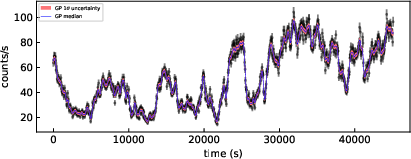
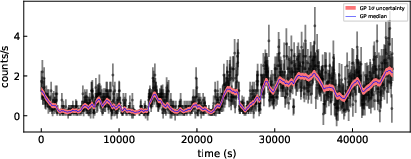
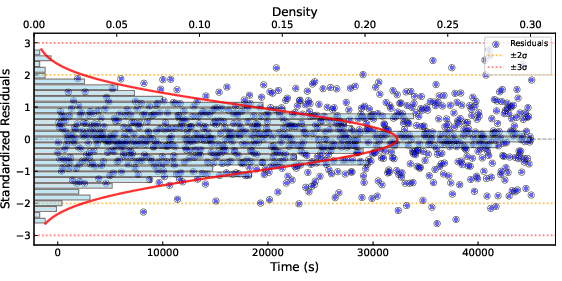
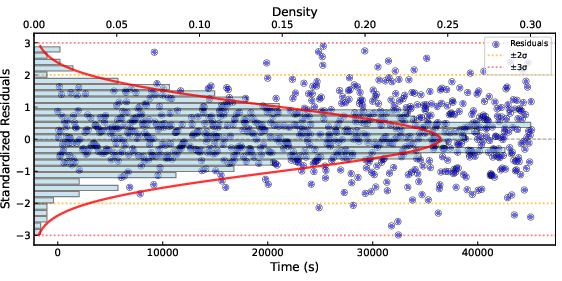
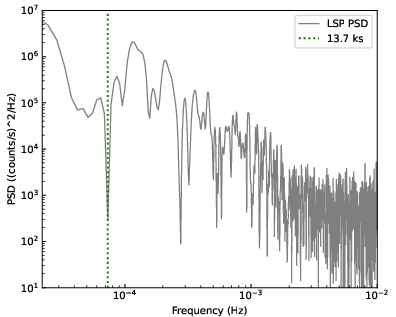
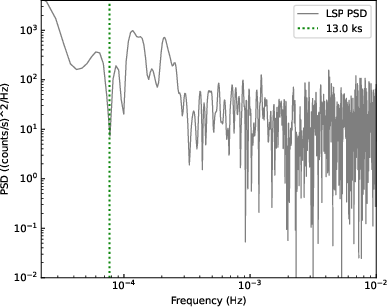
Figure 1: Single-state GP fits and residual diagnostics for PN_0843270101, demonstrating non-stationary behavior in residuals and periodograms.
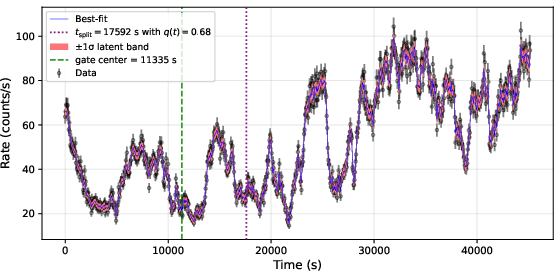
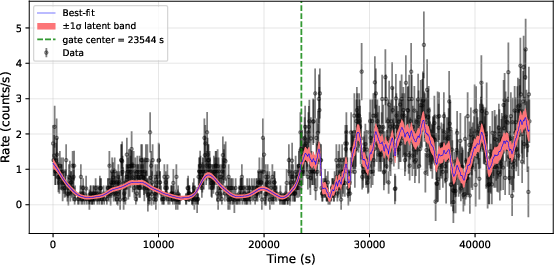
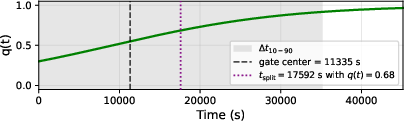
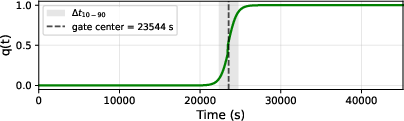
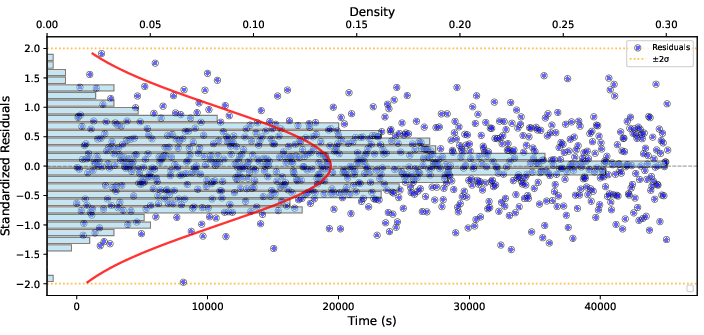
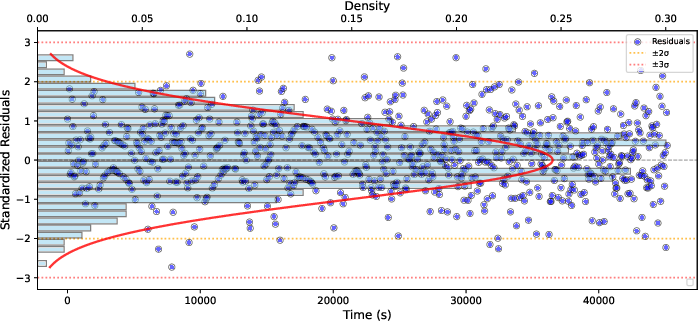
Figure 2: Gated-kernel analysis of PN_0843270101, localizing a sharp transition in covariance structure in the hard band, contrasting the gradual transition in the soft band.
Connection to Physical Evolution: Disk–Corona and QPO–Jet Phases
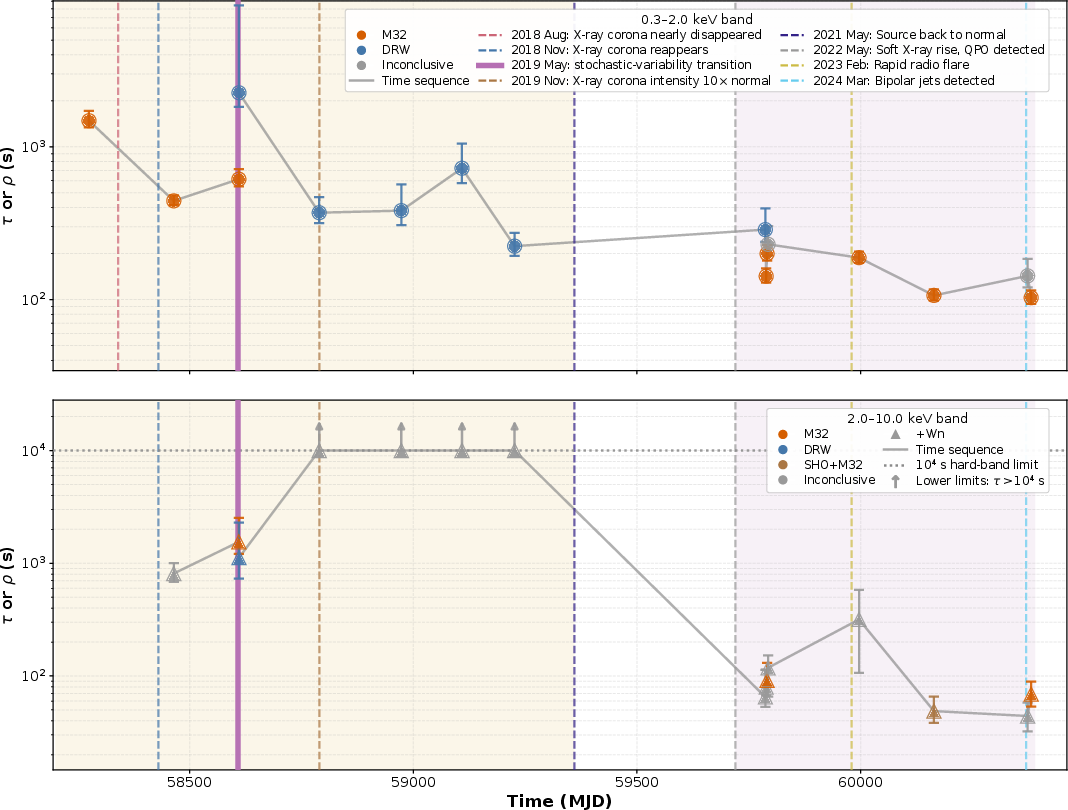
Placing the timing-domain transition in the broader timeline of 1ES 1927+654, the transition detected in the GP model precedes the peak of X-ray hardening and the emergence of the late-time jet and millihertz QPO activity seen after 2022.
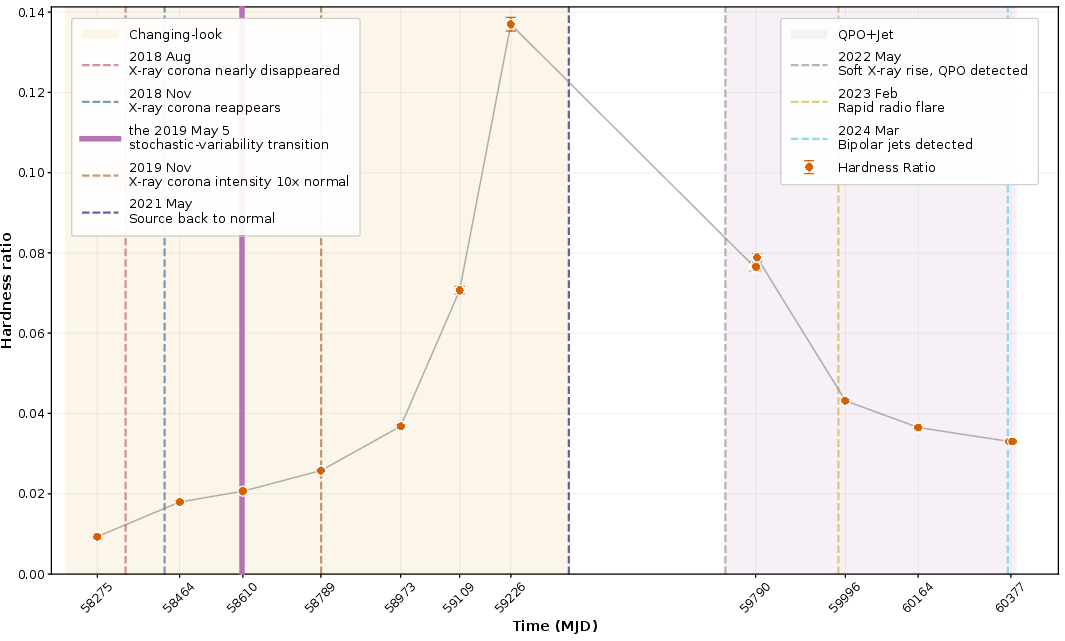
Figure 3: Long-term evolution of the X-ray hardness ratio, with phase demarcations for corona disappearance/reappearance, stochastic-variability transition, and QPO/jet events.
The stochastic-variability transition thus represents an early, quantifiable timing signature of the coronal reformation process, reflecting an intrinsic change in the variability-driving mechanisms before the onset of classical spectral state transitions.
Evolution of Stochastic and Coherent Variability
A systematic, long-term GP analysis across all 2018–2024 XMM-Newton epochs reveals the following patterns:
Implications and Theoretical Interpretation
This study demonstrates that GP-based time-domain inference can sensitively detect non-stationary stochastic-variability transitions in AGN X-ray emission, offering an alternative diagnostic to conventional spectral/hardness evolution. The observed Matérn-3/2 → DRW transition phenomenologically maps to a transformation from smoother, possibly turbulence- or viscosity-driven processes to a state dominated by short-memory, more stochastic relaxation, possibly reflecting increased internal coronal disorder or changes in coupling to the accretion disk and radiative environment.
The emergence and evolution of SHO-like components in the later (QPO-plus-jet) phase, with frequency drift and coherence build-up, directly connect to oscillatory modes in the corona likely triggered by magneto-gravitational instabilities or turbulent reconnection, which in turn may seed transient jet-launching events as observed in this AGN [2025ApJ...981..125L, 2025ApJ...979L...2M].
The broader implication is that stochastic-variability transitions—encoded in changes in the covariance structure, not simply the PSD—offer a physically informative low-latency probe of coronal state evolution, with potential applications in AGN and accreting X-ray binary population studies. Determining whether such transitions are universal or depend on the specifics of system history and microphysics invites further application to larger AGN samples and to joint multi-band datasets [2025ARA&A..63..379K, 2025ApJ...988..206Z].
Conclusion
This work establishes a robust methodology for detecting transitions in stochastic variability using Gaussian process model selection, revealing a previously unrecognized stochastic-variability transition in the recovering X-ray corona of 1ES 1927+654. The results demonstrate that time-domain covariance-state changes can precede and predict classical spectral transitions, supplying a new phenomenological handle on the physics of AGN state changes. The identification of a coherent QPO-like component at late times further supports a scenario in which coronal rebuilding and jet launching are dynamically coupled through evolving stochastic and oscillatory mechanisms.
GP-based inference is thus positioned as a sensitive, model-flexible approach for dissecting the time-varying structure of stochastic variability in high-energy accretion flows, with the potential to inform future theoretical and numerical modeling of disk–corona–jet coupling in AGN and beyond.