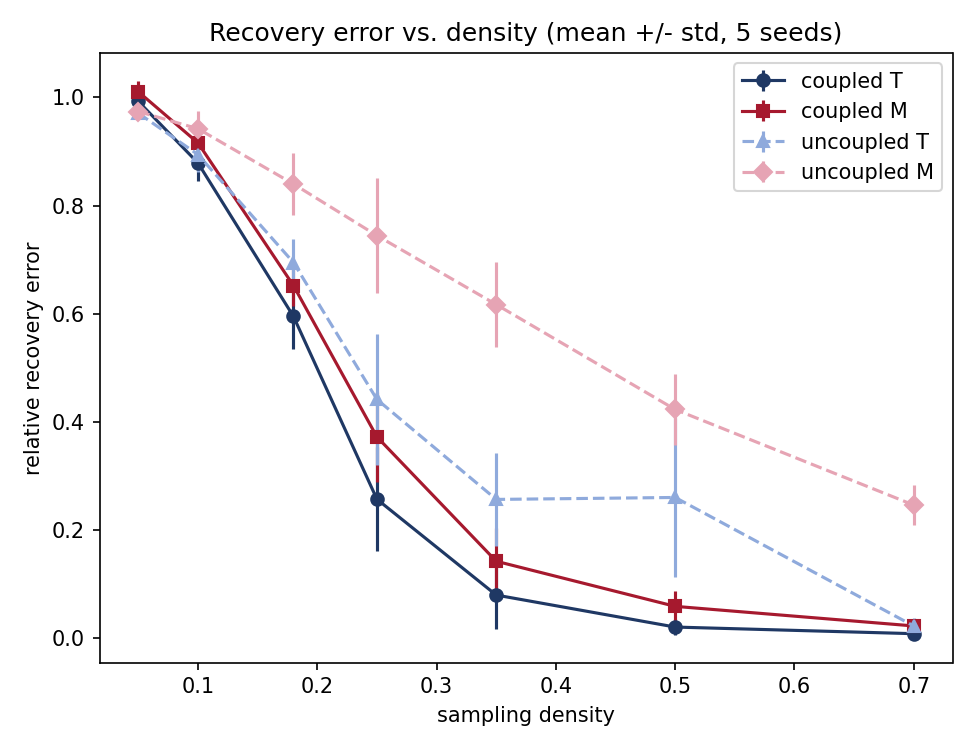
- The paper introduces a framework for joint recovery of low-rank tensor and matrix data using PALM, leveraging a shared mode coupling to overcome sparse observations.
- It provides both theoretical guarantees for sequential coupling and empirical evidence, showing marked improvements over uncoupled methods.
- Empirical tests, including synthetic experiments, validate the method's effectiveness, with recovery errors reduced by up to an order of magnitude at higher sampling densities.
Coupled Tensor–Matrix Recovery via PALM: Theory, Algorithms, and Applications
The paper introduces a framework for the joint recovery of a low-rank tensor T and a low-rank matrix M from highly sparse and noisy observations, addressing the case where T and M are connected by a shared mode and an explicit linear coupling operator. The motivation arises from scenarios such as workforce skill estimation and small-business health mapping, where multiple, imperfect sources encode complementary information over overlapping populations. Unlike classical matrix or tensor completion, this setting leverages mode-level coupling to propagate information into sparsely sampled regimes, exceeding the recovery capability of uncoupled approaches.
The nuclear norm of the mode-1 unfolding of the tensor acts as a convex surrogate for its non-unique rank, ensuring computational tractability and enabling an exact closed-form proximal operator via SVD. Coupling is implemented as T(1)≈MG⊤ with a learned G, generalizing beyond factor-sharing schemes and enabling statistical transfer by direct linear mapping.
Convex Objective, Existence, and Optimization Algorithm
The core objective is a sum of squared data fidelity terms, a coupling penalty, nuclear-norm regularization for both T and M, and Tikhonov (ridge) regularization for G. Formally, the problem is
T,M,Gmin21∥PΩT(T)−yT∥F2+21∥PΩM(M)−yM∥F2+2λC∥T(1)−MG⊤∥F2+2δ∥G∥F2+λS∥T∥∗+λR∥M∥∗,
where the nuclear norms and the linear coupling enforce the desired low-rank and information-sharing structure.
An existence theorem guarantees the well-posedness of the problem in finite dimensions, leveraging coercivity induced by the regularizers and the structure of the objective.
Optimization is performed with PALM (Proximal Alternating Linearized Minimization). Each variable block (M0, M1, M2) is updated via:
- Prox-gradient descent on the smooth part and an exact singular value thresholding proximal step for the nuclear norms,
- Ridge-regularized least squares for the M3-block.
A convergence theorem (built on [bolte2014]) establishes that the iterates converge to a critical point of the objective under standard block-wise stepsize rules when all approximations are exact.
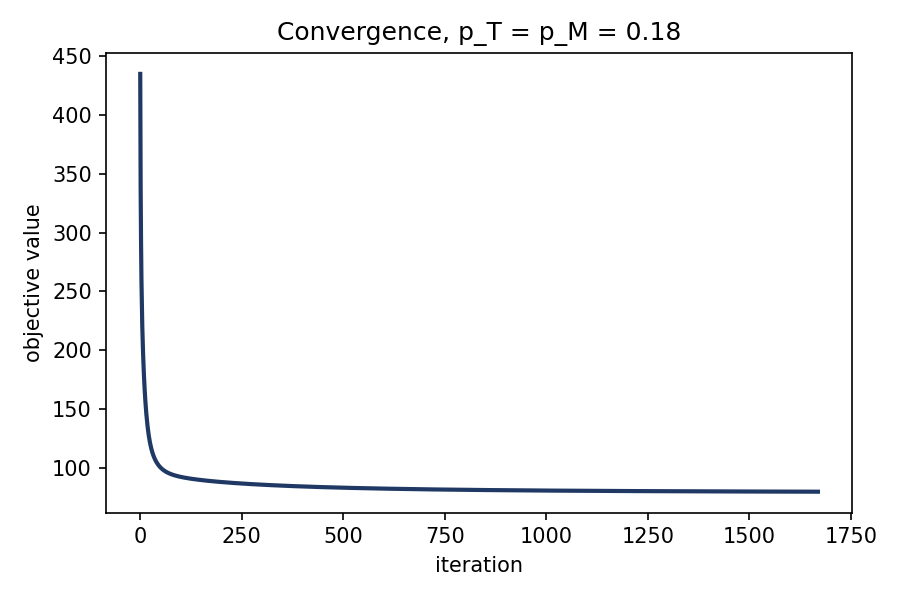
Figure 1: Objective value vs.\ iteration, M4. The monotonic decrease confirms proper PALM behavior and convergence.
Recovery Guarantees and Sample Complexity
Theoretical sample-complexity results are dissected into three levels:
- Matrix-Only Case (Uncoupled): Classical matrix completion theory applies, with recovery at M5 density M6 for bounded coherence.
- Sequential Coupling (Provable Case, Theorem 2): If the coupling M7 is known a priori, M8 can be precisely recovered from only observations of M9, using a plug-in estimator. The error bound is proportional to the recovery error for T0, scaled by the inverse minimal singular value of T1, and holds even if T2.
- Fully Joint (Empirical/Open): When T3 is not known and is estimated alternately with T4, the coupling provides strict improvements at intermediate densities, as shown empirically. Formal guarantees for this challenging statistical regime remain conjectural.
This critical distinction emphasizes a substantial guarantee for sequential coupling and quantifies the empirical benefit and its limitations for the full joint recovery case.
Numerical Results: Empirical Validation
The paper presents synthetic experiments evaluating recovery as a function of sample density, model scale, and coupling strength. Strong numerical evidence is provided for the value of coupling, especially in settings with highly asymmetric sample densities across modalities.
An anomaly is observed in the scale-up experiment: recovery error decreases with growing M4 at fixed per-entry density, which contradicts classical worst-case sample-complexity scaling in the matrix completion literature. This phenomenon is attributed to averaging across many low-dimensional rows, but remains an open topic for theoretical refinement.
Extensions, Schema Evolution, and Limitations
The formulation admits stronger regularizers (e.g., overlapped nuclear norm across all modes), but the convergence guarantee applies only to the mode-1-norm due to lack of closed-form proximal steps for the other cases.
A procedural mechanism for governance-coupled schema evolution is proposed, enabling the dynamic and auditable extension of the index sets as new categories or dimensions emerge—a critical component for real-world, evolving systems.
Limitations are transparent and significant: sample complexity for the full joint estimator is conjectural, not proved; only small- to moderate-scale synthetic experiments are presented; and application-specific results are labeled as design proposals, not validated findings. Validation on real deployment-scale data and analysis of the statistical properties of alternately estimated coupling remain open.
Implications and Outlook
This work formalizes and demonstrates a practical approach for coupled recovery in settings where two heterogeneous modalities share structure but differ in sample coverage. The theoretical advances—most notably, the rigorous guarantee for sequential coupling—clarify the boundaries of what can be definitively achieved with limited data. The differentiation between provable and conjectural phases is handled with technical care and empirical rigor.
Practically, the algorithmic choices (exact proximal steps, closed-form ridge solves) yield efficient and stable implementations. The explicit governance component anticipates real-world system needs, in which reproducibility and schema evolution are as central as optimization.
Potential future developments include:
- Extending convergence and recovery guarantees to overlapped nuclear norm settings and more general coupling functions,
- Deriving tight finite-sample rates for the alternately estimated coupling scenario,
- Application to real datasets in labor market or small business analytics, where resolution at sparse margins is a pivotal concern,
- Integration with side information or semi-supervised signals as in inductive matrix completion.
Conclusion
The paper delivers a precise characterization of coupled tensor–matrix recovery and its algorithmic realization via PALM, together with compelling evidence for joint statistical strength transfer in underobserved settings. The boundary between what is strictly guaranteed and what is empirically supported is clearly articulated. This work opens directions for both theoretical generalization and application to increasingly heterogeneous, evolving real-world systems.
(2607.10163)