- The paper establishes a Lorentzian framework for classifying relaxation-like, evanescent-like, and unstable excitation modes in relativistic media.
- It rigorously derives universal bounds on group velocity and dispersion relations, clarifying the onset of hydrodynamic breakdown via kinetic theory.
- The study applies these concepts to practical scenarios, demonstrating time dilation deviations and spectral hierarchies with validations using a photon gas model.
Lorentzian Spectral Geometry and Causality in Relativistic Relaxation Systems
Introduction
The paper "The Lorentzian geometry of relaxation" (2607.10148) develops a comprehensive geometric framework for understanding linear excitation spectra in relativistic matter, focusing on media governed by purely relaxational (non-oscillatory) modes. The approach recasts constraints from causality and stability in terms of Lorentzian geometry on the (iω,ik) dispersion plane, enabling graphical solutions to questions concerning dispersion relations, the observer dependence of spectral hierarchies, the breakdown of hydrodynamics, and the nature of spectral branch cuts in kinetic theory. The analysis integrates operator theory, generalized hydrodynamics, and kinetic theory, providing rigorous results with clear physical relevance.
Lorentzian Geometry on the Relaxation Plane
Central to the paper is the identification of a Lorentzian causal structure in the dispersion plane spanned by iω (imaginary frequency) and ik (imaginary wavenumber). The transformation rules for iω and ik under Lorentz boosts are shown to mirror those for t and x in Minkowski spacetime, and thus (iω,ik) forms a Lorentz vector:
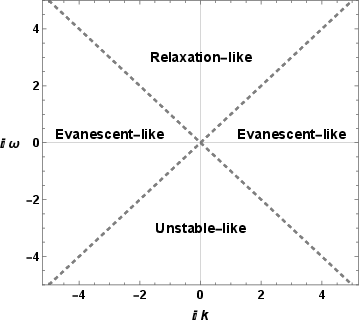
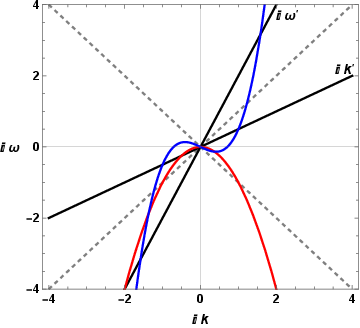
Figure 1: Geometric classification of relaxation-like, evanescent-like, and unstable-like modes; the covariant stability bound excludes unstable-like modes in a causal and stable system.
This geometric structure allows one to classify excitation modes as:
- Relaxation-like: timelike and future-directed, corresponding to homogeneous decay in some frame.
- Unstable-like: timelike and past-directed, corresponding to growth (prohibited by stability).
- Evanescent-like: spacelike, corresponding to spatially decaying (non-oscillatory, stationary) profiles.
Causality and stability enforce that only relaxation-like and evanescent-like sectors are physically realized. As (iω,ik) transforms via boosts, the geometric classification enables graphical interpretation of spectral trajectories and collision points across inertial frames.
Causality Constraints and Sharp Bounds
The work rigorously proves two central theorems constraining possible spectral evolutions under variations in ik:
- Theorem 1: The spectrum at distinct iω0 values cannot be separated by more than iω1, where iω2 is the maximal characteristic speed (bounded by unity).
- Theorem 2: The tangent to any isolated mode as a function of iω3 must be spacelike, yielding iω4.
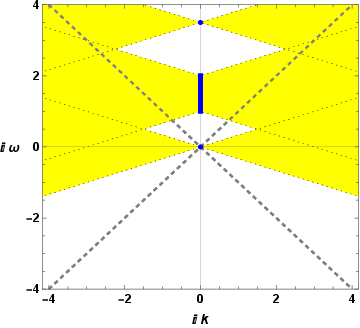
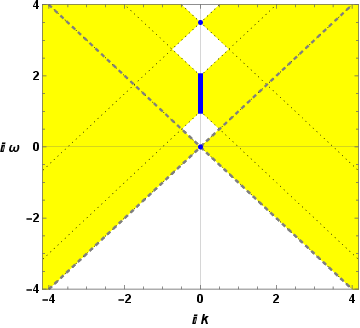
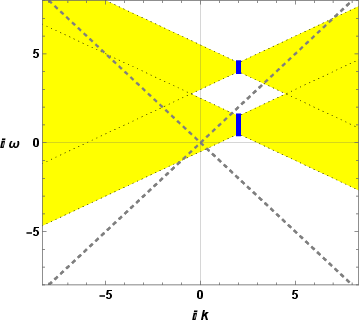
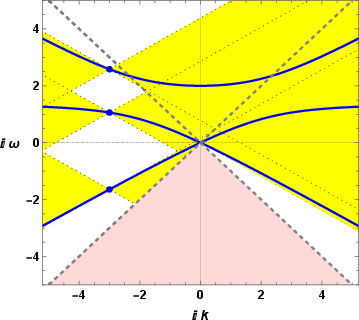
Figure 2: Illustrations of the geometric bounds from Theorem 1; spectral regions may only expand within the "light cones" set by iω5.
This yields a sharp and universal group velocity bound in imaginary directions, in contradistinction to the naive (and incorrect) real-iω6 group velocity bounds postulated in earlier literature.
Applications: Hydrodynamic Breakdown, Time Dilation, and Spectral Hierarchies
Regime of Validity for Dispersion Relations
Causality alone constrains the radius of analyticity, and thus the regime of validity, of hydrodynamic and nonhydrodynamic dispersion relations. For diffusion with iω7, the group velocity bound forces breakdown at iω8, much before instability sets in. This is confirmed by explicit kinetic theory computations.
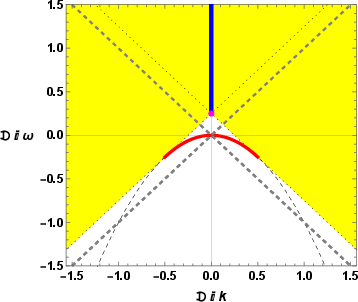
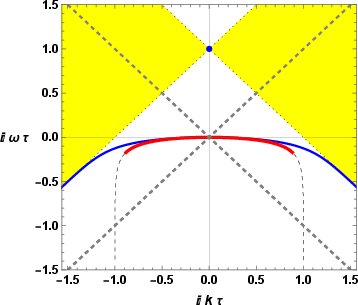
Figure 3: Application of geometric bounds to the breakdown of diffusion in Fokker-Planck and RTA kinetic theory; the predicted collision points are verified by the detailed microscopic spectrum.
Bounds on Relativistic Time Dilation of Relaxational Modes
The geometric approach quantifies possible deviations from standard Lorentz time dilation for isolated relaxational modes:
iω9
where ik0 are relaxation times in respective frames and ik1 is the boost velocity. Thus, only in the limit ik2 (essentially non-relativistic) does the standard time-dilation formula hold, while at ik3 the broadening grows significant. Precise bounds are derived and visualized.
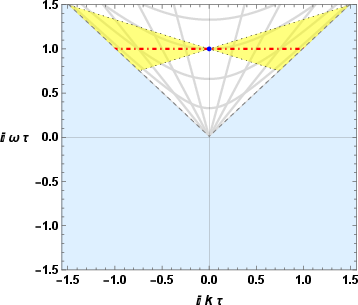
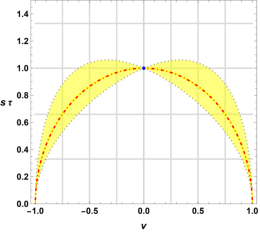
Figure 4: Deviations from pure Lorentzian time dilation for a relaxation mode as a function of maximal velocity ik4.
Observer-Dependent Breakdown of Relaxational Hierarchies
The framework provides necessary and sufficient conditions for the observer-independence of the hierarchy between slow and fast spectral sectors. For ik5, the spectral hierarchy can break down in highly boosted frames, demonstrating the intrinsic relativity of spectral separation in the presence of transport.
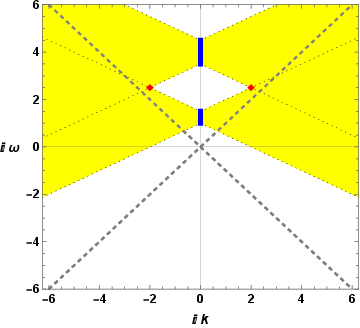
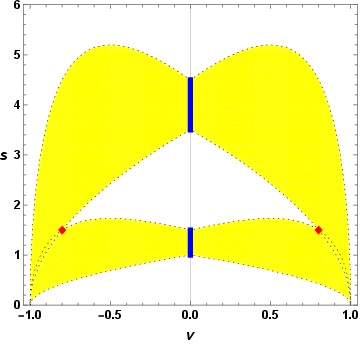
Figure 5: Model example in which spectral sectors that are strictly separated in the rest frame can merge at large boosts in the relaxation-like sector.
Hydrodynamics and Universal Transport Bounds
The analytic approach yields rigorous bounds on the validity of hydrodynamics, the maximal viscosity and diffusivity, as well as analytic radii for dispersion relations:
ik6
where ik7 is the nonhydrodynamic spectral gap. The bounds are shown to be saturated in specific kinetic models (Cattaneo, maximally viscous sound). Notably, the upper bound on diffusivity and viscosity,
ik8
is tantamount to a sharp, causality-derived restriction on transport in all consistent relativistic media.
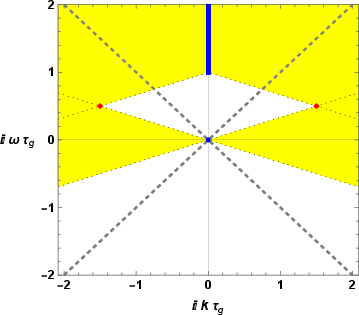
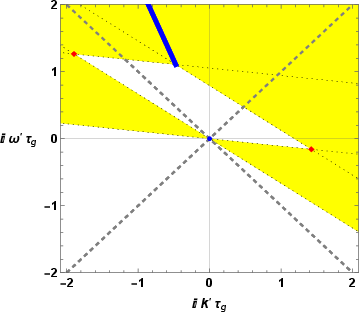
Figure 6: Minimum collision points between hydrodynamic and nonhydrodynamic sectors in the rest frame and after a Lorentz boost, illustrating the deformation of the radius of validity.
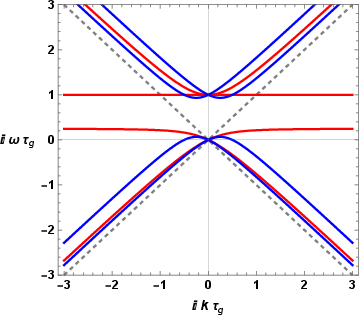
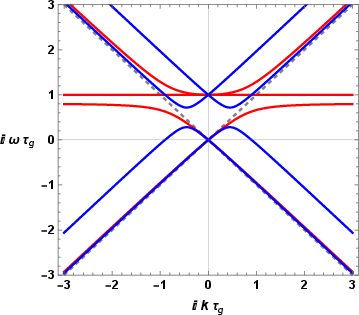
Figure 7: Sound sector spectrum illustrating the attainment of the maximal allowed diffusivity and comparison with the Israel–Stewart theory.
Nonhydrodynamic Spectral Branches: Discrete vs. Ballistic Cuts
The work clarifies, via operator-theoretic arguments, when kinetic theory models generate continuous ballistic branch cuts (e.g., RTA), and when spectra remain discrete in ik9. Systems with an infinite degeneracy at iω0 possess essential spectrum at finite iω1; this is absent when the operator structure is strictly finite-rank or when gaps are maintained.
Case Study: Photon Gas on a Plane
As a concrete application, the photon gas with fixed energy and angle diffusion (governed by a Boltzmann equation with angular diffusion) is solved analytically. The hydrodynamic sector exhibits single-mode diffusion with iω2, and excited states split as characteristic numbers of Mathieu functions. The absence of a kinetic ballistic cut is emphasized, confirming the theoretical predictions.
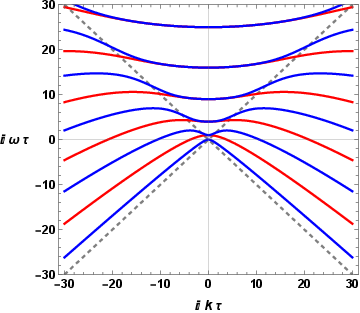
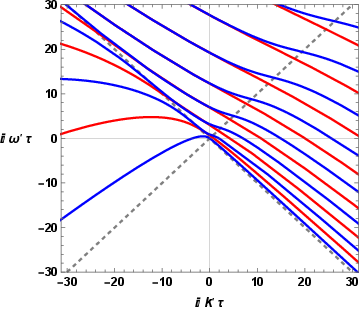
Figure 8: Analytic spectrum for the photon model, showing twofold degeneracy at iω3 and splitting at finite iω4; the spectrum lacks a ballistically expanding cut.
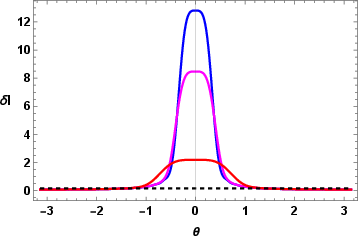
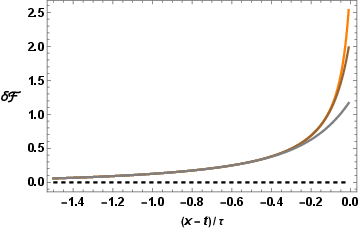
Figure 9: Pulse-induced wake in the photon distribution, illustrating the approach to isotropy and the influence of higher nonhydrodynamic modes.
Operator Bounds and the Necessity of Lorentzian Structure
The final theoretical development demonstrates that any finite-order, causal, purely relaxational PDE admits a kinetic-type (Boltzmann-operator) representation with equivalent spectral properties. Thus, all such theories must inherit the Lorentzian spectral geometry, and operator bounds on maximal velocity are both necessary and sufficient for the causal propagation of information.
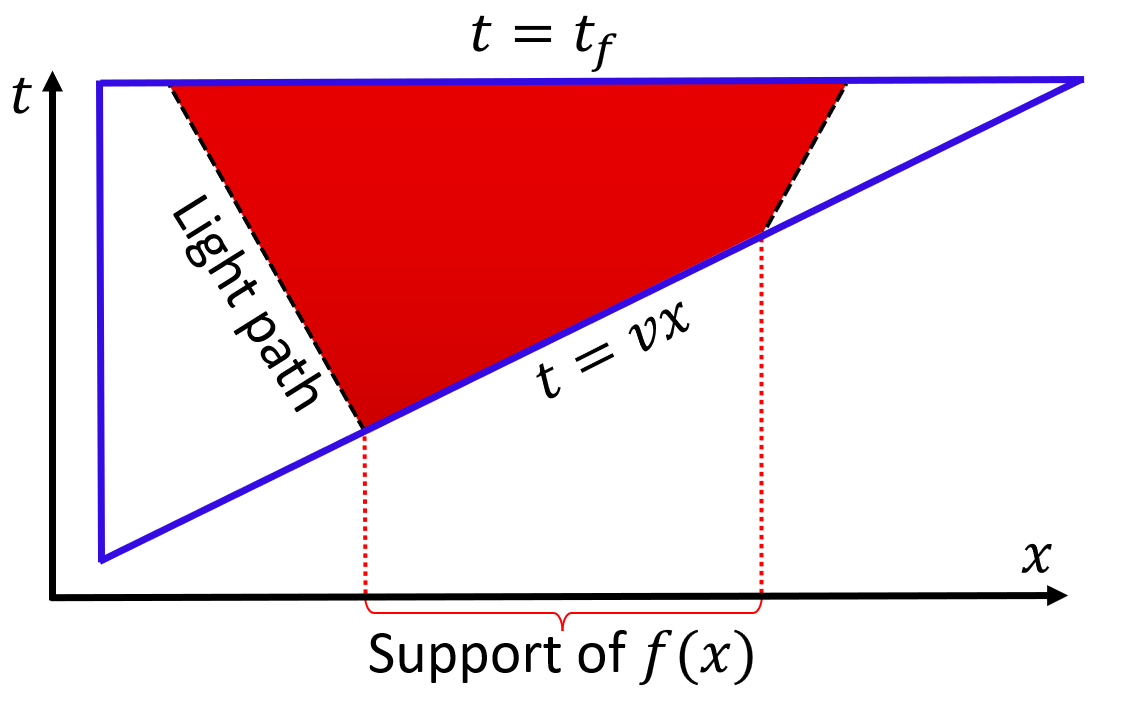
Figure 10: Minkowski diagram illustrating the breakdown of causality if the operator bound is violated; initialization on a spacelike surface leads to contradiction.
Conclusion
The geometric reinterpretation of dispersion relations for relaxational relativistic systems, as developed in "The Lorentzian geometry of relaxation," synthesizes causality, analyticity, and operator theory into a unified framework. The resulting sharp, model-independent constraints on spectral propagation, transport coefficients, and the observer dependence of the spectrum will inform the development and validation of both kinetic and effective theories for relativistic transport. The extension of these ideas to oscillatory, strongly coupled, or quantum regimes remains a direction for future investigation, but the present results offer a canonical reference for relaxation spectra in relativistic media.