- The paper introduces a symmetry-based framework for dynamically inducing nonrelativistic spin splitting (NRSS) in antiferromagnets using THz-driven nonlinear phononics, achieving spin splitting up to 40 meV.
- It employs group-theoretical selection rules to identify specific IR and Raman phonon modes that break antiunitary symmetries, as confirmed by first-principles DFT studies in NiO and LaFeO3.
- Experimental predictions include transient net moments detectable via polar MOKE, illustrating potential applications in high-speed spintronic device engineering.
Dynamical Nonrelativistic Spin Splitting in Antiferromagnets via THz Nonlinear Phononics
Overview and Motivation
This work introduces and systematizes a symmetry-based framework for the dynamical control of nonrelativistic spin splitting (NRSS) in collinear antiferromagnets, leveraging nonlinear phononics (NLP) mediated by intense terahertz (THz) optical pulses (2607.10091). Existing approaches for controlling NRSS, such as strain or chemical substitution, are fundamentally limited in speed and reversibility. Here, ultrafast light pulses drive specific infrared (IR) phonon modes, which anharmonically couple to Raman-active modes, thereby inducing transient symmetry breaking and enabling the manipulation of spin splitting on sub-picosecond timescales.
The work proposes two explicit group-theoretical selection rules for dynamically inducing NRSS via phononic excitation: (i) the wavevector of the imparted phonon distortion must be compatible with the material’s magnetic propagation vector to break translation-protected spin degeneracies, and (ii) the phonon’s inversion parity must match that of the magnetic order to break antiunitary protections (e.g., ΘI). These criteria provide a predictive framework for activating and enhancing NRSS in materials, transforming ad hoc searches into symmetry-guided design.
Collinear antiferromagnets generically exhibit spin-degenerate bands in the absence of spin-orbit coupling (SOC) due to two antiunitary symmetries: ΘI (time-reversal combined with spatial inversion) and Uτ (spin rotation plus translation). Lifting these degeneracies, i.e., inducing NRSS, requires simultaneous breaking of both protections. The paper demonstrates, by group-theoretical analysis, that only specific phonon modes can achieve this: the ones whose wavevector and parity are correlated with the material’s magnetic structure.
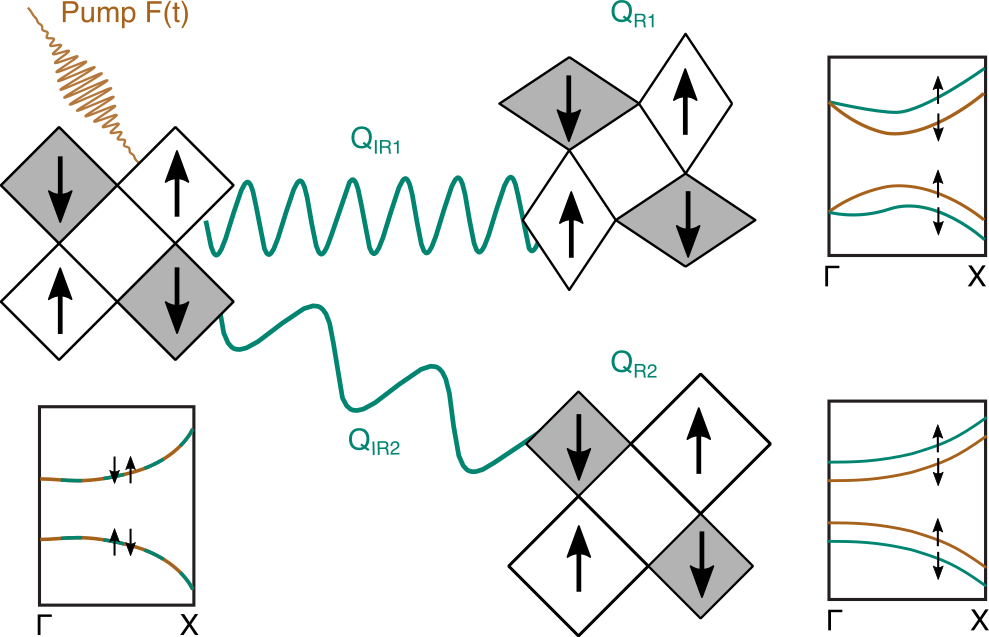
Figure 1: Nonlinear phononics enable ultrafast symmetry lowering by coupling a driven IR mode QIR to a Raman-active mode QR, thus activating NRSS via appropriate lattice distortions.
Application of these rules to prototypical NiO (rock-salt antiferromagnet) and LaFeO3 (altermagnetic perovskite) establishes distinct paradigms: complete induction of NRSS out of a spin-degenerate ground state (NiO) and resonant amplification of pre-existing splitting (LaFeO3). This framework systematizes NRSS activation and is extensible across the antiferromagnetic materials space.
First-Principles Demonstration in NiO
Phonon Mode Selection and Electronic Response
First-principles DFT calculations (see (2607.10091) SM) identify the relevant phonon mode irreps in NiO. Nine optical modes exist for the magnetic unit cell, but only two (Raman-active L3+ and L1+), dominated by oxygen sublattice displacements, satisfy the wavevector and parity selection rules for NRSS activation.
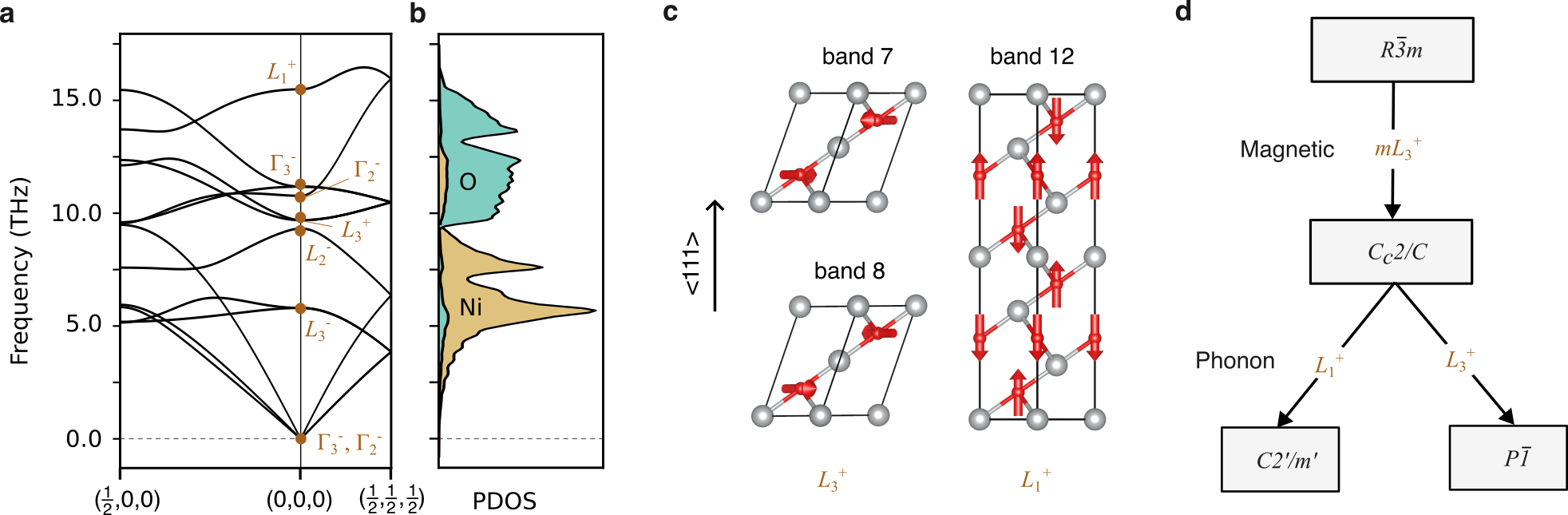
Figure 2: (a) NiO phonon dispersions; (b) atom-projected phonon densities; (c) NRSS-enabling L3+ and ΘI0 modes with visualized displacements; (d) mapping of corresponding symmetry operations.
Frozen-phonon DFT calculations show that static distortions along ΘI1 or ΘI2 Raman coordinates robustly lift spin degeneracy at all ΘI3 (Figure 3c,d). Odd-parity or wavevector-mismatched distortions (e.g., ΘI4) do not, confirming the strict symmetry requirements. The induced NRSS exhibits a magnitude up to 40 meV for realistic displacement amplitudes and is associated with a transient net moment (via SOC), setting the stage for ultrafast optical detection.
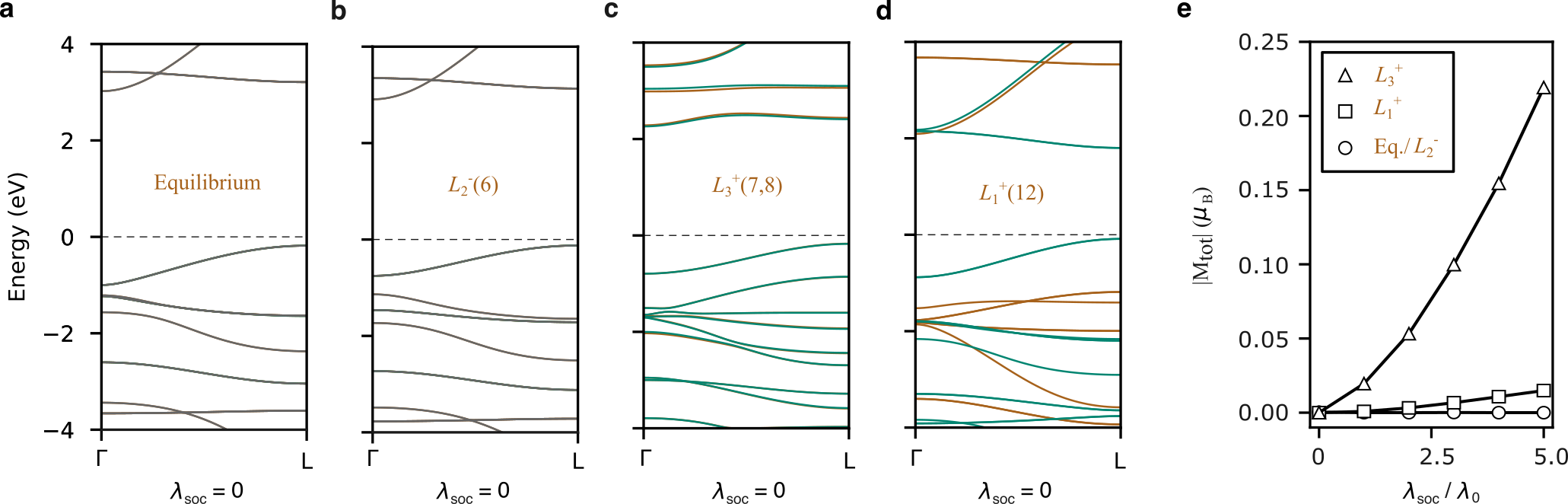
Figure 3: (a) Equilibrium (degenerate) and (b)–(d) phonon-mode-modulated NiO band structures; (e) Net magnetization as function of SOC for equilibrium and modulated structures.
Terahertz Nonlinear Phononics Dynamics
Anharmonic Coupling and Time-Evolution
The practical realization of NRSS control utilizes quartic anharmonic coupling between a driven IR mode (ΘI5 at 11.08 THz) and the relevant Raman ΘI6 mode (15.57 THz). In NiO, symmetry strictly forbids cubic coupling, making quartic interactions dominant:
ΘI7
Time-dependent phonon displacement simulations under a strong mid-IR pulse display efficient energy transfer to the NRSS-enabling Raman coordinate via quartic up-conversion, leading to a persistent, oscillating NRSS during and after the pulse.
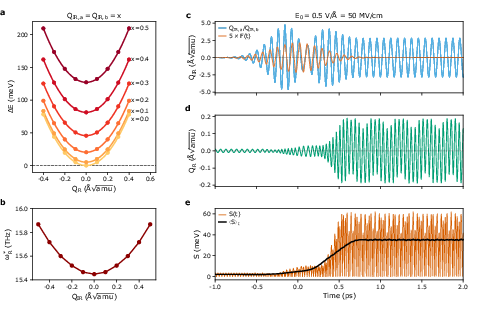
Figure 4: (a) Energy surface for nonlinear coupling; (b) Renormalized Raman frequency; (c–d) Time evolution of IR and Raman amplitudes under THz excitation; (e) Resulting instantaneous and mean NRSS ΘI8.
Spin splitting ΘI9, quantified by the Uτ0-averaged spin-resolved band separation, approaches a persistent 40 meV on 0.5 ps timescales for realistic field strengths, confirming the dynamical accessibility of NRSS using NLP.
Experimental Consequences and Optical Signatures
Magneto-Optical Kerr Effect Probes
The transient NRSS induced by Raman phonon activation results in finite net moment (SOC-aided), which can be tracked using time-resolved polar MOKE experiments. DFT-predicted Kerr rotation spectra show a transition from null response at equilibrium to robust finite values (peak Uτ10.5Uτ2 for unit-amplitude modulations, Uτ30.02Uτ4 for realistic amplitudes/E-fields). The requisite experimental temporal resolution (sub-100 fs) and high sensitivity are achievable with current setups.
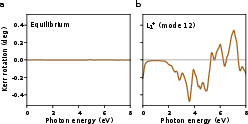
Figure 5: DFT-calculated polar MOKE response for equilibrium (a) and Uτ5-modulated (b) NiO.
Detection feasibility is discussed in the context of antiferromagnetic domain structure: the induced moment does not select domains, so MOKE must be domain-resolved or complemented by domain-insensitive probes (e.g., magnetic linear dichroism, second-harmonic generation).
Applying the symmetry selection principles to LaFeOUτ7, a perovskite antiferromagnet with pre-existing NRSS, the authors show selective driving of Uτ8 Raman phonons doubles spin splitting (from 14.5 to 28.3 meV) and induces Zeeman-like band structure features at Uτ9. Anharmonic trilinear phonon coupling efficiently transfers IR pump energy to the NRSS-enabling Raman coordinate, amplifying altermagnetic signatures and yielding finite transient net moment—again traceable via ultrafast MOKE. This highlights the broad relevance of symmetry-driven NLP for both NRSS creation and amplification.
Implications and Future Directions
This work establishes a predictive, group-theoretical design framework for dynamical control of spin splitting in a broad class of antiferromagnets. The outlined criteria and computational validation enable targeted selection of IR and Raman phonon modes to achieve transient symmetry breaking inaccessible by static strain, thus opening avenues in ultrafast spintronic device engineering, programmable quantum phases, and fundamental studies of non-equilibrium magnetism.
Experimentally, domain effects must be addressed for macroscopic detection, but contemporary advances in local and symmetry-sensitive probes facilitate direct observation of both localized and global NRSS features. The potential for coherent control (sign and amplitude reversibility via pump phase) further augments information storage and logic schemes in magnetic materials.
On the theoretical side, the protocol generalizes to odd-parity (antisymmetric) NRSS and noncollinear magnets, enabling the study and manipulation of more complex spin-momentum textures.
Conclusion
Nonlinear phononics mediated by THz pulses provides an ultrafast route for dynamical induction and control of nonrelativistic spin splitting in antiferromagnets via symmetry-guided phonon excitation. The derived selection rules systematize NRSS activation, enabling design of new materials and phenomena for high-speed, robust spintronic applications well beyond the static regime (2607.10091).