- The paper introduces a finite-cycle acceleration model showing that energy-dependent return probability naturally induces spectral curvature in shock-accelerated particles.
- It replaces continuous diffusion with a discrete shock-crossing mapping, linking angular-averaged scattering effects to measurable spectral steepening.
- Analytic expressions connect macroscopic parameters, such as magnetic field strength and shock lifetime, with observable spectral features in blazar and AGN environments.
Finite-Cycle Shock Acceleration: Breaking the Universality of Relativistic Shock Spectra
Introduction
The paper "Intrinsic Spectral Curvature from Finite-Cycle Transport at Relativistic Shocks" (2607.10060) addresses a fundamental limitation in conventional models of shock-accelerated particle spectra. Standard diffusive shock acceleration (DSA) theory predicts universal power laws for particle energy distributions, a result derived under scale-free, many-cycle assumptions with efficient, isotropic scattering and negligible escape probability. However, recent plasma simulations and astrophysical diagnostics indicate that, especially in compact or transient relativistic sources (such as blazar internal shocks and black hole coronae), the number of effective shock crossings per particle is strictly finite—a consequence of strong anisotropy, limited residence time, and rapid downstream advection.
The core contribution of the paper is the development of an analytic finite-cycle framework for relativistic shocks. The approach replaces continuous diffusion with a discrete shock-crossing mapping, in which the angularly averaged return probability Pret(E) and the mean energy gain per cycle g determine the accelerated spectrum. The central result is that an energy-dependent decrease of Pret intrinsically produces spectral curvature, not requiring radiative or external escape modifications. This formalism yields closed analytic expressions for both the energy-dependent spectral index and the characteristic steepening scale, explicitly connecting macroscopic source properties with measurable non-power-law features.
Finite-Cycle Framework and Physical Regime
DSA’s universality is predicated on asymptotic diffusive transport. The new finite-cycle formalism replaces this with a discrete sequence of acceleration cycles (Figure 1), where each particle alternates between upstream and downstream phases, acquiring energy at each shock crossing but facing a non-unity probability of returning from the downstream region due to advection, shock lifetime, and anisotropic transport.
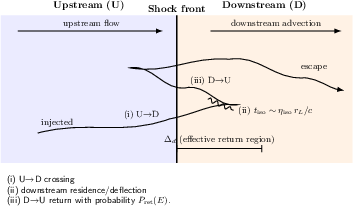
Figure 1: Schematic of finite-cycle acceleration at a relativistic shock, highlighting the discrete sequence of shock crossing, downstream residence, and return probability mediated by magnetic interactions and finite system timescales.
Within this framework, the phase-space evolution is encapsulated by a cycle operator acting on the pitch-angle and energy distributions. Upon angular averaging, the population normalization follows:
Nn+1≃Pret(pn)Nn,pn+1≃gpn
where g is the mean energy amplification per cycle, typically ∼Γrel2 for a shock Lorentz factor Γrel. The key departure from DSA arises because Pret(E), governed by the interplay of Larmor radius growth, magnetic scattering efficiency (parametrized as ηiso), downstream residence, and shock lifetime, systematically decreases with energy.
This paradigm shift is underpinned by recent simulation results showing that strong magnetic obliquity, superluminal configurations, or weak turbulence efficiently suppress repeated crossings, constraining the effective cycles available to each particle, e.g., [Sironi et al. 2010, 2013; Ligorini et al. 2021; Kirk et al. 2023].
Analytical Model and Spectral Construction
The main analytical result is the derivation of the cumulative and differential spectrum under energy-dependent Pret:
g0
For constant g1, a power law is recovered. With g2 falling exponentially with energy due to the increase in deflection time g3 versus finite removal time g4, spectral curvature naturally emerges (Figure 2). The explicit expression for return probability is:
g5
where g6 and g7 are the downstream advection and shock lifetimes, respectively, and g8 is the downstream magnetic field.
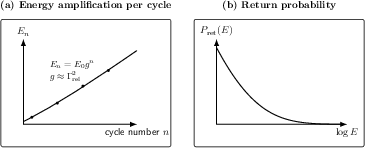
Figure 2: Schematic origin of finite-cycle spectral steepening—multiplicative energy gain per cycle and progressive suppression of return probability with energy.
The characteristic steepening energy scale g9, defined by Pret0, is given by:
Pret1
Below Pret2, multiple cycles support a near-power-law shape. Above Pret3, exponentially decreasing survival probability induces a continuous softening of the spectrum. The regime map (Figure 3) illustrates the transport boundary in the Pret4 plane, marking the transition from diffusion-like to escape-dominated behavior as a function of magnetic field strength and particle energy.
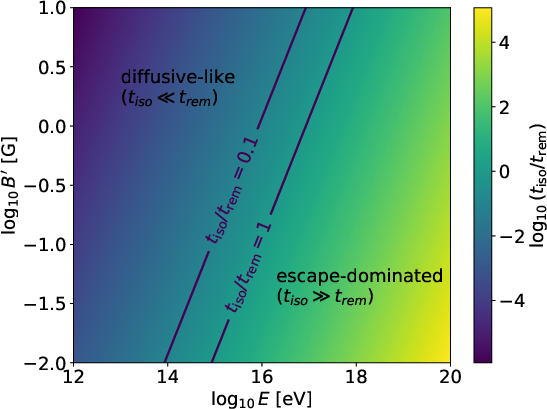
Figure 3: Regime map in the Pret5 plane showing regions of diffusion-like transport (Pret6) and finite-cycle escape (Pret7) for typical blazar internal-shock parameters.
Spectral Consequences and Parameter Dependence
Applying the framework to a typical blazar internal-shock scenario with fiducial parameters (Pret8, Pret9, Nn+1≃Pret(pn)Nn,pn+1≃gpn0, Nn+1≃Pret(pn)Nn,pn+1≃gpn1, Nn+1≃Pret(pn)Nn,pn+1≃gpn2, Nn+1≃Pret(pn)Nn,pn+1≃gpn3, Nn+1≃Pret(pn)Nn,pn+1≃gpn4, Nn+1≃Pret(pn)Nn,pn+1≃gpn5) yields Nn+1≃Pret(pn)Nn,pn+1≃gpn6. The local spectral index changes continuously, steepening from Nn+1≃Pret(pn)Nn,pn+1≃gpn7 at PeV to Nn+1≃Pret(pn)Nn,pn+1≃gpn8 at Nn+1≃Pret(pn)Nn,pn+1≃gpn9. Crucially, this curvature appears well below the Hillas confinement limit or acceleration-time cutoff (Figure 4), establishing that transport-limited curvature precedes the ultimate spectral cutoff:
g0
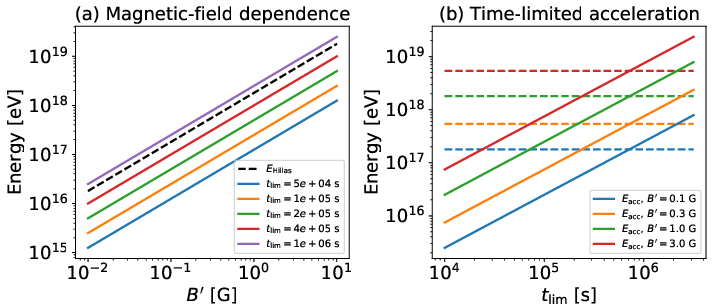
Figure 4: Comparison of Hillas confinement and time-limited acceleration energies for an internal shock; finite acceleration time can be more restrictive than spatial confinement, depending on system parameters.
Numerical realizations of the model (Figure 5) confirm these analytic trends: the onset and severity of curvature vary with g1, advective and dynamical timescales, and angular-scattering efficiency. Notably, g2 under other parameters held fixed, and larger g3 or shorter g4 shift curvature to lower energy.
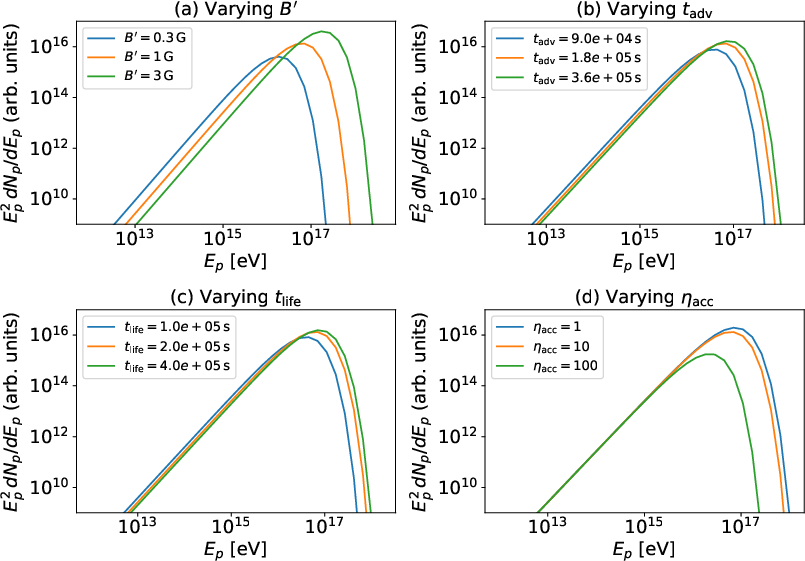
Figure 5: Proton spectra from the finite-cycle model for an internal shock, illustrating intrinsic curvature due to finite-cycle escape and parameter-driven variation in steepening and maximum energy.
Theoretical and Practical Implications
The proposed finite-cycle escape formalism challenges the presumed universality of shock-accelerated power laws in relativistic systems. The model captures the decline in cycle survivability directly, rather than as an "after-the-fact" spectral modification due to energy-dependent escape or cooling. This has several key implications:
- Astrophysical Source Modeling: The predicted continuous curvature is relevant to hadronic models of blazars, gamma-ray bursts, and compact AGN coronae, where photon and neutrino spectra may exhibit non-power-law features not attributable to cooling or propagation, but instead to intrinsic acceleration physics.
- CR Injection Spectra: The energy-dependent cycle truncation modifies the spectrum injected into cosmic-ray propagation, particularly affecting the PeV–EeV regime critical for UHECR source identification. A non-universal, transport-determined spectrum suggests that modeling based on asymptotic DSA may be insufficient.
- Numerical and PIC Diagnostics: The g5 criterion provides a diagnostic tool for interpreting results of particle-in-cell or Monte Carlo simulations, and for distinguishing finite-cycle from diffusive regimes in code outputs—directly linking microphysical turbulence properties (g6), macroscopic geometry, and observed spectral features.
- Composition and Rigidity Effects: The essential scaling of g7 with charge g8 generalizes the results to heavy nuclei, motivating further modeling of composition-dependent injection and subsequent secondary emissions.
Outlook and Future Directions
The finite-cycle model is directly extensible to include radiative losses, time-dependent injection, and spatial evolution. It sets a foundation for next-generation hadronic emission codes in compact sources and provides clearer physical separation of acceleration-induced curvature from extrinsic spectral modification. Given its closed-form expressions, the approach facilitates data-driven inference of source conditions based on observed spectral curvature, especially in the multi-messenger era.
Future theoretical work should focus on:
- Incorporating more complex removal-time distributions, turbulence spectra, and phase-space correlations.
- Coupling the finite-cycle parent spectra to photomeson and inverse-Compton interaction chains for neutrino and g9-ray predictions.
- Extending to environments with evolving turbulence and shock structure, such as highly variable transients (e.g., TDEs, GRBs).
Conclusion
This paper provides a robust analytic formalism for modeling non-power-law spectral shapes in compact relativistic shocks, attributing intrinsic spectral curvature to finite-cycle transport physics rather than extrinsic modification. The continuous curvature emerges naturally from a systematic energy dependence in the shock-crossing return probability, with the steepening scale directly set by macroscopic source properties. These results offer a new interpretive lens for both observations and simulations, demanding a re-examination of spectral universality in astrophysical acceleration sites.
References
(2607.10060)
Sironi et al., 2010, 2013; Kirk et al., 2023; Ligorini et al., 2021; etc.