- The paper demonstrates that halide alloying tunes the energetic competition between ferromagnetic and antiferromagnetic phases in 2D CrX3 systems.
- It employs first-principles DFT and SQS modeling to reveal significant band gap bowing and evolving p-d hybridization across varying halide compositions.
- The study shows that configurational entropy stabilizes mixed-halide alloys, broadening the synthesis window for future spintronic applications.
Alloy Engineering of Magnetic Phases in Two-Dimensional Chromium Trihalides
Introduction
The study thoroughly investigates the magnetic, electronic, and structural properties of two-dimensional chromium trihalides (CrX3; X = Cl, Br, I) and their ternary alloys utilizing density functional theory (DFT) with a focus on tuning their behavior via halide alloying (2607.10030). Monolayer CrX3 compounds have gained significant interest due to the discovery of intrinsic two-dimensional ferromagnetism, with their Curie temperatures and band structures highly sensitive to halide chemistry. Through systematic alloying on the halogen site, the authors probe the interplay between structural distortions, exchange interactions, band hybridization, and phase stability in both pristine and mixed-halide chromium trihalides.
Methodology
First-principles calculations were performed using VASP with the r2SCAN meta-GGA functional. Alloys were simulated using Special Quasi-random Structures (SQS) for both atomic configuration and paramagnetic phase modeling. The magnetic phase space investigated includes FM, three AFM variants (Néel, stripe, zigzag), and PM order. Exchange parameters were evaluated up to the third nearest neighbors, and Curie temperatures were derived from the 3NN-MF model. Thermodynamic stability was analyzed through computation of mixing enthalpies and Gibbs free energies incorporating configurational entropy.
Pristine Compounds: Magnetic Phases and Electronic Structure
The DFT results unambiguously reaffirm that the ground state of all CrX3 monolayers is ferromagnetic, with low-energy competition from AFM-zigzag and the disordered PM phase. Notably, the energy offset between FM and AFM-Z/PM remains in the range of 5–20 meV/f.u., supporting the experimentally observed low Curie temperatures (15–61 K depending on the halide). Lattice parameters, Cr–X bond lengths, and Cr–Cr distances increase with halogen size, but the octahedral geometry remains largely preserved.
Projected density of states (PDOS) analysis reveals a systematic evolution of the valence band maximum (VBM) character: Cr d states dominate for CrCl3, significant mixing with X p orbitals appears for CrBr3, and the VBM in CrI3 is overwhelmingly iodide p-derived.
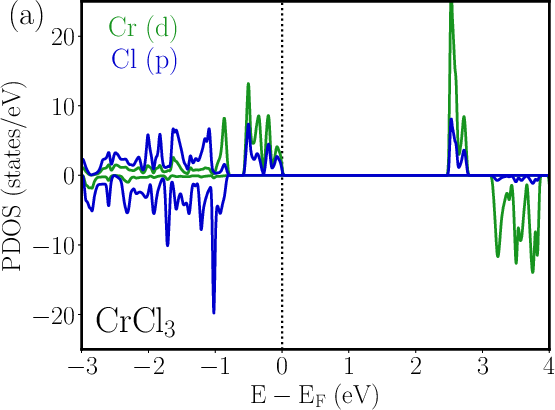
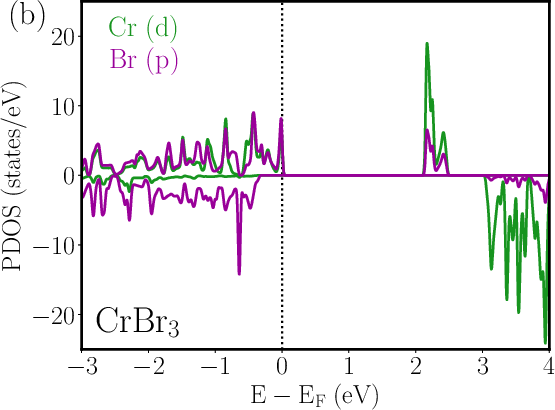
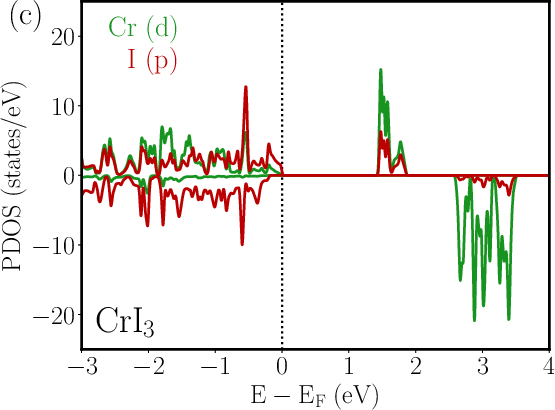
Figure 1: Projected density of states (PDOS) for ferromagnetic CrCl3, CrBr3, and CrI3, highlighting the transition from Cr d to X p dominance at the VBM.
A molecular orbital model corroborates that the increasing p-d hybridization and decreasing energy offset (30) from Cl to I underlie both the reduction in the band gap and the observed VBM trends. Structural distortions in the CrX31 octahedra break ideal degeneracies, further shaping the valence manifold.
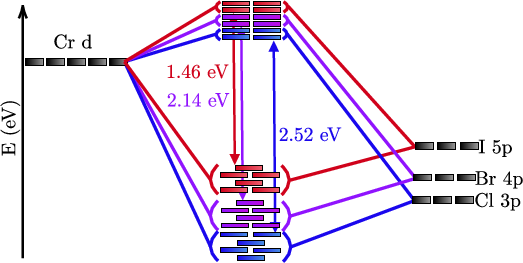
Figure 2: Molecular orbital diagram rationalizing p-d level alignment in CrX32 as a function of halogen species.
Alloying in Cr(Cl33Br34I35)36: Magnetic and Electronic Trends
Comprehensive mapping across the ternary composition space reveals persistent FM ground states in all alloys, but with energy differences to AFM-Z and PM phases strongly modulated by halogen fraction. Alloys with reduced iodine content exhibit negligible energy separation (typically <6 meV/f.u.), suggesting soft magnetic phase boundaries in Br/Cl-rich compositions.
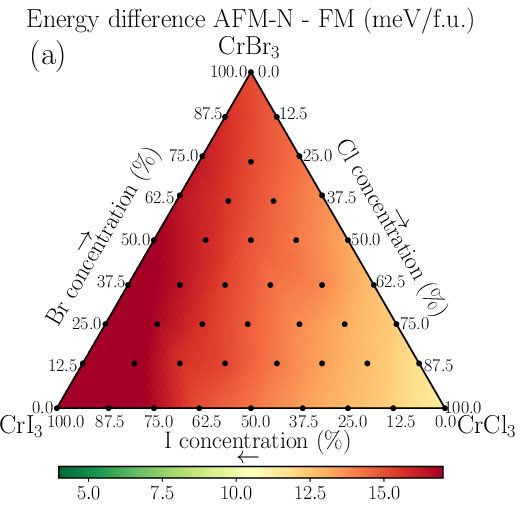
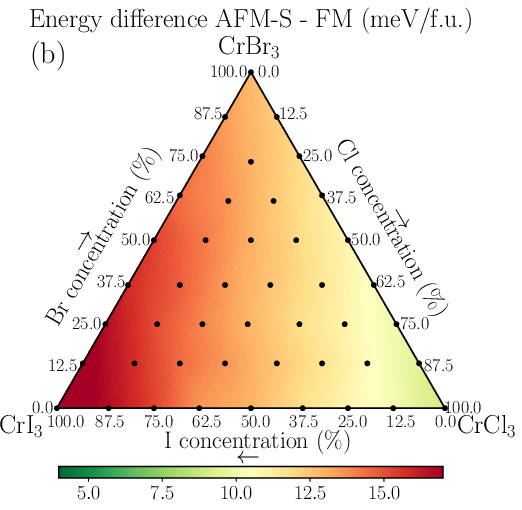
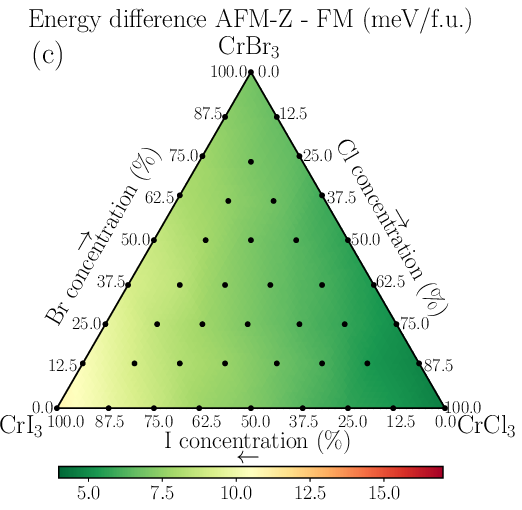
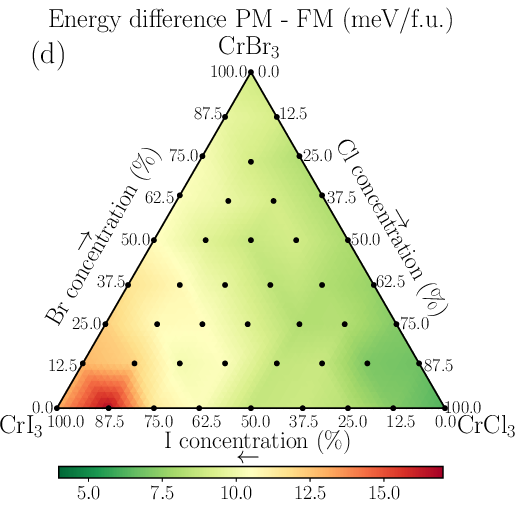
Figure 3: Energetic preference for FM ordering over competing magnetic phases across the ternary alloy space.
Electronic Structure Bowing
Band gap engineering via halogen mixing introduces pronounced bowing, especially along the Cl–I compositional edge. The band gap deviates nonlinearly from Vegard's law, reaching maximum bowing values of up to 1.43 eV, a direct consequence of asymmetric p-d interactions and lattice-induced electronic structure perturbations.
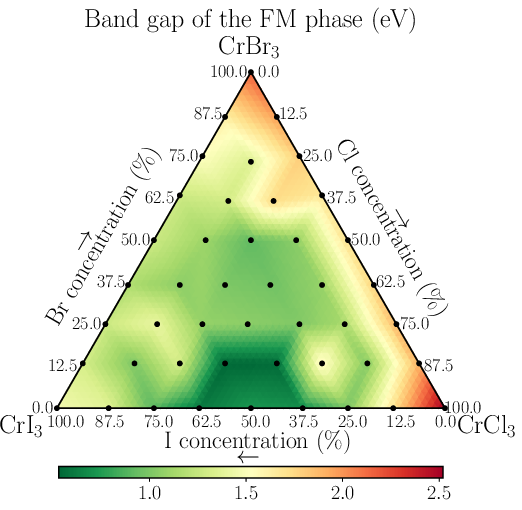
Figure 4: Band gap heatmap for FM-ordered alloys, delineating regions of maximal and minimal gap values as a function of halide content.
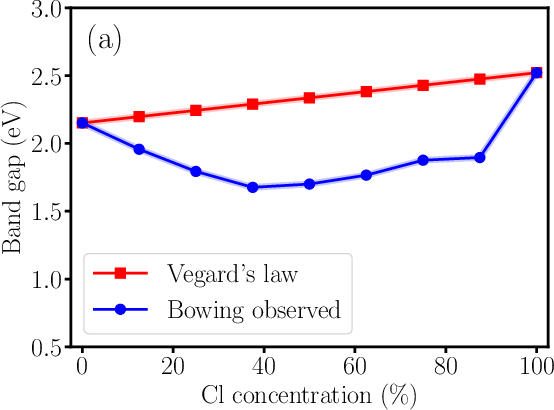
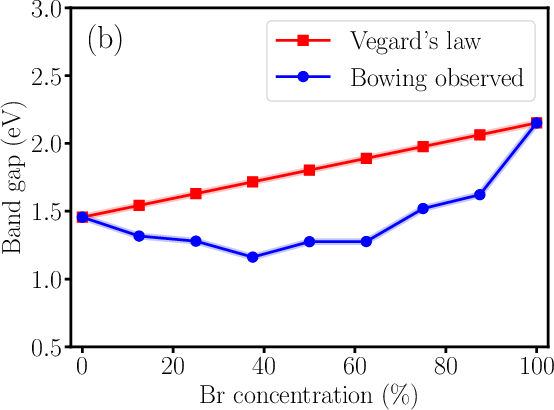
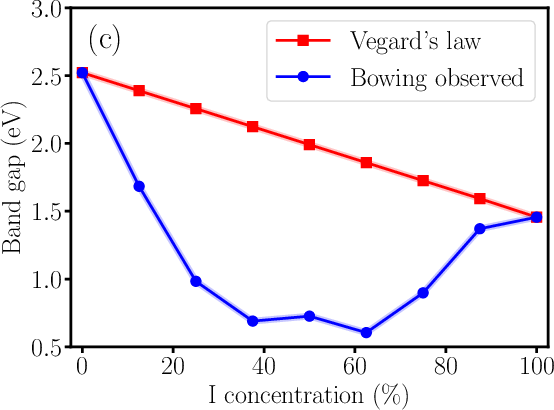
Figure 5: Quantification of band gap bowing at Br–Cl, I–Br, and Cl–I edges, illustrating deviation from the Vegard's law prediction (blue) by the observed values (red).
Magnetic Interactions
Curie temperature (37) varies smoothly as a function of composition, mirroring the linear trend observed in the nearest- and next-nearest-neighbor exchange integrals (38, 39). The highest 20 values are localized in the I-rich sector, with a minimum near the Cl-rich region, aligned with experimental benchmarks for parent compounds.
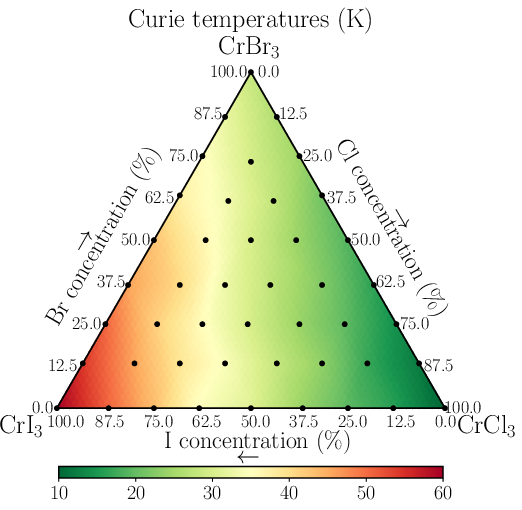
Figure 6: Curie temperature heatmap for CrX21 alloys, capturing the compositional dependence and smooth variation across the ternary diagram.
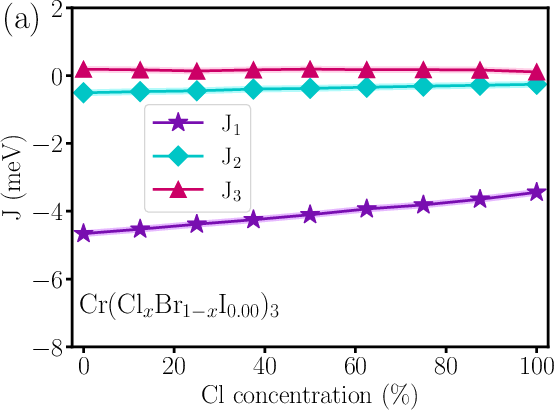
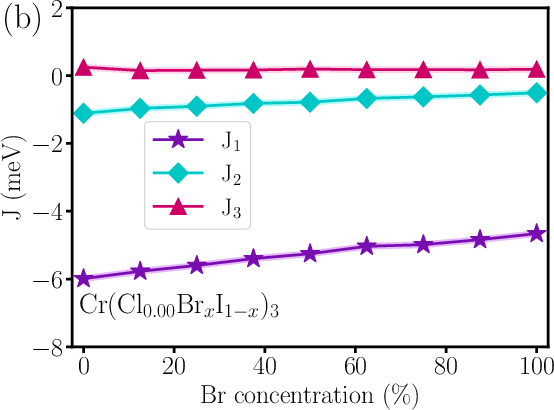
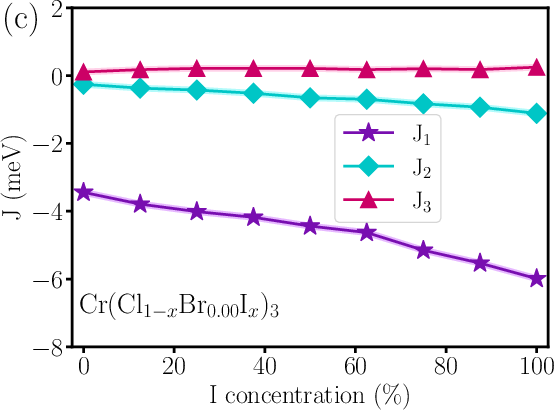
Figure 7: Evolution of magnetic exchange parameters 22, 23, 24 along binary edges, highlighting nearly linear compositional dependence.
Thermodynamic Phase Stability
Mixing enthalpy calculations indicate modest positive values, with the largest (81 meV/f.u.) in Cl–I mixed compositions, but the inclusion of configurational entropy leads to negative or near-zero Gibbs free energies at finite temperatures for most of phase space except the Cl–I edge. Alloys near the equiatomic region benefit most from entropy, stabilizing at lower synthesis temperatures. This accounts for the experimental absence of Cl/I-rich alloys and robust stability of Br/Cl and Br/I alloys.
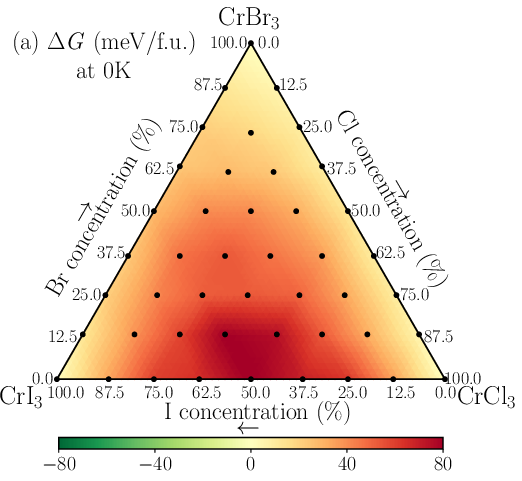
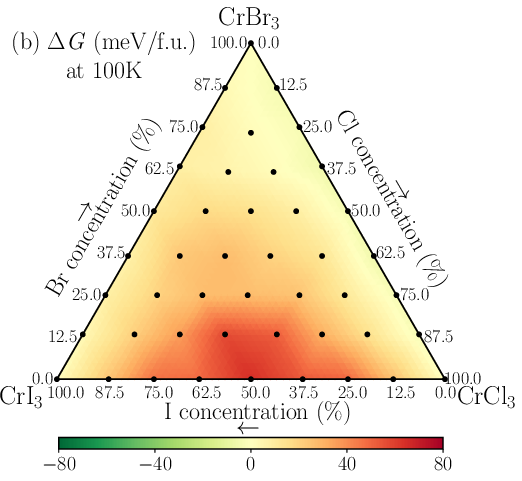
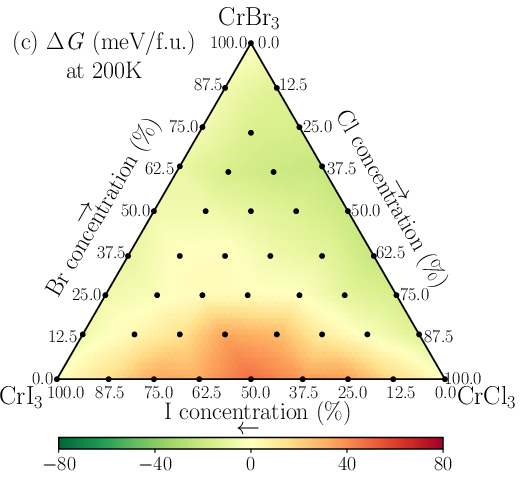
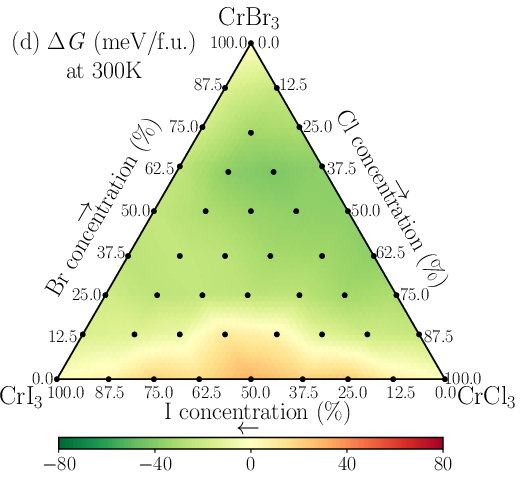
Figure 8: Gibbs free energy for alloys at several temperatures; green denotes thermodynamically stable regions induced by configurational entropy.
Implications and Outlook
This work delivers several significant insights:
- Microscopic control of magnetic phase stability through halogen alloying: The FM/AFM energy landscape is highly sensitive to local chemistry, opening routes for targeted tuning of ground state magnetism for spintronic applications.
- Band gap tunability and nonlinearity: Pronounced electronic structure bowing enables customizable gaps for optoelectronic integration, while also indicating strong coupling between lattice, electronic, and magnetic degrees of freedom unique to 2D magnets.
- Thermodynamic stabilization strategy: Alloying can fundamentally enhance the synthesis window and shelf-life of otherwise unstable 2D magnets, paralleling strategies in high entropy alloys and multi-cation semiconductors. The phase diagram guides alloy selection for device-oriented targets balancing stability and performance.
- Magnetic exchange and 25 engineering: Smooth compositional control of 26 parameters and 27 is valuable for precise design of 2D spintronic and magnonic devices.
Future theoretical work should address vibrational entropy contributions, possible dynamical disorder, and the integration of strain/field effects, while experimental synthesis should exploit identified stable alloy regions for device prototyping.
Conclusion
Through high-fidelity DFT and SQS modeling, the paper systematically maps the effects of halogen alloying on the phase stability, magnetic order, electronic structure, and overall thermodynamics of monolayer CrX28 systems (2607.10030). Strong bowing in the band gap and the drastic modulation of FM-AFM energetic offsets as a function of composition enable fine electronic and magnetic tuning, while configurational entropy offers a path to thermodynamically stable 2D magnets beyond binary halide endpoints. The results bridge fundamental understanding and applied material design, positioning CrX29 alloys as leading candidates for atomically-thin spintronic materials engineering.