- The paper demonstrates that large brane tension and a mildly negative Weyl coupling yield enhanced neutron star masses and radii.
- It employs a Bayesian inference framework with multi-messenger data from NICER and GW170817 to constrain braneworld parameters.
- The study reveals that Weyl sector corrections, rather than local quadratic terms, are pivotal for altering compact star equilibrium.
Compact Stars in a Large-Tension Braneworld: Mildly Negative Weyl Coupling Consistent with NICER and Gravitational-Wave Data
Introduction and Motivation
The research investigates compact star equilibrium in a phenomenological braneworld scenario inspired by the effective Sahni--Shtanov framework. It specifically addresses how extra-dimensional gravity corrections alter the mass–radius (M--R) relations of neutron stars and probes the parameter space using Bayesian inference, leveraging multi-messenger constraints from LIGO/Virgo (GW170817) and NICER (PSR J0740+6620 and PSR J1231-1411).
The study confronts the well-known degeneracy between dense-matter microphysics (equation of state, EoS) and modifications to the gravitational sector. By fixing the SLy hadronic EoS and varying braneworld parameters, observables are directly mapped to gravitational-sector modifications. The theoretical framework builds upon Randall--Sundrum-type braneworld models, where local quadratic corrections (parametrized by brane tension λ) and nonlocal Weyl contributions (parametrized by αU and wU) are incorporated within modified TOV equations.
The modified Einstein equations on the brane include both local and nonlocal corrections. The local quadratic term, ρ2/(2λ), emerges from brane energy-momentum tensor variations, while the Weyl sector is closed phenomenologically using the ansatz ρU=αUρ and pU=wUρU. The effective stellar density and pressure are consequently altered:
ρeff=ρ+2λρ2+αUρ
peff=p+λpρ+2λρ2+wUαUρ
These modified terms enter the TOV equations, which are numerically integrated using the SLy EoS. The analysis captures the effects of varying R0, R1, and R2, focusing on their impact on maximum mass R3 and radius at R4 (R5).
Bayesian Inference and Observational Constraints
An affine-invariant ensemble MCMC sampler is used to perform Bayesian inference on the braneworld parameters with posterior samples constrained by three datasets: GW170817 tidal deformability (LIGO/Virgo), PSR J0740+6620 and PSR J1231-1411 mass–radius posteriors (NICER). The likelihood incorporates mass–radius coverage and penalizes models violating stability or compactness bounds.
The prior is centered on large brane tension (R6) and on GR values for Weyl parameters (R7, R8), but bounded within ranges that admit departures from GR.
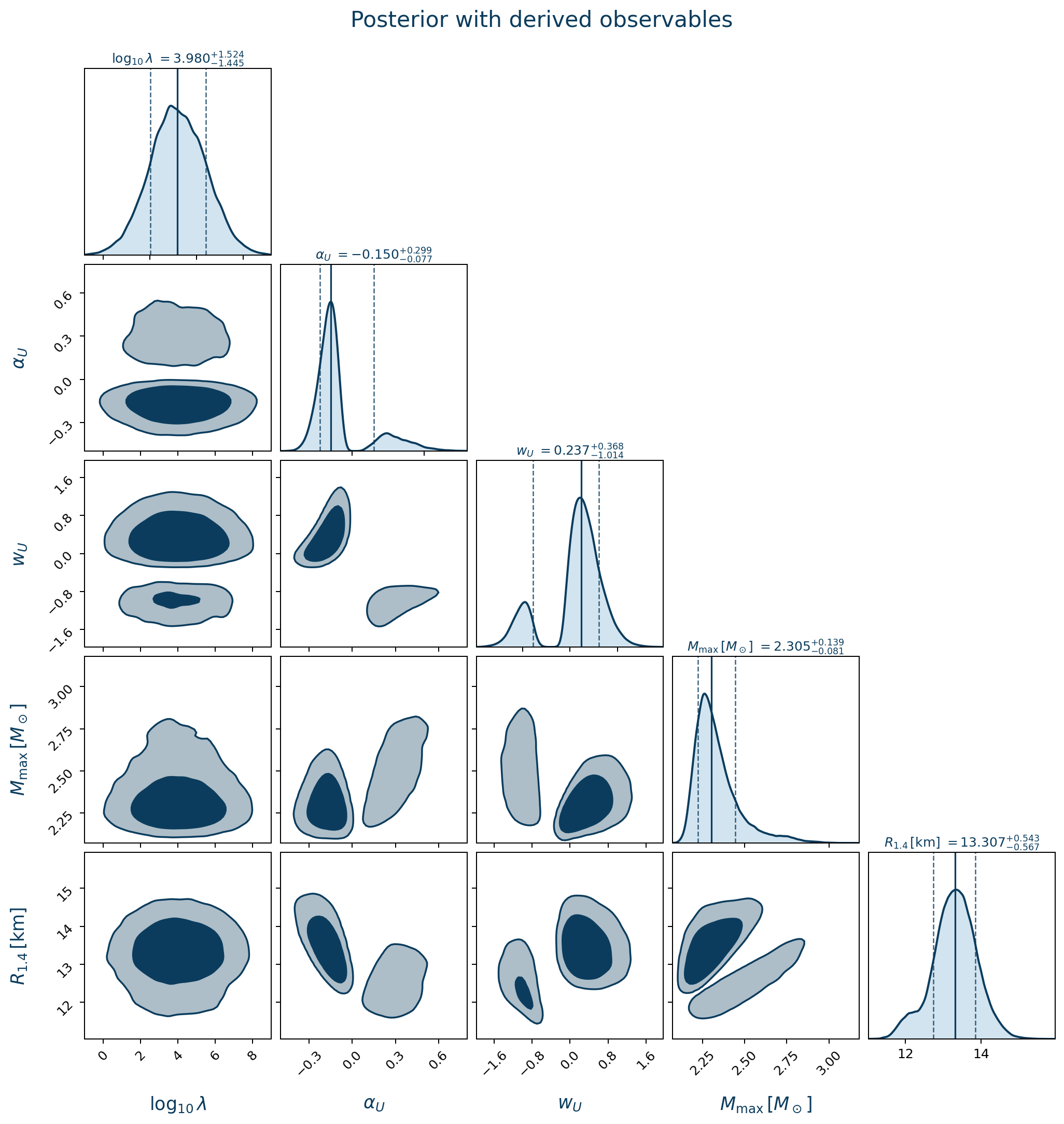
Figure 1: Posterior distributions for the braneworld parameters R9 and derived observables λ0; contours enclose 68% and 95% posterior probability, revealing dominant support at mildly negative λ1.
Results: Parameter Constraints and Mass--Radius Predictions
The inferred posterior favors a regime with large brane tension, λ2 (68%), corresponding to λ3, which suppresses the local quadratic correction in stellar interiors. The Weyl coupling λ4 is constrained to λ5 (68%), yielding mildly negative values that reduce the effective gravitational density and expand typical stellar radii.
The equation-of-state parameter λ6 is poorly constrained by the current datasets, with a broad posterior over λ7 (95%).
Posterior predictive values for key observables:
- Maximum mass: λ8 (68%)
- Radius at λ9: αU0 km (68%)
Both exceed the GR+SLy reference values (αU1, αU2 km). Notably, the upper posterior tail of αU3 overlaps the secondary mass range inferred for GW190814 (αU4--αU5), though the posterior median and highest probability region remain below this.
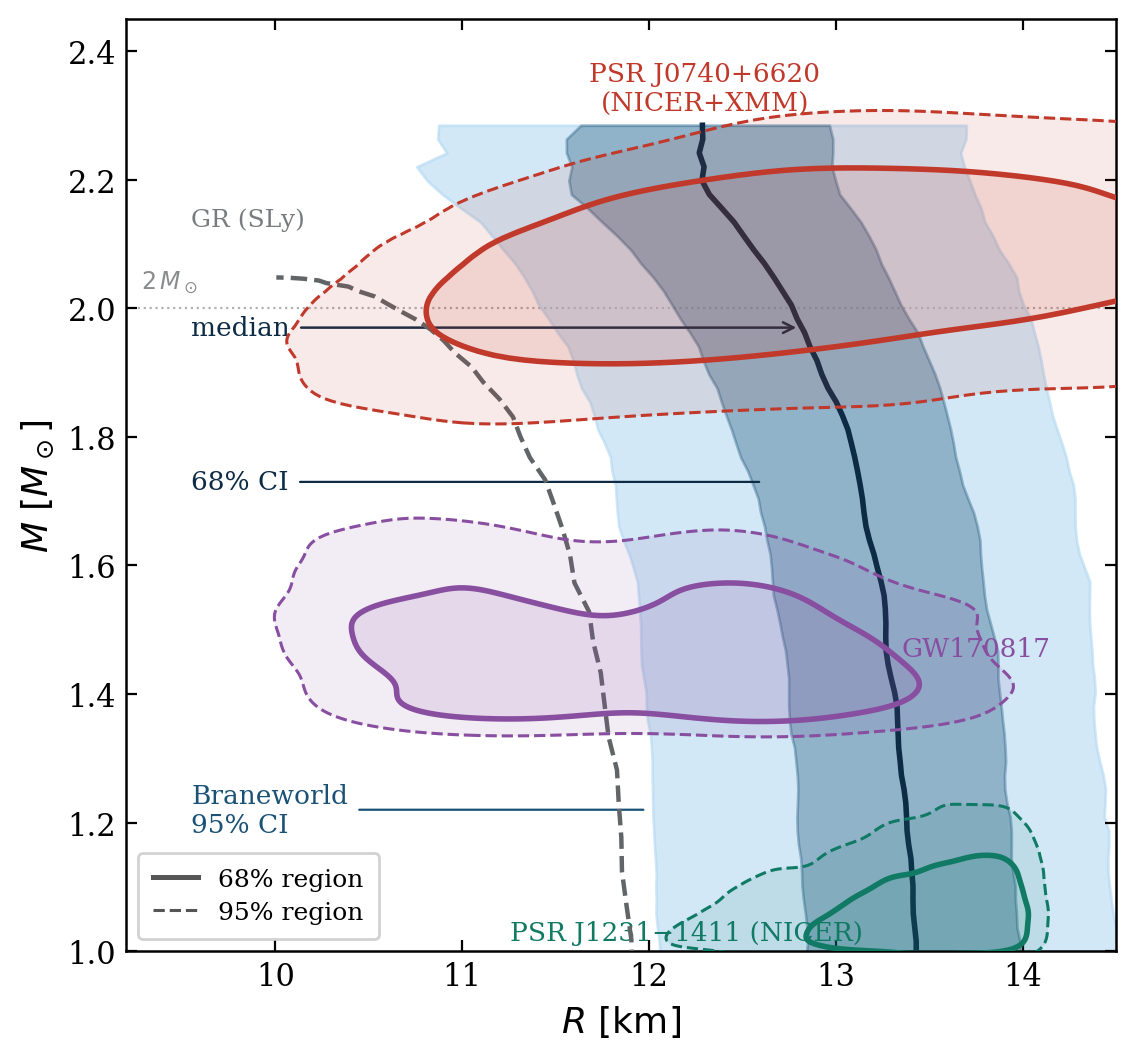
Figure 2: Posterior predictive mass–radius band for the SLy EoS in the braneworld model, showing 68% and 95% credible regions versus the standard GR mass–radius curve; the band is constrained by LIGO/Virgo GW170817 and NICER mass–radius data.
Physical and Theoretical Implications
The inference demonstrates that effective braneworld corrections, when parameterized with large tension and mildly negative Weyl coupling, can accommodate multi-messenger neutron star constraints without requiring extreme departures from GR. The local quadratic correction is subdominant in the preferred regime; the Weyl sector dominates phenomenological leverage.
The slightly negative αU6 acts as a mild gravitational screening agent, shifting mass–radius sequences rightward (towards larger radii and maximum masses) and alleviating—but not fully resolving—the αU7 neutron star interpretation for GW190814.
The model highlights the critical role of the Weyl closure: the sign and magnitude of αU8 can compensate (or enhance) local brane corrections, modifying equilibrium properties in a nontrivial, model-dependent way. This underscores the point that increased compact star masses in braneworld scenarios are not robust generic predictions, but instead depend on detailed phenomenological closures and assumptions about the bulk geometry.
The degeneracy in αU9 points to the need for further observational precision, potentially from next-generation gravitational-wave detectors or improved NICER statistics, to break parameter degeneracies intrinsic to phenomenological closures.
Comparison with Prior Braneworld Studies
Previous braneworld neutron star analyses often emphasized the possibility of enhanced maximum masses due to bulk effects or Weyl stresses. The current results clarify that such enhancements are not universal: depending on the phenomenological treatment of the Weyl sector and brane tension, local corrections can destabilize configurations unless compensated by screening contributions from the Weyl term.
The explicit Bayesian approach provides a quantitative anchor for assessing these competing effects. It also motivates future work on self-consistent bulk solutions, anisotropic Weyl closures, radial stability analyses, and tidal deformability studies in braneworld contexts.
Practical and Theoretical Outlook
From a practical standpoint, the model provides a framework to interpret compact star observations as probes of extra-dimensional gravity, with posterior parameter constraints directly tied to multi-messenger data. The rightward shift in wU0--wU1 space may enable a broader range of viable equations of state and gravity theories subject to ongoing constraints.
Theoretically, the results highlight the importance of Weyl sector closure, emphasizing that robust predictions require careful modeling of the bulk-brane dynamics. The lack of meaningful constraint on wU2 suggests the need for improved theory-data mapping and more sensitive observational probes.
Future developments in AI-aided Bayesian inference, physical modeling, and data integration will further sharpen the ability to distinguish gravitational-sector modifications from microphysical uncertainties in neutron star structure, particularly as multi-messenger datasets grow.
Conclusion
The Bayesian inference of the effective Sahni--Shtanov braneworld model using multi-messenger neutron star data identifies a large-tension regime (wU3) and a mildly negative Weyl coupling (wU4) as phenomenologically consistent with existing GW170817 and NICER mass–radius constraints. This combination yields mass–radius sequences with wU5 and wU6 km—both larger than in GR with SLy EoS—without requiring extreme parameter values.
The analysis demonstrates that the Weyl sector is the dominant lever for phenomenological deviations from GR; local quadratic corrections remain subdominant under the high-tension prior. Enhanced maximum masses are contingent upon negative Weyl coupling and not generically predicted by braneworld gravity. Further observational and theoretical work is needed to resolve parameter degeneracies and clarify the bulk-brane correspondence for compact-star equilibrium.
Figure 2: Posterior predictive mass–radius band highlights the rightward shift relative to GR, as favored by multi-messenger data and Weyl screening.