- The paper presents a kinetic-theory based RET6 framework that systematically derives dynamical pressure and non-equilibrium relations for polyatomic gases in curved spacetime.
- By applying the Maximum Entropy Principle and minimal coupling in FLRW cosmology, the model confirms a robust convergence to a de Sitter attractor, aligning with ΛCDM evolution.
- Numerical analyses show that non-equilibrium corrections rapidly damp out, validating the strong energy condition and limiting bulk viscous effects from driving cosmic acceleration.
Six-Field Rational Extended Thermodynamics of Polyatomic Gases in Curved Spacetime: An Expert Summary
Overview and Motivation
This paper introduces a generally covariant six-field Rational Extended Thermodynamics (RET6) framework for relativistic polyatomic gases in curved spacetime (2607.09463). The approach incorporates the dynamical pressure as the canonical non-equilibrium variable, systematically derived from a polyatomic extension of the Boltzmann–Chernikov kinetic equation and closed via the Maximum Entropy Principle (MEP). Unlike phenomenological Müller–Israel-type theories, RET6 enforces that all constitutive and production relations arise from kinetic foundations, not ad hoc hypotheses. The authors further extend RET6 to curved backgrounds by minimal coupling and analyze its cosmological implications within the homogeneous and isotropic FLRW geometry.
The principal results are: (i) a kinetic-theory no-go theorem demonstrating that any stress-energy tensor from a non-negative relativistic one-particle distribution satisfies the strong energy condition (SEC), excluding self-driven acceleration by kinetic matter alone; (ii) local and asymptotic properties of the ΛRET6 model (RET6 with a cosmological constant), including a rigorous demonstration of a late-time de Sitter attractor; and (iii) detailed numerical investigations confirming that, with physically motivated parameters, non-equilibrium corrections rapidly decay, yielding an expansion history essentially indistinguishable from ΛCDM.
RET6 Construction from Kinetic Theory
RET6 is derived as a principal subsystem of the fifteen-field polyatomic RET15 hierarchy, distinguished by setting the trace-free components of the Lagrange multipliers to zero while retaining the scalar dynamical pressure 60. The system is governed by particle, energy-momentum, and projected third-order moment conservation laws, with independent fields 61. The underlying polyatomic Boltzmann–Chernikov equation includes an internal-energy variable 62, whose state density 63 generalizes the phase-space structure for non-monatomic gases.
Explicitly, the energy-momentum tensor takes the form
64
with 65 the equilibrium pressure, 66 the total energy density, and 67 the spatial projector in the local rest frame. The closure and production terms for higher moments, including the dynamical pressure relaxation, are determined unambiguously by MEP closure, differentiating this approach from phenomenological models.
Hyperbolicity and causality are explicitly verified in the admissible state space. The region ensuring characteristic velocities 68 is delineated in the 69-plane, where 60 is the dimensionless inverse temperature and 61.
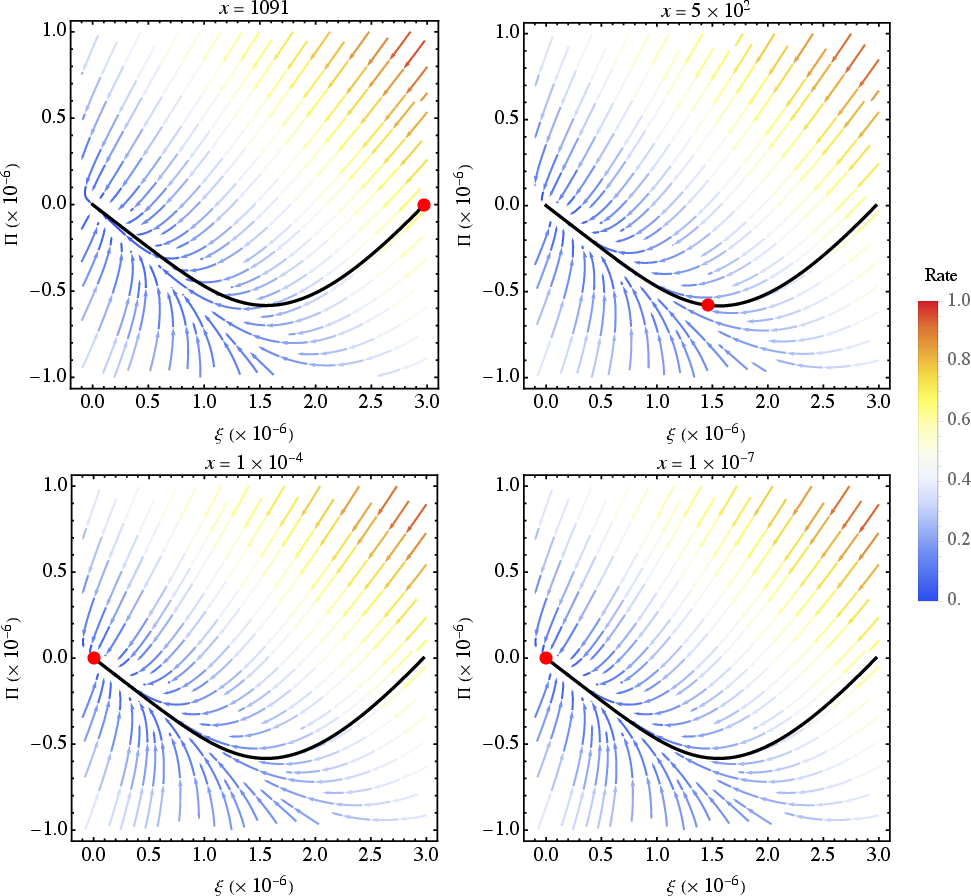
Figure 1: Phase portrait of the de Sitter attractor for the 62RET63 dynamical system, showing the system's trajectory approaching 64.
Extension to Curved Spacetimes and FLRW Cosmology
Minimal coupling promotes the RET65 system to general relativity, replacing 66 and all derivatives with covariant ones. In FLRW geometry, dissipative variables other than 67 decay due to isotropy and homogeneity, so RET68 provides the unique hyperbolic non-equilibrium extension of perfect-fluid Euler cosmology.
The system reduces to evolution equations for the scale factor 69, temperature-like variable Λ0, and dynamical pressure Λ1, supplemented by the generalized Friedmann equations. In dimensionless units, the dynamical pressure acts as a source of bulk viscous corrections, with a relaxation equation gauged by the kinetic relaxation time Λ2.
Strong numerical evidence is given that for cosmological initial data, non-equilibrium corrections from Λ3 are rapidly damped, leaving only transient departures from equilibrium.
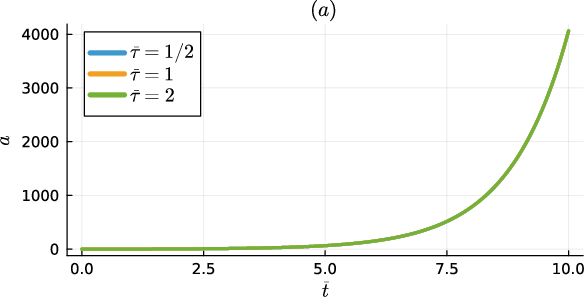
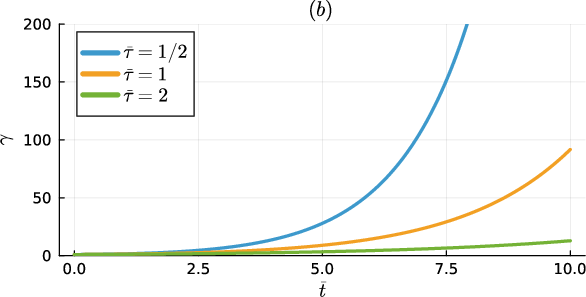
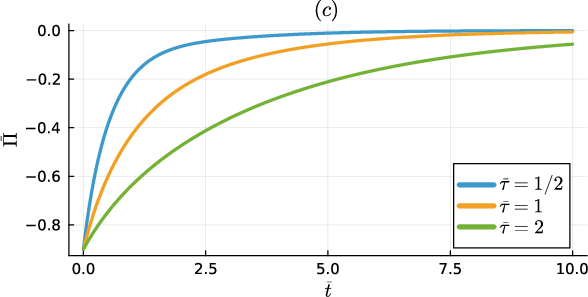
Figure 2: Evolution of Λ4, Λ5, and Λ6 for Λ7, Λ8, and initial negative bulk pressure, showing rapid relaxation.
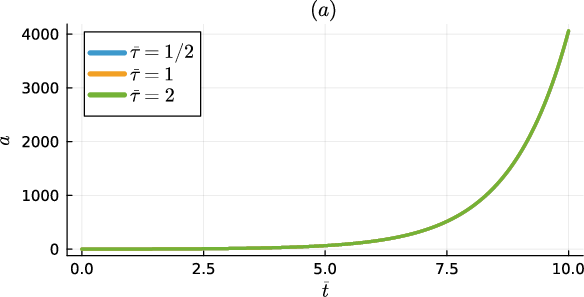
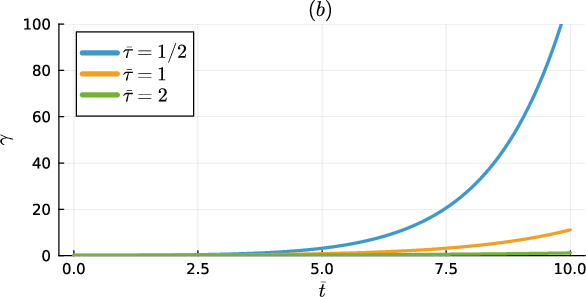
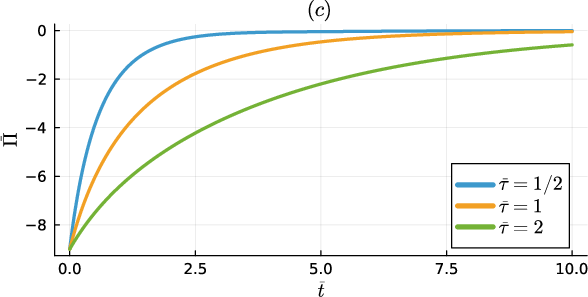
Figure 3: Evolution with Λ9, 60; the larger relativistic effects yield higher magnitude but still rapidly damped non-equilibrium transients.
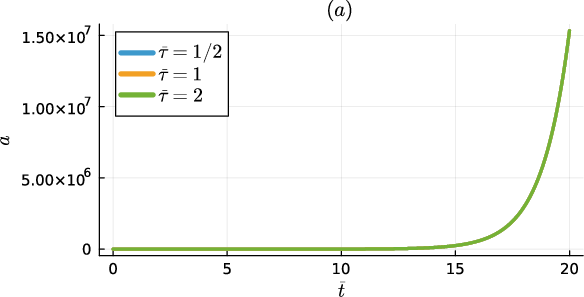
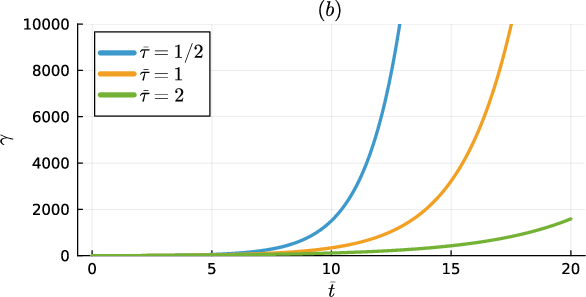
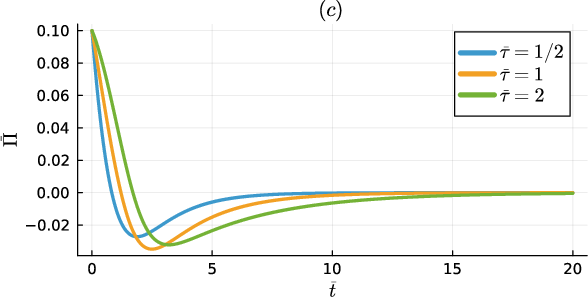
Figure 4: Non-monotonic relaxation of 61 for initial positive values; the dynamical pressure briefly overshoots before decaying.
Kinetic-Theory No-Go Theorem and Implications
A key theoretical result is the kinetic-theory no-go theorem: any macroscopic stress-energy constructed from a non-negative, admissible polyatomic one-particle distribution satisfies the SEC—
62
(pointwise, in any local inertial frame). The theorem is independent of closure details, applying to all finite-moment RET models with a kinetic foundation. In FLRW applications, this implies that a RET63 polyatomic gas cannot drive accelerated cosmic expansion; regardless of the magnitude of allowed bulk pressure, the deceleration parameter remains 64 in the absence of a cosmological constant or truly exotic matter.
65RET66 Analysis and de Sitter Attractor
Upon restoring a positive cosmological constant to the Einstein equations, the 67RET68 system is shown to possess a de Sitter attractor at late times. A dynamical-systems analysis, conducted in rescaled variables suitable for late-time asymptotics, yields that all eigenvalues of the linearized Jacobian at the attractor are negative definite provided 69. Thus, the system is locally asymptotically stable and cosmic expansion generically converges to de Sitter behavior at late times, even with non-zero initial 60.
Numerical Results: Convergence to 61CDM
Numerical integrations, both for arbitrary initial non-equilibrium states and for realistic post-recombination parameters, confirm the analytic predictions.
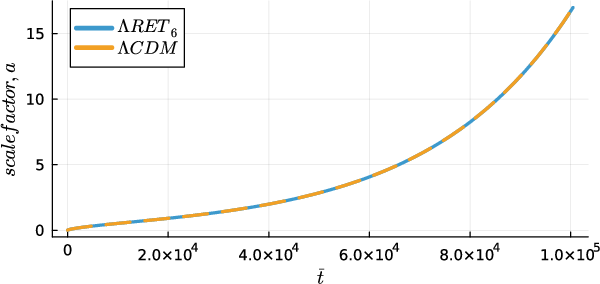
Figure 5: Direct comparison of 62 obtained with 63RET64 and standard 65CDM evolution from recombination, showing indistinguishable expansion histories.
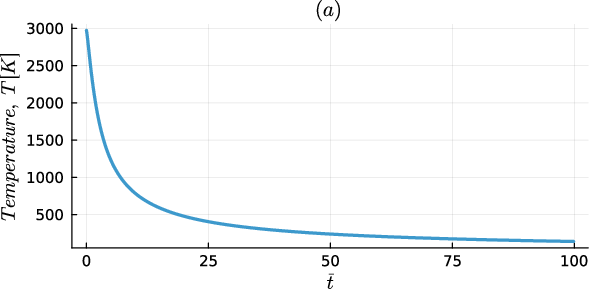
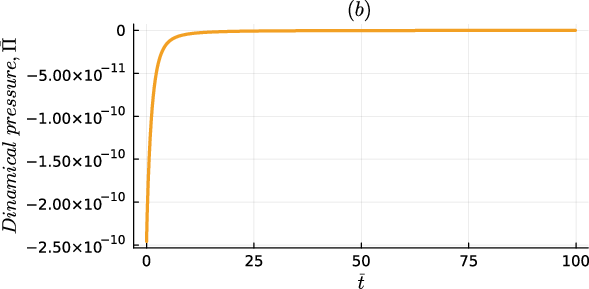
Figure 6: Temperature and dynamical pressure evolution: 66 returns to equilibrium (67) rapidly, and 68 decreases monotonically.
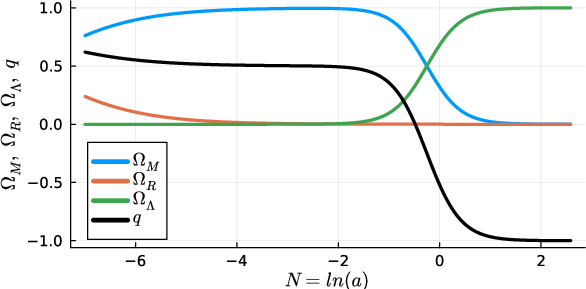
Figure 7: Density parameters 69, Λ0, Λ1 and deceleration parameter Λ2 under Λ3RETΛ4 evolution; dynamical corrections are negligible after early times.
Over a range of realistic relaxation times and initial conditions, the non-equilibrium contributions from the dynamical pressure are consistently found to be subdominant and quickly erased by relaxation. The convergence to Λ5CDM is robust, and deviations are at most transient.
Conclusions and Outlook
This work provides a rigorous, kinetic-theory-consistent construction of a six-field relativistic dissipative gas in general relativity that incorporates polyatomic internal structure. All field equations and closure relations are derived from first principles, without phenomenological input. The kinetic-theory no-go result sets a sharp boundary for what types of cosmic acceleration can be realized by kinetic matter: in standard RET closures, bulk viscosity is insufficient to drive accelerated expansion.
Practical implications include the validation of Λ6CDM as a late-time attractor even in the presence of kinetic-theory-motivated non-equilibrium corrections, with RETΛ7 offering a theoretically robust mechanism for bulk viscosity and transient deviations from equilibrium. Theoretically, this framework demonstrates that RET-based cosmologies, once coupled to gravity, naturally inherit foundational energy conditions from their kinetic microstructure, reinforcing the hierarchy between dark energy and standard matter models.
Future developments may explore: alternative closure schemes to circumvent the SEC; inclusion of more complex non-equilibrium variables (e.g., heat flux, shear stress in less symmetric cosmologies); and the impact on early-universe processes such as baryogenesis, structure formation, or nonequilibrium phase transitions. The RETΛ8 paradigm offers a promising base for mathematically rigorous, physically motivated cosmological fluid modeling beyond ideal hydrodynamics.