A Sovereign, Open-Source Foundation Model for German and English
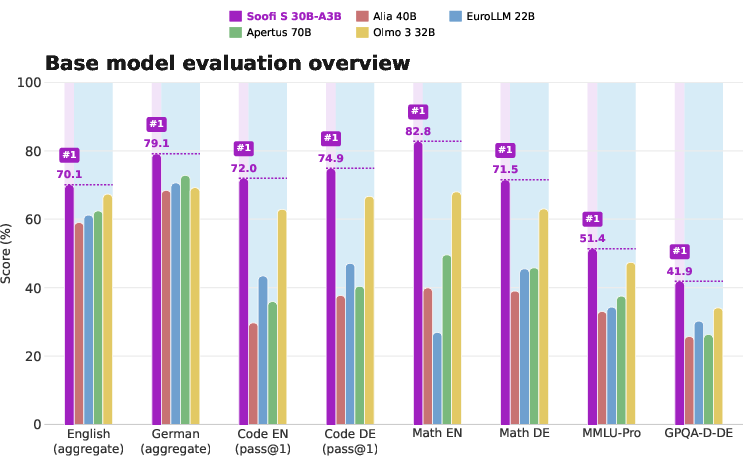
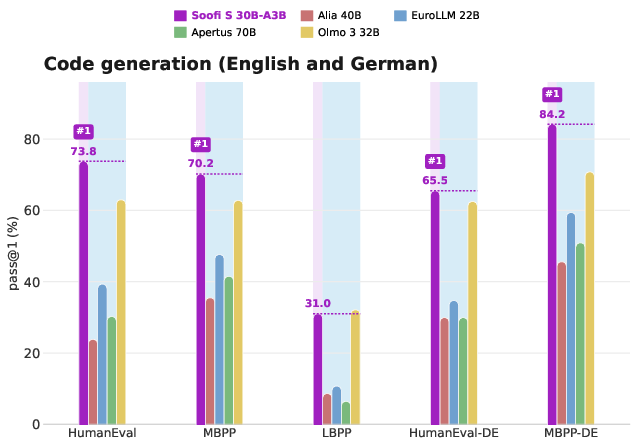
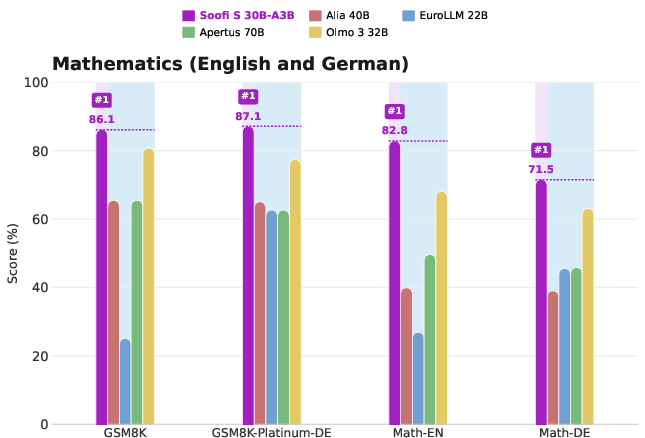
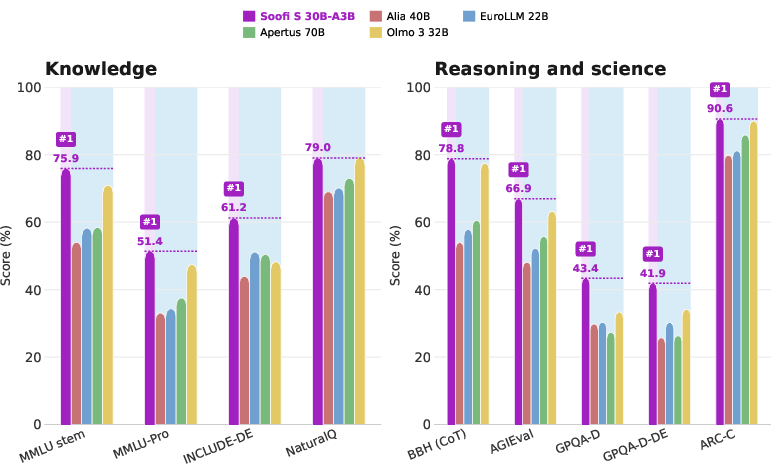
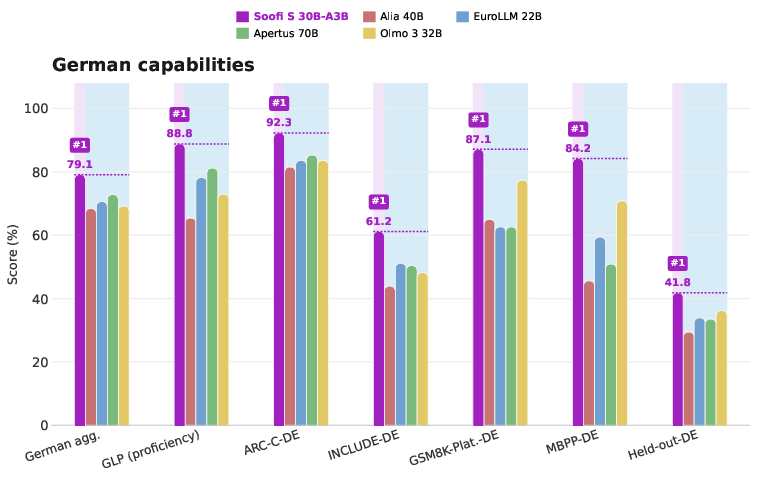
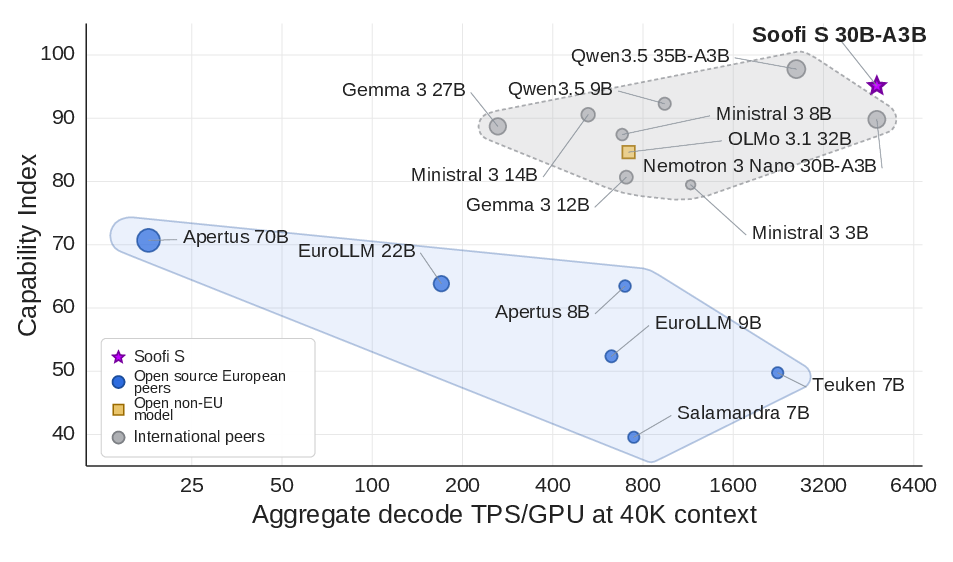
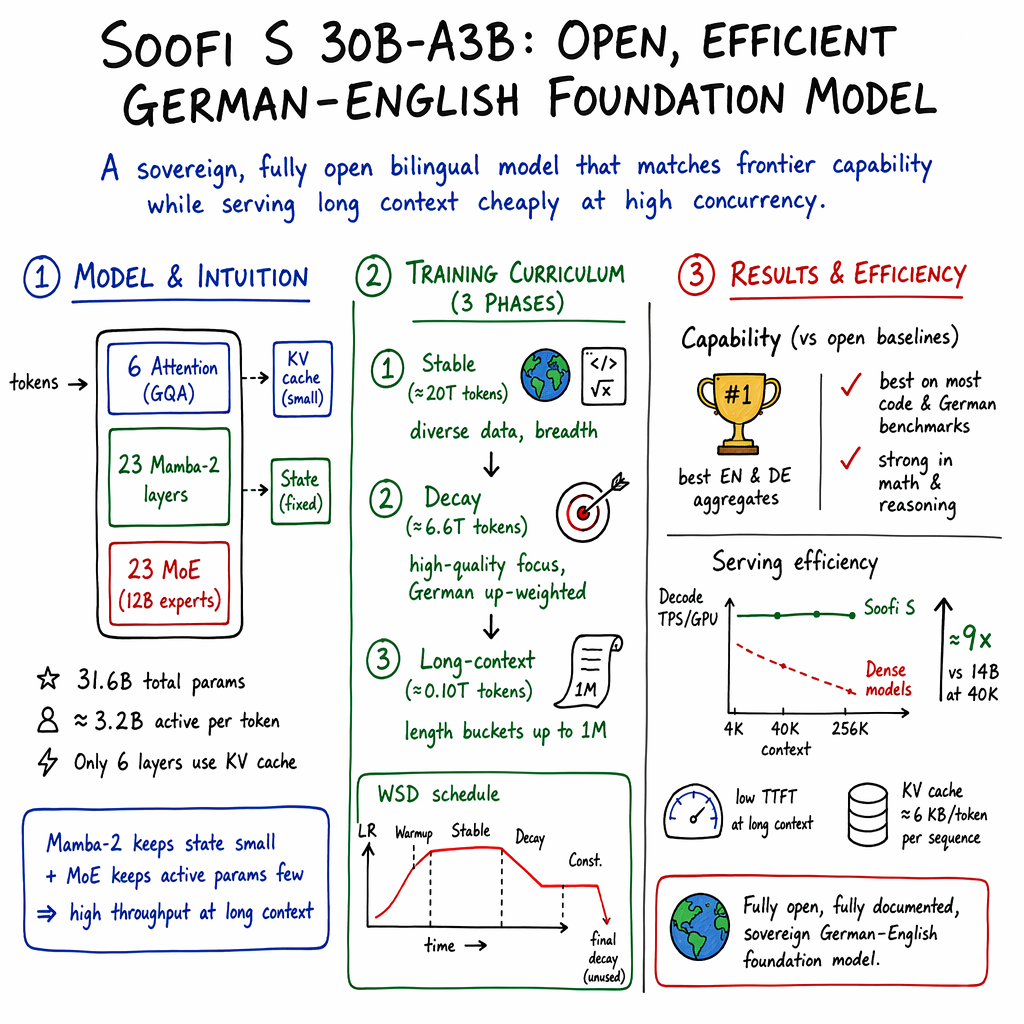
Abstract: We present Soofi S 30B-A3B, a sovereign, open-source Mixture-of-Experts (MoE) hybrid Mamba Transformer foundation model for German and English. Its hybrid design activates only 3B of 30B parameters per token and keeps the inference cache near-constant as context grows, giving it a decisive throughput advantage over dense models for long-context, high-concurrency deployment. Pretrained on roughly 27 trillion tokens with deliberately up-weighted German, Soofi S matches dense 14 to 27B models on aggregate English and German benchmarks while achieving the best code aggregates in both languages among 17 open base models, and outperforms every European sovereign baseline in our comparison, including ones far larger in active parameters. Among fully open models, Soofi S obtains the highest English and German evaluation scores, ahead of Olmo 3 32B and Apertus 70B. Soofi S was built end-to-end on the German Industrial AI Cloud, a sovereign HPC scale AI infrastructure operated by Deutsche Telekom in Munich. Soofi S will be released under highly permissive, open-access terms: weights, selected intermediate checkpoints, full per-source data accounting, hyperparameters, and training and evaluation code. Where source licenses permit, data-construction artifacts are released under permissive licenses; commercially licensed sources are documented with aggregate statistics and exact mixture accounting.
Paper Prompts
Sign up for free to create and run prompts on this paper using GPT-5.
Top Community Prompts
Explain it Like I'm 14
Overview
This paper introduces Soofi S, a large open-source AI LLM designed to be excellent at both German and English. It was built to be “sovereign,” which means it was trained on European infrastructure with strong transparency so people can trust and audit how it was made. Soofi S is engineered to be fast and affordable to run when handling long documents or many users at once.
What questions did the researchers ask?
Here are the main questions the team wanted to answer:
- Can we create a powerful, fully open model that treats German as a first-class language, not an afterthought?
- Can we make the model fast and cost-efficient for long texts and busy systems (many users at the same time)?
- Can we share enough details (data mix, code, checkpoints, settings) so others can audit, reproduce, and improve the model?
How did they build and train the model?
The model’s “brain” in simple terms
- Total size vs. active size: Soofi S has about 31.6 billion “parameters” (think of parameters as tiny adjustable knobs that help the AI learn patterns). But it only uses about 3.2 billion of them at a time for each word it processes. This makes it act like a big model with a small model’s running cost.
- Mixture-of-Experts (MoE): Imagine a large team of specialists (experts). For each word, the model picks a few relevant specialists instead of asking everyone. This saves time and energy while keeping quality high.
- Mamba-2 + Transformer: Transformers are like readers with powerful “attention,” looking back at previous words. Mamba-2 adds a smart memory that doesn’t grow huge as the text gets longer. Combining them keeps speed high even for very long documents.
- Small “notes” during generation: Traditional Transformers store a lot of “notes” (called a KV cache) about past words. That grows as the text gets longer and slows things down. Soofi S keeps those notes small and almost constant, so it stays fast.
Training recipe and data (like teaching the model)
- Tokens: The model was trained on around 27 trillion tokens (a “token” is a chunk of text, often roughly a word or part of a word).
- Phases of learning:
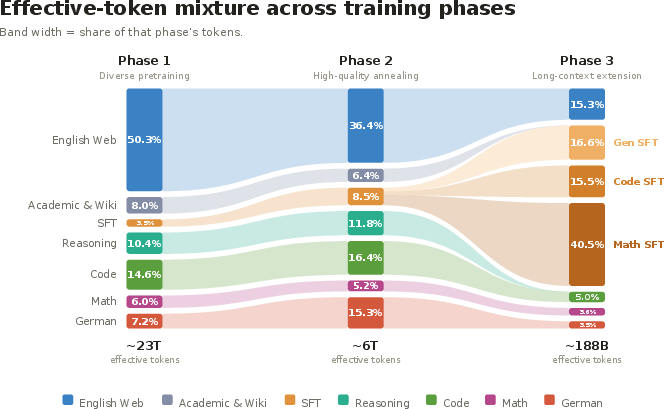
- Phase 1 (diverse reading): The model reads a very wide range of text—web pages, code, math, reasoning, and documents—to learn general knowledge. German is deliberately up-weighted.
- Phase 2 (high-quality focus): The model concentrates on the best-quality data (more code, math, reasoning, instructions, and more German). Think of this as polishing its skills.
- Phase 3 (long-context stretch): The model practices reading extremely long texts—up to about 1,000,000 tokens—so it stays stable and useful for long reports or books.
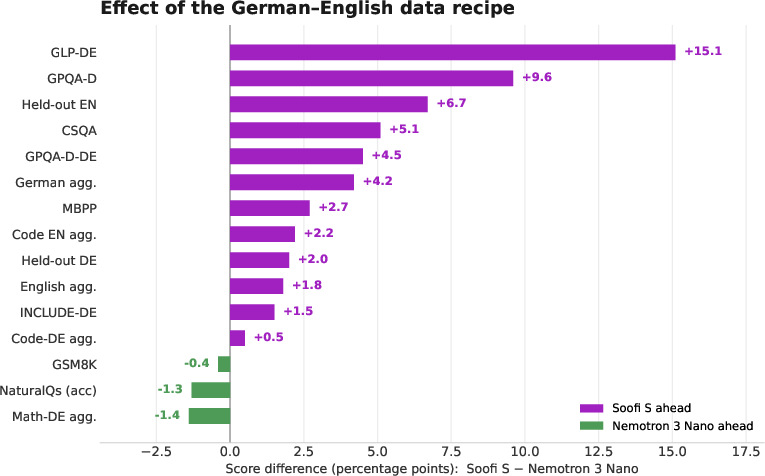
- Why more German: Many multilingual models focus mostly on English. Soofi S raises the share of German during training to make sure it performs strongly in German too.
- Openness: The team plans to release the weights, some checkpoints, training and evaluation code, and detailed data accounting. One data source (Genios, a commercial news archive) cannot be redistributed, but its contribution is documented. Almost everything else is reconstructable from public sources.
Where and how it was trained
- Sovereign infrastructure: The model was trained in Germany on a high-performance AI cloud operated by Deutsche Telekom. This supports European data protection and energy goals (renewable power, efficient cooling, and heat reuse).
Long-context efficiency (why it’s fast when texts are long)
- Picture processing text like a conveyor belt. Other big models slow down as the belt gets longer because they carry bigger and bigger “notes” about past words. Soofi S keeps those notes small and reads fewer expert weights per token, so it can keep the belt moving quickly—even with very long inputs and many users at once.
What did they find?
Here are the key results:
- Strong German and English performance: Soofi S matches or beats models that activate far more parameters (like dense 14–27B models) on overall English and German benchmarks.
- Best code scores among open base models tested: Across 17 open base models, Soofi S achieves the strongest code results in both languages.
- Top fully open model on English and German: It scores higher than other fully open models like Olmo 3 (32B) and Apertus (70B) on aggregate English and German evaluations.
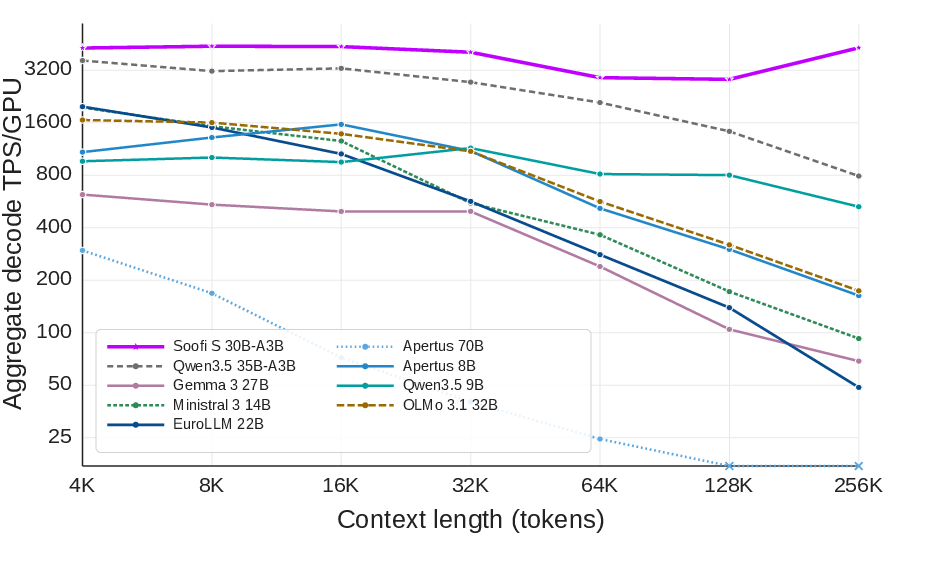
- Long-text speed: At very long contexts (for example, 40,000 tokens), Soofi S achieves 8–9× higher generation throughput per GPU than typical dense 14–24B models. Its speed stays almost flat from 4,000 up to 256,000 tokens, while many other models slow down.
- Full transparency: The paper provides detailed training settings, data mix per source, and the reasons behind design choices, enabling audits and reproduction.
Why it matters:
- Strong German support helps schools, researchers, companies, and public institutions that need high-quality AI in German.
- Faster, cheaper serving at long contexts means better user experience and lower costs when handling lengthy documents or many simultaneous chats.
What’s the impact?
Soofi S shows that you can build:
- A powerful, open, and transparent model that treats German seriously.
- A model that is practical to deploy at scale because it stays fast with long inputs and high traffic.
- A foundation others can audit, rebuild (where licenses allow), and improve.
This can help Europe advance “sovereign” AI—technology developed and operated under local rules and values—while giving developers and institutions a strong, open starting point for German and English applications, from coding help and math tutoring to document analysis and knowledge assistants.
Knowledge Gaps
Knowledge gaps, limitations, and open questions
Below is a consolidated list of specific gaps and open questions that remain unresolved in the paper and could guide future research.
- Architecture ablations are absent: no systematic study of the trade-offs among number and placement of GQA layers, Mamba-2 state size/groups, expert count/top-k, routing function, and auxiliary load-balancing losses versus accuracy and throughput, especially for German-heavy training.
- Expert routing behavior is uncharacterized: no analysis of expert load balance, token drop/overflow rates, specialization by language (German vs. English), domain (code/math/web), or brittleness under distribution shift.
- Positional information in attention layers is unclear: the table lists “Positional embeddings: none,” yet 6 GQA layers require some positional mechanism; clarify what (if any) positional scheme is used and how it scales to 1M tokens.
- Tokenizer suitability for German is not evaluated: no assessment of subword efficiency on German compounding/inflection, OOV rates, or whether a German-aware tokenizer would reduce sequence length and improve quality.
- No head-to-head baseline on the same data: the impact of adopting the Nemotron hybrid architecture versus a dense Transformer or pure Mamba baseline trained on the identical German–English mixture remains unmeasured.
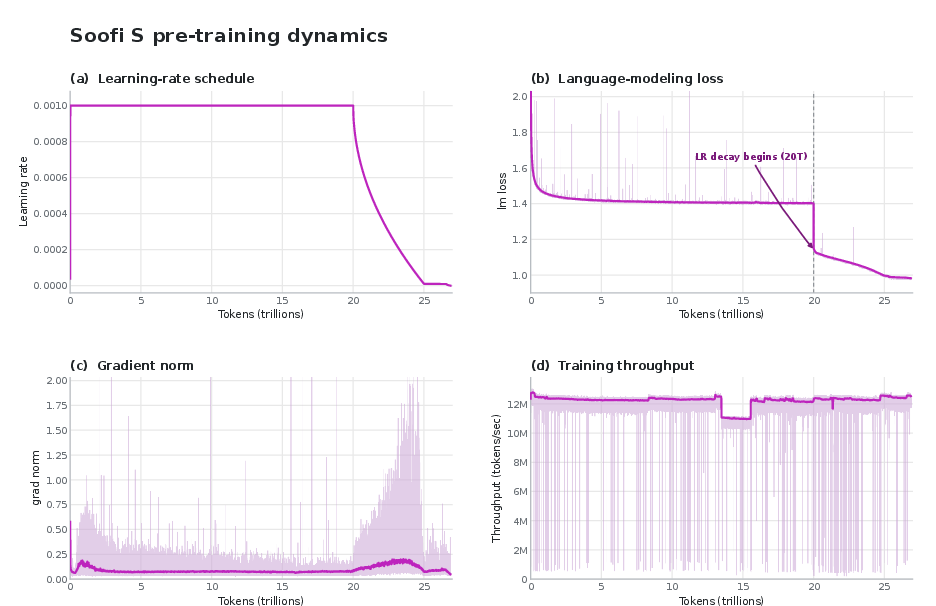
- Optimization schedule choices are not ablated: WSD with minus_sqrt decay, the constant-LR tail, and the discarded final decay stage are presented without comparisons to cosine, linear, one-cycle, or different annealing token budgets.
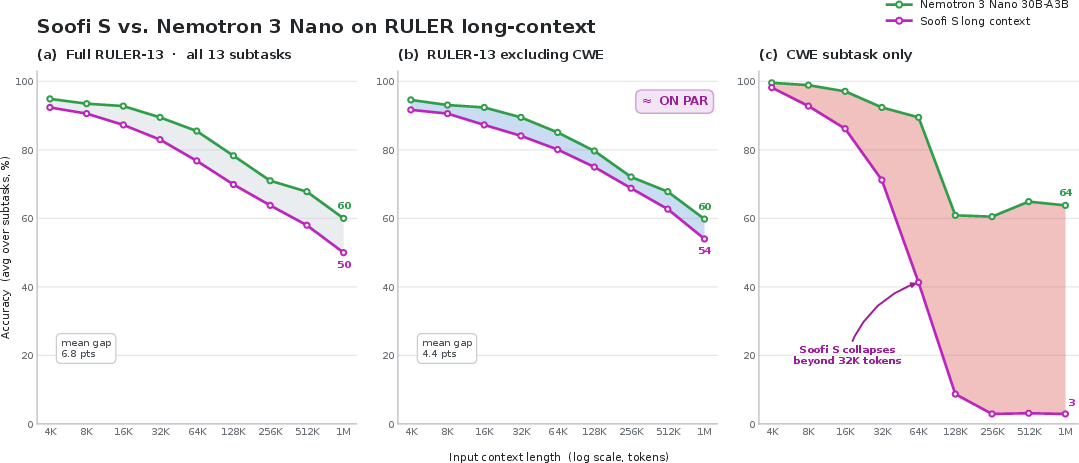
- Long-context functionality lacks task evaluations: beyond throughput, there is no evidence on retrieval, reasoning, summarization, and coherence at 32K–1M tokens (e.g., LongBench, RULER, LV-Eval, NILC/needle-in-haystack, book-level QA).
- Long-context training design is underexplored: no ablation of bucket allocations, total LC tokens (~100.7B), the “no intra-document masking” choice, or the heavy SFT share in Phase 3 on style drift and downstream behavior.
- Potential regression after long-context adaptation is unreported: whether Phase 3 degrades short-context performance, code/math strength, or calibration is not evaluated.
- Memory usage is not quantified: serving results report decode TPS but omit per-request VRAM footprints versus context/batch size and prefill latency, which are critical for capacity planning.
- Hardware generality is untested: throughput is measured on B200 (TP=1, batch 32); no results on A100/H100/L40S/consumer GPUs, multi-GPU tensor-parallel inference, or different concurrency regimes.
- Evaluation contamination risk is unresolved: the mix explicitly includes paraphrased training splits for standard benchmarks and substantial synthetic/translated content; no overlap audits (near-duplicate and semantic) against all eval sets are provided.
- Global deduplication across sources is not documented: outside curated code, there is no evidence of cross-corpus dedup/near-dedup at scale to reduce memorization and leakage.
- Quality and impact of machine-translated and synthetic German are not measured: no human ratings or automatic metrics (MQM, BLEURT, COMET) for translationese artifacts, domain/style skew, or effects on German downstream performance and safety.
- German coverage granularity is not reported: performance across D-A-CH variants, domain-specific German (legal, medical, finance), dialectal robustness, and orthographic variants remains unknown.
- Safety, bias, and toxicity are not evaluated: despite including safety SFT sources, there is no red-teaming, jailbreak resistance, toxicity, bias (gender/ethnicity/region), or disinformation/harmful content assessment—especially in German.
- Factuality and hallucination are unmeasured: no evidence on factual QA, open-domain retrieval settings, calibration, self-consistency, or truthfulness (e.g., TruthfulQA, HaluEval, multilingual variants).
- Code evaluation methodology is unspecified here: datasets, pass@k protocol, temperature, sampling, filtering, and contamination controls for HumanEval/MBPP/MultiPL-E (or equivalents) are not disclosed in this report section.
- Math reasoning usage is unclear: no results contrasting base-only vs. chain-of-thought prompting, or ablations on math-specific data contributions (Nemotron-CC-Math vs. UltraData-Math).
- MoE system-level reliability is not detailed: no report of gating stability over training, expert collapse/imbalance, router hyperparameters (e.g., z-loss, capacity factor), or failure/mitigation behaviors at inference under varying loads.
- Data mixture precision is limited in Phases 1–2: token counts rely on dataset-card estimates with heterogeneous tokenizers, complicating exact reconstruction of sampling probabilities; exact per-source tokens with the model’s tokenizer are not provided for these phases.
- Pre-release and mutable datasets risk irreproducibility: reliance on HPLT v4 pre-release and evolving public corpora is not pinned to exact snapshot hashes/SHAs; long-term rebuildability could suffer.
- Full sampling/seeding details are missing: the paper does not specify RNG seeds, dataloader shuffling policy, document packing scheme, and sampling-without/with-replacement per phase—key for bitwise reproducibility.
- Open-data completeness is partial: 1.3% of Phase 1 (Genios) is closed; there is no “fully open” variant or documented drop-in replacement to enable complete end-to-end open reconstruction.
- Trade-off of German up-weighting is unquantified: how varying the German:English:code ratios affects English capability, code/math strength, and overall efficiency is not explored via controlled ablations.
- Generalization beyond German–English is unknown: capability on other European languages (and cross-lingual transfer) is not measured; potential performance regressions relative to multilingual baselines are unaddressed.
- Instruction-tuned/RLHF results are absent: only a base model is reported; effectiveness and safety after SFT/RLHF (and the benefit of pretraining-stage SFT) are not demonstrated.
- In-context learning and few-shot behavior are unreported: no systematic few-shot/icl evaluations across tasks or analysis of how the hybrid architecture and minimal KV cache affect ICL fidelity.
- Cost-effectiveness is not end-to-end quantified: while decode TPS is higher, there is no comprehensive cost-per-output-token analysis under realistic workloads that include prefill, batching variability, MoE all-to-all overhead, and memory constraints.
- Carbon accounting is incomplete: training energy use and emissions are not quantified despite the renewable-powered claim; standard carbon reporting would aid sustainability assessment.
Practical Applications
Immediate Applications
Below are concrete, deployable use cases that can be built now on top of the Soofi S 30B-A3B base release and its openly documented training pipeline. Each item notes sectors, why Soofi S is a fit, potential tools/products, and key dependencies/assumptions.
- Sovereign, on‑prem German–English assistant for regulated data
- Sectors: public sector, finance, insurance, telecom, manufacturing
- What: Internal Q&A, meeting/report summarization, policy drafting, and knowledge assistance with strict EU data residency
- Why Soofi S: German-first capability, full transparency of data/recipe, deployability on sovereign EU infrastructure, vLLM support for immediate serving
- Tools/products/workflows: vLLM-based microservice, retrieval-augmented generation (RAG) over internal corpora, SSO/LDAP integration, audit logging
- Dependencies/assumptions: Instruction/safety tuning recommended (base model), legal review for governance, suitable GPU capacity or managed sovereign cloud
- Long-document analytics and compliance copilots
- Sectors: legal, pharma, energy, finance, government
- What: Contract analysis, eDiscovery threading, regulatory change monitoring, technical manual summarization, multipage PDF/RfP synthesis
- Why Soofi S: 40K–1M context support with near-constant cache and 8–9× higher long-context decode TPS vs dense 14–24B models; strong German/English coverage
- Tools/products/workflows: Ingestion pipeline for PDFs (FinePDFs-style), length-bucketed processing, hierarchical summaries, RAG fallback
- Dependencies/assumptions: Quality depends on prompt design and long-context evaluation; human-in-the-loop for high-stakes outputs
- Cost-efficient, high-concurrency LLM serving for consumer and enterprise SaaS
- Sectors: software/SaaS, telecom, CX platforms
- What: Chat, summarization, classification, content moderation at scale with lower GPU cost per request
- Why Soofi S: Mamba–MoE hybrid keeps per-sequence state small; validated throughput advantage at long contexts and batch 32
- Tools/products/workflows: vLLM deployment, autoscaling, quantization (4–8-bit), token-bucket rate limiting
- Dependencies/assumptions: Capacity planning and telemetry; alignment layer for chat experiences
- Code intelligence for German/English teams
- Sectors: software, automotive, industrial automation, enterprise IT
- What: Code review, refactoring, docstring/tests generation, repository Q&A
- Why Soofi S: Best code aggregates among 17 open base models; mixed code + natural language pretraining
- Tools/products/workflows: IDE extensions (VS Code/JetBrains), CI bots for PR feedback, internal code RAG over monorepos
- Dependencies/assumptions: Optional domain fine-tuning on org repositories; guardrails for unsafe patterns; license compliance scanning
- German‑centric knowledge-base assistants (RAG)
- Sectors: media, healthcare admin, insurance, manufacturing, education
- What: Multilingual FAQ bots, policy/handbook copilots, product catalog search
- Why Soofi S: Up-weighted German training, strong base performance in DE/EN, efficient at large prompt contexts
- Tools/products/workflows: Open-source RAG stacks (Haystack, LlamaIndex), semantic search, caching for hot documents
- Dependencies/assumptions: Good retriever/embedding choice; domain adaptation may be needed for specialized jargon
- Transparency-first data governance and audit workflows
- Sectors: enterprise ML, compliance, legal, academia
- What: Per-source data ledgers, reproducible pretraining/fine-tuning mixtures, GDPR-friendly provenance
- Why Soofi S: Full per-source accounting, rebuildable mixtures, OSAID 1.0 compliance (with a documented 1.3% commercial source)
- Tools/products/workflows: Adapt the provided mixture scripts to enterprise datasets; dashboards for data lineage and takedown tracking
- Dependencies/assumptions: Access to listed open datasets; clear internal data policies and counsel review
- Academic baselines for German NLP and long-context methods
- Sectors: academia, public research labs
- What: Reproducible experiments in German NLP, MoE/Mamba ablations, long-context evaluation, curriculum learning studies
- Why Soofi S: Full training/eval code and hyperparameters; architecture parity with Nemotron 3 Nano enables controlled comparisons
- Tools/products/workflows: Provided base-eval/eval-hive, WSD schedules, length-bucketed long-context datasets
- Dependencies/assumptions: Compute availability; adherence to the released recipes
- “Sovereign LLM” cloud SKUs in EU data centers
- Sectors: cloud/hosting, telecom
- What: Managed Soofi S endpoints with EU data residency guarantees, priced for long-context workloads
- Why Soofi S: Demonstrated on the German Industrial AI Cloud; energy-efficient operations emphasized
- Tools/products/workflows: vLLM hosting, per-tenant isolation, cost governance and carbon reporting
- Dependencies/assumptions: Commercial support/SLA, security certifications for public buyers
- Bilingual content generation and localization
- Sectors: publishing, e-commerce, tourism, education
- What: German/English copywriting, style transfer, technical documentation localization
- Why Soofi S: Strong German and English base capability; high-quality web and document pretraining
- Tools/products/workflows: Prompt libraries, editorial review loop, terminology glossaries
- Dependencies/assumptions: Not a dedicated MT system—expect post-editing for mission-critical translations
- Regulatory and policy drafting aides
- Sectors: public policy, legal, finance
- What: Summaries of directives, impact assessments, consultation responses
- Why Soofi S: Long-document throughput; German-language strength; transparent data provenance suits public scrutiny
- Tools/products/workflows: Citation-enforced prompting, change-diff summarizers, human validation workflows
- Dependencies/assumptions: Legal sign-off; careful handling of hallucination via source-grounding
- Education content creation (German STEM/math/programming)
- Sectors: edtech, higher education, vocational training
- What: Problem/exam generation, code/maths explanations, syllabus-aligned reading aids
- Why Soofi S: Strong code and math signals; German emphasis; SFT-like exposure in pretraining eases instruction following
- Tools/products/workflows: Curriculum-aligned prompt templates, difficulty calibration, educator-in-the-loop
- Dependencies/assumptions: Alignment for age-appropriateness and safety; institutional approvals
- Energy- and cost-aware AI operations
- Sectors: data center ops, enterprise IT, cloud FinOps
- What: Lower token-cost and energy per result for long-context and concurrent workloads
- Why Soofi S: Measured decode TPS gains; near-constant per-sequence cache
- Tools/products/workflows: Cost dashboards, carbon accounting, autoscaling tuned to context lengths
- Dependencies/assumptions: Real-world measurements on target hardware; quantization/throughput tuning
Long-Term Applications
These opportunities are promising but require further alignment, domain adaptation, scaling, or research before broad deployment.
- National public‑sector AI platform (sovereign model family)
- Sectors: government
- What: Cross‑ministry assistants, records summarization, citizen services
- Why Soofi S: Sovereign infrastructure, transparency, German strength
- Dependencies/assumptions: Robust safety/alignment, certification, red-teaming, procurement and lifecycle governance
- Clinical LLM for German healthcare
- Sectors: healthcare
- What: EHR summarization over long patient histories, discharge letters, guideline concordance
- Why Soofi S: Long-context throughput for longitudinal records; bilingual documentation support
- Dependencies/assumptions: Domain fine-tuning on de‑identified data, MDR/ISO compliance, rigorous safety evaluation
- Large‑scale legal eDiscovery and case-building agents
- Sectors: legal
- What: Multi‑stage review of millions of documents with agentic workflows and persistent memory
- Why Soofi S: Efficient 100K–1M token reads; code/maths for structured reasoning
- Dependencies/assumptions: Tool use, chain‑of‑thought governance, verifiable retrieval and traceability
- Finance risk, supervision, and reporting copilots
- Sectors: finance, fintech, audit
- What: Parsing long annual reports, stress‑test narratives, regulatory reporting
- Why Soofi S: Long‑document strength; German/English financial text support
- Dependencies/assumptions: Domain SFT/RLHF, strict hallucination controls, audit trails
- Multilingual expansion to broader European languages
- Sectors: public sector, media, education
- What: A family of sovereign EU LLMs with parity across major languages
- Why Soofi S: Reproducible pipeline, transparent mixtures, KletterMix‑style translation pipelines
- Dependencies/assumptions: High‑quality corpora for each language, funding for additional pretraining
- Certification-ready open model governance frameworks
- Sectors: policy, standards bodies
- What: Standardized provenance ledgers, “bill of materials” for model data/training, CE‑like marks for AI
- Why Soofi S: Per‑source accounting and openness as a template
- Dependencies/assumptions: Regulator buy‑in, harmonized metrics for openness and risk
- Long‑horizon planning for robotics and industrial automation
- Sectors: robotics, manufacturing
- What: Instruction following over extended logs, maintenance reasoning with manuals and telemetry
- Why Soofi S: Long-context efficiency; code reasoning for PLC/automation scripts
- Dependencies/assumptions: Multimodal extensions (vision/sensor), real‑time constraints, safety controllers
- GDPR “right‑to‑be‑forgotten” and targeted unlearning
- Sectors: policy, enterprise ML
- What: Traceable removal of data contributions and model updates
- Why Soofi S: Documented mixtures enable candidate identification
- Dependencies/assumptions: Practical, scalable unlearning methods for MoE/Mamba; reproducible re‑training deltas
- Privacy‑preserving domain adaptation on sovereign compute
- Sectors: healthcare, finance, public sector
- What: Federated or on‑prem SFT of Soofi S with confidential data
- Why Soofi S: On‑prem deployability and EU data residency; smaller active parameter set
- Dependencies/assumptions: Federated fine‑tuning protocols for MoE; secure enclaves/HSMs
- Green AI procurement and energy benchmarking
- Sectors: public procurement, cloud
- What: Standard metrics for energy per token and context‑length sensitivity
- Why Soofi S: Architectural advantage maps to measurable energy savings at scale
- Dependencies/assumptions: Transparent, comparable measurement methodologies and third‑party audits
- Open developer ecosystem for Mamba–MoE optimization
- Sectors: software infrastructure
- What: Better kernels, quantization, memory planners, and KV‑light decoding for long contexts
- Why Soofi S: Popular, open, architecture‑identical to Nemotron 3 Nano; attractive baseline
- Dependencies/assumptions: Community engagement, upstreaming to vLLM and serving stacks
- Autonomous research assistants for literature synthesis
- Sectors: academia, pharma, materials science
- What: Reading and synthesizing hundreds of papers with citation tracking
- Why Soofi S: Efficient long‑context plus academic/wiki pretraining
- Dependencies/assumptions: Advanced tool use (search, citation validation), rigorous grounding and de‑duplication
Key cross-cutting assumptions and dependencies
- Instruction tuning and safety alignment: The released model is a base model; production chat/agent use benefits from SFT/RLHF and safety guardrails.
- Hardware footprint: Although active parameters per token are ~3.2B, total parameters are ~31.6B; multi‑GPU serving or high‑memory GPUs are typically required; quantization helps.
- Long‑context behavior: While trained up to 1M tokens, task‑level quality across extreme lengths should be validated per domain; hybrid RAG + long‑context often yields best reliability.
- Legal and data governance: Use in regulated settings requires policy, auditing, and human oversight; respect source licenses, especially for the 1.3% commercial Genios component in the pretraining mix.
- Domain adaptation: High‑stakes domains (clinical, legal, finance) need domain‑specific fine‑tuning, evaluation, and monitoring.
Glossary
- Activated experts per token: In MoE models, the number of expert subnetworks selected by the router to process each token. "Activated experts per token & 6"
- AdamW: An optimizer that decouples weight decay from the gradient-based update for better L2 regularization in deep networks. "using AdamW~\cite{loshchilov2019adamw} under a Warmup--Stable--Decay (WSD)~\cite{hu2024minicpm,hagele2024scaling} learning-rate schedule"
- All-to-all communication: A distributed communication pattern where each device exchanges data with all others, often a bottleneck in MoE training. "all-to-all communication sits on the critical path"
- Annealing: A late-phase training regime where the learning rate is decayed to refine the model on higher-quality data. "The annealing phase coincides with the learning-rate decay"
- bf16 mixed precision: Training that uses bfloat16 for certain tensors to reduce memory and improve speed while maintaining numerical stability. "All stages are trained in bf16 mixed precision."
- Capability Index: A composite score aggregating performance across multiple benchmark groups to provide a single capability measure. "The Capability Index averages five benchmark groups"
- ConnectX-7: NVIDIA’s high-speed network adapter used for GPU-to-network connectivity in HPC clusters. "one 400\,Gb/s ConnectX-7 port per GPU"
- Context-parallel: A parallelism strategy that splits long sequences across devices to enable extremely long context training. "We use a context-parallel size of $16$"
- Decode TPS/GPU: Tokens-per-second generated during decoding per GPU, a throughput metric for inference. "Aggregate decode TPS/GPU is measured with a TP=1, one-B200 vLLM latency-subtraction protocol."
- Expert-parallel (EP): A distributed training mode that shards MoE experts across devices to increase capacity without replicating all experts. "expert-parallel (EP) size 8"
- GPQA-Diamond: A challenging subset of the GPQA benchmark targeting graduate-level physics questions used for evaluating reasoning. "GSM8K, GPQA-Diamond, English aggregate"
- Grouped-Query Attention (GQA): An attention variant that groups queries to reduce key-value memory and improve efficiency. "6 Grouped-Query Attention (GQA) layers"
- GSM8K: A math word problem benchmark of grade-school difficulty used to evaluate arithmetic and reasoning. "GSM8K, GPQA-Diamond, English aggregate"
- HybridEP: A hybrid expert-parallel technique used in long-context training to improve efficiency and scalability. "HybridEP is enabled"
- Inference cache: Memory storing intermediate states (like key–value pairs) during inference to avoid recomputation across tokens. "keeps the inference cache near-constant as context grows"
- Key–value (KV) cache: In attention models, stored keys and values for prior tokens to enable fast autoregressive decoding. "this key--value (KV) cache comes to dominate"
- Mamba-2: A state-space sequence model variant providing efficient sequence mixing with a fixed-size recurrent state. "Mamba-2 sequence-mixing layers"
- Mamba–Transformer hybrid: An architecture combining Mamba sequence-mixing layers with Transformer attention layers to balance efficiency and capacity. "a Mixture-of-Experts (MoE) hybrid Mamba Transformer foundation model"
- Megatron-Bridge: NVIDIA’s training framework for large-scale distributed model training, including MoE and hybrid architectures. "We train Soofi S with the Megatron-Bridge framework"
- Mixture-of-Experts (MoE): An architecture that routes tokens to a sparse subset of expert subnetworks, increasing capacity without proportional compute. "Mixture-of-Experts (MoE) hybrid Mamba Transformer"
- minus_sqrt decay: A specific learning-rate decay schedule where the LR decreases with a negative square-root shape. "decay segment follows a shape."
- NDR InfiniBand: NVIDIA’s next-generation high-bandwidth InfiniBand standard used for low-latency GPU interconnects in clusters. "an eight-rail NVIDIA Quantum-2 NDR InfiniBand fabric"
- Nemotron-3 Nano: An openly specified reference architecture used as a baseline for model design and reproducibility. "the openly published Nemotron~3~Nano reference design"
- NVLink/NVSwitch: NVIDIA’s intra-node high-bandwidth interconnect technologies enabling fast GPU-to-GPU communication. "fifth-generation NVLink/NVSwitch"
- Optimizer-state-sharded optimizer: A distributed optimizer that shards optimizer states across devices to reduce memory overhead. "a distributed (optimizer-state-sharded) optimizer."
- Prefill: The initial encoding phase of a prompt before autoregressive decoding, whose cost scales with input length. "prefill and decode costs grow near-linearly in sequence length"
- Recurrent state: The fixed-size internal state maintained by state-space models like Mamba to summarize past tokens efficiently. "with a fixed-size recurrent state"
- RMSNorm: A normalization technique that uses root-mean-square statistics instead of mean and variance as in LayerNorm. "Normalization & RMSNorm"
- Router (learned MLP, sigmoid gating): The component in MoE that selects experts for each token based on a learned gating function. "Router & learned MLP, sigmoid gating"
- Routed experts: The number of available expert networks among which tokens can be routed in an MoE layer. "Routed experts & 128"
- Sequence parallelism: A distributed strategy that partitions sequences across devices during training; can be disabled to simplify training. "sequence parallelism disabled"
- Shared experts: Experts present across multiple MoE layers or shards to provide common capacity alongside routed experts. "Shared experts & 2"
- Squared ReLU: An activation function variant where ReLU outputs are squared, often used in MoE experts for expressivity. "MoE activation & squared ReLU"
- Tensor-model-parallel (TP): A model parallelism method that partitions individual layers’ tensors across devices. "tensor-model-parallel (TP) size $1$"
- Untied embeddings: A configuration where input embeddings and output projection weights are not shared (tied). "Embedding / projection tying & untied"
- vLLM: An optimized inference and serving framework for LLMs with efficient memory management. "vLLM latency-subtraction protocol."
- Warmup–Stable–Decay (WSD): A learning-rate schedule that warms up, holds steady, then decays, aligning with data curriculum phases. "Warmup--Stable--Decay (WSD) learning-rate schedule"
Collections
Sign up for free to add this paper to one or more collections.

