Quantum stochastic thermodynamics of macroscopic systems: an algebraic approach
Abstract: We build a framework for the thermodynamics of macroscopic quantum systems. In contrast with approaches requiring access to the full density matrix, our framework relies on a coarse-grained description, based on measurement statistics of a few observables. When these observables commute, the outcomes define classical macrostates whose entropy is quantified by observational entropy, accounting for uncertainty about both the macrostate and the microstate within it. We extend this notion to non-commuting observables forming a subalgebra of the operator space, and use Jaynes' principle to define an algebra-dependent entropy interpolating between von Neumann and observational entropies. Given initial and final measurement sets, connected by internal and/or environment-induced dynamics, we derive a second law for the coarse-grained dynamics. Unlike formulations based on von Neumann entropy, our inequality captures irreversibility from both non-unitary environment-induced dynamics and internal equilibration. It takes the usual form of a positive entropy production when the system is initially at internal equilibrium, while correction terms capture nonequilibrium resources ignored by the coarse-graining. We also derive fluctuation theorems for coarse-grained thermodynamic quantities. Along a quasi-static path of measurement schemes, we identify quantum macroscopic notions of work and heat fulfilling the first and second laws, including an additional work contribution from manipulating the algebra to which the system is confined, through external constraints or quantum measurement backaction. Finally, we apply our framework to examples illustrating the impact of varying the coarse-graining scheme. Our approach unifies macroscopic and stochastic thermodynamics in a genuinely quantum framework, laying the basis for a versatile, experimentally friendly toolbox to analyze complex quantum dynamics.
Paper Prompts
Sign up for free to create and run prompts on this paper.
Top Community Prompts
Explain it Like I'm 14
Overview
This paper builds a simple-to-use toolbox for understanding how big quantum systems behave, without needing to know absolutely everything about them. Instead of trying to keep track of every tiny quantum detail (which is impossible for large systems), the authors focus on a few “big-picture” measurements—the things you can actually observe in a lab with limited tools. From those few measurements, they define a kind of entropy (a measure of uncertainty or “missing information”) and show that familiar thermodynamic laws—like the second law—still hold in this coarse, practical view. They also explain how to talk about heat and work in this setting and how randomness in small systems fits into the picture.
Key objectives and questions
The paper aims to answer these questions in everyday terms:
- How can we describe the thermodynamics (heat, work, entropy) of a big quantum system if we can only measure a few “coarse” features of it?
- Can we define an entropy that uses only what we can actually observe and still behaves like thermodynamic entropy should?
- Will a version of the second law of thermodynamics (that entropy tends to increase) still hold when we only look at coarse information?
- Can we say something about the size and likelihood of fluctuations (random ups and downs) in energy and entropy at this coarse level?
- How should we define heat and work along slow, controlled changes when what we can measure or control is itself changing?
Approach and methods (explained simply)
The authors use a few core ideas. Here’s the picture:
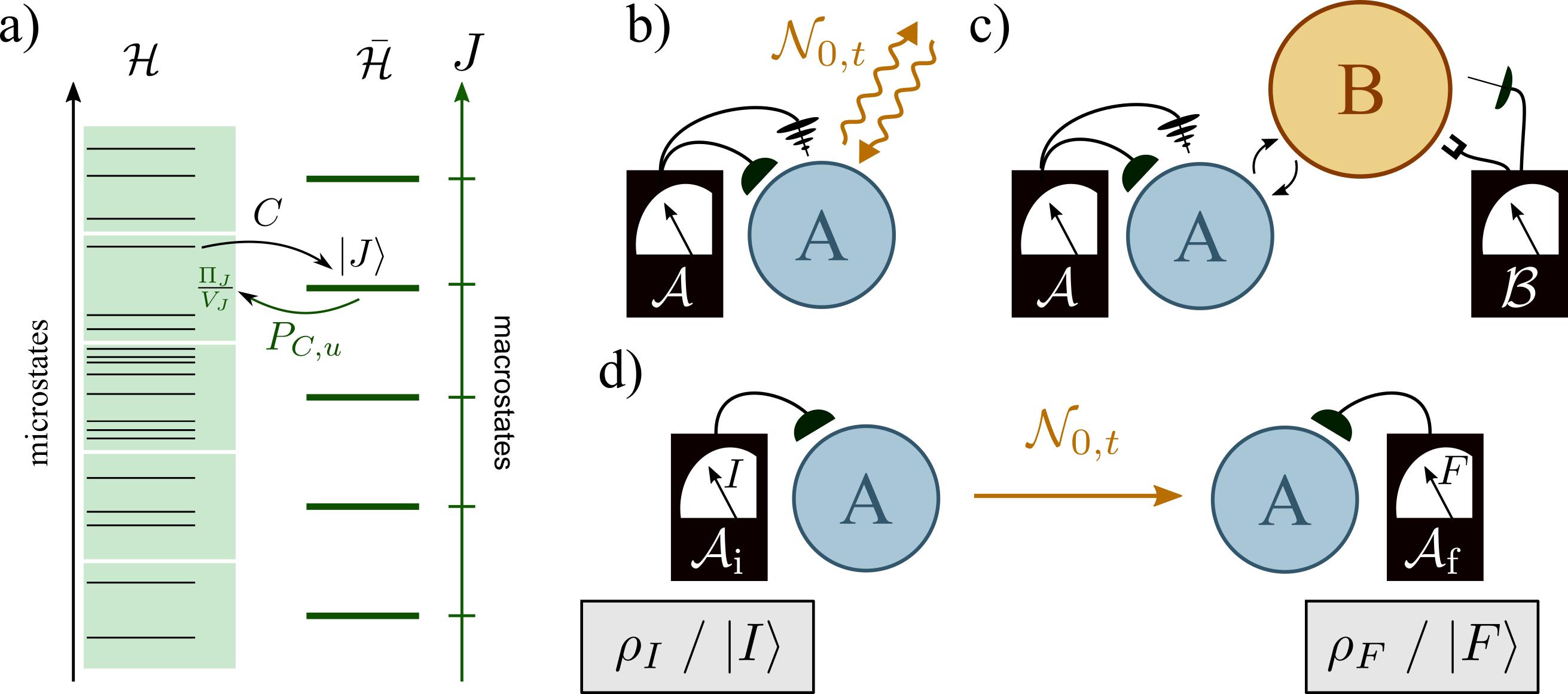
- Coarse-graining: Think of a giant library you can’t fully catalog. Instead of listing every single book (the “microstates”), you just count how many books are on each shelf (the “macrostates”). You lose detail, but you keep the big picture. In physics, this means grouping many tiny quantum details into a few measured quantities.
- Accessible vs. inaccessible: The “accessible” part is what your measurement setup can see and control. The “inaccessible” part is everything it can’t. Mathematically, the accessible set is described by an “algebra” of observables—a structured set of things you can measure. Sometimes these observables get along (“commute”) and sometimes they don’t (“non-commute”), like trying to measure both position and momentum precisely at once—you can’t.
- Macrostates and coarse-grained states: A macrostate is the summary of what you measured. The authors then build a “coarse-grained state”: among all the detailed quantum states that match your measurements, they pick the most unbiased one—the one with the largest entropy. This follows Jaynes’ maximum-entropy principle: don’t assume anything you didn’t measure. For the hidden parts you can’t see, they fill them with a uniform “don’t-know” distribution.
- An entropy that fits the situation: Their entropy splits into three intuitive pieces: 1) a Shannon/Gibbs term that measures your uncertainty about which big category (“shelf”) the system is in, 2) a von Neumann term that measures quantum uncertainty within the accessible part of each category, 3) a Boltzmann-like term that counts how many hidden microstates sit behind each category (how much detail you’re ignoring). This entropy smoothly connects two familiar extremes: if you can see everything, it becomes the usual von Neumann entropy; if you only count categories, it becomes “observational entropy.”
- Two viewpoints for dynamics:
- Open system: Your system may be nudged by an environment you don’t control, making its behavior noisy or irreversible.
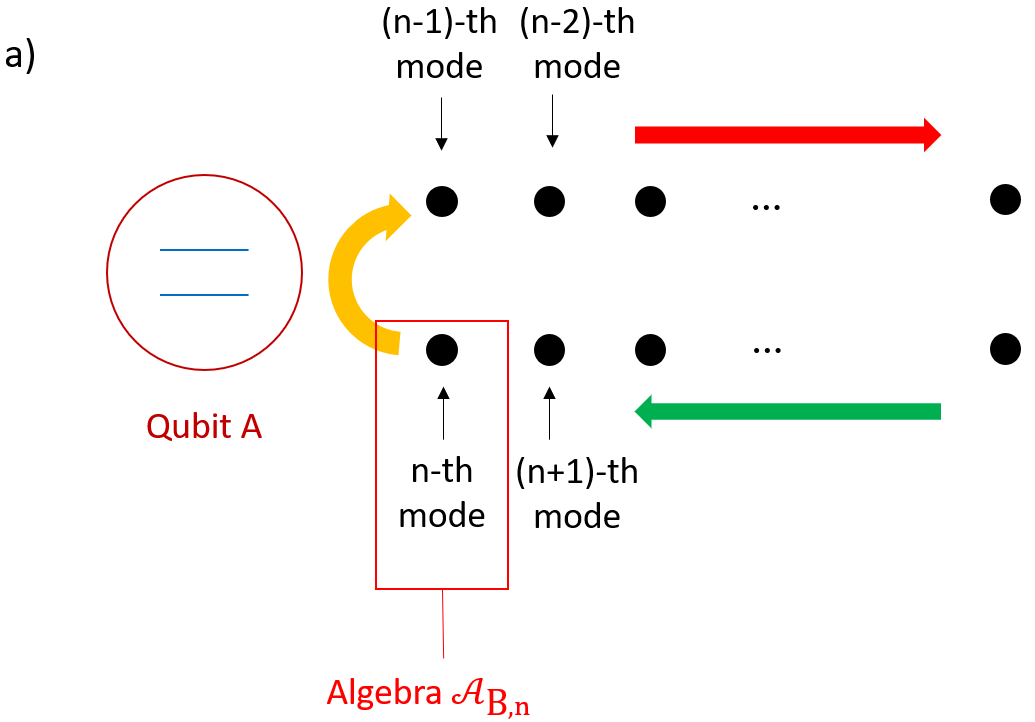
- Autonomous pair: Two systems push and pull on each other in isolation, and you measure each one coarsely.
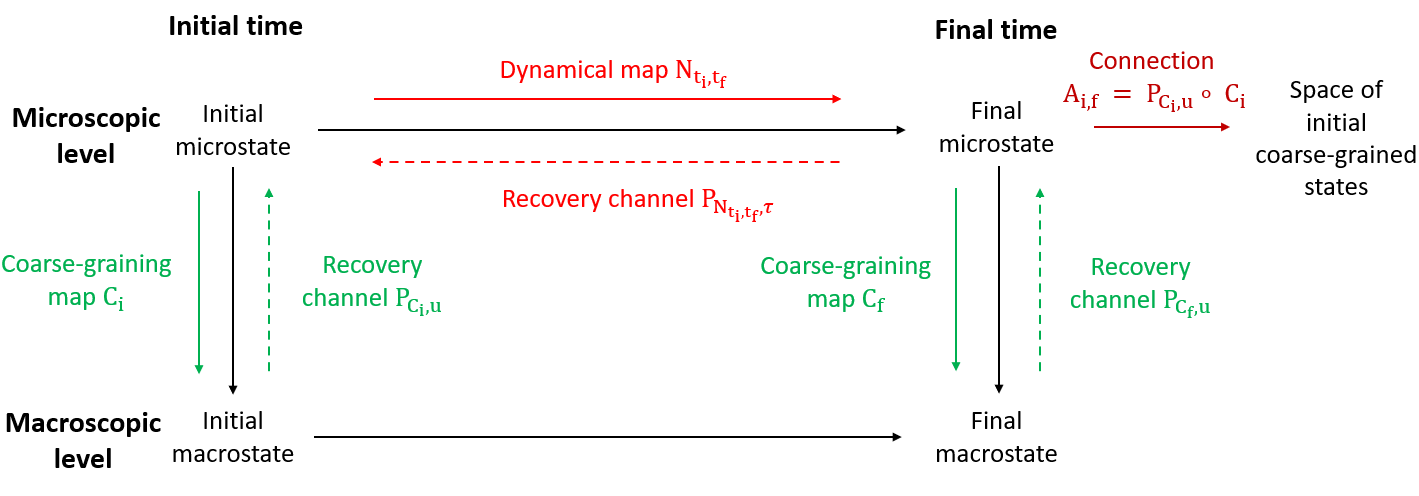
- Second law and fluctuations: They look at what you measure at the start and the end of a process, and show that coarse-grained entropy obeys a second-law-like inequality. They also establish fluctuation theorems—rules about how likely it is to see rare “entropy-decreasing” events versus ordinary “entropy-increasing” ones.
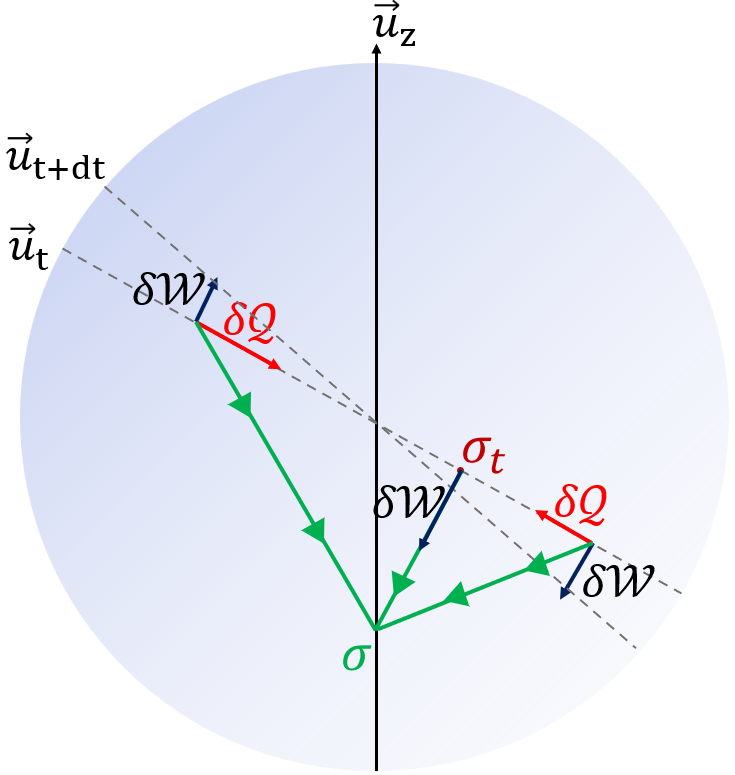
- Heat and work along slow changes: When you change things gradually (quasi-statically), you can split energy changes into “heat” and “work” at the coarse level. Surprisingly, they find an extra kind of “work” that comes from changing what you can measure or constrain—like moving walls to confine the system or changing the measurement that defines your coarse view.
Main findings and why they matter
Here are the key takeaways in plain language:
- A practical entropy that matches what you can actually measure: The paper defines a coarse-grained entropy that treats both kinds of uncertainty fairly—the uncertainty about which big category the system is in and the uncertainty inside each category. This extends “observational entropy” to cases where your different measurements don’t all align.
- A second law that captures two sources of irreversibility at once:
- External irreversibility: randomness injected by the environment (noise, dissipation).
- Internal irreversibility: the natural “smoothing out” that happens when a big system’s hidden details settle into an even spread (internal equilibration).
- Their second-law inequality covers both effects, which standard quantum approaches (based only on the full density matrix) can miss at the “internal” level.
- Corrections when the hidden parts aren’t equilibrated: If the invisible details haven’t settled, the inequality includes extra correction terms. This tells you exactly how much your coarse picture can deviate from the neat textbook version of thermodynamics—and why.
- Fluctuation theorems at the coarse level: Even when you only see a few big features, the paper shows that powerful relations still constrain the ups and downs of heat, work, and entropy. This generalizes well-known results to a more realistic, measurement-limited setting.
- Work and heat emerge naturally—and there’s a new “algebra-change” work: Along slow, controlled changes, energy splits into heat and work as expected. But there’s an additional work-like cost if you change the very way you measure or constrain the system (for example, adding/removing restrictions or performing measurements that reshape what’s accessible). This is a distinctly quantum-and-operational insight.
- A clear hierarchy of entropies: The more you coarse-grain (the less you can see), the larger your entropy. Symbolically: von Neumann entropy ≤ algebra-based entropy ≤ observational entropy. This matches the idea that less information means more uncertainty.
Implications and potential impact
- Fits real experiments: In big or many-body quantum systems, you usually can’t reconstruct the full quantum state. This framework works with just a few coarse measurements—the kinds that are actually feasible—yet still gives you honest thermodynamics.
- Bridges two worlds: It connects macroscopic thermodynamics (where lots of details are averaged out) and quantum stochastic thermodynamics (which tracks everything), letting you slide between them by changing how coarse your view is.
- Explains irreversibility without magic: It clarifies that entropy can grow because of outside noise and also because you choose to ignore internal details—both contribute to the “arrow of time” you observe.
- Guides design and interpretation: It offers an “experimental-friendly” way to define heat, work, and entropy in complex quantum devices, helping researchers analyze and compare setups even when only partial information is available.
- Foundations and the quantum-to-classical transition: By showing how classical-like thermodynamic behavior emerges from quantum rules when you look coarsely, it strengthens our understanding of how the familiar macroscopic world arises from the strange quantum one.
In short, the paper shows how to do honest, useful thermodynamics with the information you can actually get from large quantum systems—and it tells you exactly how your choices of what to measure affect what you see as heat, work, and entropy.
Knowledge Gaps
Knowledge gaps, limitations, and open questions
Below is a single, consolidated list of what remains missing, uncertain, or unexplored in the paper, expressed as concrete, actionable items for future research.
- Extension beyond type-I, finite-dimensional von Neumann algebras: how to generalize the framework (definitions of macrostates, Petz-based coarse-graining, entropy hierarchy, second law and fluctuation theorems) to infinite-dimensional systems and to type-II/III algebras (relevant for QFT and thermodynamic limits).
- Realistic measurements (POVMs): the paper defers a general treatment to future work; a complete theory is needed for POVMs that do not generate subalgebras, including (i) systematic construction of coarse-grained states and entropies under non-projective, non-idempotent measurements, (ii) stability under repeated measurements, and (iii) implications for second-law inequalities and fluctuation theorems.
- Operational identification of the accessible algebra: concrete procedures to infer, certify, or learn the accessible subalgebra from finite, noisy data (including partial tomographic sets within sectors), and to reconstruct macrostates without requiring full knowledge of all operators in the algebra.
- Robustness to experimental imperfections: quantitative bounds on how errors in estimating sector probabilities, within-sector states, or sector dimensions propagate to the coarse-grained entropy, entropy production, and the derived inequalities.
- Choice and determination of sector “volumes” VJ and V′J: practical methods to determine these dimensions in macroscopic or many-body systems (where symmetries, constraints, or selection rules may limit accessible microstates), and how misestimation affects the Boltzmann terms and thermodynamic conclusions.
- Internal equilibrium criterion: precise dynamical conditions (mixing/ergodicity, timescale separation, locality, unitality) that guarantee relaxation to the algebra-dependent coarse-grained state ρcgA, including convergence rates and finite-size corrections.
- Non-equilibrium corrections: explicit, quantitative bounds on deviations from the standard second law when the internal degrees of freedom have not equilibrated relative to the chosen algebra (how large can “correction terms” be and how to estimate them operationally).
- Interplay with ETH and thermalization: rigorous connections between the internal-equilibrium condition and eigenstate thermalization for local/coarse observables, including which classes of Hamiltonians and observables ensure emergence of the proposed thermodynamics.
- Non-Markovian dynamics: validity conditions and modifications of the second law and fluctuation theorems when the system dynamics is non-Markovian (e.g., initially correlated environments, memory kernels) and how these manifest at the coarse-grained level.
- Strong system–environment coupling: explicit treatment of interaction energy and partition ambiguities when defining work and heat under coarse-graining, and how the algebra choice affects heat/work splits in the strong-coupling regime.
- Energy observable outside the algebra: how to define and interpret energy, work, and heat when the Hamiltonian (or parts of it) is not contained in the accessible algebra; whether “representative” projections of the Hamiltonian are physically meaningful and how they impact the first and second laws.
- Additional work from algebra manipulation: operational protocols and measurement schemes to implement, quantify, and experimentally verify the “work-like” contribution arising from changing the accessible algebra (e.g., constraint changes or measurement backaction), including its energetic and entropic costs.
- Protocol dependence with incompatible algebras: trajectory-level formulations (two-point or multi-point measurements) when initial and final algebras are incompatible, including systematic accounting of measurement backaction, memory-register costs, and their effects on fluctuation theorems.
- Dependence on the Petz prior: exploration of non-uniform priors (e.g., KMS states) in the Petz recovery/Jaynes maximization, including conditions under which coarse-grained entropy still bounds or increases relative to von Neumann entropy and how the second-law statements change with alternative priors.
- Formal properties of the algebraic entropy: proofs (or counterexamples) of subadditivity, strong subadditivity, and other thermodynamic concavity/convexity properties for S𝒜; characterization of data-processing inequalities and monotonicity under physically relevant CPTP maps that respect or coarsen the algebra.
- Choice/optimization of the algebra: principled criteria or algorithms to select the “right” level of coarse-graining (i.e., an accessible algebra) that balances predictive power with experimental feasibility and minimizes non-equilibrium correction terms.
- Gauge/representation dependence: analysis of how the algebra’s chosen representation (and unitary embedding U) affects the Boltzmann terms and thermodynamic quantities; conditions under which results are invariant or how to enforce representation-independent statements.
- Composition and multipartite settings: general composition rules for interacting subsystems with different accessible algebras (e.g., 𝒜A⊗𝒜B vs. joint algebras), and how to define and bound correlations, mutual information, and entropy production consistently across composite systems.
- Time coarse-graining: formal development of the suggested macroscopic time-averaging (coarse time resolution) and its interplay with the algebra-based coarse-graining, including how time-averaging alters Petz reconstruction and entropy production.
- Heat/work definitions along non-commutative, quasi-static paths: rigorous conditions for path-independence, integrability, and potential geometric (gauge/Berry-like) contributions when the accessible algebra varies along a quasi-static protocol; experimental strategies to detect such contributions.
- Fluctuation theorem assumptions: explicit microreversibility/detailed-balance conditions required for the coarse-grained fluctuation theorems (open vs. autonomous cases), including how violations (e.g., control noise, feedback, algebra changes) modify the theorems.
- Measurement memory and Landauer costs: incorporation of the energetic/entropic costs of recording and erasing measurement outcomes in the memory that stores macrostates, and how these costs interact with the second law at the coarse-grained level.
- Scalability and computational tractability: algorithms for decomposing many-body Hilbert spaces into sectors, computing ρcgA, and evaluating S𝒜 in large systems; approximate methods with guarantees (e.g., tensor networks, randomized measurements) and their error–complexity tradeoffs.
- Benchmarks on many-body dynamics: systematic numerical and experimental case studies (quenches, transport, thermalization, chaos vs. integrability) quantifying when and how the algebra-dependent thermodynamics captures observed irreversibility and macroscopic laws.
- Relation to other coarse-grained entropies: comparative analysis with diagonal, diagonal-in-energy, or coarse-grained phase-space entropies; conditions under which S𝒜 coincides with or differs from these alternatives, and operational consequences for thermodynamic predictions.
Practical Applications
Immediate Applications
The following use cases can be deployed with today’s experimental and computational capabilities, leveraging coarse-grained measurements and the algebraic framework (accessible subalgebras, Petz/Jaynes coarse-grained state, observational/algebraic entropy, two-point measurement protocols, and fluctuation theorems).
- Coarse-grained thermodynamic monitoring of quantum hardware
- Sectors: software, hardware (quantum computing), energy
- Use: Estimate entropy production, heat, and work in superconducting qubits, trapped ions, or spin ensembles using only readily available measurement data (e.g., populations, stabilizer outcomes, parity checks), avoiding full state tomography.
- Tools/workflows: A software library integrating with Qiskit/Cirq/PennyLane to compute algebra-dependent entropy S_A and observational entropy from measurement counts; dashboards for per-experiment entropy production and irreversibility diagnostics.
- Assumptions/dependencies: Choice of accessible subalgebra aligned with actual measurement operators; sufficient statistics from repeated runs; approximate projective readout or calibrated POVMs; internal equilibrium approximation if one seeks “standard” second-law forms.
- Thermodynamic calibration of quantum heat engines and refrigerators with partial access
- Sectors: quantum thermodynamics, energy, experimental physics
- Use: Quantify work/heat in circuit QED or trapped-ion engines via two-point coarse-grained measurements; include the “algebra manipulation” work due to constraint/measurement changes.
- Tools/workflows: Two-point measurement protocols across coarse observables; data processing pipelines that compute heat/work splits from quasi-static paths of measurement schemes; uncertainty estimates via fluctuation theorems.
- Assumptions/dependencies: Repeatable preparation and measurement; knowledge of sector volumes V_J; control over measurement settings to define quasi-static paths; partial tomographic access within sectors for noncommutative algebras.
- Many-body equilibration and thermalization tests via observational/algebraic entropy
- Sectors: academia (quantum many-body physics), materials/condensed matter, cold atoms
- Use: Evaluate equilibration in cold-atom lattices or spin chains with only coarse observables (e.g., binned number counts, parity, structure factors); diagnose internal vs environment-induced irreversibility.
- Tools/workflows: Protocols computing Sob and S_A from coarse measurement histograms over time; comparison across different subalgebras to separate internal equilibration from open-system effects.
- Assumptions/dependencies: Appropriate coarse-graining reflecting experimental resolution; ergodic/typical dynamics at the microlevel; stability against detection noise.
- Energy-aware error-correction and syndrome processing
- Sectors: quantum computing, energy
- Use: Use algebras generated by stabilizer measurements to quantify entropy/heat contributions per QEC cycle, including measurement backaction as “algebra work,” informing cryogenic budget and cycle optimization.
- Tools/workflows: Integration into QEC pipelines to log S_A increments per round; automatic alerts when entropy production per cycle exceeds thresholds; cross-correlation with physical qubit energy dissipation.
- Assumptions/dependencies: Reliable stabilizer measurement statistics; mapping of syndrome outcomes to sectors J; internal equilibrium for ancillary degrees of freedom, or inclusion of the correction terms when not satisfied.
- Partial-observability diagnostics in open systems
- Sectors: experimental quantum physics, hardware diagnostics
- Use: Disentangle irreversibility from environment-induced noise vs internal equilibration by varying the accessible subalgebra and comparing entropy production; validate noise models (e.g., dephasing vs relaxation).
- Tools/workflows: Systematic campaigns with alternative measurement bases; entropy production estimators that attribute contributions to environment vs internal degrees of freedom.
- Assumptions/dependencies: Ability to switch measurement setups across noncommuting bases; sufficiently slow drift to compare runs; identified commutant structure for interpretation.
- Materials and spectroscopy: nonequilibrium thermodynamics from limited probes
- Sectors: materials science, NMR/ESR, neutron and X-ray scattering
- Use: Quantify entropy production and equilibration during quenches or pump–probe sequences using accessible coarse observables (e.g., a few moments or correlators), avoiding full density-matrix reconstruction.
- Tools/workflows: Data analysis routines mapping measured correlators to representatives in the accessible algebra and estimating S_A changes and fluctuation-theorem bounds.
- Assumptions/dependencies: Valid representatives for measured observables; reliable estimation of sector dimensions; stationarity or controlled protocols to apply two-point schemes.
- Resource accounting in cryogenic testbeds
- Sectors: energy, hardware operations
- Use: Track cumulative entropy production and inferred heat loads during device operation using coarse-grained metrics, complementing direct thermal sensors.
- Tools/workflows: Continuous streaming of measurement counts to compute rolling S_A trends; integration with cryostat telemetry to correlate thermodynamic metrics with cooling performance.
- Assumptions/dependencies: Calibration linking entropy production to heat under the chosen coarse-graining; repeated-run statistics; stable measurement channels.
- Representative-operator estimation under coarse access
- Sectors: software, academia, hardware
- Use: Compute “representatives” of desired observables within the accessible algebra to estimate expectation values from coarse data (e.g., block-diagonal projections), enabling performance metrics without finer measurements.
- Tools/workflows: Software implementing o_A = (Petz ∘ C)(o) and expectation estimation on ρcg_A; uncertainty quantification from finite sampling.
- Assumptions/dependencies: Known accessible algebra and Petz prior (typically uniform); Type-I algebra decomposition for finite systems; invertibility of C(u) on support.
- Teaching/verification of fluctuation theorems with limited measurements
- Sectors: education, academia
- Use: Lab modules using two-point macroscopic measurements to verify coarse-grained fluctuation theorems and entropy production inequalities without full tomography.
- Tools/workflows: Open-source datasets and scripts; step-by-step labs on observational entropy and algebraic entropy construction.
- Assumptions/dependencies: Stable preparation and readout; sufficient sample sizes.
Long-Term Applications
These opportunities require further research and/or scaling, including improved measurement control, larger devices, standards, and integration with industrial workflows.
- Energy-efficient quantum computing and scheduling
- Sectors: software, hardware, energy
- Use: Incorporate coarse-grained thermodynamic metrics into compilers/schedulers to minimize entropy production and heat per algorithm, with constraints on measurement backaction and “algebra work.”
- Tools/products: Thermo-aware transpilers; runtime policies that select measurement/control algebras to reduce dissipation.
- Assumptions/dependencies: Mature models linking S_A trajectories to physical heat; robust estimation under time-varying noise; verified quasi-static manipulation sequences.
- Measurement-induced work engines and thermodynamic devices
- Sectors: quantum thermodynamics, hardware innovation
- Use: Design engines that exploit the identified “algebra manipulation” work (from changing constraints/measurement backaction) to extract useful work or enhance refrigeration.
- Tools/products: Prototype devices using controlled changes in accessible algebras (e.g., measurement-induced constraints) as a resource.
- Assumptions/dependencies: Fast, accurate control of measurement bases; low-loss ancillary systems; validated accounting of measurement backaction as work at scale.
- Standards for thermodynamic reporting under partial observability
- Sectors: policy, metrology, industry consortia
- Use: Define standardized protocols for reporting entropy production, work, and heat based on accessible subalgebras and coarse measurements (analogous to benchmarking standards).
- Tools/products: Reference implementations, conformance test suites, and certification processes.
- Assumptions/dependencies: Community consensus on accessible-algebra choices for given platforms; traceability to physical units; error budgets for coarse-grained metrics.
- Scalable telemetry for quantum data centers
- Sectors: energy, operations, cloud services
- Use: Deploy continuous coarse-grained thermodynamic monitoring of large quantum fleets to optimize cooling loads and scheduling, and to detect drifts/failures via irreversibility signatures.
- Tools/products: Fleet-level dashboards; predictive maintenance models using S_A trends and fluctuation-theorem deviations.
- Assumptions/dependencies: Aggregation of statistically meaningful measurement data; cyber-physical integration with cooling and power systems.
- Thermodynamic control of macroscopic quantum sensors and oscillators
- Sectors: sensing, metrology
- Use: Maintain internal equilibrium and minimal dissipation in macroscopic quantum devices (e.g., optomechanical resonators, superconducting sensors) using control policies derived from algebraic thermodynamics.
- Tools/products: Controllers that adapt accessible algebras and measurement strengths in real time to keep entropy production low while meeting sensing performance.
- Assumptions/dependencies: Real-time state-of-statistics estimation; accurate models for commutant dynamics and equilibration rates.
- Energy-aware design of quantum network nodes
- Sectors: communications, distributed systems
- Use: Apply bipartite autonomous viewpoint to audit and optimize energy/entropy exchanges between interacting nodes under partial measurement constraints.
- Tools/products: Node-level protocols that log S_A-based metrics alongside link-level QoS; thermodynamic budgets for entanglement distribution.
- Assumptions/dependencies: Distributed synchronization of two-point measurements; cross-node calibration of accessible algebras.
- Quantum materials engineering guided by equilibration diagnostics
- Sectors: materials science, manufacturing
- Use: Use algebraic/observational entropy as design metrics to favor fast internal equilibration with weak macroscopic dissipation, informing material selection and processing.
- Tools/products: Screening workflows for candidate materials using coarse-grained entropy production in quenches/anneals as figures of merit.
- Assumptions/dependencies: Correlation between coarse-grained metrics and device-level durability/efficiency; scalable measurement pipelines.
- Robust control under partial observability
- Sectors: control engineering, robotics (quantum-enabled), industrial automation
- Use: Develop controllers that explicitly reason with accessible subalgebras and entropy bounds to stabilize large quantum systems without full observability.
- Tools/products: Control algorithms that exploit the entropy hierarchy (Sob ≥ S_A ≥ S_vN) to trade off measurement burden vs performance.
- Assumptions/dependencies: Verified models of the algebra-dependent second law and fluctuation bounds for the target system; reliable inference of ρcg_A in feedback loops.
- Privacy-respecting thermodynamic auditing
- Sectors: compliance, cloud services
- Use: Provide high-level thermodynamic compliance guarantees (e.g., energy use, waste heat) using only coarse aggregate measurements that avoid exposing intellectual property or sensitive states.
- Tools/products: Auditing APIs exposing standardized S_A-based summaries; third-party verification services using fluctuation-theorem tests.
- Assumptions/dependencies: Acceptance of coarse-grained metrics in regulatory frameworks; agreed-upon priors and sector decompositions.
Cross-cutting assumptions and dependencies
- Accessible subalgebra identification: Practical deployment depends on aligning the chosen subalgebra with what the measurement/control hardware truly accesses; for noncommutative cases, sufficient coverage across incompatible bases is needed.
- Internal equilibrium: “Textbook” second-law forms emerge when unresolved degrees of freedom (commutant algebra) equilibrate; otherwise, correction terms must be accounted for.
- Finite-dimensional/type-I setting: The decomposition into sectors relies on type-I von Neumann algebras (typical for finite, engineered systems); extensions to infinite-dimensional cases need care.
- Petz/Jaynes prior: Using the uniform prior ensures monotonicity of entropy under coarse-graining; nonuniform priors (e.g., KMS/thermal) are possible but alter interpretations.
- Experimental considerations: Approximate projective measurements or well-characterized POVMs, repeated-run statistics, and stable protocols are required to estimate p_J and ρ_J reliably.
- Model validation: Translating S_A variations into heat/work requires validated models (e.g., Hamiltonians, coupling to environments) and careful accounting for measurement backaction.
Glossary
- Accessible subalgebra: A specified subset of observables (closed as a von Neumann subalgebra) that the observer can measure and use to describe the system. "we introduce the notion of coarse-graining of a system based on the specification of an accessible subalgebra."
- Algebra-dependent entropy: An entropy defined by maximizing von Neumann entropy subject to constraints from a chosen subalgebra of accessible observables; it interpolates between von Neumann and observational entropies. "and use Jaynes principle to define an algebra-dependent entropy which interpolates between the von Neumann and observational entropies."
- Automorphism: A structure-preserving map from an algebra to itself; here, a one-parameter group acting on the commutant to formalize equilibrium (KMS) conditions. "satisfy a KMS condition with respect to a prescribed one-parameter group of automorphisms α_t"
- Boltzmann entropy: The entropy associated with the logarithm of the number of microstates compatible with a macrostate (state counting). "as quantified by Boltzmann entropy and the second law"
- Commutant: The set of all operators that commute with every operator in a given algebra; it represents the inaccessible degrees of freedom relative to the accessible algebra. "It is useful to introduce the commutant 𝒜′ of the algebra 𝒜"
- Commutative algebra: An algebra in which all elements commute; here generated by a single measurement basis. "we first review this framework in the case of a commutative algebra generated by the measurement of a single (coarse) observable"
- Complete Positive Trace Preserving (CPTP) map: A quantum channel that maps density operators to density operators while preserving positivity on extended systems and trace. "via the Complete Positive Trace Preserving (CPTP) micro-macro channel"
- Coarse-grained state: The maximum-entropy state consistent with the statistics of accessible observables, representing a representative microstate compatible with macroscopic data. "the coarse-grained state is defined as the state reaching this maximal von Neumann entropy"
- Coarse-graining: A reduction of description that retains only statistics of selected observables, grouping many microstates into macrostates. "We achieve this program by proposing a notion of coarse-graining formally based upon defining a subalgebra of accessible observables of the system."
- Density operator: The operator describing a quantum state (possibly mixed), from which all measurement statistics are derived. "which is a functional of the full system density operator."
- Ergodicity: The assumption that microscopic degrees of freedom explore all compatible microstates, justifying maximum-entropy assignments at fixed macroscopic constraints. "Under such assumption of ergodicity, the unresolved degrees of freedom encoded in 𝒜′ can therefore be described"
- Fluctuation theorems: Exact relations that constrain the statistics of thermodynamic fluctuations, extending the second law beyond averages. "We also derive fluctuation theorems constraining the fluctuations of thermodynamic functions at the coarse-grained level."
- Jaynes principle: The maximum-entropy principle for assigning states given partial information (constraints) about observables. "and use Jaynes principle to define an algebra-dependent entropy"
- KMS condition: A mathematical criterion characterizing thermal (equilibrium) states in algebraic quantum theory relative to a time-automorphism group. "satisfy a KMS condition with respect to a prescribed one-parameter group of automorphisms α_t"
- Macrostate: A coarse description of the system specified by accessible measurement outcomes (or reduced sectors), typically of much lower dimension than the full Hilbert space. "This information can be encoded in a macrostate belonging to a smaller Hilbert space"
- Micro-macro map: The channel mapping a microscopic quantum state to its macroscopic (coarse) description defined by the accessible measurement outcomes. "The micro-macro map C maps a microstate from 𝓗 onto the corresponding macrostate in 𝖧̄."
- Micro-canonical distribution: The uniform distribution over all microstates compatible with fixed macroscopic constraints (e.g., energy and particle number). "when the variables one chose to ignore in the coarse-graining reach a micro-canonical distribution"
- Noncommutative algebra: An algebra whose elements do not necessarily commute; accessing such an algebra combines information from incompatible measurements within sectors. "general coarse-graining associated to noncommutative algebras."
- Observational entropy: The maximal von Neumann entropy consistent with coarse measurement outcomes; decomposes into Shannon and Boltzmann-like contributions. "the so-called observational entropy"
- Partial trace: An operation that discards (traces out) some degrees of freedom to obtain a reduced state for the remaining subsystem. "or from a partial trace"
- Petz recovery map: A canonical, CPTP “inverse” of a quantum channel relative to a chosen reference state, recovering the maximum-entropy state consistent with coarse data. "The Petz recovery map P_{C,u}, or equivalently, Jaynes maximization principle, can be employed to recover the most probable microstate compatible with the observation"
- POVM: A positive-operator valued measure; a general (non-projective) quantum measurement described by positive operators summing to identity. "one typically employs a POVM"
- Projective measurement: An ideal measurement described by orthogonal projectors, used here to define coarse observables and macrostates. "via a projective measurement associated to a set of orthogonal projectors"
- Pure-dephasing channel: A unital, non-unitary quantum channel that suppresses coherences in a given basis without changing populations. "non-unitary and unital (i.e. a pure-dephasing channel)"
- Quasi-static path: A sequence of infinitesimal changes (here, of measurement schemes or constraints) slow enough to define thermodynamic work/heat consistently. "By considering a quasi-static path of measurement schemes"
- Tomographically-complete set: A set of measurements sufficient to reconstruct a quantum state uniquely. "combine results from a tomographically-complete set of measurements to re-build a density operator."
- Type I von Neumann algebra: A class of von Neumann algebras that decompose into direct sums of full matrix algebras, enabling sector-wise descriptions. "the type I von Neumann subalgebra 𝒜 ⊂ ℬ(ℋ)"
- Unital channel: A quantum channel that preserves the identity operator; it does not decrease the maximally mixed state. "non-unitary and unital (i.e. a pure-dephasing channel)"
- von Neumann algebra: A weakly closed, self-adjoint operator algebra on a Hilbert space, central in the algebraic formulation of quantum theory. "type-I von Neumann algebras."
- von Neumann entropy: The quantum analogue of Shannon entropy defined as S(ρ) = −Tr(ρ ln ρ). "the von Neumann entropy"