- The paper develops a geometric and algebraic formalism to decompose higher-order correlator families into reducible and irreducible components.
- It employs systematic conditioning procedures to reveal key differences in dynamics across free, integrable, and chaotic regimes.
- The framework quantifies redundancy and independence in many-body systems, enabling precise comparisons between experimental and theoretical models.
Irreducible Geometry of Higher-Order Correlator Families: A Technical Review
Introduction and Motivation
The study of quantum many-body systems centers on the statistics of operator dynamics and correlations, from traditional equal-time correlators to increasingly complex higher-point functions, such as OTOCs. While programmable quantum simulators have enabled the measurement of high-order correlators up to nontrivial many-body complexity, the theoretical frameworks for organizing and interpreting these extensive data sets remain rudimentary. The redundancy, interdependence, and structural content of correlator families are inadequately captured by isolated observables or ad hoc summaries.
"Irreducible Geometry of Higher-Order Correlator Families" (2607.08761) develops a geometric and algebraic formalism that systematizes the analysis of such correlator families. By representing correlators as inner products (Hilbert-Schmidt) between operator words, the authors identify systematic procedures, termed "conditioning," to decompose the collective correlation structure into reducible (resolved) and irreducible (residual) information. This approach enables the quantification and visualization of independent many-body data embedded in complex correlator families, beyond what is accessible from single or low-point statistics.
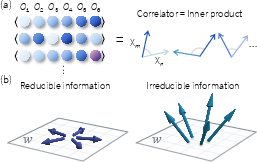
Figure 1: (a) Illustration of families of correlators generated by permutations or replacements of operators as inner products of operator words; (b) Decomposition of correlator geometry into reducible and irreducible components relative to a conditioning subspace W.
The starting point is an operator word family Ω={Xm}, with each Xm an element of the operator algebra (products of local operators, possibly at different times). Constructing all pairwise Hilbert-Schmidt inner products ⟨Xm,Xn⟩ yields the Gram matrix G(Ω) of the family, encoding both redundancy and independent content of the correlators.
The authors introduce the central concept of conditioning: choosing a subspace W, representing the resolved sector (which may encode known physics, experimental accessibility, a symmetry, etc.), each Xm is split as Xm=PWXm+Rm(W), with Rm(W) the residual orthogonal to W. The irreducible component—the core of unexplained, high-dimensional many-body dynamics—is characterized by the Gram matrix Ω={Xm}0 of the residuals. The eigenstructure and associated elementary symmetric polynomials Ω={Xm}1 quantify irreducible Ω={Xm}2-dimensional geometric structure of the correlator family relative to the resolved sector.
Canonical Conditioning and Dynamical Regimes
The intrinsic, data-driven choice for conditioning is canonical conditioning, in which the optimal (maximal capture of correlator weight) Ω={Xm}3-dimensional subspace Ω={Xm}4 is constructed by the leading Ω={Xm}5 eigenmodes of the Gram matrix. The irreducible geometry, as encoded in the tail of the spectrum, reveals fundamental distinctions across free, integrable, and chaotic dynamics.
Numerical studies on XYZ spin chains in all three regimes are performed with systematic operator-word families built from permutations of local operators. The time and rank evolution of the irreducible volume profile Ω={Xm}6 and the mean irreducible level Ω={Xm}7 expose marked differences: chaotic dynamics rapidly approach the uniform (maximally spread) limit, whereas free-fermion and integrable systems exhibit highly compressed (low-dimensional) correlator geometries, reflecting constraints from conservation laws and algebraic structure.
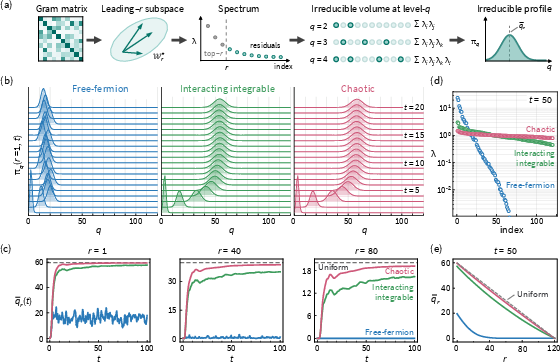
Figure 2: (a) Schematic of constructing irreducible volume profiles via canonical conditioning; (b) Time dependence of volume profiles for different dynamics; (c) Evolution of mean irreducible level for several conditioning ranks, with comparison to the uniform reference.
Targeted Conditioning: Probing Physical Constraints
Beyond canonical conditioning, targeted conditioning is used to operationally dissect correlator geometry according to physically meaningful subspaces:
- Spatial conditioning isolates the contribution to the correlator geometry originating from or detected in a specific spatial region (diagnostic for operator spreading and MBL-induced localization). The mean irreducible level Ω={Xm}8 and Ω={Xm}9 quantify, as a function of disorder, how localization confines or suppresses the support of irreducible components.
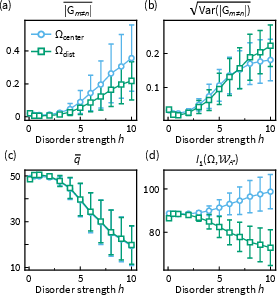
Figure 3: (a)-(b) Disorder dependence of statistical moments of off-diagonal Gram matrix entries; (c)-(d) Disorder dependence of geometric diagnostics (Xm0, Xm1) for two word families in the MBL chain.
- Measurement-targeted conditioning considers constraints due to experimental accessibility (e.g., projection-basis measurements with limited off-diagonal support), classifying the residual inaccessible geometry and its organization as a function of the measurement sector depth.
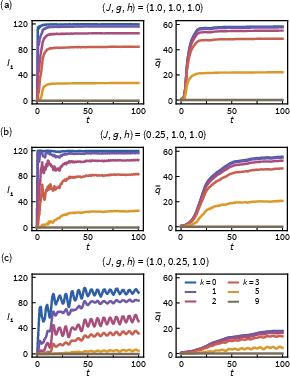
Figure 4: Time evolution of Xm2 and Xm3 conditioned on measurement-accessible subspaces for varying off-diagonal depth Xm4 and Hamiltonian parameters.
- State-dependent conditioning incorporates reference-state structure (e.g., energy eigenstates or thermal states), comparing how conditioning on different spectral sectors resolves the irreducible correlator geometry and reveals spectral selectivity (e.g., low-energy windows preferentially capture the residual geometry of ground-state-evolved operators).
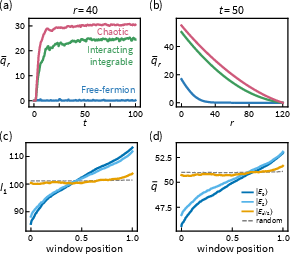
Figure 5: (a)-(b) State-dependent mean irreducible level time and rank dependence under canonical conditioning; (c)-(d) Energy-window dependence of Xm5 and Xm6 for different reference states.
Comparative Geometry: Krylov and Cross Conditioning
The framework is extended to compare geometries, not just their internal organization:
- Krylov conditioning utilizes the Liouvillian-generated Krylov subspace, tracking how the correlator geometry reshapes over time under deterministic Hamiltonian evolution. Krylov-resolved overlaps Xm7 and the conditioned mean irreducible level detect the memory and dynamical connection between subspaces at different times beyond simple (static) overlap metrics.
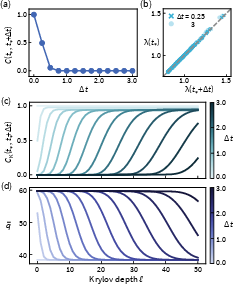
Figure 6: (a) Decay of canonical subspace overlap over time; (b) Gram spectrum comparison at fixed times; (c)-(d) Krylov-resolved overlap and mean irreducible level as a function of Krylov depth and time separation.
- Cross conditioning systematically compares geometries generated by distinct dynamics. The reference canonical sector from one dynamics (e.g., high-frequency Floquet effective Hamiltonian) is used as the conditioning basis for the correlator family from another (e.g., full Floquet evolution), providing a sensitive diagnostic for breakdowns of effective descriptions at the geometric level, even when individual correlator values (or intrinsic irreducible profiles) show close agreement.
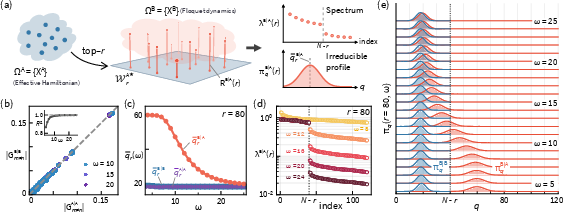
Figure 7: (a) Cross conditioning schematic; (b) Correlator value correlation between effective and Floquet dynamics; (c)-(e) Comparison and frequency dependence of mean irreducible levels, residual Gram spectra, and volume profiles for cross and self-conditioned sectors.
Implications and Prospects
This geometric formalism reconceptualizes higher-order correlators as not merely large sets of complex-valued data, but as relational geometric structures with reducible and irreducible subcomponents. The irreducible geometry framework enables:
- Quantification of redundancy and independence in large families of measured or computed correlators, distinguishing physically meaningful high-dimensional many-body effects from experiment-specific artifacts or redundant information.
- Precise characterization of dynamical regimes: the geometric profile provides signatures distinguishing integrable, nonintegrable, and MBL dynamics, with direct implications for using quantum devices to benchmark complexity, ergodicity, and localization.
- Identification of physical limitations and resources associated with experimental constraints, state preparation, or spectral content.
- Rigorous comparison between different system evolutions, useful for verifying effective descriptions, benchmarking protocols, and identifying nonperturbative corrections.
The approach provides a scalable route to incorporate experimental limitations, classical simulation resources, and quantum advantage criteria, pointing toward geometric resource theories for many-body quantum dynamics.
Conclusion
The irreducible geometry framework for higher-order correlator families (2607.08761) systematically classifies and quantifies the organization of complex many-body information. By analyzing correlator families as structured geometries in operator space, and introducing conditioning constructs (canonical, targeted, Krylov, cross), the approach enables both intra-family and inter-family diagnostics beyond the reach of single correlator analyses. This geometric perspective is poised to underpin new advances in quantum characterization, distinguishing dynamical regimes, and formulating rigorous comparisons for both theory and experiment.