- The paper introduces an algebraic framework revealing an internal SU(2) pseudospin structure that governs neutrino–antineutrino coherence.
- It systematically grades operators by lepton number and helicity, distinguishing observable mass terms and coherence channels.
- The approach clarifies Dirac–Majorana distinctions, showing that explicit ΔL=2 terms are necessary for physical neutrino-antineutrino transitions.
Internal Pseudospin Structure and Lepton-Number Superselection in Massive Neutral-Fermion States
Introduction
This work introduces a formal algebraic framework for analyzing the four-dimensional, fixed-momentum state space of a single massive neutral Dirac fermion, with immediate application to the Dirac–Majorana question in neutrino physics (2607.08739). The analysis demonstrates that at a fixed three-momentum, the one-particle state space consisting of two helicities for both neutrinos and antineutrinos admits an internal SU(2) pseudospin algebra, distinct from the standard Wigner little group. The core of the approach is a tensor product structure based on particle–antiparticle and helicity labels, enabling a systematic grading of amplitudes by lepton number (L) and helicity, with direct consequences for how various physical mass terms manifest as observable phenomena.
Internal SU(2) Pseudospin Algebra
The state basis at fixed p is decomposed as
Bp=(ν−,ν+,νˉ−,νˉ+)
where subscripts denote helicity. The corresponding Hilbert space is regarded as a tensor product of particle--antiparticle and helicity sectors, which permits an explicit representation of operators in terms of Pauli matrices acting on each space. Within this structure, three specific Hermitian and unitary operators are constructed:
U1=τ3⊗σ2U2=τ1⊗I2U3=τ2⊗σ2
where τi (σi) are Pauli matrices on the particle–antiparticle (helicity) sector. These generators collectively satisfy [Ui,Uj]=2iϵijkUk, closing a subalgebra isomorphic to SU(2). Importantly, this L0 is internal—its generators exchange states not only of the same charge and spin (as in the Wigner little group), but also particle with antiparticle at fixed helicity or helicity flip at fixed charge.
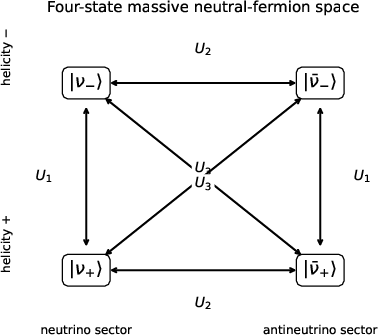
Figure 1: Four-state fixed-momentum space of a massive neutral Dirac fermion. L1 flips helicity, L2 exchanges particle and antiparticle, and L3 combines both.
A crucial result is that L4 coincides with the lepton-number-weighted spin rotation, L5, elucidating the subtle distinction between kinematical state-space symmetries and conserved quantum numbers.
Grading by Lepton Number and Helicity
The method exploits the fact that both lepton number (L6) and helicity (L7) can be realized as commuting involutive operators, dividing the operator space into four classes based on their commutation and anticommutation relations. Expanding all possible L8 operators as L9, the physical content of a given operator (including the generators above) is graded by SU(2)0, distinguishing lepton-number-conserving and violating sectors as well as helicity-preserving and flipping terms. The relevance to phenomenology becomes evident by tracking which mass and mixing parameters couple to each class.
Lepton-Number Superselection and Physical Implications
Lepton-number superselection rules, if exact, enforce SU(2)1 and SU(2)2, eliminating all terms in the effective Hamiltonian and density matrix proportional to SU(2)3 (i.e., those that would mix sectors with different lepton number). This enforces a superselection constraint: in a strict Dirac theory, only SU(2)4 generates physical coherent transformations; SU(2)5 and SU(2)6 are mathematically definable but physically superselected.
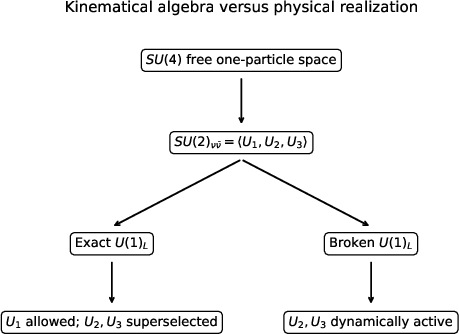
Figure 2: Kinematical algebra versus physical realization—the algebraic SU(2)7 is physically truncated under lepton-number superselection.
The situation transforms fundamentally if SU(2)8 is broken by a Majorana mass or other SU(2)9 terms: charge-conjugating directions are physically accessible and can induce neutrino–antineutrino coherence phenomena. This distinction encapsulates why the mere presence of the p0 algebra is not evidence for Majorana neutrinos—the dynamical activation of physical channels requires explicit lepton-number-violating terms.
Operator Representation and Density Matrix Structure
The density matrix formulation offers a transparent mechanism for distinguishing between physically allowed and forbidden coherences. Strict superselection projects out the off-diagonal blocks in particle–antiparticle space.
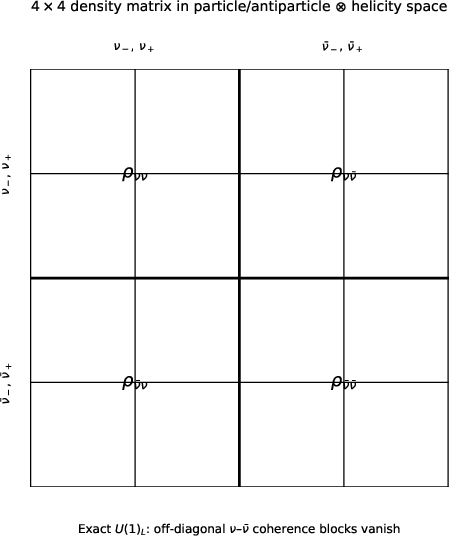
Figure 3: Block structure of the p1 density matrix—off-diagonal blocks represent neutrino–antineutrino coherence, forbidden when lepton number is superselected.
Operators that mediate p2 transitions correspond to off-diagonal blocks and are only physical in the presence of p3 dynamics.
Majorana and Pseudo-Dirac Classification
The Majorana limit is algebraically implemented as projection onto the p4 eigenspace, collapsing the four-state Dirac space to a two-state space labeled purely by helicity. In this Majorana subspace, the only residual p5 algebra is that of the Wigner spin; the internal pseudospin transformations p6 act trivially. Consequently, what is a neutrino–antineutrino coherence in the Dirac language becomes simply the helicity density matrix in the Majorana language.
In the pseudo-Dirac regime, minute p7 mass terms induce small splittings between nearly degenerate Majorana states—captured by helicity-preserving, lepton-number-violating terms (p8 class). The relevant observable is the active-to-sterile oscillation probability, with phase set by p9. By contrast, helicity-flipping terms (Bp=(ν−,ν+,νˉ−,νˉ+)0 class) tie to the amplitude for lepton-number-violating processes such as neutrinoless double-beta decay or spin coherence in dense media, carrying explicit suppression by Bp=(ν−,ν+,νˉ−,νˉ+)1 in the relativistic limit.
Minimal Two-State Models and Oscillation Probabilities
Both helicity-preserving and helicity-flipping Bp=(ν−,ν+,νˉ−,νˉ+)2 channels reduce to minimal two-state systems. The generic Hamiltonian for such systems is
Bp=(ν−,ν+,νˉ−,νˉ+)3
with transition probability
Bp=(ν−,ν+,νˉ−,νˉ+)4
Elucidating the dynamical roles of Bp=(ν−,ν+,νˉ−,νˉ+)5 and Bp=(ν−,ν+,νˉ−,νˉ+)6 in each channel highlights the difference between unsuppressed (pseudo-Dirac) and suppressed (Majorana, active-active) oscillation probabilities.
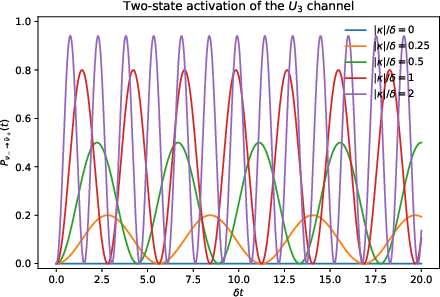
Figure 4: Transition probability for the minimal two-state model, applicable to both Bp=(ν−,ν+,νˉ−,νˉ+)7 channels, with parameters set by the specific physical mechanism.
Key Numerical and Structural Results
- Pseudo-Dirac oscillation amplitude is controlled by Bp=(ν−,ν+,νˉ−,νˉ+)8 and is unsuppressed for active-to-sterile transitions in vacuum.
- Helicity-flipping active–active conversion amplitudes are suppressed by Bp=(ν−,ν+,νˉ−,νˉ+)9 (or U1=τ3⊗σ2U2=τ1⊗I2U3=τ2⊗σ20 in U1=τ3⊗σ2U2=τ1⊗I2U3=τ2⊗σ21) and are strongly blocked in matter due to large U1=τ3⊗σ2U2=τ1⊗I2U3=τ2⊗σ22.
- The grading by U1=τ3⊗σ2U2=τ1⊗I2U3=τ2⊗σ23 is shown to fully determine which channels are amplitude-suppressed, with no ambiguities or intermediate cases.
Theoretical and Practical Implications
The framework provides a rigorous operator-algebraic perspective on which observables are sensitive to lepton-number violation, clarifies ambiguities in the literature regarding the mapping from Hamiltonian terms to physical processes, and shows that the Dirac–Majorana distinction is not a question of basis symmetry, but of dynamical accessibility selected via superselection rules and explicit Hamiltonian structure. This approach unifies and clarifies the classification of possible one-particle states and transitions, with direct relevance to neutrino oscillation phenomenology, neutrinoless double-beta decay, and quantum kinetic treatments of spin and charge coherence.
The implication for future neutrino experiments is that only explicit U1=τ3⊗σ2U2=τ1⊗I2U3=τ2⊗σ24 amplitudes can probe the physical reality of the algebraic directions identified here. The formalism may also be of practical use in modeling sterile neutrino phenomenology, Majorana searches, and the algebraic structure of quantum kinetic theories for massive neutrinos.
Conclusion
The paper provides a formal and comprehensive classification of the internal symmetry structure of fixed-momentum massive neutral-fermion one-particle spaces, identifying a kinematical U1=τ3⊗σ2U2=τ1⊗I2U3=τ2⊗σ25 pseudospin algebra distinguished by its grading under lepton number and helicity labels. The distinction between symmetry and dynamics is made explicit: only when lepton number is violated do the charge-conjugating directions correspond to physical coherence phenomena. The correspondence between Hamiltonian terms, grading classes, and physical observables is clarified, eliminating common ambiguities in the mapping of abstract operators to observable effects in neutrino oscillation, spin coherence, and lepton-number-violating processes.